How Many Genes Do Humans Have? The Current Estimate
You can build a human brain with fewer protein-making genes than a banana plant carries. So how many genes do humans have? You have about 20,000 protein-coding genes: stretches of DNA, your inherited instruction molecule, that cells use to make proteins. Proteins build cell structures and carry out much of your cells’ work.
That familiar number counts one category. Your broader total includes genes with other useful products. To make sense of conflicting answers, separate gene categories, catalog versions, and the copies you inherit.
Key Takeaways
- About 20,000 protein-coding genes in your human gene catalog.
- Noncoding genes add tens of thousands of entries.
- Catalog categories and release dates explain conflicting totals.
- Two inherited copies usually count as one gene identity.
- Gene activity matters more than a species’ gene-count ranking.
The myth of 100,000 protein-coding genes
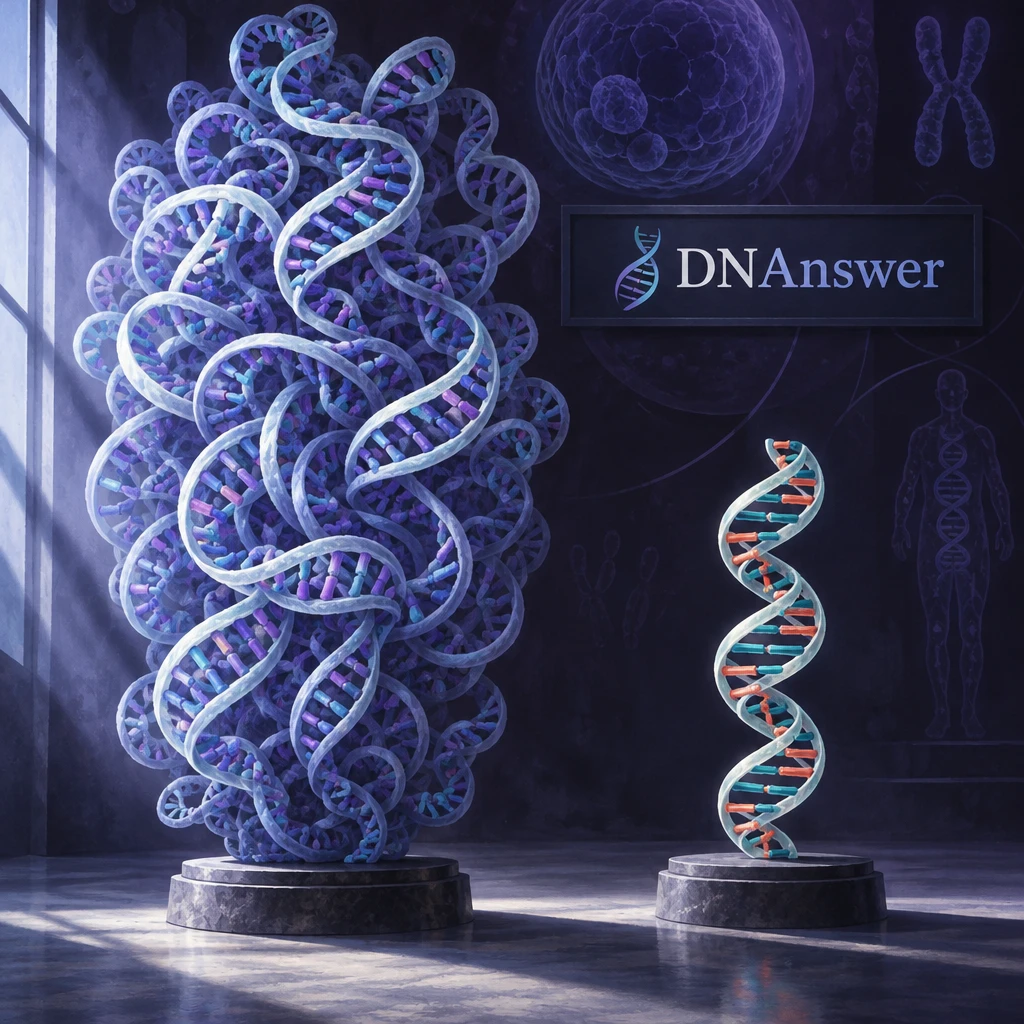
You have approximately 20,000 protein-coding genes, rather than the 100,000 you might remember from an older textbook. Early estimates reflected reasonable expectations before scientists could read nearly all human DNA. Better evidence brought the count down.
The difference matters when you compare biology articles. A large number might reflect an old estimate, a broader definition, or a count of gene products.
Why the higher estimates made sense
Imagine trying to count the recipes in a cookbook before anyone has assembled its scattered pages. Before scientists mapped the human genome, your complete set of DNA instructions, they faced a similar problem.
Human bodies make many different proteins. Scientists reasonably expected a large gene collection to explain that variety. During the 1990s, estimates commonly reached 50,000–100,000 genes, with much of the discussion focusing on protein-coding genes.
The Human Genome Project ran from 1990 to 2003. In 2001, its researchers and a separate private team published draft human DNA sequences. Those drafts suggested fewer protein-coding genes than many researchers had expected.
What changed after scientists read the DNA
In 2004, Human Genome Project researchers estimated roughly 20,000–25,000 protein-coding genes. Later work narrowed the useful rounded answer to about 20,000.
Reading DNA gave researchers something stronger than an expectation based on human complexity. They could examine individual sequences, compare them across species, and test whether cells used them to make proteins.
For a source-dated catalog, use GENCODE human annotation release 50, which the project released in June 2026. An annotation identifies genes and describes their features along the DNA sequence. Keep the release date beside any exact catalog count.
When you encounter an older figure, first ask what its authors counted and when they counted it. A 1990s estimate tells you something about the history of discovery; it does not describe today’s protein-coding estimate.
Does 20,000 include every kind of gene?
No. The roughly 20,000 estimate covers protein-coding genes. Your DNA also contains noncoding RNA genes, whose products work without becoming proteins. RNA is a molecule that helps cells use genetic information and can perform cellular tasks itself.
The misunderstanding has an honest origin. Many school explanations introduce genes through proteins, using examples such as insulin or the proteins that carry oxygen. That approach teaches an important pathway while leaving out another large gene category.
Genes can produce working RNA
A broader definition helps you see what the protein-focused explanation misses:
A gene is a stretch of DNA whose instructions produce a molecule that does a job in a cell.
For a protein-coding gene, your cell first makes an RNA copy of the instructions, then uses that copy to build a protein. For a noncoding RNA gene, the RNA itself serves as the useful product.
For example, transfer RNA, a small RNA molecule, carries protein building blocks to the cell’s protein-making machinery. Ribosomal RNA, another working RNA, forms a central part of that machinery. Neither needs to become a protein to perform its job.
Other noncoding RNAs help control gene activity. The category therefore includes molecules with different sizes and roles, rather than one uniform class of spare instructions.
What happens to the total when you include them?
A dated broader estimate gives you a useful scale. In 2024, computational biologist Steven Salzberg described roughly 15,000–20,000 additional noncoding genes. Adding that range to about 20,000 protein-coding genes gives roughly 35,000–40,000 genes under that counting approach.
Treat that as a dated estimate, not as the total for GENCODE release 50. Broader catalogs can recognize additional RNA entries and use different classification rules.
You may also encounter pseudogenes: gene-like DNA sequences that often lack the ability to perform their original job. Many arose when a gene copy accumulated changes over time. Some still produce RNA or influence other genes, so “broken gene” oversimplifies the category.
When you read a total, identify its ingredients:
- Protein-coding genes.
- Noncoding RNA genes.
- Pseudogenes.
- Other entries the catalog recognizes.
Those labels tell you far more than a large number on its own.
A complete DNA sequence does not fix the gene count
Knowing the DNA letters gives you the material for a gene catalog. Deciding which stretches qualify as genes requires another layer of evidence. That distinction explains why current catalogs can disagree even when researchers examine the same DNA.
If you expected one final answer after the Human Genome Project, that expectation makes sense. Headlines about completing the genome naturally sounded like scientists had finished both reading and interpreting the instructions.
Reading the sequence and identifying genes solve different problems
Picture a long document with no spaces or punctuation. Reading every letter would complete one task. Finding the words and sentences would require another.
DNA presents a harder version of that problem. A sequence can resemble a protein-making instruction by chance. A cell can also copy a stretch of DNA into RNA without that RNA performing a useful function.
Researchers therefore combine several kinds of evidence. They look for RNA in particular cells, evidence of protein production, and similar sequences that evolution preserved in other species. Each line of evidence answers a different question.
A rare gene product creates another challenge. A gene that works mainly in one cell type or during a short stage of development may escape a study that examines other samples. Better sampling can reveal entries that an earlier catalog missed.
Catalogs apply evidence and categories differently
GENCODE and RefSeq, the gene catalog that the National Center for Biotechnology Information maintains, both organize human gene information. Their teams can make different decisions about a sequence’s boundaries, category, or strength of evidence.
Those differences often become larger for noncoding RNA genes than for well-established protein-coding genes. Researchers may agree that cells produce a particular RNA while continuing to investigate its function.
Also separate genes from transcripts. A transcript is an RNA copy that a cell makes from DNA. One gene can generate several transcript forms, so a catalog with hundreds of thousands of transcripts does not imply hundreds of thousands of genes.
To compare two totals fairly, follow four steps:
- Match the catalog name.
- Match the release date or version.
- Match the gene categories.
- Confirm that both figures count genes rather than transcripts.
That comparison turns an apparent scientific contradiction into a clear difference in counting rules.
Two parents do not double your gene catalog
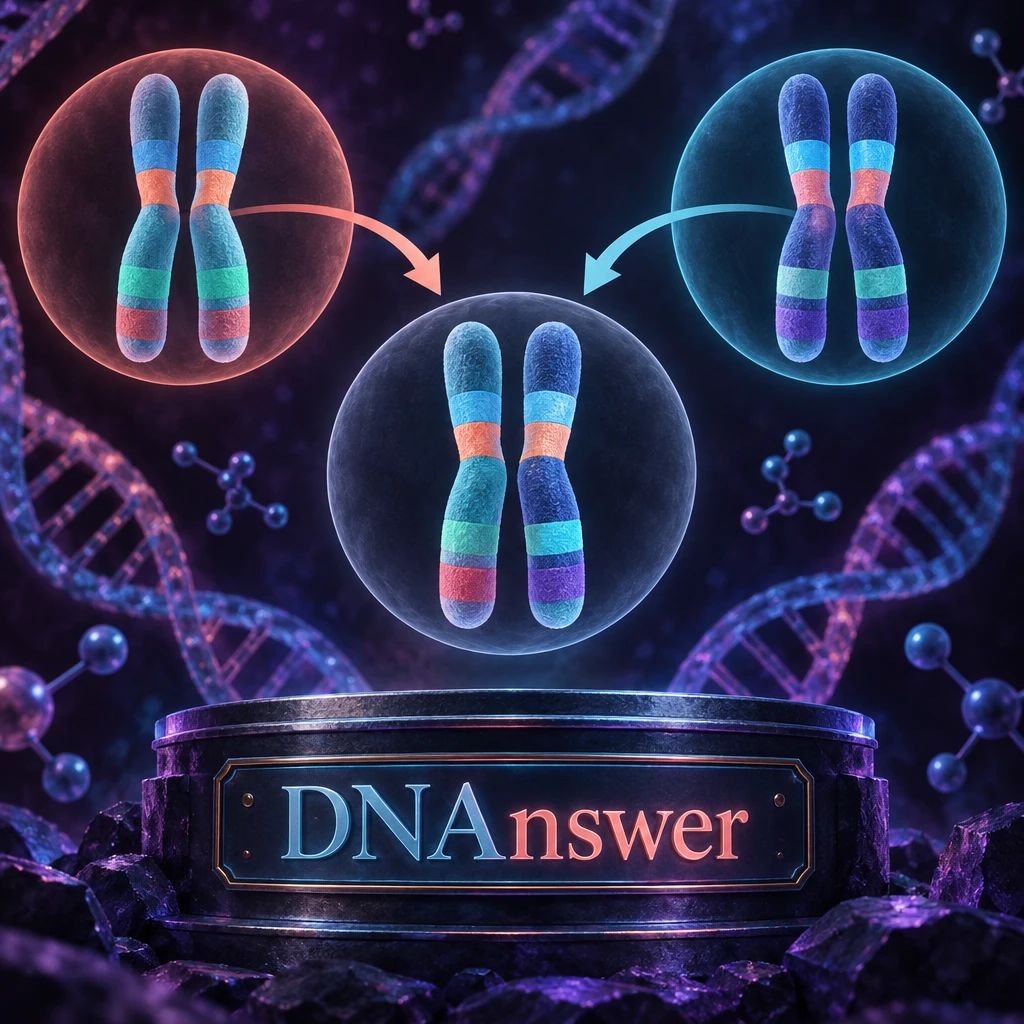
You usually inherit two copies of each gene on your non-sex chromosomes: one from each parent. Gene catalogs count the gene’s identity once, rather than adding your maternal and paternal copies together.
The doubling idea comes from a correct observation. You inherit substantial DNA from both parents. The confusion starts when you mix the number of gene identities with the number of physical copies in your cells.
Your chromosomes package inherited copies
Your chromosomes, the DNA packages inside cells, usually come in 23 pairs in your body’s ordinary cells. That gives you 46 chromosomes: 23 from each parent.
Of those pairs, 22 consist of autosomes, the chromosomes other than the sex chromosomes. The remaining pair consists of sex chromosomes, which help shape sexual development and carry many other genes.
For a typical autosomal gene, you receive a copy from each parent. Those copies occupy corresponding positions on the two matching chromosomes.
Different versions of the same gene are alleles. If you inherit one version from your mother and another from your father, you have two alleles of one gene. You have not gained a new gene identity.
Chromosomes carry unequal numbers of genes
You also cannot divide the gene total by 23 and assume every chromosome carries that many genes. Chromosomes differ in size, and their genes have uneven spacing.
Chromosome 1 carries many more genes than the Y chromosome. Some DNA stretches contain clusters of genes; others contain relatively few. The chromosome count tells you how the DNA packages divide up, not how evenly genes fill them.
The usual two-copy rule also has specific exceptions. With an X and a Y chromosome, you have one copy of many X-linked genes, meaning genes on the X chromosome. Some people also carry extra or missing copies of particular DNA stretches.
For a concrete example, consider HBB, the gene that helps make part of hemoglobin, the protein that carries oxygen in red blood cells. You usually inherit one HBB copy from each parent. A gene catalog lists HBB once.
When you read an inheritance explanation, keep asking which quantity it describes: gene identities, inherited copies, or alleles. Each answers a different question.
The one-gene, one-protein shortcut
One gene can contribute to several protein forms. Your cells can combine parts of a gene’s RNA instructions in different ways, then further modify the resulting proteins.
The one-gene, one-protein idea remains a useful first sketch. A particular gene often connects clearly to a particular protein. Trouble starts when you treat that sketch as a strict counting rule.
Your cells can assemble different RNA versions
Start with an RNA copy from a protein-coding gene. The first copy often contains sections that the cell removes before using the instructions.
During alternative splicing, your cell combines the remaining RNA pieces in different arrangements. Think of several usable versions of one set of instructions, each keeping a different selection of sections.
For a simple example, imagine a gene with four usable sections: A, B, C, and D. One RNA version might keep A-B-D; another might keep A-C-D. If both versions supply workable protein instructions, one gene can support two protein forms.
The CALCA gene provides a real example. Cells process its RNA differently in different tissues, helping produce calcitonin, a hormone involved in calcium control, or CGRP, a small protein messenger involved in nerve signaling.
RNA variety and protein variety are different totals
Your cells can also start or stop RNA copies at different places. After a cell makes a protein, chemical changes and cutting steps can alter its activity or final form.
These mechanisms help explain how a relatively modest protein-coding gene collection supports a wide range of cellular jobs.
Keep one limitation beside that explanation: an observed RNA version does not prove a useful protein exists. Some RNA copies never lead to stable proteins, and some reflect errors in processing.
When you see a huge protein or RNA total, look for the counting unit. Gene identities, RNA versions, and final protein forms describe different levels of biology.
The myth that more genes mean more complex life
A species with more protein-coding genes does not automatically build a more complex body. Gene count measures the size of a catalog, while development depends heavily on when, where, and how cells use those instructions.
Your intuition still has a reasonable foundation. A more capable machine often needs more parts. Living systems, however, reuse their parts in different combinations and control them across space and time.
Consider the banana comparison. The 2012 reference genome for Musa acuminata, a banana species, reported about 36,500 predicted protein-coding genes. That exceeded the human estimate.
Plants have their own demanding jobs. They manage growth, respond to changing light, and make many chemicals while staying rooted in place. Gene duplication, a process that creates extra gene copies, can also expand a species’ catalog.
Within your body, a nerve cell and a muscle cell carry largely the same gene collection. Different patterns of gene activity help give them different shapes, connections, and jobs.
A control sequence, a stretch of DNA that influences gene activity, can help determine whether a gene works in a particular cell. The timing and amount of that activity matter alongside the protein’s properties and its interactions with other molecules.
So use the banana comparison to question gene-count rankings. Before comparing species, match protein-coding counts with protein-coding counts and consider how each catalog identified its entries. A bigger catalog alone tells you little about intelligence, anatomy, or behavior.
Put the next gene count in context
Next time a headline gives you a human gene total, write four labels beside it: category, catalog, date, and counting unit. Try that with an older textbook figure and a recent catalog entry. You will quickly see whether they describe the same thing. Once you separate gene identities from inherited copies and RNA versions, you can judge the number instead of memorizing it.
Frequently Asked Questions
How many genes do you have in total, including noncoding genes?
Your broader total includes tens of thousands of noncoding genes alongside about 20,000 protein-coding genes. A 2024 estimate put the combined count around 35,000–40,000; use its date and definition when comparing it with newer catalogs or totals that include pseudogenes.
How many genes do you inherit from each parent?
You usually inherit one copy of each autosomal gene from each parent, giving you two copies of most such genes. Both parents therefore contribute largely the same set of gene identities, while the versions you receive can differ.
Do all your cells have the same number of genes?
Most of your body cells carry essentially the same gene collection, but important exceptions exist. Mature red blood cells discard their nucleus, the compartment that holds most cellular DNA; sperm and egg cells usually carry one chromosome set rather than two.
Does your gene count change as you get older?
Your age does not drive a predictable rise or fall in your gene count. Individual cells can gain or lose DNA through acquired changes, while aging also changes gene activity, so the instructions your cells use can shift without changing the basic catalog.