What Is Heredity in Genetics? How Traits Pass On
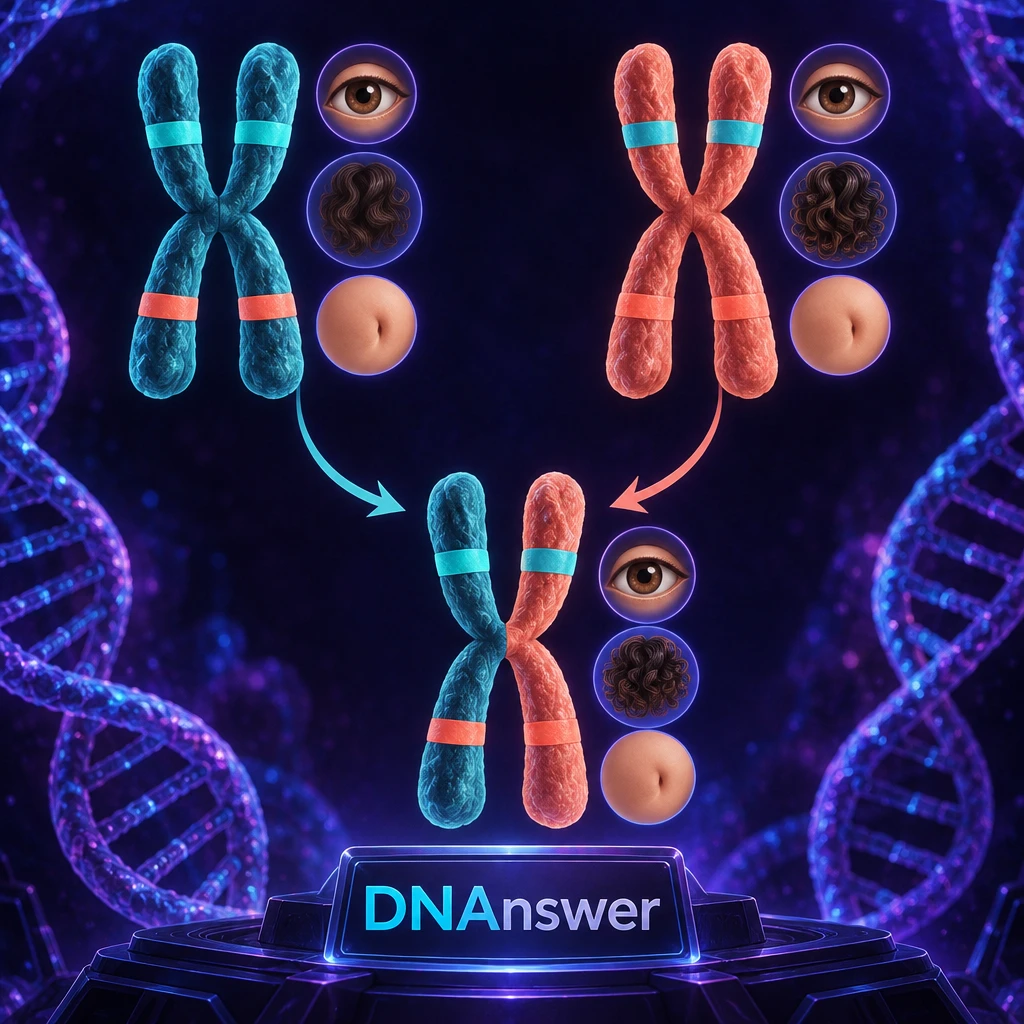
Did you really get more of your genes from your mom? No. You got almost exactly half of your nuclear DNA from each parent. That is the short answer to what heredity in genetics means: your parents pass genetic information to you through one egg and one sperm.
The surprise is what happens next. That even split rarely produces an even-looking mix. You might share your dad's nose, your mom's laugh and neither parent's eye color. To see why, you need to correct a handful of beliefs almost everyone picks up in childhood.
Key Takeaways
- Each parent supplies about half your nuclear DNA
- Mitochondrial DNA comes almost entirely from your mother
- Eye color and height involve many genes, not one
- "Dominant" means expressed, not stronger or more common
- Scars and skills come from your life, not your genes
- Every pregnancy is a fresh genetic draw
What heredity actually means

Heredity is the passing of genetic information from parents to their children. Genetics is the science that studies how that works. Here is the machinery in plain terms.
The instruction set
Your instructions live in DNA, a long molecule that stores biological information in a four-letter chemical code. A gene is a stretch of DNA that helps build a working product, usually a protein. Your body packs its DNA into chromosomes, which are tightly wound bundles of DNA. Most of your cells hold 23 pairs, 46 chromosomes in total. In each pair, one chromosome came from your mother and one from your father.
Twenty-two of those pairs are autosomes, meaning chromosomes that look the same in males and females. The 23rd pair is the sex chromosomes. Females usually carry two X chromosomes. Males usually carry one X and one Y.
Versions of the same gene
Genes come in different versions called alleles. Picture one gene with a "brown" version and a "blue" version. You carry two alleles for most genes, one from each parent. If they match, biologists call you homozygous ("same"). If they differ, you are heterozygous ("different").
Heredity: the passing of genetic information from parents to their offspring, mainly through the chromosomes in eggs and sperm.
How the handoff works
Eggs and sperm form through a special kind of cell division called meiosis. Meiosis splits each chromosome pair, so every egg or sperm carries one set of 23. At fertilization, the two sets join and rebuild the full 46.
Before the split, matching chromosomes swap chunks of DNA. That swap is called recombination. It means the chromosome you pass on is a patchwork of your two parents' versions. Scientists have found no other egg or sperm quite like it.
Myth 1: You get more genes from one parent
This is the belief people ask about most. It feels true when you look like a carbon copy of one parent. It also has a real kernel. Your mother does give you something your father does not.
The kernel of truth
Your cells contain tiny power plants called mitochondria. They carry their own small loop of DNA, about 16,500 DNA letters long. That mitochondrial DNA comes almost entirely from the egg. Sperm mitochondria get broken down after fertilization. So yes, your mom supplies a slice of DNA your dad does not.
But compare the sizes. Your nuclear DNA, the material inside your chromosomes, runs to roughly 3 billion letters per set. The mitochondrial share is a sliver of a percent of your total genome.
The real split
For the 22 autosome pairs, the split is exactly one chromosome from each parent. The sex chromosomes tilt things slightly. A daughter gets an X from each parent, so her split stays even. A son gets an X from mom and a Y from dad. The X carries far more genes than the Y, roughly 800 to 900 protein-coding genes against fewer than 100. So a son carries a few more genes from his mother.
Why you look like one parent anyway
Resemblance does not track the DNA count. A few genes with strong, visible effects can make you look like one side of the family. The underlying split stays close to 50/50. Next time someone says you "got all your dad's genes," you can tell them you got about half, and some of his happened to show.
Myth 2: One gene decides your eye color
Most people met genetics through a school chart. Brown beats blue; two blue-eyed parents always have blue-eyed kids. It is tidy, and it is wrong for real people.
The belief comes straight from Gregor Mendel. In the 1860s, he bred pea plants with traits controlled by single genes, such as purple or white flowers. His rules still hold. Textbooks then used eye color as a familiar human stand-in, and the simplification stuck.
Here is what is actually true. Eye color depends on several genes. Two on chromosome 15, OCA2 and HERC2, do much of the work. Several others nudge the shade toward green, hazel or gray. That is why two blue-eyed parents can, rarely, have a brown-eyed child. Height is even more spread out. Researchers have linked over 12,000 DNA variants to adult height, each adding a tiny push.
Traits shaped by many genes are called polygenic traits. Most of what you can see is polygenic:
- height and body build
- skin, hair and eye color
- face shape
- risk for common conditions like type 2 diabetes and heart disease
Some traits do come close to the single-gene model. Variation in one gene, MC1R, plays a major role in freckles and red hair. Even classroom favorites like tongue rolling turned out to be messier than taught. Studies of twins as early as 1971 showed identical twins who did not match.
So stop using a one-gene chart to guess a baby's eye color. Treat a family's eye colors as a hint about probabilities, not a rule.
Myth 3: Dominant means stronger or more common
The word "dominant" sounds like it should win fights. People assume dominant alleles are healthier, better or more widespread. That reading is natural English. It is just not what geneticists mean.
What dominance really describes
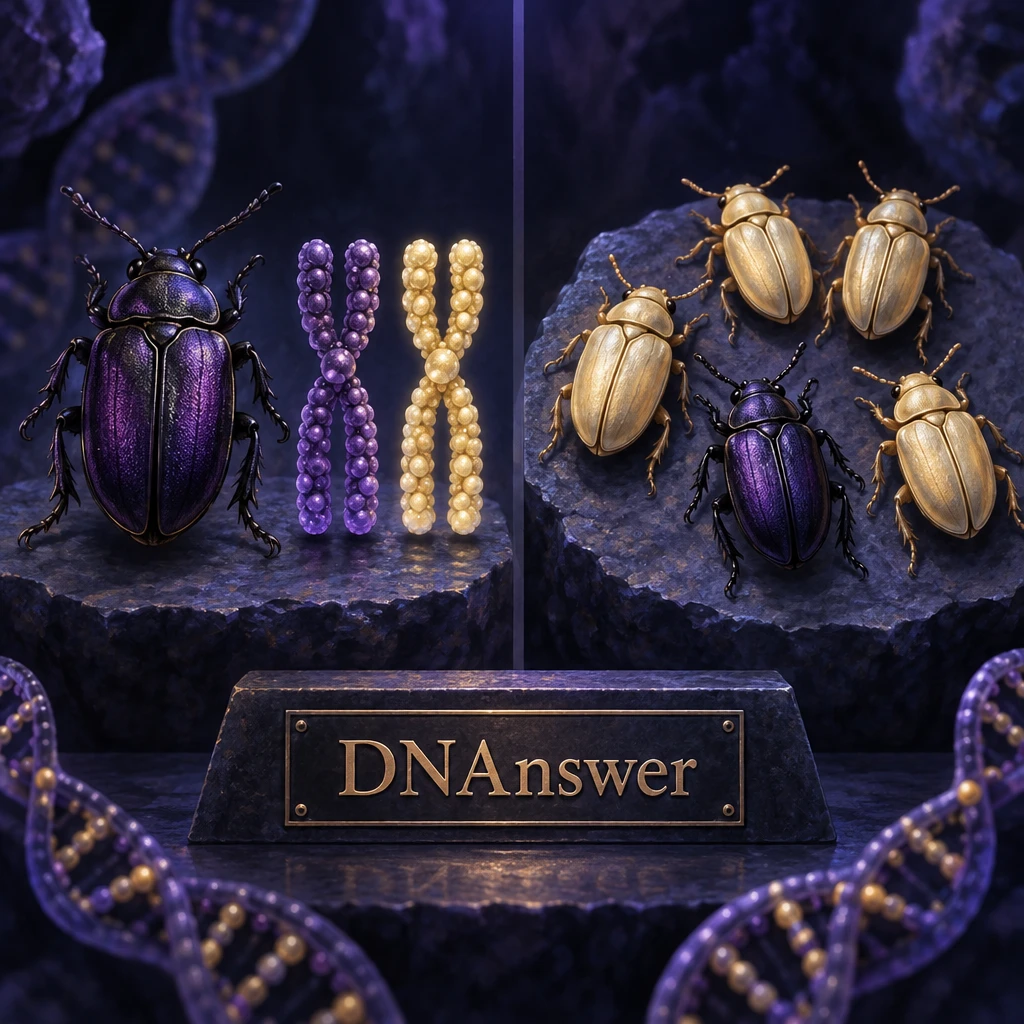
A dominant allele shows its effect with only one copy. A recessive allele shows its effect only when you carry two copies. In a heterozygous person, the dominant version masks the recessive one. Dominance describes expression, how a trait shows up. It says nothing about strength, health or how common an allele is.
Consider Huntington's disease. It is caused by a dominant allele, and it is rare. Meanwhile, the allele for type O blood is recessive, and type O is the most common blood type in the United States. Dominant and rare, recessive and common. Both happen all the time.
The hidden-allele math
Recessive alleles can ride along silently for generations. Imagine two parents who each carry one copy of a recessive allele, written Aa. Each parent passes A or a with a 1 in 2 chance. The odds a child gets a from both: 1/2 × 1/2 = 1/4, or 25%. The odds the child shows the dominant trait: 1/4 + 1/4 + 1/4 = 3/4, or 75%.
That math is why cystic fibrosis and sickle cell disease can surprise families with no visible history. When a doctor says "recessive," read it as "needs two copies," and ask about carrier testing if a condition runs in your family.
Myth 4: Some traits come only from your mom or only from your dad
This one is partly right, which makes it stubborn. A few things really do travel down one line. The mistake is stretching that to cover traits like baldness or intelligence "from your mother's side."
Geneticists sort inheritance into four main routes. Each one predicts a different pattern:
- Autosomal inheritance covers genes on the 22 numbered chromosome pairs. Either parent can pass them to a son or daughter equally.
- X-linked inheritance covers genes on the X chromosome. A mother passes one of her two X chromosomes to every child. A father passes his X to every daughter and to no son.
- Y-linked inheritance covers the few genes on the Y. They pass only from father to son, almost unchanged.
- Mitochondrial inheritance passes from a mother to all her children. Only daughters pass it on further.
Now map that onto family pairs. Mother to daughter: the daughter gets an X, autosomes and mitochondrial DNA. Mother to son: the same, and his single X comes from her. That is why X-linked conditions like red-green color blindness and hemophilia show up mostly in males. A son with only one X has no backup copy. Father to daughter: she gets his only X, so every daughter of a color-blind man carries the allele. Father to son: the Y and autosomes, never the X.
Baldness shows the limit of the myth. A major baldness gene, AR, sits on the X, so your mother's father matters. But dozens of autosomal genes from both sides also contribute. If you want to forecast your hairline, look at both sides of the family, not just one grandfather.
Myth 5: You and your siblings should inherit the same mix
Parents often expect kids to land in a predictable pattern. If the first child got the recessive trait, the next "should" be safe. It feels like fairness, or like drawing cards from a shrinking deck.
The kernel of truth is real. Probabilities in genetics are accurate across large numbers of births. Mendel's ratios come out cleanly when you count hundreds of pea plants.
But each egg and sperm forms independently. Your 23 chromosome pairs separate randomly, which alone allows over 8 million combinations per parent (2 to the 23rd power is 8,388,608). Recombination then multiplies that far further. Two parents can produce trillions of distinct genetic children.
So in the Aa × Aa family, each pregnancy carries its own fresh 25% chance. Having one affected child does not lower the next child's odds. Three kids could all be affected, or none. Siblings share about 50% of their DNA on average, but the exact figure varies, roughly 40% to 60%. Identical twins are the exception, since they come from one fertilized egg.
When a genetic counselor gives you odds, apply them to every pregnancy separately. Siblings who differ wildly are not a sign that something "went wrong."
Myth 6: Everything about you came from your genes
The final myth runs in two directions. Some people credit genes for everything. Others think a life habit, like a parent's gym routine, gets written into the baby. Both miss how traits actually form.
Genes set ranges; life fills them in
Your genes give instructions, and your environment shapes how they play out. Height is strongly heritable. Yet average height in many countries rose by several inches across the 20th century, mostly from better nutrition. The genes barely changed in that time. The food did. Skin tone shifts with sun exposure. Body weight depends heavily on diet, sleep and activity.
What you acquire, not inherit
Some traits come purely from your experience. A scar, a tattoo, a second language, piano skills and a tan all belong to you alone. Bodybuilders do not have stronger babies because of their workouts. These changes happen in body cells, not in the DNA of eggs and sperm.
New changes in the DNA itself
There is a third category. Sometimes a gene changes spontaneously, with no parent carrying it. These de novo changes, meaning brand-new variants, arise mostly during egg or sperm formation. Each child carries roughly 50 to 100 of them, and most do nothing. Occasionally one causes a condition. In March 2026, researchers at Sanford Burnham Prebys used genome sequencing and recessive-trait mapping to define a new premature-aging disease tied to the IVNS1ABP gene.
When you wonder where a trait came from, sort it into one of three bins: inherited, shaped by environment or newly changed.
Put your new model to work
Next time a family resemblance or a health question comes up, ask three things. Which route could this travel: autosomal, X-linked, Y-linked or mitochondrial? Is it one gene or many? How much does environment shape it? Those questions beat any one-gene chart. If you want to test your knowledge, try DNAnswer's free molecular biology quizzes.
Frequently Asked Questions
What is heredity in genetics?
Heredity is the passing of genetic information from parents to children through egg and sperm cells. Each parent contributes one set of 23 chromosomes, which explains why you share traits with both sides of your family.
Which parent gives you more genes?
Neither, for the most part. You get half your nuclear DNA from each parent. Your mother also supplies your mitochondrial DNA, and sons get a few extra genes from mom because her X carries more genes than dad's Y.
What traits can't you inherit from your parents?
You cannot inherit acquired traits such as scars, learned skills, accents, tattoos or muscle built at the gym. These change your body cells, not the DNA inside eggs and sperm, so they stop with you.
Can two brown-eyed parents have a blue-eyed child?
Yes. If both parents carry hidden alleles that favor blue eyes, their child can inherit two copies and show the blue shade. Because several genes shape eye color, the exact odds depend on each parent's full combination.