Somatic Cell vs Germ Cell: Key Differences
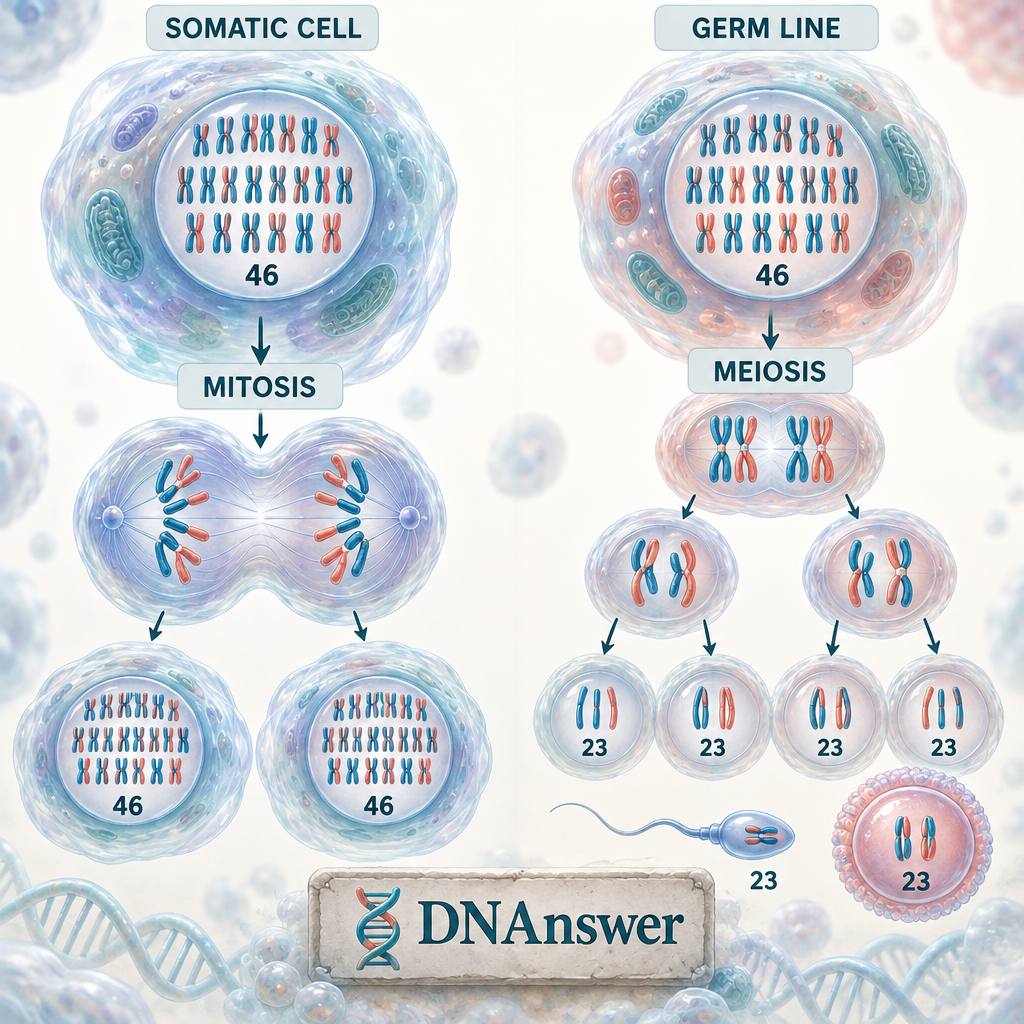
Here's something that surprises most people: the cancer cells growing in someone's body right now will never appear in their children's DNA, no matter how severe the mutation. That's not luck. It's basic cell biology, and it comes down to the difference between a somatic cell and a germ cell. Once you understand which is which, a lot of confusing headlines about "genetic mutations" suddenly make sense.
People searching for somatic cell information usually want one thing: a clear line between the cells that make up your body and the cells that make the next generation. This article draws that line and corrects the mix-ups that trip up most explanations.
Key Takeaways
- Somatic cells build your body; germ cells build the next generation.
- Somatic cells are diploid (two chromosome sets); germ cells become haploid (one set) only after meiosis.
- Somatic mutations (like most cancers) never pass to children.
- Germ cell mutations can appear in every cell of a child's body.
- Mitosis makes identical copies; meiosis shuffles and halves chromosomes.
- A single sperm or egg mutation can affect generations, unlike a skin cell mutation.
What a Somatic Cell Actually Is
Nearly every cell in your body is a somatic cell. Skin, muscle, liver, neurons, blood cells — all somatic. The word comes from the Greek soma, meaning "body," and that's exactly the job: building and running the physical you.
Somatic cells are diploid, meaning each one carries two full sets of chromosomes, one from each of your biological parents. In humans, that's 46 chromosomes per cell, arranged in 23 pairs. When a somatic cell divides to replace itself (say, a skin cell shedding and getting replaced), it uses a process called mitosis.
Mitosis is copy-and-paste division. The cell duplicates its entire DNA, then splits into two daughter cells, each with an identical set of 46 chromosomes. No shuffling, no mixing. This happens constantly: your body produces roughly 330 billion new cells a day just to replace worn-out ones, according to estimates from a 2021 study in Nature Medicine that measured human cell turnover.
Because mitosis is a copying job, mistakes happen the way typos happen when you retype the same document a million times. Most get caught and fixed by DNA repair enzymes. Some don't, and that's where mutations creep in.
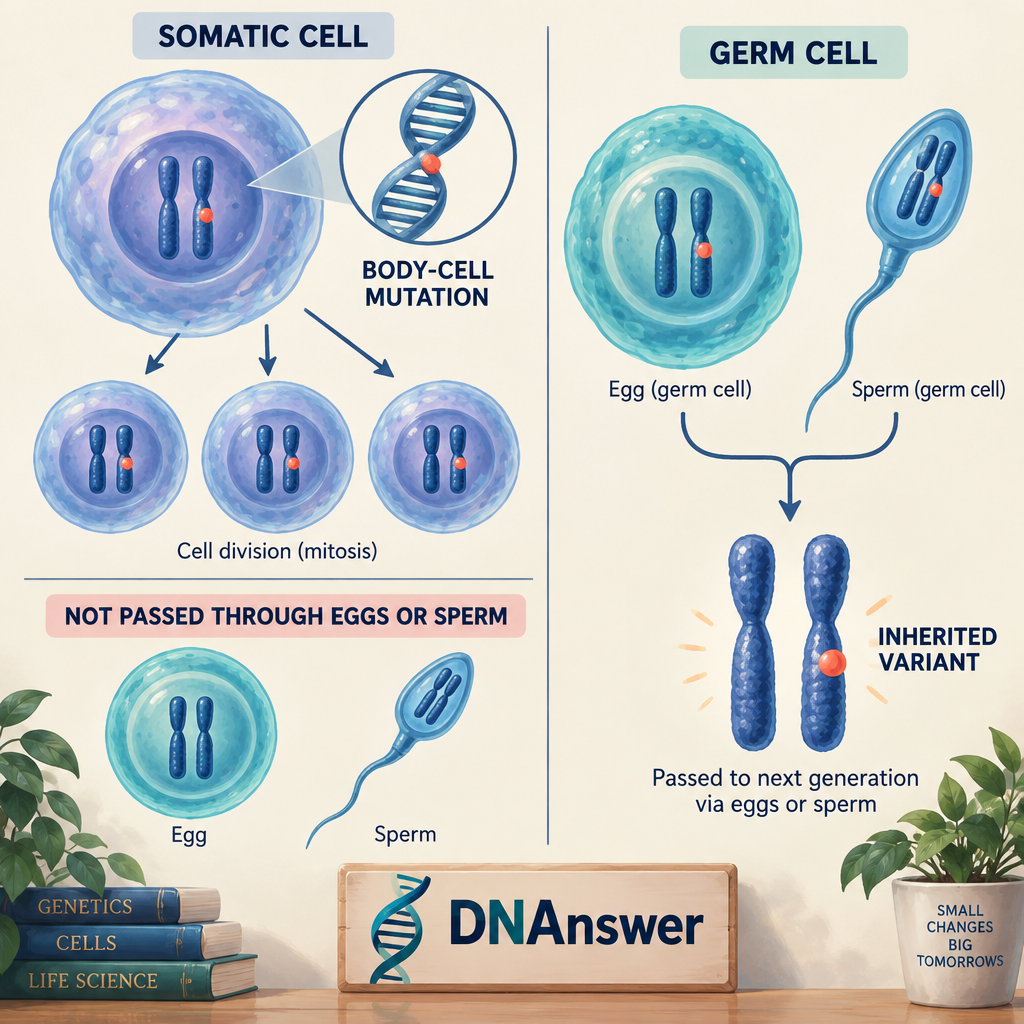
Here's the part that matters most: a mutation in a somatic cell stays local. If a mutation causes a lung cell to divide out of control, you get lung cancer in that person's lungs. It doesn't spread to their reproductive cells, and it has no route into a sperm or egg. The mutation is trapped inside that one body, for that one lifetime.
This is why families don't inherit their parent's melanoma or leukemia as a genetic trait, even though both are caused by DNA mutations. The mutation exists in skin cells or blood cells, not in the cells responsible for making offspring. Cancer researchers sometimes phrase it plainly:
"Somatic mutations accumulate in the cells of the body and die with the individual; they are not passed to offspring." — a foundational principle in cancer genetics, reflected in the somatic mutation theory of cancer.
Understanding that boundary changes how you read news about "cancer genes." A somatic mutation found in a tumor biopsy tells you about that tumor, not about the patient's kids.
What a Germ Cell Actually Is
Germ cells are the opposite story. They're the small, specialized population of cells whose entire purpose is reproduction: sperm cells in men, egg cells (oocytes) in women. Everything else in the body, no matter how important, is somatic by comparison.
Where Germ Cells Live
Germ cells originate early in embryonic development from a lineage called primordial germ cells, which migrate to the developing testes or ovaries and stay there for life. In men, sperm-producing cells keep dividing throughout adulthood. In women, the ovaries hold a fixed supply of immature egg cells from birth, roughly 1 to 2 million, according to reproductive biology estimates, though only about 300 to 400 ever mature and release during a lifetime.
Why They Divide Differently
Germ cells don't use mitosis to become gametes (the technical term for sperm and egg cells). They use meiosis, a two-round division process that does something mitosis never does: it cuts the chromosome number in half. A germ cell starts out diploid, just like a somatic cell, with 46 chromosomes. Only after completing meiosis does it become haploid, carrying just 23 chromosomes.
That halving step is the whole point. When a haploid sperm (23 chromosomes) fuses with a haploid egg (23 chromosomes) at fertilization, the resulting embryo gets back to 46: one full diploid set, half from each parent. Skip the halving, and every generation would double its chromosome count. Humans would be walking around with thousands of chromosomes within a few centuries.
Meiosis also does something mitosis doesn't: it shuffles genetic material between chromosome pairs in a step called crossing over, which is why siblings share DNA but aren't identical (except for twins). This shuffling is a feature, not a glitch, and it's part of why genetic diversity exists at all.
Somatic vs. Germ Cell: The Direct Comparison
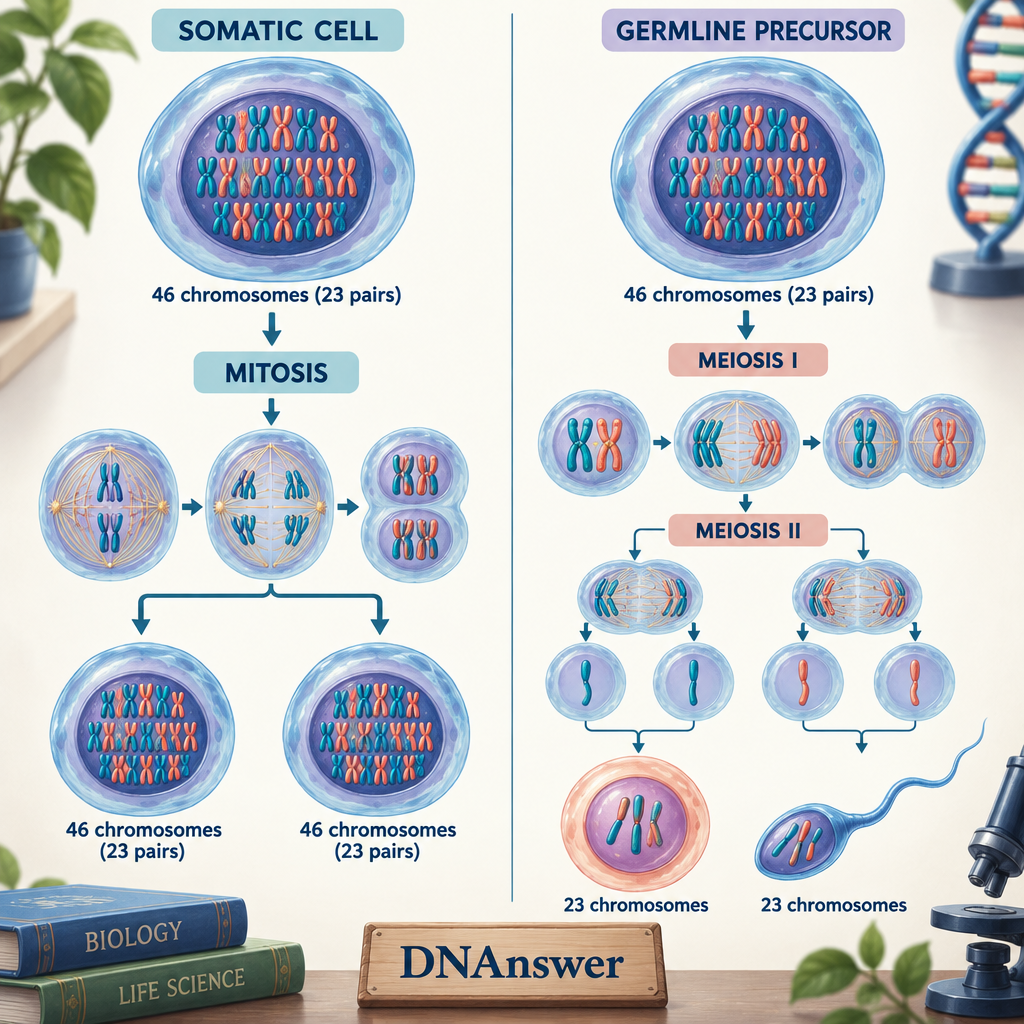
Put side by side, the differences aren't subtle once you know what to look for. A somatic cell is diploid (46 chromosomes in humans), divides by mitosis, produces two identical daughter cells, and makes up organs, skin, blood, muscle, and nearly everything else in your body. A germ cell starts diploid but becomes haploid (23 chromosomes) after meiosis, produces genetically varied daughter cells (four from one starting cell, in the case of sperm), and exists specifically to become a sperm or egg.
The clearest way to separate them is by consequence: a mutation in a somatic cell affects only the individual who carries it and can cause disease like cancer, but stops there. A mutation in a germ cell can appear in every single cell of a future child's body, because that mutated genetic material becomes the starting template for the entire new organism.
Think about it this way: your liver has trillions of cells, and if one develops a cancer-causing mutation tomorrow, your children are completely unaffected. But if one mutation occurs in the single egg cell that happens to get fertilized, that mutation becomes part of the blueprint for a whole new person, present in their liver, brain, skin, and everything else.
This is also why genetic counselors care so much about de novo mutations, meaning ones that appear fresh in a germ cell rather than being inherited from either parent's existing genome. A single sperm or egg cell can carry a brand-new mutation that neither parent shows any sign of, and that mutation then becomes heritable starting with that child.
Myth: "A Cancer Mutation Can Be Passed Down to Your Kids"
This is the most common misunderstanding, and it's an understandable one. People hear "genetic mutation causes cancer" and "genetic traits get inherited" in the same breath, so it seems logical that cancer mutations should pass to children too.
The kernel of truth here is real: some cancers do run in families, and specific inherited mutations (like BRCA1 or BRCA2) do raise cancer risk across generations. But that inheritance happens through germ cells carrying a pre-existing mutation, not through the tumor itself creating a new inheritable change.
Here's what actually happens. A tumor arises when a somatic cell, somewhere in your body, accumulates a series of mutations that let it divide uncontrollably. That process happens entirely within body cells that have no connection to sperm or eggs. The mutations in a breast tumor, for instance, exist in breast tissue; they never touch the ovaries or the eggs stored there. The tumor's DNA and the DNA in your reproductive cells are physically separate.
The BRCA gene mutations that do run in families work differently: the person was born with that mutation already present in every cell, including their germ cells, because they inherited it from a parent who also carried it in their germline. The tumor caused by BRCA is a downstream effect, not the source of inheritance.
Getting this straight matters practically. If you or a family member gets a cancer diagnosis, the question worth asking a genetic counselor isn't "will my cancer pass to my kids," but "did I inherit a mutation that increases cancer risk, and could I have passed that specific gene to my children?" Those are very different questions with very different testing pathways (somatic tumor sequencing versus germline genetic testing).
Myth: "All Cells in the Body Divide the Same Way"
It's an easy assumption. Biology class often introduces "cell division" as one concept, and many textbooks cover mitosis in depth while glossing over meiosis as a footnote about reproduction. So it's natural to assume there's just one process running everywhere in the body.
The honest origin of this myth is curriculum sequencing: mitosis gets taught first, gets more repetition, and applies to more visible examples (wound healing, growth, hair regrowth). Meiosis feels like a specialized side topic, reserved for reproductive biology units.
But the two processes are structurally different, not just different in location. Mitosis is one round of division producing two identical diploid cells. Meiosis is two rounds of division producing four genetically distinct haploid cells. Mitosis happens in essentially every dividing somatic cell in your body; meiosis happens exclusively in the testes and ovaries, in cells specifically committed to becoming gametes.
The practical distinction shows up when people talk about "cell division" in medical contexts. A biopsy report describing "rapid cell division" in a tumor is talking about mitosis gone wrong (uncontrolled copying), never meiosis. Fertility discussions about egg or sperm quality, by contrast, often involve meiosis, especially with age-related changes: errors in meiosis increase with maternal age, which is part of why chromosomal conditions like Down syndrome (trisomy 21) become more common in pregnancies after age 35.
Myth: "Germ Cells Are Diploid Just Like Regular Body Cells"
This one comes from a fair assumption: since germ cells come from your body and share your overall genome, it seems logical they'd carry the same 46 chromosomes as every other cell.
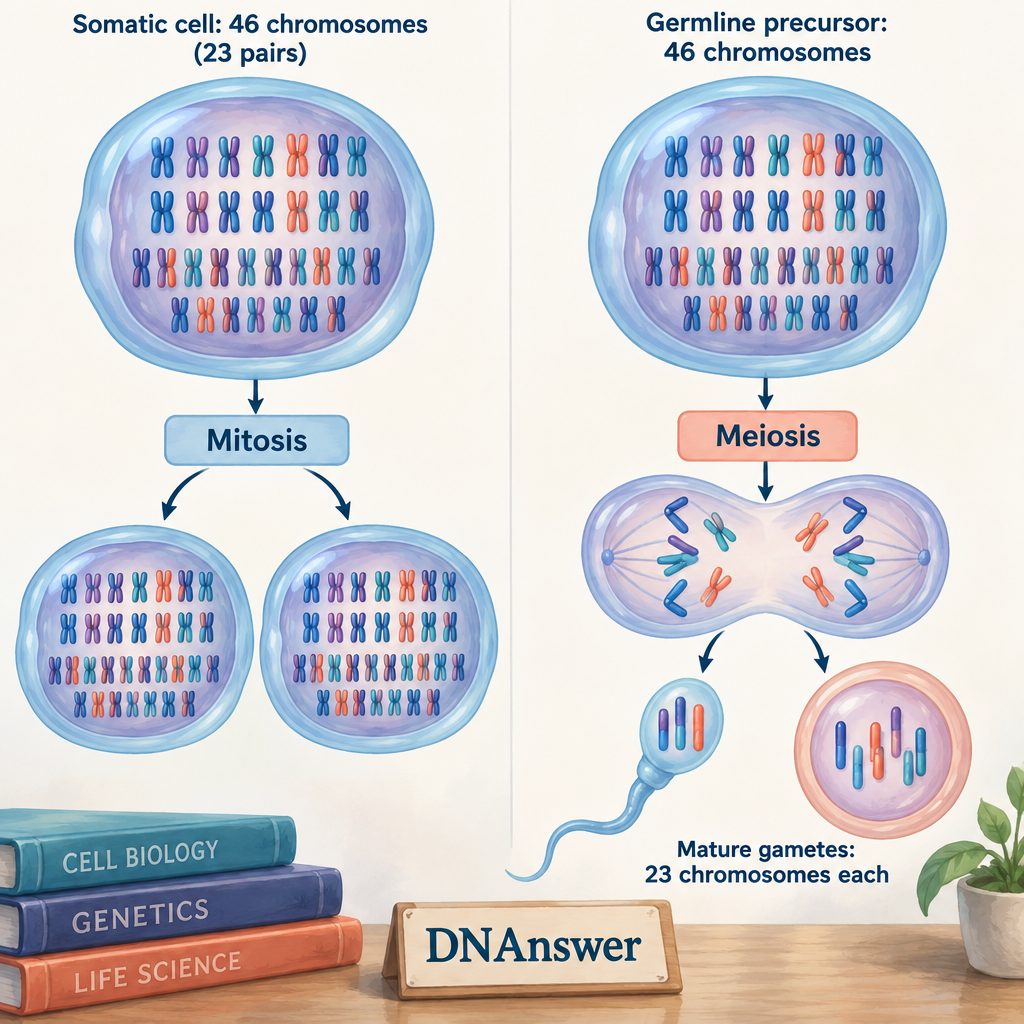
And for part of their life, that's true. The precursor cells that eventually become sperm or eggs, called spermatogonia and oogonia, start out fully diploid, with 46 chromosomes, identical in count to your skin or liver cells. If you looked at these precursor cells under a microscope early on, you genuinely couldn't tell them apart from somatic cells by chromosome count alone.
The shift happens specifically during meiosis. Before meiosis begins, these precursor cells still have 46 chromosomes. It's only after completing both rounds of meiotic division that the resulting sperm or egg cells drop to 23 chromosomes, the haploid number. Calling an immature germ cell "haploid" before it undergoes meiosis is simply inaccurate; the halving is the outcome of a process, not a starting condition.
This distinction has a real consequence: not every cell in the testes or ovaries is haploid. Only the mature gametes are. Everything upstream in that lineage, including the stem cells that continually produce new sperm-forming cells in men, stays diploid. A man's testes constantly replenish spermatogonial stem cells (diploid) that then undergo meiosis to produce haploid sperm, a cycle that takes about 64 days from start to mature sperm, per studies on human spermatogenesis.
Once you know this timing, a lot of embryology terminology clicks into place. Terms like "primary oocyte" and "secondary oocyte" refer to specific, distinct stages of meiosis, each with a different chromosome count, not interchangeable labels for "egg cell."
Verdict: Which Cell Type Explains What You're Trying to Understand
If you're trying to understand cancer risk, mutation accumulation from aging, or how wounds heal, you're dealing with somatic cells and mitosis. That's where the vast majority of biological activity in your body happens daily, and it's where acquired mutations (the ones from sun exposure, smoking, or just random replication errors) live and die with you.
If you're trying to understand inherited disease, genetic counseling, IVF, egg freezing, or why siblings look different despite sharing parents, you're dealing with germ cells and meiosis. This is the narrower but higher-stakes category: fewer cells, but each one has the potential to define the genetic makeup of an entire new person.
Choose the somatic lens when the question is about the body you're living in right now. Choose the germ cell lens when the question is about what gets passed forward.
Conclusion
Next time you read about a "genetic mutation" in the news, ask one question first: is this happening in a somatic cell or a germ cell? That single distinction tells you whether the story is about one person's health or about a change that could ripple through future generations. If you want to test how well this distinction has stuck, a quick cell-biology quiz (DNAnswer's app has one) is a fast way to check.
Frequently Asked Questions
Can a somatic mutation ever become a germ cell mutation?
No, under normal biology, somatic and germ cell lineages stay separate from early embryonic development onward. The one narrow exception researchers study is certain viral infections that insert DNA into germ cells directly, which is rare and distinct from typical somatic mutation.
Why do germ cells need to be haploid before fertilization?
Halving the chromosome count through meiosis keeps the total at 46 after fertilization instead of doubling every generation. Without this haploid step, chromosome numbers would spiral upward with each new generation, which isn't biologically sustainable.
Do somatic cells ever become germ cells later in life?
No, the germ cell lineage is set aside during early embryonic development, long before birth, and somatic cells never convert into it. This is why gene therapies targeting somatic cells (like most current cancer or genetic disease treatments) don't get passed to a patient's children.
Is a fertilized egg a somatic cell or a germ cell?
Neither, technically: a fertilized egg (zygote) is a new diploid organism formed from the fusion of two germ cells, and it starts producing somatic cells almost immediately through mitosis as it develops.