Polygenic Traits: Why Your Height Isn't Controlled by a Single Gene
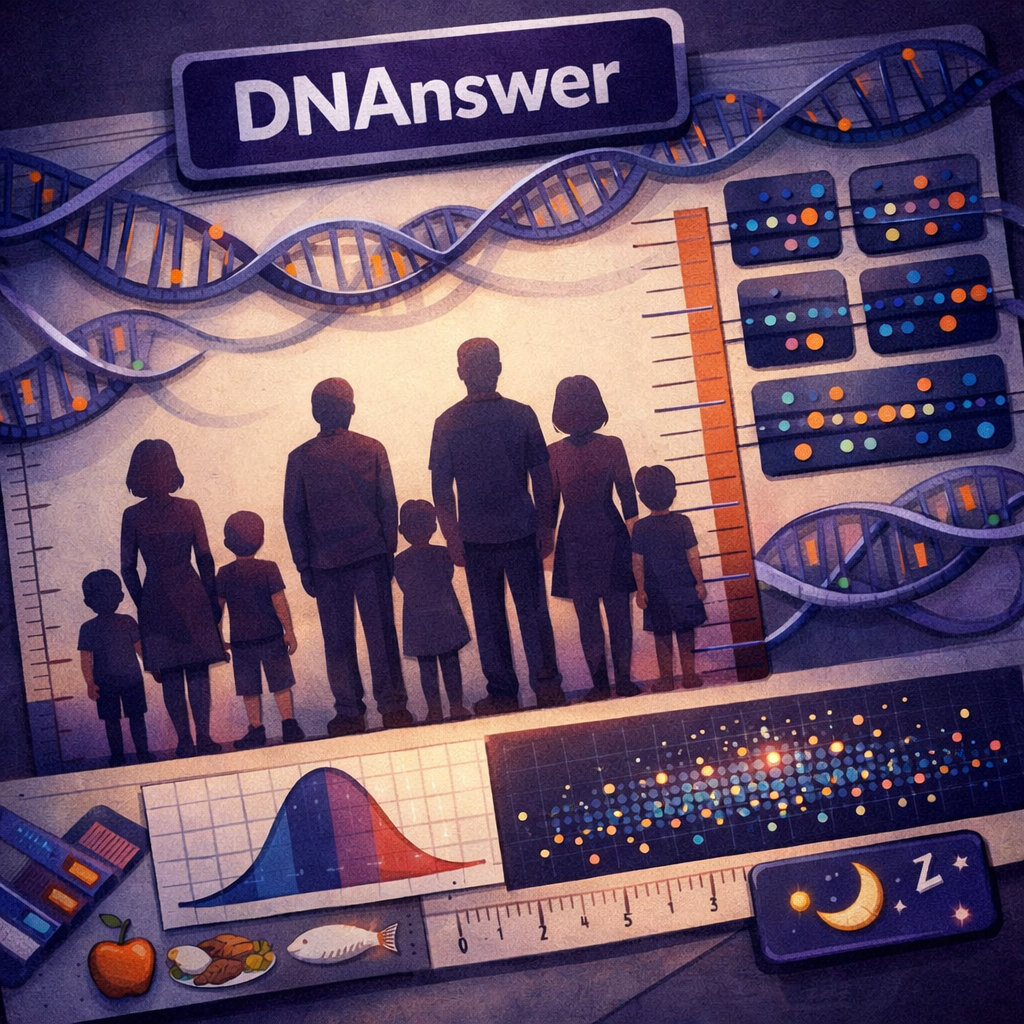
You inherited your height from your parents, but not the way you inherited a widow's peak or the ability to roll your tongue. If you learned genetics through Mendel's pea plants, you probably picture one gene, two alleles, and a clean 3:1 ratio. Height doesn't work that way, and neither do most human traits worth caring about. Polygenic inheritance — the idea that many genes act together to build one trait — explains why your height, skin tone, and even your risk for heart disease come from quantitative traits, shaped by multiple genes, not a single genetic switch.
Key Takeaways
- No single "height gene" exists — over 700 gene regions influence adult height.
- Polygenic traits produce continuous, bell-curve variation, not neat categories.
- Environment (nutrition, illness, sleep) shifts outcomes even with identical genes.
- Polygenic risk scores estimate probability, not a guaranteed individual outcome.
- GWAS studies reveal small, additive effects spread across hundreds of genes.
- Mendelian ratios apply to traits like cystic fibrosis, not to height or IQ.
Myth #1: There's a Single "Height Gene" or "Eye Color Gene"
There's no such thing as a height gene or an eye color gene, and this is the myth that costs people the most understanding. Height comes from the combined, additive effect of hundreds of genes, each contributing a tiny nudge upward or downward. The same is true for eye color, which most people believe follows a simple brown-dominant, blue-recessive pattern.
It's an honest mistake, because it's what most of us were taught. Mendelian genetics — the model built from Gregor Mendel's 19th-century pea plant experiments — uses single genes with two clear versions, or alleles, that sort into dominant and recessive categories. That model works beautifully for traits like pea pod shape. It also works for a short list of human traits: ABO blood type, for instance, or single-gene disorders like cystic fibrosis. The kernel of truth is real. Some traits genuinely are Mendelian.
Why Height Breaks the Punnett Square
A Punnett square works when one gene, with two alleles, determines an outcome. Height involves more than 700 genetic regions identified through genome-wide association studies, or GWAS — large studies that scan the genomes of hundreds of thousands of people to find spots in DNA statistically linked to a trait. No single region controls more than a fraction of a percent of the variation in adult height.
Eye color follows a similar pattern, just with fewer players. Researchers have identified at least 16 genes involved in eye color, with two (OCA2 and HERC2) having outsized influence, but plenty of others tuning the exact shade. That's why two brown-eyed parents can occasionally have a blue-eyed child, something a strict dominant-recessive model can't explain.
What Actually Determines These Traits
Each of these hundreds of genes has what geneticists call a small additive effect — it nudges the trait a fraction of an inch, or a shade lighter or darker, and then those nudges sum together. Think of it like a jury vote spread across a thousand jurors instead of one judge's ruling.
A polygenic trait is a phenotype influenced by two or more genes, each contributing a small, cumulative effect to the overall outcome.
If you take one thing from this section, take this: stop looking for "the gene" behind any visible trait. Ask instead how many genes are involved and how they add up. That question alone will save you from most of the genetics myths still floating around dinner-table conversations and internet quizzes.
Myth #2: Polygenic Traits Follow the Same Dominant-Recessive Rules as Pea Plants
Many people assume that if a trait is genetic, it must follow dominant-recessive rules, the way brown eyes supposedly "beat" blue. Polygenic traits don't sort into dominant and recessive categories at all — they blend, creating continuous variation instead of discrete categories.
This confusion makes sense once you see where it comes from. Biology class usually starts and ends with Mendelian traits because they're teachable in one lesson: one gene, two alleles, a 3:1 or 1:2:1 ratio, done. It's tidy. It's also the exception, not the rule, for complex human traits.
Discrete Categories vs. Continuous Distribution
Mendelian traits sort you into buckets. You either have Huntington's disease or you don't; your blood type is A, B, AB, or O. There's no "type A-and-a-half."
Height, on the other hand, doesn't put people into buckets. Plot the height of any large group of adults and you get a smooth, symmetrical bell curve, formally known as a normal distribution, with most people clustered near the average and progressively fewer as you move toward the extremes. There's no gap between "short people" and "tall people." Every inch in between is occupied by someone.
The Math Behind the Bell Curve
Here's the mechanism: when many genes each add a small plus or minus to a trait, the combinations multiply. Flip one coin, and you get two outcomes: heads or tails. Flip 20 coins and count the heads, and you get a smooth curve from 0 to 20, with most results landing near 10. Height works the same way, except instead of coins, you're combining hundreds of gene variants, each adding or subtracting a small amount, plus a substantial dose of environmental variation layered on top.
This is also why siblings from the same two parents can land at noticeably different heights. Each child inherits a different random combination of the parents' gene variants — a process called genetic recombination that shuffles the deck every generation. Two full siblings might share 50% of their variable DNA on average, but which specific height-related variants each one gets is close to a coin flip repeated hundreds of times.
The takeaway: when you hear someone describe a trait as "dominant" or "recessive," ask whether it's actually one gene. If it's height, skin tone, blood pressure, or most personality traits, that vocabulary doesn't apply. Reach instead for words like "additive" and "distributed."
Myth #3: Genetics Alone Determines Traits Like Height, With Environment Playing a Minor Role
Genetics sets the range; environment decides where you land inside it. Even identical twins, who share effectively 100% of their DNA, can differ in height by an inch or more depending on childhood nutrition, illness, and other conditions. Genetics alone doesn't hand you a final number.
The belief that DNA is destiny is understandable, because genetics gets most of the press. Headlines about "the gene for X" are catchier than headlines about food security or public health infrastructure. And it's not entirely wrong — genes clearly matter enormously for height. The mistake is treating genes as the whole story instead of one half of a two-part equation.
Heritability Doesn't Mean "Fixed"
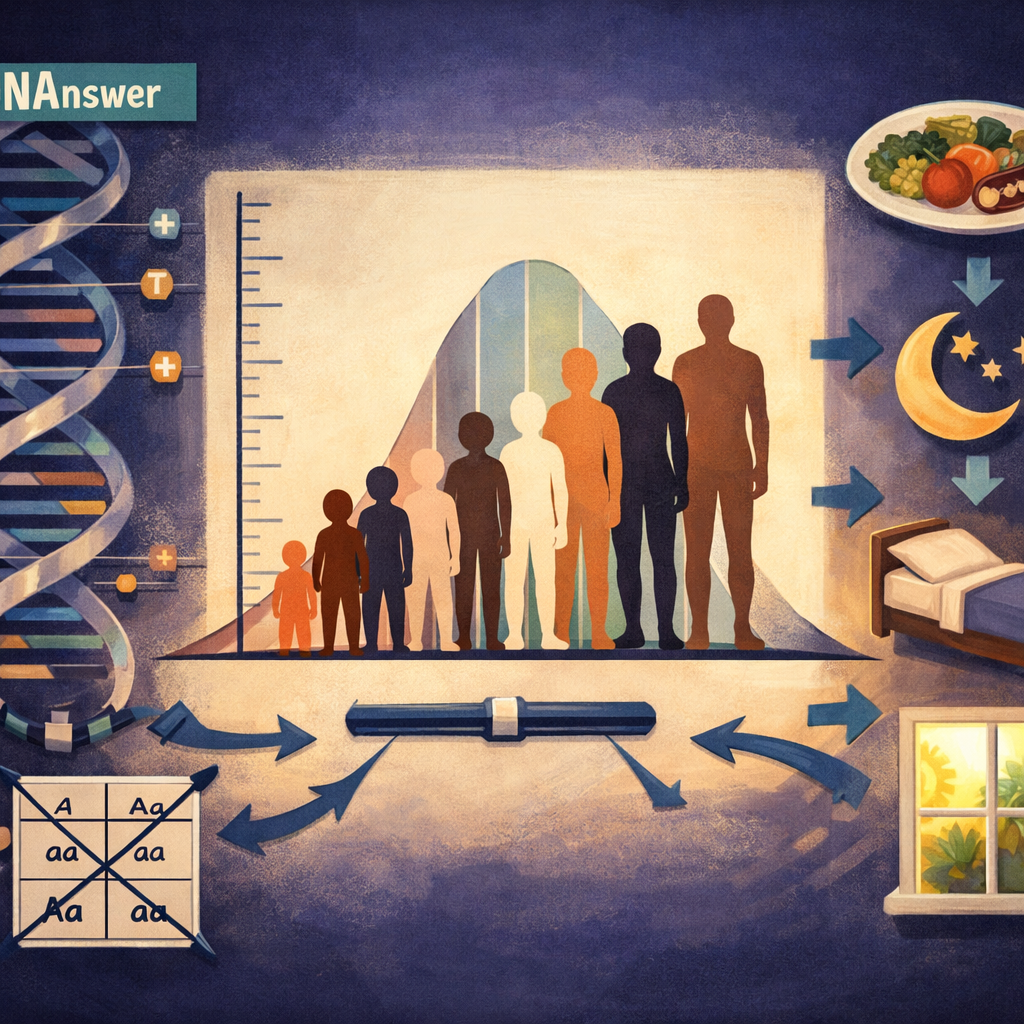
Heritability is a term researchers use to describe how much of the variation in a trait, within a specific population, traces back to genetic differences. For adult height in developed countries with generally adequate nutrition, heritability estimates commonly fall between 80% and 90%. That sounds like genetics wins decisively.
Here's the catch: heritability is a population-level statistic about variation, not a rule about any one person's fate. It also changes depending on the environment you're measuring. In a population where some children face chronic malnutrition and others don't, environmental differences explain more of the height variation, and heritability estimates drop. Change the environment, and you change the math — the genes didn't change at all.
Nutrition, Illness, and the "Secular Trend" in Height
Population height has shifted dramatically within a few generations, and genes can't move that fast. Average heights across much of Europe and East Asia rose several inches between the late 19th century and today, a well-documented pattern researchers call the secular trend in height. The genome of a population doesn't meaningfully change in 100 years. Better nutrition, reduced childhood disease, and improved public health did the heavy lifting.
Individual case studies point the same direction. Children who experience chronic malnutrition or repeated serious illness during key growth windows — particularly in the first few years of life and again during puberty — tend to fall short of their genetic potential for height, even when both parents are tall. Catch-up growth can recover some of that lost ground if conditions improve early enough, but not always all of it.
If you're evaluating your own height, or a child's, don't treat genetics as an unchangeable verdict. Look at the whole picture: diet, sleep, chronic illness, and access to health care all shape the final number as much as any inherited variant does.
Myth #4: A Polygenic Risk Score Can Predict Your Exact Height or Disease Outcome
A polygenic risk score gives you a probability, not a prophecy. It tells you where you likely fall relative to other people, based on hundreds or thousands of genetic variants — it does not hand you an exact number or a guaranteed diagnosis.
This myth spreads because polygenic scores get marketed with a confidence that outpaces the science. Direct-to-consumer genetic testing companies sometimes present results as clean percentages, and it's easy to read a number like "78th percentile for height" as a fact rather than an estimate with real uncertainty attached.
How a Polygenic Score Actually Works

A polygenic risk score (sometimes called a polygenic score, or PGS) adds up the small effects of many genetic variants identified through GWAS, weighting each one by how strongly it's associated with the trait in study data. For height, a well-built score built from large datasets can explain a meaningful chunk of the variation between people, but even the best current models fall well short of accounting for all the heritability researchers know exists — some of the "missing" variation likely comes from rare variants, gene interactions, and effects that current studies haven't captured or weighted precisely yet.
For disease risk, the gap between score and certainty matters even more. A high polygenic score for type 2 diabetes or coronary artery disease means elevated probability across a population, not a diagnosis for an individual. Plenty of people with high scores never develop the condition, and plenty of people with low scores do, because environment, lifestyle, and chance still play enormous roles.
Where These Scores Genuinely Help
None of this makes polygenic scores useless. They're genuinely valuable for a few specific jobs:
- Ranking relative risk across large groups, useful in research and public health planning.
- Flagging people who might benefit from earlier or more frequent screening for a condition.
- Guiding agricultural and livestock breeding, where the technique originated decades before human applications.
- Informing, not replacing, clinical judgment alongside family history and lifestyle factors.
- Powering curiosity-driven tools, like the trait-based quizzes on platforms such as dnanswer.app, where seeing how dozens of variants combine to shape a trait makes the abstract idea of polygenic inheritance click in a way a textbook paragraph rarely does.
Treat any polygenic score, whether for height or heart disease, as a weather forecast. A 70% chance of rain tells you something real and useful. It still doesn't guarantee you'll get wet.
How Scientists Actually Found These Genes: A Short History of GWAS
Before genome-wide association studies existed, geneticists genuinely believed complex traits might trace back to a handful of major genes, because that's all the technology of the time could detect. The shift to modern polygenic thinking is a story about tools catching up to reality.
Early 20th-century researchers studying human traits worked with pedigree charts and educated guesses. Then, in the early 2000s, the Human Genome Project and the drop in DNA sequencing costs opened the door to scanning entire genomes across huge groups of people at once. That's the origin of GWAS.
From Candidate Genes to Genome-Wide Scans
Researchers used to hunt for "candidate genes" — picking a gene they suspected mattered, based on its known biological function, and testing it directly. This approach found real answers for some traits but consistently missed the bigger picture for complex ones. It was like searching for your car keys only under the streetlight.
GWAS flipped the approach. Instead of guessing which gene mattered, researchers scan the entire genome of tens or hundreds of thousands of participants, looking for tiny DNA differences, called single nucleotide polymorphisms (SNPs), that show up more often in people with a particular trait or condition. No assumptions required going in.
What GWAS Revealed About Height Specifically
Large height GWAS studies, drawing on datasets like the UK Biobank with genetic and health data from roughly 500,000 participants, have identified over 700 distinct genomic regions associated with adult height. Each region typically shifts height by a fraction of a millimeter to a few millimeters on its own. Stack all of them together, and you get a meaningful chunk of the story, though not the entire one — rare variants and gene-environment interactions still account for a real share of the remaining gap.
This is the finding most biology students never encounter past the pea-plant chapter: complex traits aren't controlled by a few genes with big effects. They're controlled by a large crowd of genes with small effects, each easy to overlook individually and only visible once you study enough people at once. That shift in scale, not just in vocabulary, is what separates real polygenic genetics from the classroom version most of us grew up with.
Practical Ways to Spot a Polygenic Trait in Everyday Life
You don't need a lab to recognize polygenic inheritance once you know what to look for. The clearest sign is the shape of variation itself: polygenic traits form smooth, continuous ranges, while Mendelian traits sort into discrete, countable categories.
Skin tone is a good everyday example. Walk down any city block and you'll see a full spectrum, not a handful of fixed shades. That gradient exists because skin pigmentation involves multiple genes (research points to at least a few dozen contributing variants), each nudging melanin production up or down.
A Quick Mental Checklist

Ask yourself these questions when you're trying to figure out whether a trait is polygenic or Mendelian:
- Does the trait come in a smooth range, or in clearly separate categories?
- Do close relatives vary noticeably despite sharing a lot of DNA?
- Does environment (diet, sun exposure, training, illness) visibly shift the outcome?
- Would a single gene mutation plausibly explain the whole trait, or does that feel too simple?
If you answered "smooth range," "yes," "yes," and "too simple," you're almost certainly looking at a polygenic trait.
Traits That Fool People Most Often
Height, skin tone, and blood pressure top the list of traits people wrongly assume are single-gene. IQ and most personality traits belong there too, and both are considerably more polygenic and environmentally sensitive than eye color, even though eye color gets more attention in casual conversation.
On the flip side, don't overcorrect. Some traits really are Mendelian: cystic fibrosis, Huntington's disease, and ABO blood type all trace back to one gene with clearly defined dominant or recessive versions. The skill worth building isn't "assume everything is polygenic." It's learning to ask which category a given trait falls into before you reason about it — and being comfortable saying "it depends on the trait" instead of reaching for one rule to explain all of biology.
Conclusion
Next time someone mentions a "gene for" height, intelligence, or skin tone, ask which model actually applies. If the trait forms a smooth range and runs in families unevenly, assume polygenic: many genes, each small, plus real environmental input. If it sorts into clean either/or categories, Mendelian rules still hold. Knowing which lens fits keeps you from over-trusting any single genetic test or headline.
Frequently Asked Questions
Is height 100% genetic, or does environment really change it?
Height is not 100% genetic. Heritability estimates for adult height typically run 80-90% within well-nourished populations, meaning genes explain most, but not all, of the variation — nutrition and illness still shift real outcomes.
How many genes actually influence human height?
Over 700 distinct genomic regions have been linked to adult height through genome-wide association studies. Each contributes a small additive effect, and together they explain a substantial share of height variation, though not all of it.
Can a DNA test tell me exactly how tall my child will be?
No. A polygenic score can estimate a probable range or percentile based on hundreds of variants, but it can't predict an exact height, since environment and untested rare variants still influence the outcome.
Why do eye color and height both get called "polygenic," but eye color seems simpler?
Eye color involves at least 16 known genes, far fewer than height's 700-plus regions, which is why it shows more visible clustering into common shades even though it's still technically polygenic, not simple dominant-recessive.