Diploid vs Haploid Cells: Why Eggs and Sperm Carry Half the Chromosomes
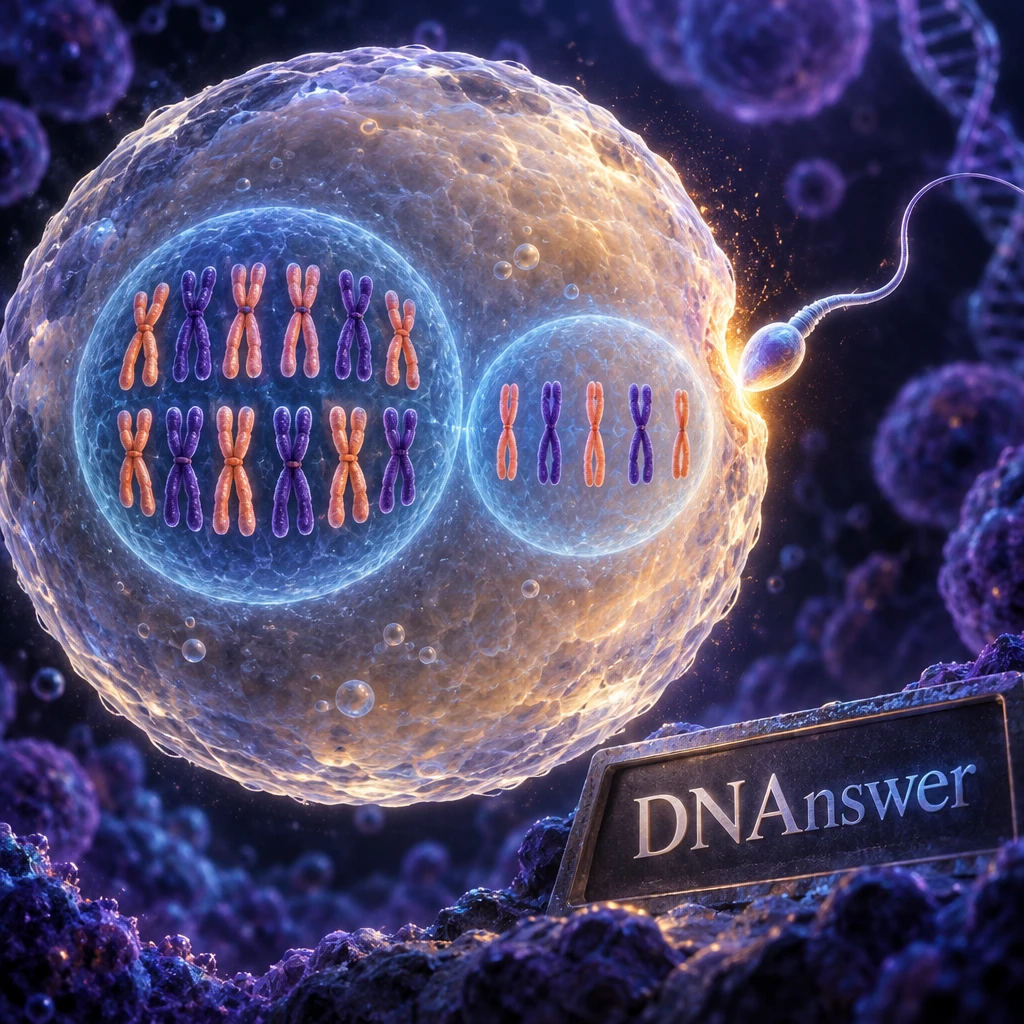
Your egg or sperm cell does not carry "half of you." It carries one complete set of 23 chromosomes, a full instruction manual that is just shuffled differently from every other copy. A diploid cell holds two full sets (46 in humans, one set from each parent). A haploid cell holds one set (23). Eggs and sperm are haploid because meiosis, a special type of cell division, cuts the count so fertilization restores 46 instead of doubling it.
Key Takeaways
- Haploid means one complete set of chromosomes, not half of every chromosome.
- Humans: body cells carry 46 chromosomes, eggs and sperm carry 23.
- Meiosis divides twice, turning one diploid cell into four haploid cells.
- Haploid cells exist outside eggs and sperm: spores, male bees, some algae.
- Crossing over shuffles genes, so no two gametes match.
- The number 92 appears after DNA copying, not as a normal human count.
Myth 1: "Eggs and Sperm Carry Half of Everything"
Picture a recipe book with 23 chapters. A body cell owns two copies of each chapter. A sperm owns one copy of each chapter. It does not own half of every page.
That is the first myth worth killing, and it is the most common one. Most people picture a chromosome sliced in two, with each parent donating a torn half. The picture feels logical, because textbooks say gametes (sex cells, meaning egg and sperm) have "half the number of chromosomes." The phrase is true, but the word "half" refers to the count, not to the content.
What "half" really counts
A chromosome is a long, tightly packed strand of DNA. You have 23 types, numbered 1 through 22 plus the sex chromosomes (X and Y). Your body cells hold two of each type, which makes 23 pairs and 46 chromosomes. A gamete holds exactly one of each type. Chromosome 1 is there. So are chromosomes 2 through 22, and one sex chromosome.
So a gamete is missing nothing. Every chapter is present once. What it lacks is the second copy.
Why the myth feels right
The shorthand "half the DNA" is easy to say, and in raw amount it is roughly accurate: a gamete holds about half the DNA of a body cell. But amount is not the same as information. Your body cell stores each chapter twice, and the two copies are close but not identical, because they came from two different parents.
That means a haploid cell holds the full set of gene types, with one version of each. A single sperm could, in principle, build the basic plan of a human if it met a matching set.
What to do with this: when you read "half the chromosomes," translate it as "one full set." That small edit prevents a dozen later mistakes.
Myth 2: "Gametes Are Diploid, or Only Eggs and Sperm Are Haploid"
Two opposite mistakes hide here. One says gametes are diploid. The other says haploid is a word reserved for eggs and sperm. Both are wrong, and both are understandable.
The first mistake comes from the fact that gametes start life inside diploid cells. Germ cells (the cells in your ovaries and testes that become eggs and sperm) are diploid, just like skin or blood cells, until meiosis cuts them down. Seen early, they look like any other body cell. Only the finished products are haploid.
The second mistake comes from school, where eggs and sperm are the only haploid examples most of us meet. In the larger living world, they are one case among many.
Haploid and diploid in humans: who is which
Almost every cell in your body is diploid, including skin, muscle, neurons and blood cells. Your somatic cells (body cells that do not become eggs or sperm) all carry 46 chromosomes. In humans, only eggs and sperm are haploid. The fertilized egg, called a zygote, is diploid again, with 23 chromosomes from each parent.
Haploid beyond humans
Male honeybees, called drones, hatch from unfertilized eggs. They are haploid their entire lives, with one set of 16 chromosomes in each cell. Their sisters, the workers and queens, are diploid with 32.
Plants and fungi make spores, small reproductive cells that grow into new individuals without fertilization. In many mosses and ferns, spores are haploid, and they grow into a haploid body that later makes gametes. Many fungi spend most of their lives haploid. Some bacteria also carry a single copy of their genome, though they do not use meiosis.
What to do with this: treat "haploid" as a description of chromosome sets, not a job title. Any cell with one set counts, whatever it does.
Diploid vs Haploid Cell: Side-by-Side Comparison
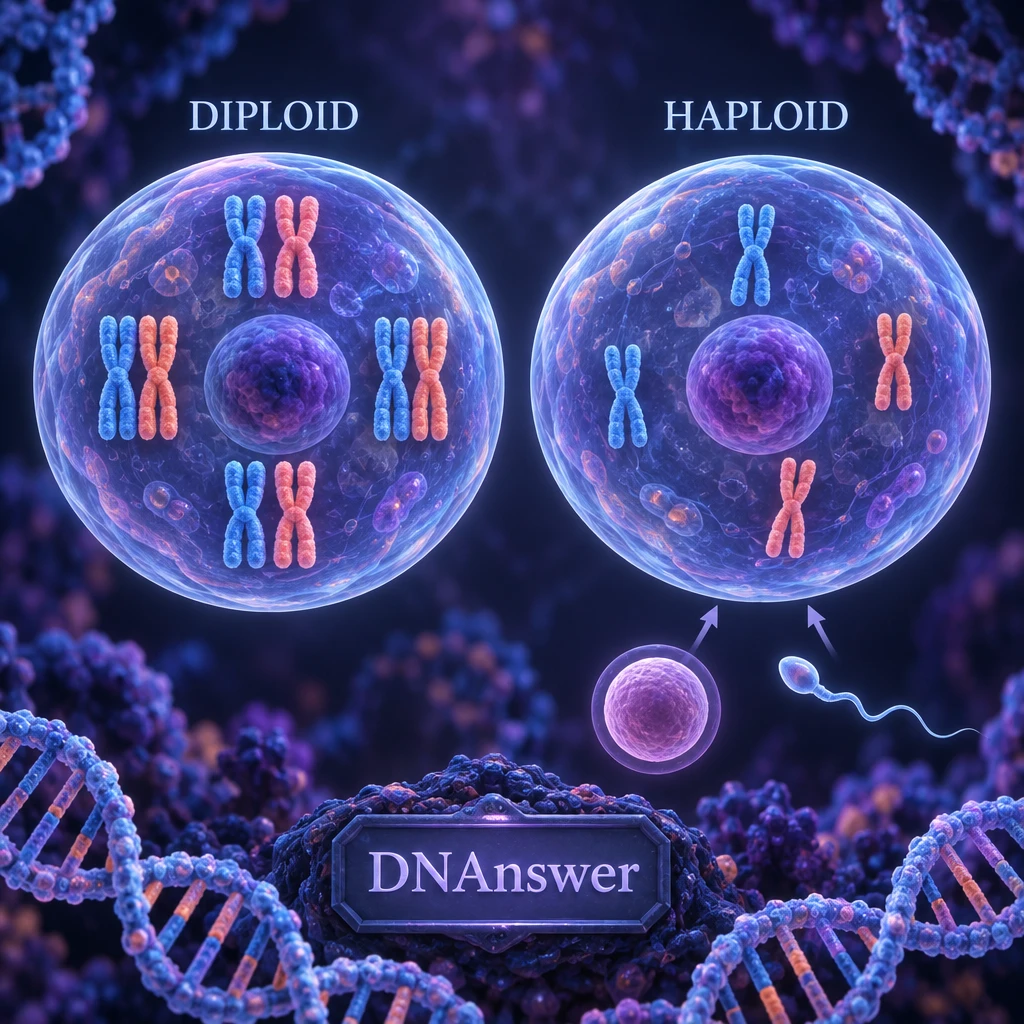
Here is how the two compare on the criteria that matter.
Chromosome sets. A diploid cell (written 2n) carries two complete sets. A haploid cell (written n) carries one. In humans, that is 46 versus 23.
Homologous chromosomes. In a diploid cell, chromosomes come in homologous pairs: two chromosomes of the same type, one from each parent, carrying the same genes in possibly different versions. A haploid cell has no pairs, only singles. So "do haploid cells have homologous chromosomes?" has a clean answer: no, only one of each is present.
Where you find them. Diploid cells make up nearly your whole body. Haploid cells in humans appear only as mature eggs and sperm.
How they form. A diploid cell usually makes more diploid cells by mitosis, ordinary division that produces two identical copies. A haploid gamete forms through meiosis, which starts with a diploid cell and ends with four genetically different haploid cells.
Genetic identity. Mitosis copies a cell faithfully. Meiosis shuffles, so each haploid cell is unique.
Job. Diploid cells run the body. Haploid cells exist to meet another haploid cell and rebuild a diploid one.
Gene copies. A diploid cell has two versions (alleles) of each gene. A haploid cell has one.
Fertilization adds the two sets together: n + n = 2n.
One caution on terms. Biologists sometimes use haploid to mean "half of the parent's count." In a species with more than two sets, such as wheat (six sets, 42 chromosomes), a gamete is haploid but still carries three sets. For humans and most animals, the simple "one set" definition works fine.
Myth 3: "Meiosis Is Just Mitosis With a Different Name"
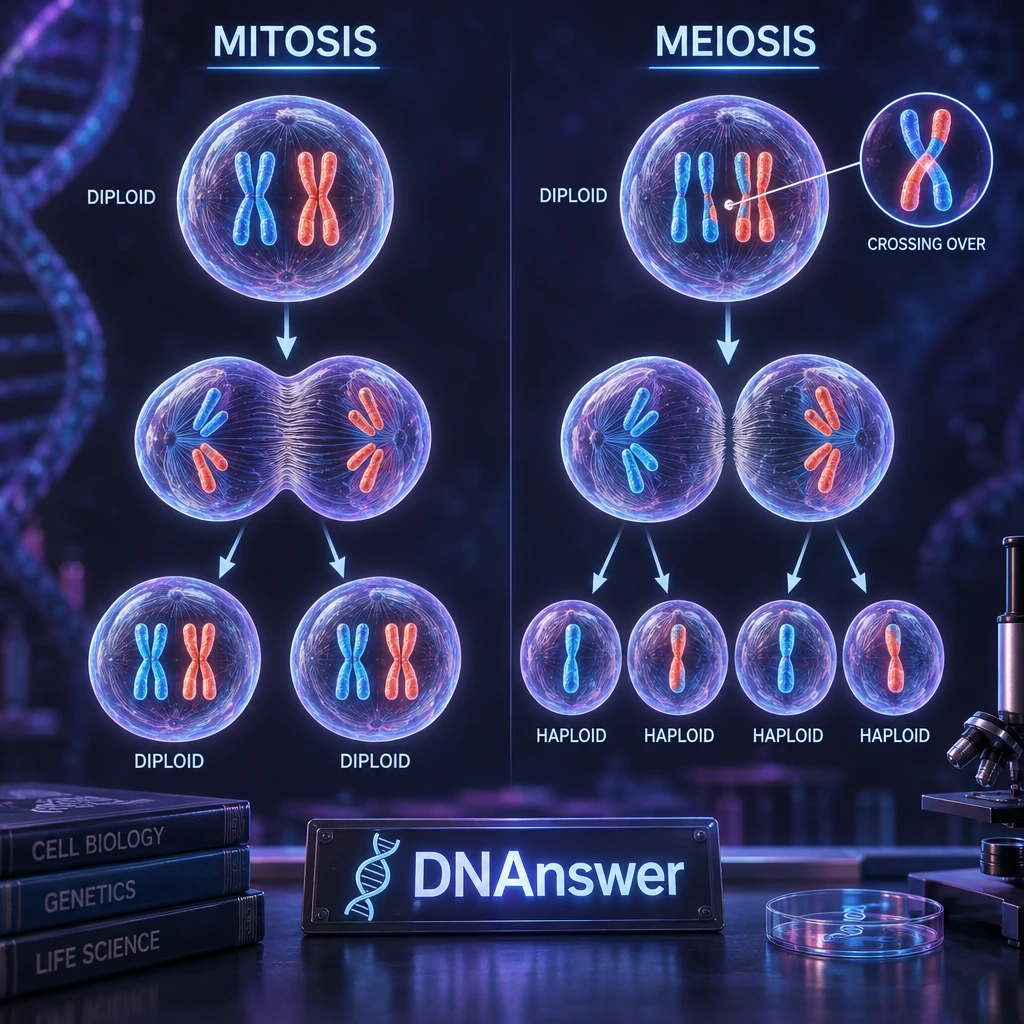
Meiosis and mitosis both split cells. Both have phases with similar names, like prophase and anaphase. No wonder people blend them.
But they do opposite jobs. Mitosis keeps the chromosome number and makes copies. Meiosis cuts the number and makes variety. A second belief rides along with this one: that the halving happens in a single division. It does not. Meiosis uses two.
Meiosis I: the reduction division
Before meiosis starts, the cell copies its DNA, so each chromosome becomes two joined identical strands called sister chromatids. A cell with 46 chromosomes now holds 92 chromatids. (This is one answer to "who has 92 chromosomes?": a human cell right after DNA copying has 92 strands, but they are still counted as 46 chromosomes.)
Then comes the key step. Homologous chromosomes find each other and pair up. They swap pieces of DNA in a process called crossing over. Then the cell divides, and each new cell gets one chromosome from each pair. That drops the count from 46 to 23 chromosomes, though each is still doubled.
Meiosis II: separating the copies
The two cells divide again, this time pulling sister chromatids apart, much like mitosis does. The result is four haploid cells, each with 23 single chromosomes.
Here is the sequence in order:
- A diploid germ cell copies its DNA (46 chromosomes, 92 chromatids).
- Homologous chromosomes pair up and swap DNA pieces.
- Meiosis I splits the pairs into two cells with 23 doubled chromosomes each.
- Meiosis II separates the sister chromatids in each cell.
- Four haploid cells result, each with 23 chromosomes.
What to do with this: when you see a diagram, ask one question first: are the pairs separating, or the sister copies? Pairs mean meiosis I. Sister copies mean meiosis II (or mitosis).
One difference between sexes is worth knowing. Sperm production yields four working sperm per germ cell. Egg production yields one egg and tiny discarded cells called polar bodies, because the cytoplasm (the cell's inner material) goes mostly to one cell.
Myth 4: "Every Egg and Sperm Is a Random Half of Its Owner"
Some people imagine a gamete as a neat, predictable slice of the person who made it. Others assume siblings share everything because they share parents. The reality is more random than either idea.
The kernel of truth: your gametes do draw only from your own genes. Nothing new enters from outside. The error is in thinking the draw is fixed.
Two sources of shuffling
First, independent assortment. In meiosis I, each of your 23 pairs lines up and splits on its own, regardless of the others. For each pair, the gamete gets your mother's version or your father's, like a coin flip. With 23 pairs, that gives 2^23 combinations, or about 8.4 million, before any other shuffling.
Second, crossing over. Pieces of homologous chromosomes trade places, so a single chromosome in your gamete may be part your mother's and part your father's. This multiplies the possibilities far beyond 8.4 million.
That is why 23 is not a leftover half but a full, freshly reshuffled instruction set. Two siblings can look alike yet differ, because each came from a different egg and a different sperm.
Mitosis makes identical copies. Meiosis makes unique ones.
What to do with this: if a family-history or ancestry result surprises you, remember the shuffle. Siblings inherit different pieces of the same parental pool.
What Would Happen Without Meiosis? The Doubling Problem
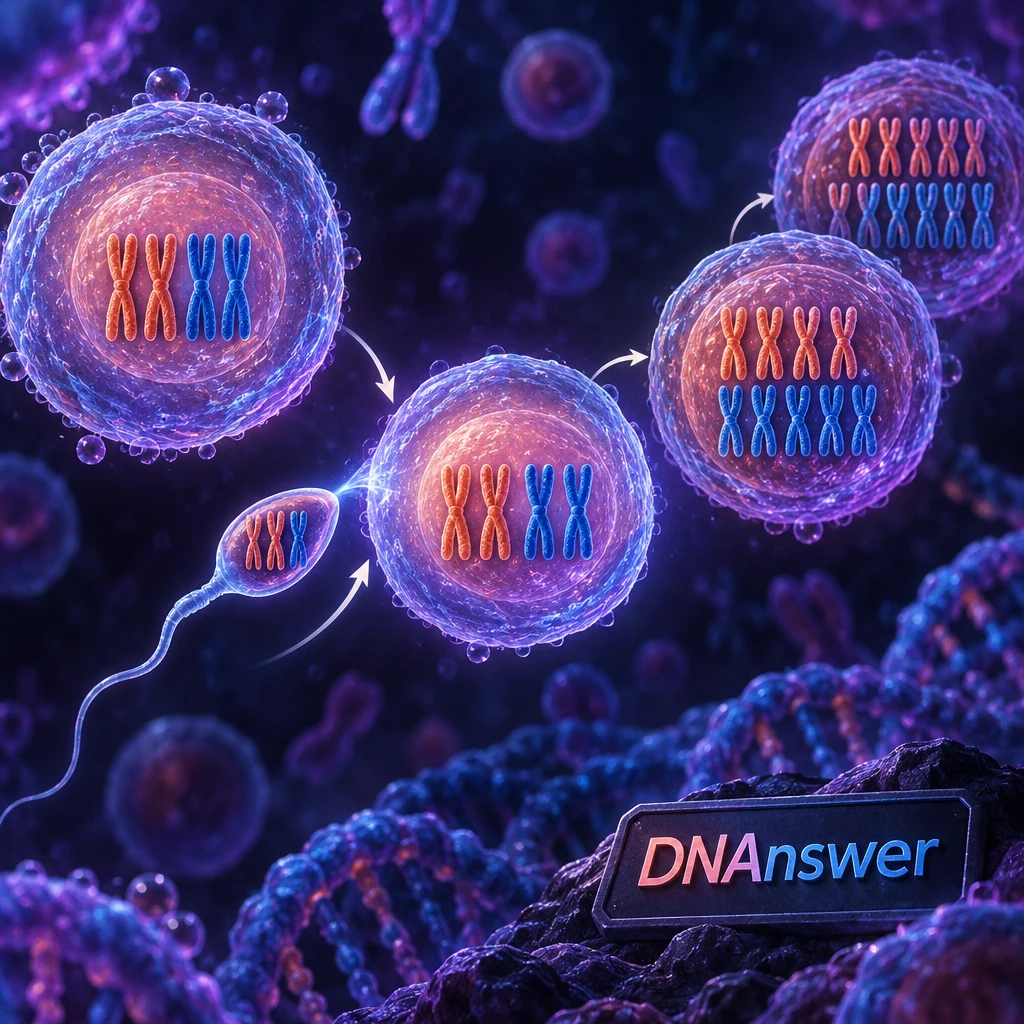
Imagine skipping the reduction step. A diploid egg with 46 chromosomes meets a diploid sperm with 46. The zygote gets 92. Next generation: 184. Then 368. Within ten generations, a cell would need over 47,000 chromosomes. No nucleus could hold them, and cells could not sort them.
Meiosis prevents this. Because each gamete carries one set, fertilization adds them to get back to two sets. The count holds steady, generation after generation.
When the count goes wrong
Meiosis occasionally misfires. A pair or a sister pair fails to separate, an error called nondisjunction. The gamete then carries an extra or missing chromosome. Down syndrome is the best-known case: the child has three copies of chromosome 21 instead of two, for 47 chromosomes in total.
Sometimes a gamete ends up with a whole extra set. Fertilization then produces a triploid embryo (three sets, 69 chromosomes), which in humans almost never survives to birth.
Polyploidy: a problem for animals, a tool for plants
Having extra full sets is called polyploidy. In animals it is usually lethal. In plants it is often useful. Bread wheat has six sets, 42 chromosomes in all, and many fruits and crops gained size and vigor from extra sets. Plant breeders have used polyploidy on purpose, for example in seedless watermelons, which are triploid and so cannot make normal seeds.
What to do with this: when you hear "92 chromosomes," ask whether the speaker means chromosomes or chromatids. A normal human cell never settles at 92 chromosomes. Nondisjunction, not design, is what causes counts like 47 or 69.
Which Reader Should Remember What: A Verdict
Both cell types matter, but they answer different questions.
Choose diploid as your mental default if you are asking about the body, inheritance of traits, or why you carry two versions of a gene. Diploid is the normal state in humans and most animals, and it explains dominant and recessive traits: one copy can mask another.
Choose haploid if you are asking about reproduction, why siblings differ, or how a species keeps its chromosome number steady. Haploid is the handoff state, one set carried from one generation to the next.
If you are studying for a biology class, anchor on three facts: 2n equals 46, n equals 23, and n plus n returns 2n. Everything else builds on them. To practice, you can try the meiosis and chromosome quizzes on DNAnswer, which are free and add new questions regularly.
Conclusion
Your gametes are not fragments of you. Each holds one full, reshuffled set of instructions, built so that two of them can meet and restore a complete person. Next time you see a chromosome diagram, count sets before you count chromosomes. Then check whether the cell is pairing up (meiosis I) or splitting copies (meiosis II). That habit settles most diploid vs haploid confusion in seconds.
Frequently Asked Questions
Why do sperm and egg cells only have half the number of chromosomes?
Meiosis halves the count so fertilization can restore it. If eggs and sperm were diploid, each generation would double its chromosomes: 46, then 92, then 184. A single set of 23 per gamete keeps the human total at 46.
Are gametes diploid or haploid?
In humans, gametes are haploid, with 23 chromosomes. The cells that produce them are diploid. In species with more than two chromosome sets, such as wheat, a gamete is still haploid but carries several sets.
Who has 92 chromosomes?
No normal human does. A human cell has 92 chromatids (copied strands) after DNA replication, but they still count as 46 chromosomes. A rare 92-chromosome condition, called tetraploidy, is almost always lethal in the embryo.
What are some haploid and diploid examples outside humans?
Male honeybees are haploid, with 16 chromosomes, while female bees are diploid with 32. Moss spores and many fungi are haploid for much of their lives. Most animals, like dogs and mice, have diploid body cells and haploid gametes.