When Does Replication of DNA Occur? Cell Cycle
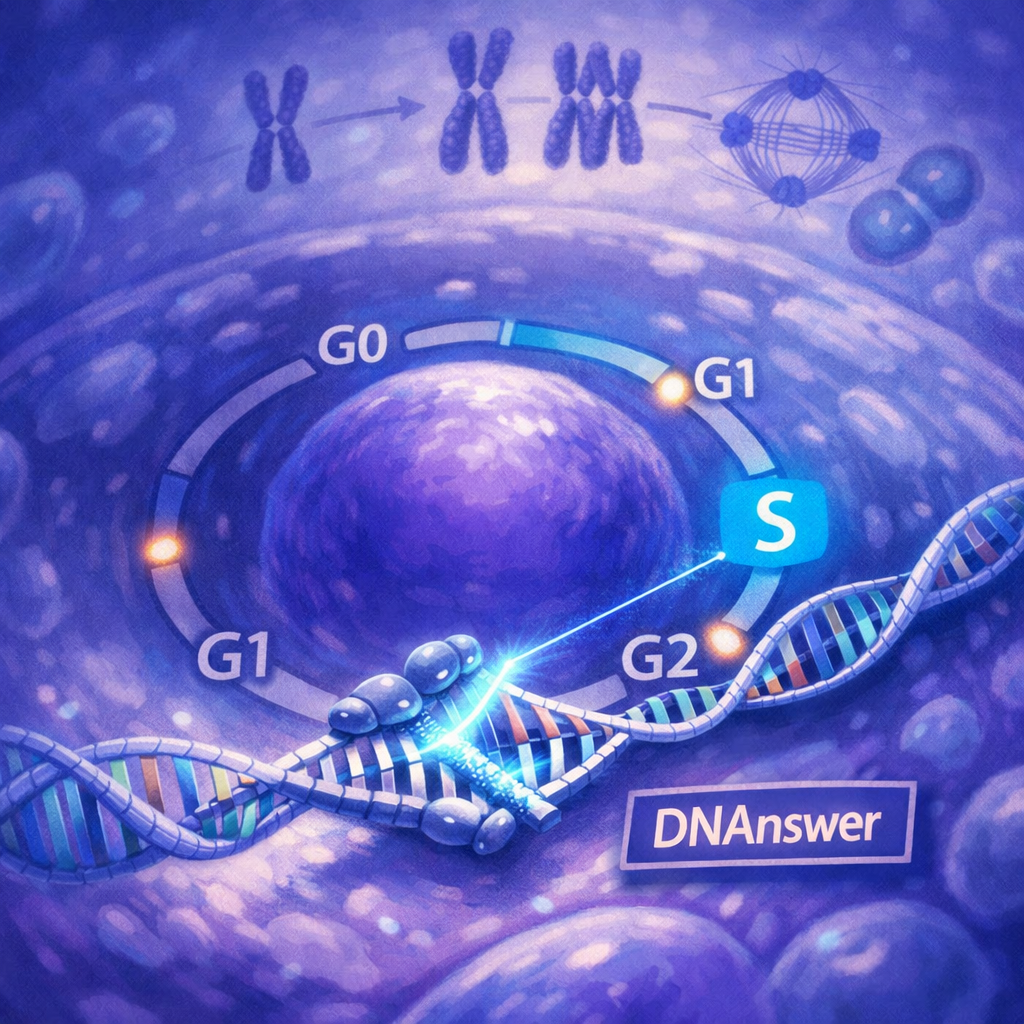
You picture a cell splitting in two, and somewhere in that dramatic split, you assume the DNA is getting copied. That's the version most people carry around from ninth-grade biology, and it's backward. DNA replication — the process of copying a cell's entire genetic instruction set — happens well before division starts, in a quiet, tightly guarded stretch called S phase.
Getting the timing right matters more than it sounds. It changes how you understand cancer, how chemotherapy drugs work, and why your skin cells behave nothing like your brain cells. The order of operations isn't a trivia detail — it's the whole safety system.
Key Takeaways
- DNA replication happens during S phase, hours before mitosis even begins.
- Mitosis divides copied DNA — it doesn't create the copies itself.
- Cell cycle checkpoints block division if replication isn't finished or is damaged.
- Not all cells replicate constantly — many sit permanently in a resting state called G0.
- Replication and transcription are different processes with different jobs and different timing.
- Skipping replication's checkpoints is a direct route to the uncontrolled growth seen in cancer.
Myth #1: DNA Copies Itself During Mitosis
This is the big one, and it's the one that costs students the most exam points. The honest truth: DNA replication is finished long before mitosis starts. Mitosis is the division phase — it splits already-copied chromosomes into two cells. It doesn't do any copying itself.
It's an easy mistake to make. Diagrams of mitosis are everywhere — the dramatic drawings of chromosomes lining up, spindle fibers pulling them apart, cells pinching into two. Textbooks spend far more time illustrating mitosis than the quieter phase that precedes it, so it's natural to assume that's where all the action, including copying, happens. Visually, mitosis just looks busier.
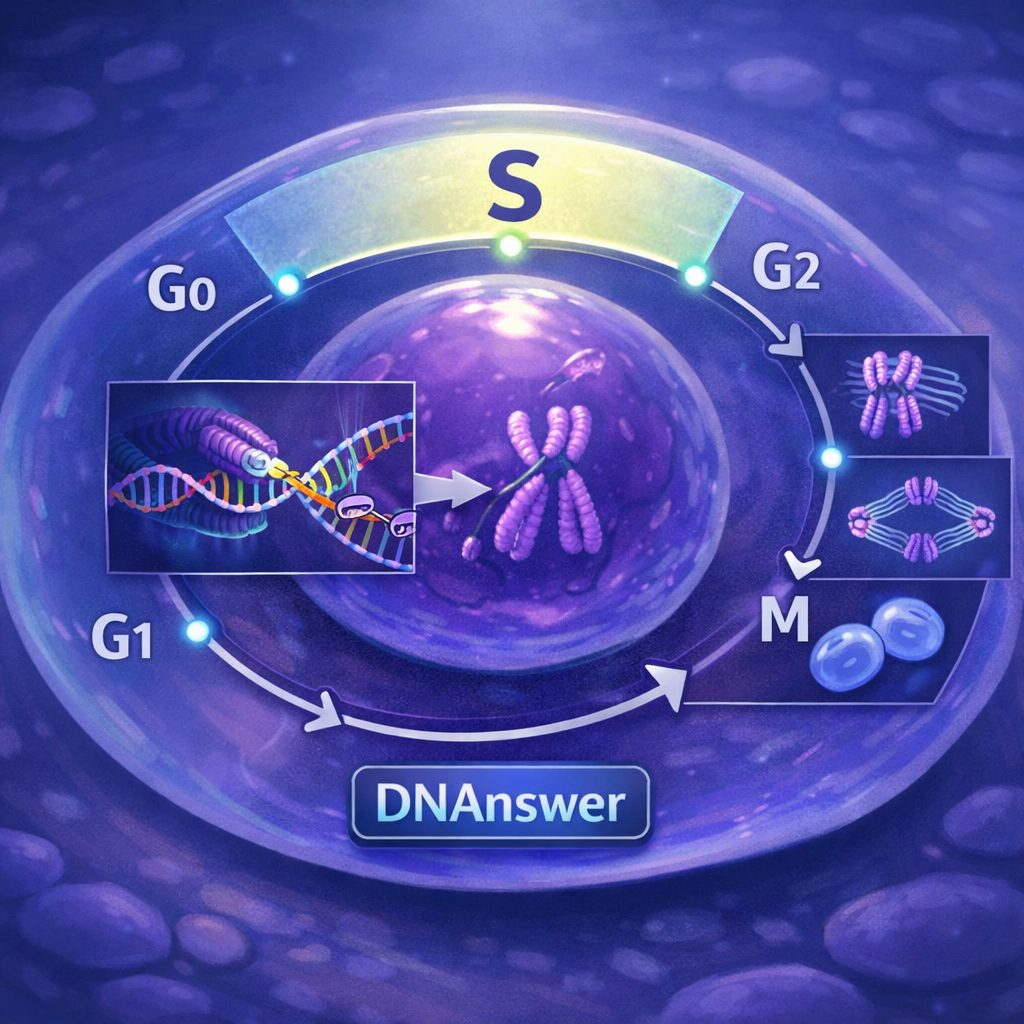
Here's what's actually going on. The cell cycle has two broad chapters: interphase, where the cell grows and copies its DNA, and the mitotic phase, where it divides. Interphase itself splits into three parts: G1 (first gap), S phase (synthesis), and G2 (second gap). Replication — the actual doubling of DNA — happens exclusively during S phase, which for a typical human cell takes roughly 6 to 8 hours out of a full 24-hour cycle.
Why the Order Matters
By the time a cell enters mitosis, every chromosome already exists as two identical copies, joined at a pinch point called the centromere. Mitosis's job is mechanical: pull those two copies apart and hand one to each daughter cell. There's no synthesis machinery active during mitosis at all — the enzymes that build DNA aren't even running.
Think about what would happen if copying happened during division instead. You'd be trying to duplicate a strand of DNA while simultaneously yanking it apart with molecular ropes. That's a recipe for broken chromosomes, not new cells. The cell avoids that collision entirely by finishing all the copying first, checking its work, and only then starting the pulling-apart step.
What to Remember Instead
If you take one correction from this article, take this one: replication is an interphase event, specifically an S-phase event. Mitosis is just distribution. When you see a diagram of chromosomes doubling and lining up in the middle of a dividing cell, that doubling already happened hours earlier — the diagram is just showing you the result.
Myth #2: Replication and Transcription Are the Same Thing
People often use "DNA copying" and "making RNA" interchangeably, but they're different jobs with different products, different enzymes, and different timing. Replication copies DNA into DNA. Transcription copies DNA into RNA (a related molecule used to build proteins). Mixing them up isn't a minor slip — it scrambles your understanding of when and why each one happens.
The confusion has a real source. Both processes involve unzipping the DNA double helix. Both involve an enzyme reading one strand and building a new strand based on it. If you only remember the "unzip and read" part, the two processes blur together in memory, especially years after you last drew them on a worksheet.
But the differences are sharp once you look closely. Replication uses the enzyme DNA polymerase and happens once per cell cycle, during S phase, to duplicate the entire genome — all 3 billion base pairs in a human cell. Transcription uses a different enzyme, RNA polymerase, and happens constantly, throughout G1, S, and G2, on small sections of DNA — just the specific genes a cell needs active at that moment.
- Replication copies the whole genome; transcription copies one gene or a handful of genes at a time.
- Replication happens once per cycle, in S phase; transcription happens continuously across interphase.
- Replication produces two DNA molecules; transcription produces RNA molecules, mostly messenger RNA.
- Replication precedes cell division; transcription supports ongoing cell function, division or not.
- Replication uses DNA polymerase; transcription uses RNA polymerase.
A liver cell that never divides again still transcribes genes every day to make the proteins it needs. It almost never replicates its DNA. That single fact — a cell can transcribe without ever replicating — is the cleanest proof that these are separate systems running on separate schedules.
Myth #3: All Cells Are Constantly Copying Their DNA
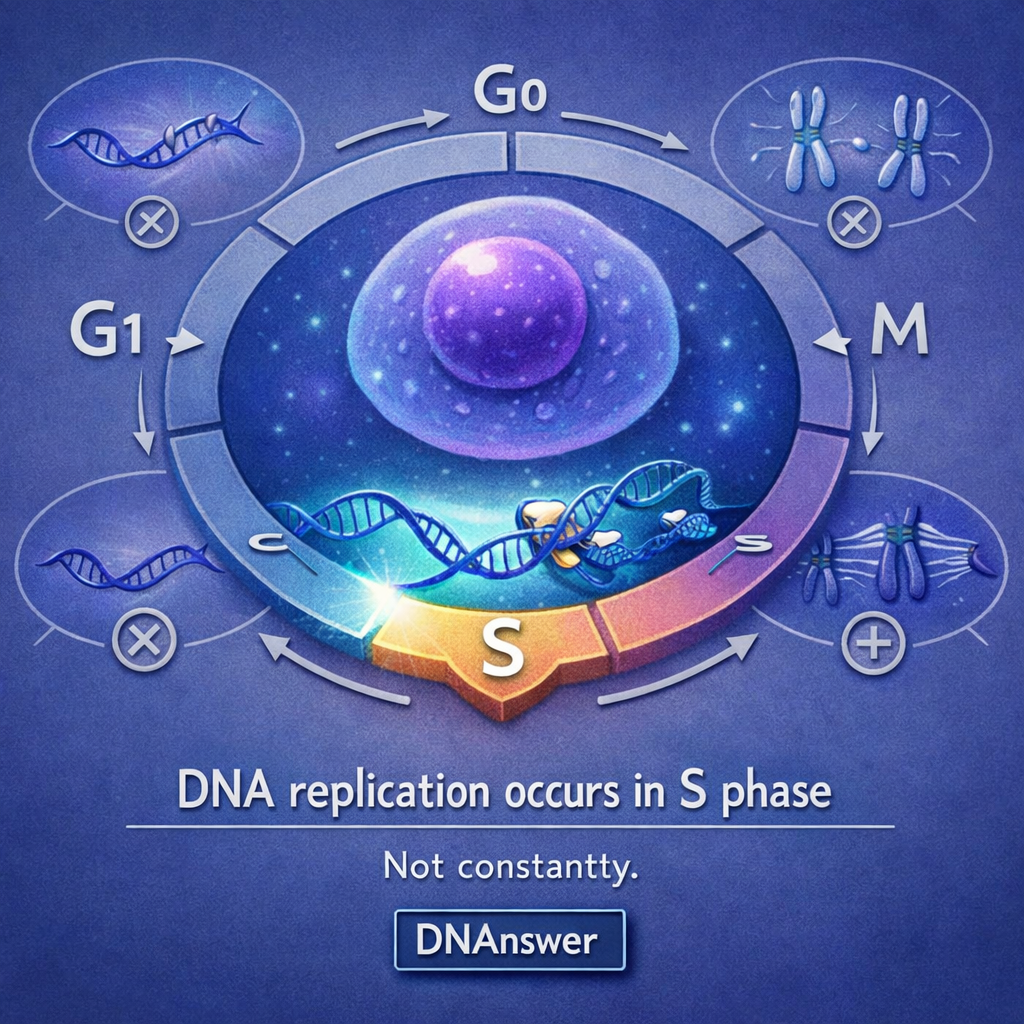
Plenty of people assume every cell in the body is in some kind of nonstop replication loop, quietly doubling its DNA around the clock. It isn't true. Most of the cells in your body right now are not replicating DNA at all — they've exited the cycle entirely and parked in a resting state called G0.
The misconception probably comes from how replication gets taught: as a universal, defining feature of "what cells do," without much mention of exceptions. Combine that with the fact that some cells genuinely do divide fast — the lining of your gut turns over every few days — and it's easy to generalize that pace to every cell type.
The reality is closer to a spectrum than a rule. Skin cells at the surface, gut lining cells, and bone marrow stem cells replicate often, sometimes every day or two, to keep replacing cells that wear out or die. Mature neurons and most heart muscle cells, on the other hand, exit the cycle after early development and essentially never replicate again for the rest of your life. Liver cells sit in between: they mostly stay quiet in G0 but can re-enter the cycle and replicate if part of the liver is damaged.
Why G0 Exists
G0 isn't a malfunction — it's a deliberate off-ramp. A cell that has finished dividing and settled into its specialized job (a neuron firing signals, a muscle cell contracting) doesn't need to keep copying DNA. Copying carries risk: every round of replication is a chance for an error to slip through. Cells that don't need to divide again reduce that risk simply by not replicating.
The Practical Takeaway
If a friend tells you their cells are "constantly copying DNA to stay young," you now know that's backward. Most non-dividing cells are doing the opposite — sitting still in G0, replication machinery switched off, precisely because staying quiet is safer than staying busy.
Myth #4: The Cell Cycle Is Basically Just Mitosis
Ask someone to describe the cell cycle and you'll usually hear one word: mitosis. That's incomplete. Mitosis is only one phase of the cycle, and it's often the shortest one. The bulk of a cell's time — interphase — gets left out of the mental picture almost entirely.
The cell cycle is the ordered sequence of events by which a cell duplicates its contents and divides into two daughter cells, consisting of interphase (G1, S, and G2) followed by the mitotic phase.
That framing, standard in cell biology, makes the imbalance obvious. In a fast-dividing human cell with a 24-hour cycle, mitosis itself might take under an hour. Interphase eats up the other 20-plus hours — growing, copying DNA, and preparing every component needed for two functional cells instead of one.
The reason mitosis dominates the popular imagination is simple: it's the visible part. Chromosomes condense, become distinct, and get sorted into two piles under a microscope. Interphase, by contrast, looks like nothing — a cell just sitting there, seemingly idle. But "looks idle" and "is idle" are not the same thing.
The Three Parts of Interphase
G1 is the growth phase — the cell builds proteins and organelles and monitors whether conditions are favorable to move forward. S phase is where replication happens, doubling every chromosome. G2 is a second checking-and-building phase, where the cell confirms replication finished correctly and assembles the machinery it'll need for mitosis, including the spindle fiber components that will later pull chromosomes apart.
Why This Framing Matters for Cancer
Nearly every cancer-related question in molecular biology traces back to a failure somewhere in this fuller cycle, not just in the mitosis step. A tumor doesn't form because mitosis "goes wrong" in isolation — it forms because a cell slips past the checkpoints in G1, S, or G2 that were supposed to stop it. Understanding the whole cycle, not just the division step, is what makes cancer biology make sense at all.
What Actually Happens During S Phase
S phase is where the real copying takes place, and it runs on a genuinely elegant mechanism worth understanding on its own terms. The enzyme DNA polymerase moves along each strand of the opened-up double helix, reading the sequence and building a new, complementary strand base by base.
The result is semiconservative replication: each of the two new DNA molecules contains one original (old) strand and one newly built strand. Neither daughter molecule is entirely new, and neither is entirely old — each is a 50/50 blend. This was confirmed experimentally in 1958 by Matthew Meselson and Franklin Stahl, whose classic experiment tracked heavier, isotope-labeled DNA strands through multiple rounds of replication and showed exactly this splitting pattern.
Replication doesn't start at one end of a chromosome and crawl to the other. Human chromosomes are enormous — some hold over 200 million base pairs — so copying them start-to-finish with a single starting point would take far too long. Instead, replication kicks off at thousands of separate starting points called origins of replication simultaneously, and the copied segments eventually merge into complete new strands.
Why Errors Are Rare but Not Impossible
DNA polymerase is fast and accurate, but not perfect. It makes an error roughly once every 100,000 to 1,000,000 bases on the first pass. That sounds alarming until you factor in proofreading: the enzyme checks its own work as it goes, and a separate repair system checks again afterward. Combined, these systems bring the final, uncorrected error rate down to roughly one mistake per billion bases copied.
What This Means Practically
Every time your body replaces a batch of skin cells or heals a cut, this exact molecular process runs, correctly, millions of times over. The vast majority of replication events finish clean. The rare ones that don't are exactly the ones the cell's checkpoint system exists to catch — which is the subject worth tackling next.
Checkpoints: The System That Stops Replication From Going Wrong
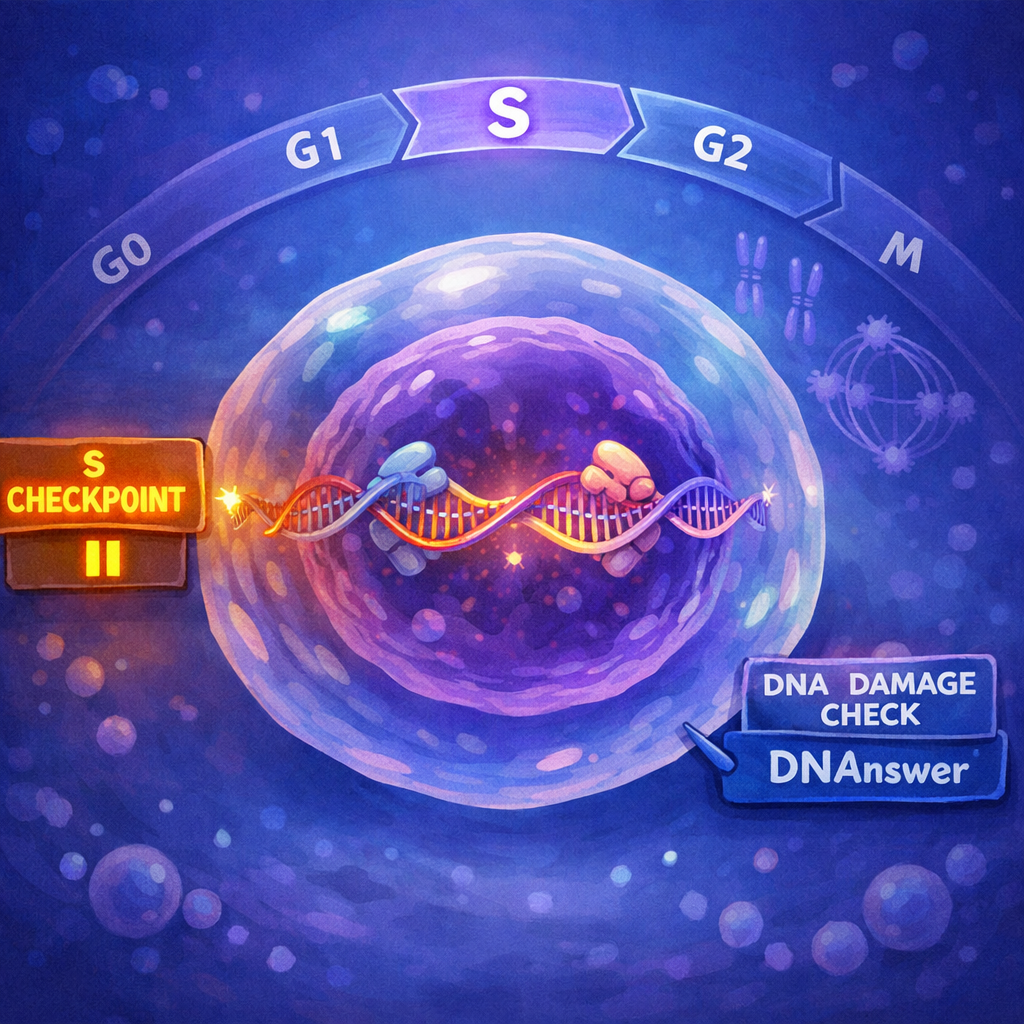
A checkpoint is a built-in pause button the cell cycle hits at specific points, checking whether it's safe to move to the next phase. There are three major checkpoints: one at the end of G1 (before committing to replicate), one at the end of G2 (before committing to divide), and one during mitosis itself (checking that chromosomes are properly attached before splitting).
The G1 Checkpoint
This is the cell's biggest decision point, sometimes called the restriction point. Here, the cell asks whether conditions — nutrient levels, growth signals, DNA integrity — support moving forward into S phase. If DNA is already damaged, proteins like p53 step in and halt the cycle, giving repair systems time to work before any copying starts. p53 is significant enough that it's sometimes called the "guardian of the genome," because when it's mutated, cells lose their ability to stop and check before replicating damaged DNA.
The G2 Checkpoint
After S phase finishes, the G2 checkpoint verifies that replication actually completed and that no major DNA damage occurred during the copying process. This is the direct enforcement of the "replicate before you divide" rule. A cell that tries to skip ahead to mitosis with incompletely copied chromosomes gets stopped here.
The Mitotic Checkpoint
Once in mitosis, a final checkpoint confirms that every chromosome pair is correctly attached to the spindle apparatus (the structure that pulls chromosomes apart) before allowing separation to proceed. This prevents chromosomes from being torn apart unevenly, which would leave one daughter cell with too many and the other with too few.
Put these three together and you get a system that only allows replication once conditions are safe, only allows division once replication is confirmed complete, and only allows separation once attachment is confirmed correct. It's less like a single event and more like a series of locked doors, each requiring a specific key before the next one opens.
Why Getting This Timing Wrong Connects Directly to Cancer
Cancer isn't just "cells dividing too much" in some vague sense — it's cells that have lost the checkpoint controls governing when replication and division are allowed to happen. Mutations that disable checkpoint proteins let cells replicate damaged DNA, skip repair, and divide anyway. That's the mechanistic link between the cell cycle timeline and disease.
The most commonly damaged checkpoint gene across human cancers is TP53, the gene that codes for the p53 protein mentioned earlier. Roughly half of all human cancers involve a mutation in this single gene, according to research summarized by the National Cancer Institute. When p53 doesn't work, the G1 checkpoint stops catching damaged DNA before S phase, so cells replicate errors instead of pausing to fix them.
Once a cell replicates damaged DNA and its checkpoints fail to catch the problem, those errors get locked into every future copy. The daughter cells inherit the mutation, and if that mutation happens to disable more checkpoint genes, the cycle compounds. Over years, this is how a single cell lineage can accumulate the pile of mutations associated with a tumor — not from one dramatic event, but from repeated, uncaught replication mistakes.
This is also exactly why many chemotherapy drugs target S phase specifically. Drugs in a category called antimetabolites work by disrupting DNA replication directly — blocking DNA polymerase or starving the cell of the raw materials it needs to build new strands. Because cancer cells replicate more often than most healthy adult cells, they're disproportionately affected by drugs that interfere with the S-phase machinery, though this is also why chemotherapy affects other fast-replicating tissue, like hair follicles and gut lining, causing familiar side effects.
Understanding when replication happens isn't academic trivia — it's the exact mechanism doctors and researchers are targeting when they design a cancer treatment. If you want to test how well this timeline actually sticks, running through a short cell cycle quiz, like the ones on the DNAnswer app, is a quick way to see whether the order of G1, S, G2, and mitosis has actually clicked or just sounds familiar.
Conclusion
Once you know replication happens in S phase, not during mitosis, the rest of the cell cycle starts making sense as a sequence of deliberate checkpoints, not a single blurry event. Next time you see a diagram of dividing chromosomes, ask yourself which phase you're actually looking at — that habit alone will sharpen how you read any biology explanation going forward.
Frequently Asked Questions
Does DNA replication happen in G1 or S phase?
DNA replication happens exclusively in S phase, not G1. G1 is a preparation and checkpoint phase where the cell grows and checks conditions before committing to copy its DNA in S phase.
How long does S phase actually last?
In a typical human cell with a 24-hour cell cycle, S phase runs roughly 6 to 8 hours. The exact length varies by cell type; some rapidly dividing cells compress this window shorter.
Can a cell skip S phase and still divide?
No — cells can't divide with unreplicated DNA without producing broken or missing chromosomes. The G2 checkpoint specifically blocks entry into mitosis until S phase finishes and DNA integrity is confirmed.
Is DNA replication the same as cell division?
No. Replication copies DNA molecules during S phase; cell division (mitosis) physically splits the cell into two, distributing already-copied chromosomes. Replication always finishes hours before division begins.