How Many Chromosomes Do Humans Have? Why We Have 46 and Apes Have 48
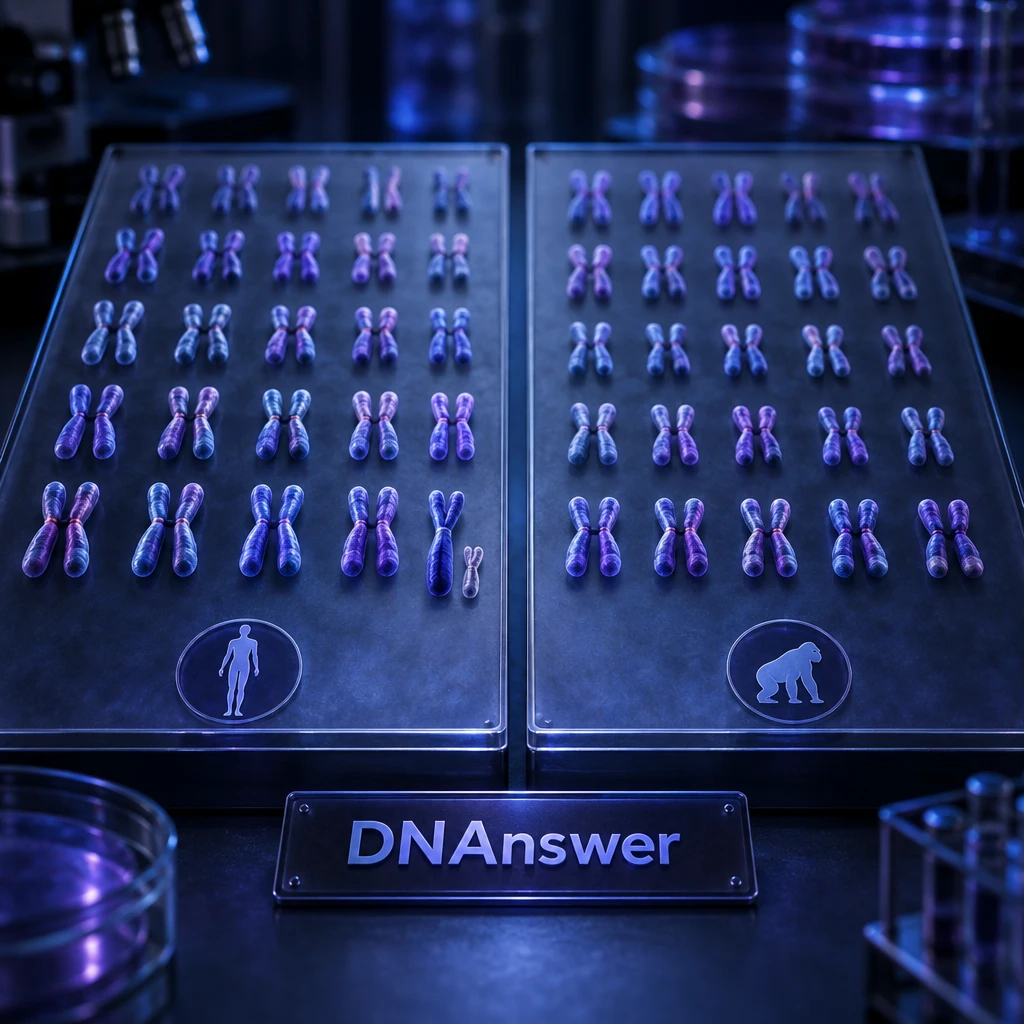
Why do you have fewer chromosomes than a chimpanzee, when you share about 98% of your DNA with one? Humans normally have 46 chromosomes, arranged in 23 pairs. Chimpanzees, gorillas and orangutans have 48, or 24 pairs. The gap is not a loss. Two chromosomes in an ancient ape ancestor joined end to end and became your chromosome 2. Nearly all the genetic content came along.
Key Takeaways
- Humans have 46 chromosomes (23 pairs); great apes have 48 (24 pairs).
- Human chromosome 2 formed when two ancestral ape chromosomes fused.
- Fewer chromosomes does not mean less DNA or a simpler organism.
- Humans did not evolve from chimpanzees; both descend from a shared ancestor.
- Monkeys vary widely in chromosome count; the 48 figure covers great apes only.
- A person with 47 chromosomes has a medical condition, not ape traits.
Myth 1: "Fewer Chromosomes Means Less DNA"
Picture a bookshelf. Merge two volumes into one thick book and you have one fewer book, but every page is still there. That is what happened to your chromosome 2.
A chromosome is a long, tightly packed strand of DNA, the molecule that holds your genetic instructions. People assume that 46 versus 48 means humans lost two chromosomes' worth of information. The belief makes sense: in most everyday counting, fewer means less.
What the fusion actually did
Two ancestral chromosomes, called 2a and 2b by researchers, joined end to end. Chimpanzees still carry them as separate chromosomes. Your chromosome 2 matches those two chimp chromosomes closely, gene for gene. The total amount of DNA stayed about the same.
Researchers confirmed this by lining up the sequences. The closest human relative, the chimpanzee, has nearly identical DNA to human chromosome 2, but it sits on two chromosomes. Gorillas and orangutans show the same split.
Why count does not equal complexity
Chromosome number says little about how complex an organism is. A fern can carry hundreds of chromosomes. Some small insects carry just a handful. Count is a packaging detail, not a measure of how much information a genome holds.
So don't read 46 as a deficit. Read it as a different filing system.
Myth 2: "Humans Evolved From Chimpanzees"
Nobody evolved from a chimpanzee. This is the most common misreading of the 46 versus 48 story, and the mistake is understandable. If we share so much DNA with chimps, it feels natural to imagine a chimp turning into a person.
The real picture is a family tree. Humans and chimpanzees share a common ancestor, a species that lived millions of years ago and was neither human nor chimp. Its descendants split into separate lineages. One led to chimpanzees and bonobos. The other led to us.
Think of cousins. You and your first cousin share grandparents, but you did not descend from your cousin.
That matters for the chromosome count. The ancestor most likely had 48 chromosomes, like today's great apes. Only in the human lineage did the fusion happen. Chimpanzees did not "fail" to fuse. They kept the ancestral arrangement.
Scientists once weighed two explanations. Either the ancestor had 24 pairs and humans carry a fusion, or the ancestor had 23 pairs and apes carry a split. The evidence in chromosome 2 settled it in favor of fusion, and the next section shows how.
Myth 3: "The Chromosome 2 Fusion Is Just a Story"
Some people doubt the fusion, and the doubt has a fair starting point. Nobody watched it happen. It occurred millions of years ago, so how can anyone claim it?
The answer is that DNA keeps scars. Think of a detective arriving after the event, finding fingerprints that could not be there by accident.
Clue one: telomeres in the wrong place
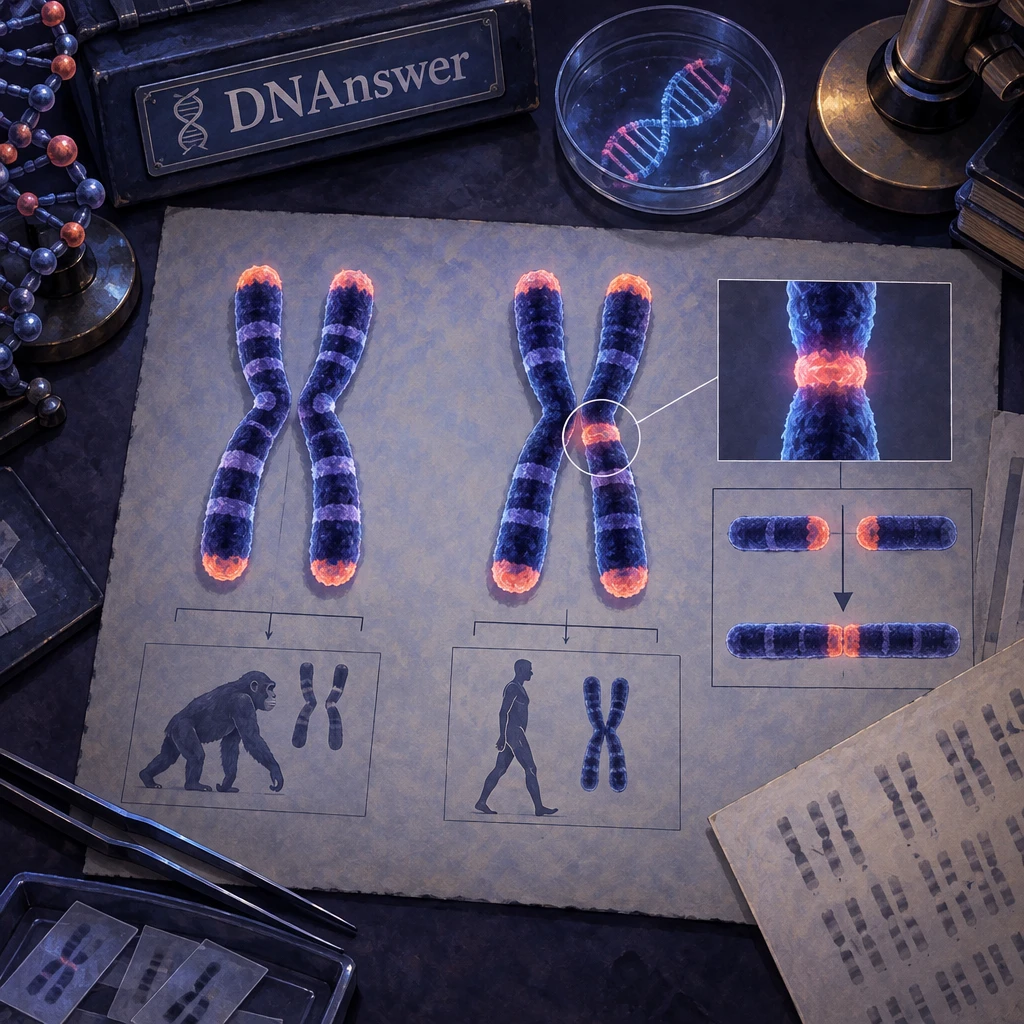
Telomeres are repeating DNA caps at the ends of chromosomes. They work like the plastic tips on shoelaces and keep the ends from fraying or sticking to other chromosomes. In the human telomere, the repeat is TTAGGG.
A telomere belongs at an end. On chromosome 2, near a spot called 2q13, there are telomere-like repeats in the middle of the chromosome, far from either end. They face head to head, exactly as you would expect if two chromosome ends had been joined. A team led by J.W. IJdo reported this in a 1991 paper in Proceedings of the National Academy of Sciences, which described the site as the relic of an ancient telomere-to-telomere fusion.
Clue two: a dead second centromere
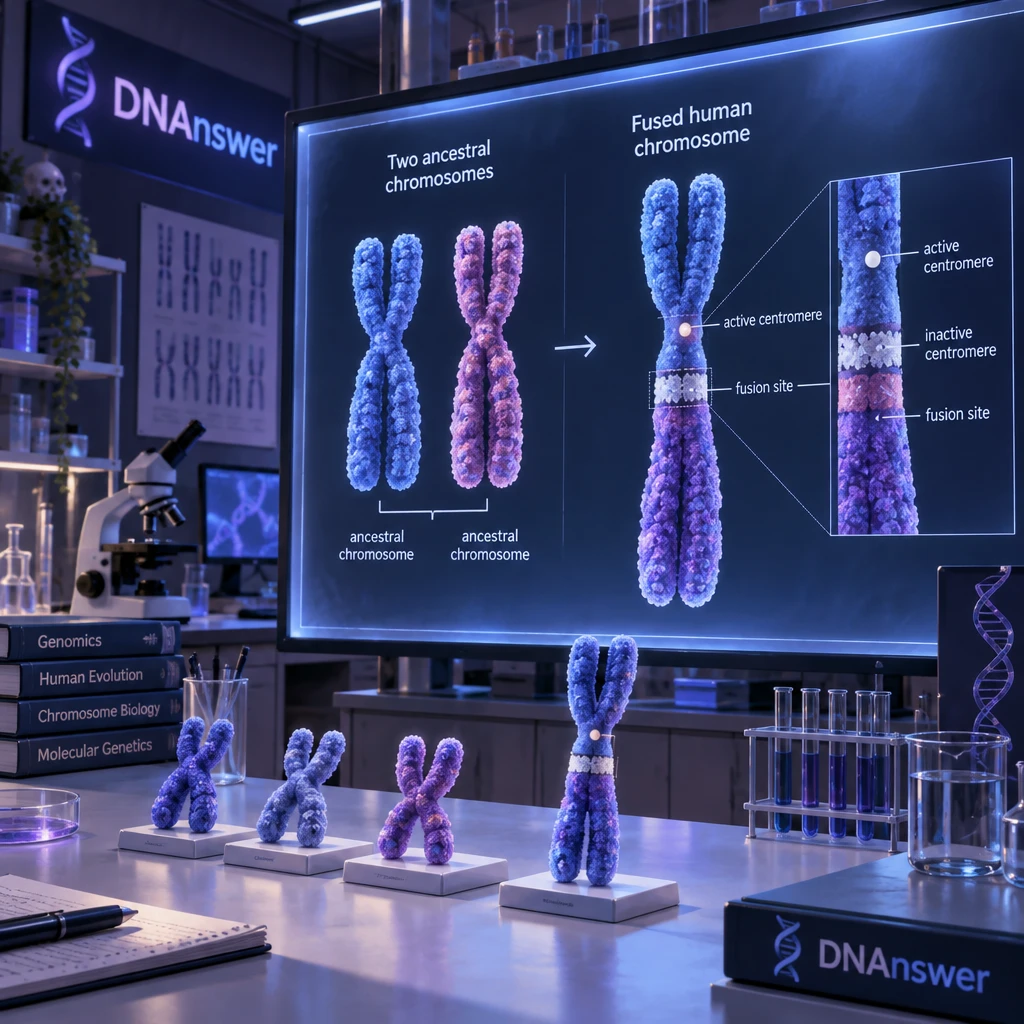
A centromere is the pinch point of a chromosome. When a cell divides, protein machinery grabs the centromere and pulls copies of the chromosome apart. Each normal chromosome has one.
Human chromosome 2 carries remnants of a second centromere, in the region called q21.3–q22.1. It no longer works. A chromosome with two active centromeres can get pulled in two directions during cell division and break. So after the fusion, one centromere went silent and slowly decayed.
Clue three: matching patterns
Stain chromosomes with dye and each shows a pattern of stripes, called banding. Human chromosome 2 matches the stripe patterns of two separate chimp chromosomes, 2a and 2b. Microscopists spotted this decades before DNA sequencing existed.
What about the critics?
Some critics argue that the fusion site sits inside a gene called DDX11L2 and so cannot be a leftover scar. That is a fair-sounding point, but it does not overturn the evidence. DNA that was once junk can later pick up a job, and the head-to-head telomere repeats, the dead centromere and the chimp match still need an explanation. Fusion explains all three.
The scar was also not a clean one. Recent genome assemblies show that the fusion region is full of repeated segments, and that some of the "telomere" sequence was already degraded when the fusion occurred. Even a messy scar is still a scar.
Humans normally have 23 pairs of chromosomes, while all other living members of the great ape family have 24 pairs. — Wikipedia's chromosome 2 entry, summarizing the genomic evidence
Myth 4: "All Apes and Monkeys Have 48 Chromosomes"
Many people carry one number for "primates" in their head. It is easy to see why: the great apes (chimpanzees, bonobos, gorillas and orangutans) all land on 48, so the number feels universal.
It is not. Monkeys vary widely. Here is a rough guide, with counts as typically reported:
- Humans: 46 (23 pairs)
- Chimpanzees, bonobos, gorillas, orangutans: 48 (24 pairs)
- Rhesus macaques: 42
- Dogs: 78
- Horses: 64
- Donkeys: 62
The 48 figure belongs to great apes only. Rhesus macaques, the monkeys often used in medical research, carry 42. Other monkeys range lower and higher.
Neanderthals and Denisovans, our extinct close relatives, most likely had 23 pairs like us. Sequencing supports that, which means the fusion happened before our lineages split.
So when someone says "apes have 48," the right reply is "great apes do." Monkeys follow no single number.
Myth 5: "A Person With 48 Chromosomes Would Be Ape-Like"
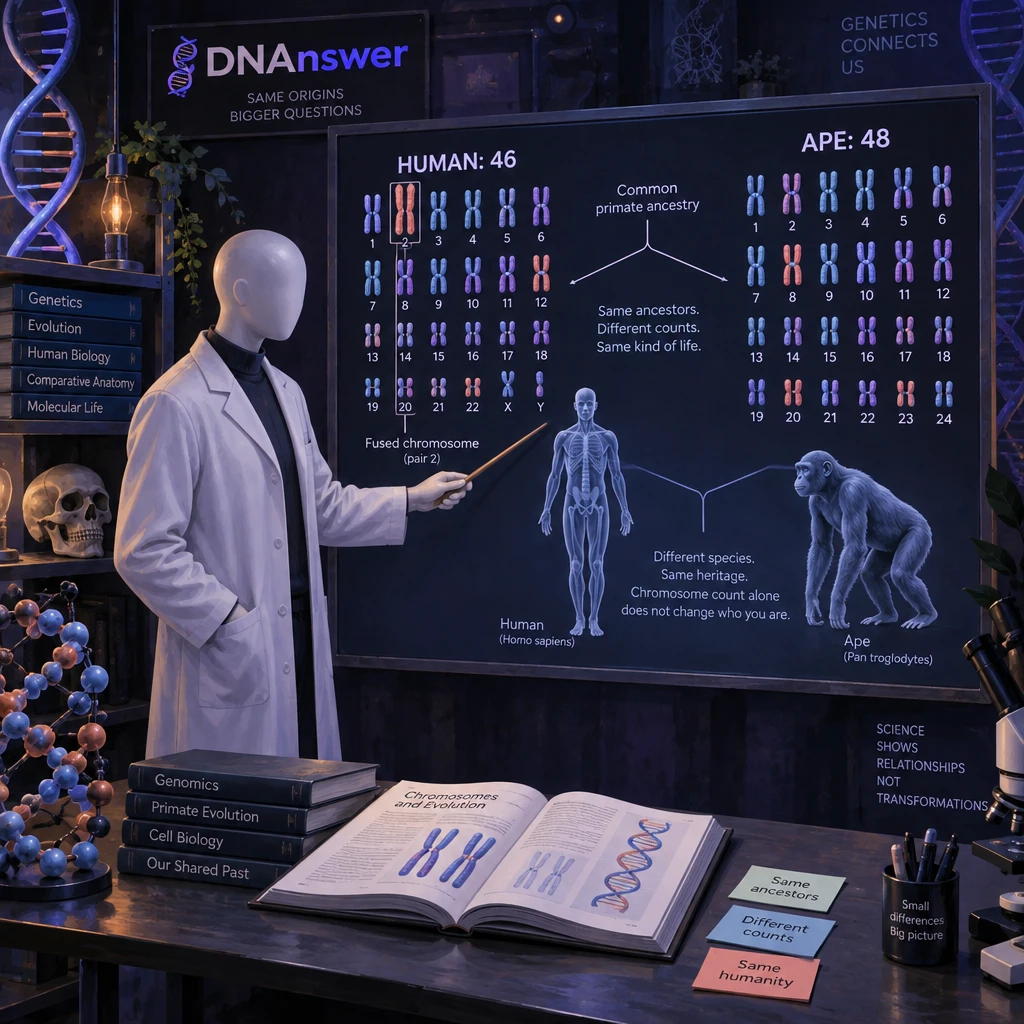
This one comes from a clever-sounding question: if apes have 48, what would a human with 48 look like? The belief rests on a real kernel. Chromosome count does separate us from apes on paper, so adding two back seems like a step toward them.
Biology does not work that way. The chromosomes you would add are not the ancestral 2a and 2b. They would be extra copies of ordinary human chromosomes, and extra copies usually cause medical conditions.
The best-known example is Down syndrome. People with it have 47 chromosomes, because they carry three copies of chromosome 21 instead of two. The medical term for having the wrong number of chromosomes is aneuploidy. It brings developmental and health effects, not ape traits. Other examples include trisomy 18 and trisomy 13, which are usually more severe.
Has a human ever had 48 chromosomes? Cells can carry 48 in rare cases, usually from extra copies of one or more chromosomes, but this is a medical situation, not a throwback. Those extra chromosomes are human ones.
If you or a relative has a karyotype result (a picture of all your chromosomes lined up in pairs) showing an unusual number, talk to a genetic counselor. They can explain what it means for health in plain terms.
Myth 6: "A Fusion Like This Would Have Caused Infertility or Inbreeding"
Here is the strongest objection, and it deserves a straight answer. If one early human had 46 chromosomes while everyone else had 48, who could that person have children with? Wouldn't the mismatch make offspring sterile, or force relatives to mate?
The worry has a real basis. Mismatched chromosome numbers often do cause problems. Horses have 64 chromosomes and donkeys have 62. Their offspring, the mule, usually cannot have children, because the chromosomes cannot pair up neatly when egg and sperm cells form.
Why a fusion can slip through
A fusion is gentler than a mismatch between species. A person carrying one fused chromosome 2 and one unfused pair still has all the same genes. During egg and sperm formation, the fused chromosome can pair with its two separate partners in a three-way arrangement. Many carriers of this kind of rearrangement in modern humans, called Robertsonian translocations, are healthy. Their fertility can be somewhat reduced, because some eggs or sperm get an unbalanced share of the chromosomes. But it is not zero.
Some people today carry a fused chromosome and are otherwise normal. That shows a carrier can live a healthy life and have children.
Did early humans have to inbreed?
Not necessarily. The fusion did not appear in one lone individual who then needed a partner like himself. A carrier could pair with someone without the fusion, and some of their children would inherit it. If the arrangement caused little harm, it could drift through a small population over many generations. Chance alone can spread a harmless variant, and a small group makes that easier.
Researchers still debate exactly when and how the fusion became standard. A 2025 genomics study in a peer-reviewed journal tied the fusion site to patterns of shared ancestry during early African great ape speciation. In plain terms, the fusion was likely not a single clean event but part of a long, messy split between lineages.
What about odd numbers?
Some readers ask why humans have an "odd" number. We don't. Your cells hold 46, an even number. What is odd is 23, the number in a sperm or egg cell alone. Nothing in biology requires that half-count to be even.
Can humans and chimpanzees have offspring?
No documented case exists. The fusion alone does not guarantee sterility, but the two species also differ in many genes, in how their chromosomes are arranged, and in the timing of reproduction. Think of the count difference as one barrier among several.
Why the Fusion Matters Beyond Trivia
Chromosome 2 is not just a curiosity. It is the second-largest human chromosome and holds many genes, including the HOXD cluster, a group of genes that helps lay out your body plan as an embryo grows, including your limbs. Those genes sit on a chromosome that was built by fusion, and they work fine.
The fusion also shows how evolution tests ideas. Scientists predicted that if humans descended from an ancestor with 48 chromosomes, a fusion scar should exist in our DNA. They looked, and in 1991 they found it. A prediction that could have failed instead held up. That is how a hypothesis earns trust.
If you want to test your own grasp of chromosomes, DNAnswer has free genetics quizzes where you can earn XP and climb the leaderboard.
Conclusion
Use the chromosome 2 story as a check on your own reasoning. When a number looks like a loss, ask what was packed together. When a claim sounds too neat, ask what evidence would settle it. Next time someone says "apes have 48 and we have 46, so something's missing," you can answer: nothing is missing, two chromosomes became one, and the proof sits in the middle of chromosome 2.
Frequently Asked Questions
How many chromosomes do humans have?
Humans normally have 46 chromosomes, arranged in 23 pairs. You inherit one set of 23 from each parent. Of those 46, two are sex chromosomes: XX in most females and XY in most males.
Why do humans have 46 chromosomes while apes have 48?
Two ancestral ape chromosomes fused end to end in the human lineage, forming chromosome 2. Chimpanzees, gorillas and orangutans kept the two chromosomes separate. The fusion left behind telomere repeats in the middle of chromosome 2 and a dead second centromere.
Has a human ever had 48 chromosomes?
Yes, but only through extra copies of ordinary human chromosomes, which causes a medical condition rather than ape-like traits. Down syndrome, with 47 chromosomes, is the best-known example of the wrong chromosome number in humans.
How many chromosomes do chimpanzees, gorillas and monkeys have?
Chimpanzees, bonobos, gorillas and orangutans each have 48. Monkeys vary: rhesus macaques, for instance, have 42. The 48 figure applies to great apes, not to all primates.