Define Recessive Biology: Alleles and Traits
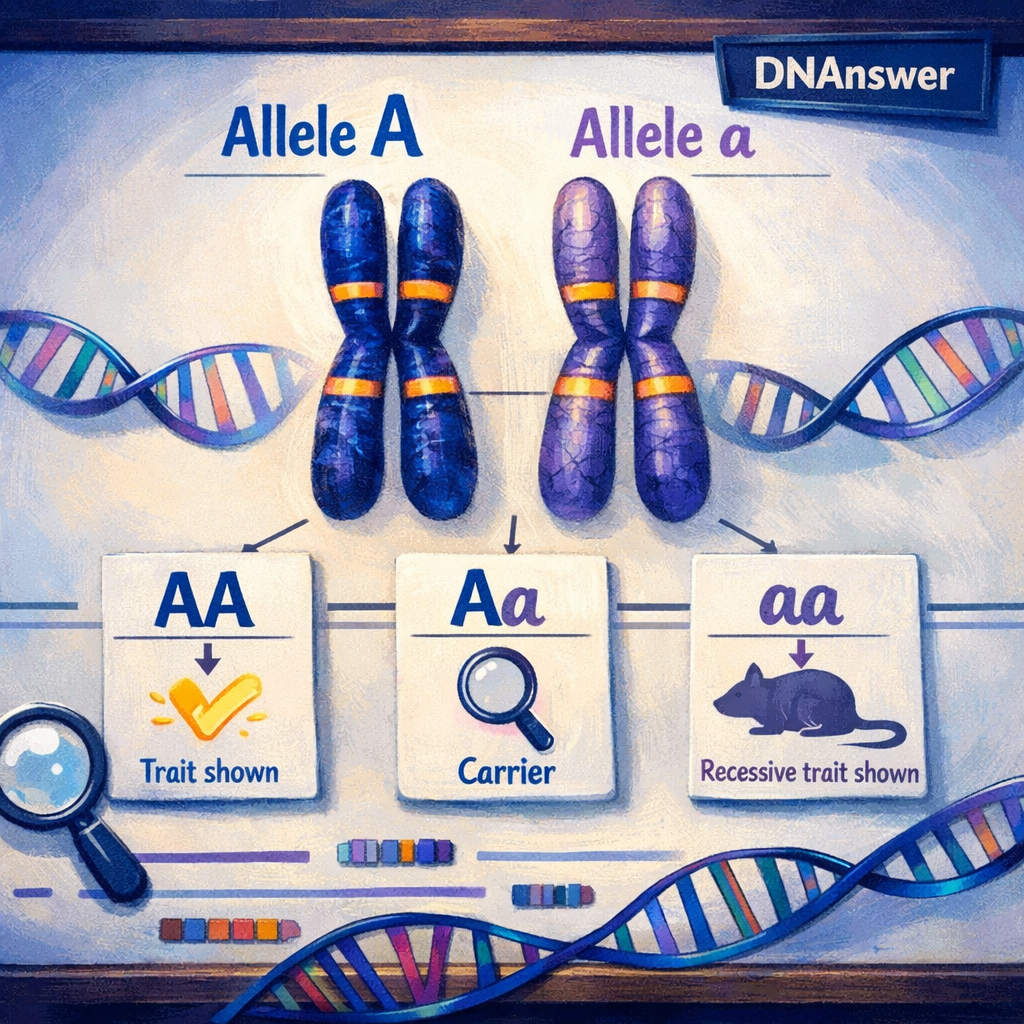
You probably learned it wrong. If you were taught that "recessive" means weak, faded, or on its way out of the gene pool, you learned a version of genetics that biology dropped decades ago. To define recessive biology accurately, you have to separate two things people mix up constantly: how strong a trait is, and how it gets inherited.
Recessive is a rule about pairing, not a description of power. It just means a trait shows up only when both copies of a gene match. That single fact changes how you think about family traits, genetic testing results, and disorders like cystic fibrosis that seem to "appear out of nowhere."
Key Takeaways
- Recessive means masked, not weak — it's about allele pairing, not trait strength.
- Many recessive traits are common; blue eyes and red hair are recessive, not rare.
- Carriers (heterozygotes) can pass a recessive allele silently for generations.
- Both parents must contribute a recessive allele for a child to show the recessive trait.
- Incomplete dominance and codominance are different mechanisms, not "partial recessiveness."
- A Punnett square predicts probability, not guaranteed outcomes for any single child.
Myth: Recessive Means the Trait Is Weak
Recessive doesn't mean weak. It means a version of a gene, called an allele, only shows up in a person's observable traits (their phenotype) when there's no dominant allele around to override it. Strength has nothing to do with it — this is about chemistry, not competition.
Here's where the confusion starts. In everyday English, "recessive" sounds like "receding" — shrinking back, losing ground. People hear it and picture a trait fading away, overpowered by something tougher. That's a reasonable guess based on the word alone. It's just not how genetics works.
A gene is a stretch of DNA that codes for a specific trait — eye color, blood type, earlobe shape. Each person carries two copies of most genes, one from each parent, called alleles. When the two alleles are identical, you're homozygous for that gene. When they're different, you're heterozygous.
Dominant and recessive describe what happens inside a heterozygous pairing. A dominant allele produces a protein that gets expressed even with just one copy. A recessive allele's effect only shows up when there's no dominant allele to mask it — meaning both copies have to be the recessive version.
Think about the enzyme that breaks down phenylalanine, an amino acid found in protein-rich foods and diet soda. People with two working copies of the gene process it fine. People with two non-working (recessive) copies develop phenylketonuria, a metabolic disorder detected in newborn screening across every U.S. state. The recessive allele isn't "weaker" biochemically — it just fails to produce a working enzyme, and one working copy from the other parent is enough to cover for it.
So "recessive" describes a pattern of expression, not a measure of biological force. A recessive allele can code for something completely inert, something harmful, or something totally neutral, like the trait for attached earlobes.
Once you separate "recessive" from "weak," a lot of confusing biology starts making sense — including why so-called weak traits show up in millions of people.
Myth: Recessive Traits Are Always Rare
Recessive doesn't mean rare, either. It's easy to assume that because a trait needs two matching alleles, it must be uncommon. But how often a recessive trait shows up depends entirely on how often that allele exists in the population — not on the dominant/recessive rule itself.
This myth persists because the recessive disorders people hear about most — cystic fibrosis, sickle cell anemia, Tay-Sachs disease — are genuinely rare in the general population. Cystic fibrosis affects roughly 1 in 2,500 to 3,500 births among people of European descent in the U.S., according to the Cystic Fibrosis Foundation. That number sticks in people's heads, and it gets generalized into "recessive = rare."
But look at ordinary human traits, and the pattern falls apart fast.
Common Recessive Traits Hiding in Plain Sight
Blue eyes are recessive. So is red hair. Attached earlobes, the inability to roll your tongue in certain family lines, and straight hair versus curly (in some inheritance patterns) all follow recessive rules — and none of them are rare. In parts of Northern Europe, blue eyes show up in a majority of the population, not a minority.
The reason is simple: allele frequency and dominance are separate variables. If a recessive allele happens to be common in a gene pool, the recessive trait will be common too, regardless of the fact that it's "masked" in heterozygotes. Rarity comes from population genetics — mutation rates, geography, founder effects — not from the dominant/recessive labeling itself.
Why the Confusion Costs You Something Real
Getting this wrong matters beyond trivia. If you assume "recessive" automatically means "rare," you might dismiss the odds of a genetic condition running in your family, or misread a genetic counselor's explanation of carrier frequency. Recessive just describes the mechanism of masking. Frequency is a completely different question, answered by looking at real population data, not by the dominant/recessive label alone.
Myth: A Recessive Trait Disappears From the Gene Pool
A recessive trait doesn't disappear just because it stops showing up for a generation or two. It goes quiet, not extinct. The allele keeps circulating in the population through carriers — people who are heterozygous, holding one recessive allele alongside one dominant allele, showing no sign of the recessive trait at all.
People believe this myth because it seems logical on the surface. If a recessive trait needs two matching alleles to appear, and most people in a population are heterozygous carriers, shouldn't the trait get rarer and rarer each generation until it vanishes? This was actually a real puzzle in early genetics, sometimes called "the problem of blending inheritance" before Gregor Mendel's pea plant experiments in the 1860s sorted it out.
Mendel's work — and the math that followed it, formalized as the Hardy-Weinberg principle in 1908 — showed that without selection pressure, mutation, or genetic drift acting on a gene, allele frequencies in a population stay stable generation after generation. A recessive allele doesn't get diluted or worn down by being paired with a dominant one. It just sits there, fully intact, waiting for another recessive allele to pair up with.
A crisp way biology textbooks define this: "Recessive alleles are not lost from a population; they persist in heterozygous carriers and can reappear in homozygous offspring for many generations."
This is exactly how autosomal recessive disorders work. Autosomal means the gene sits on one of the 22 non-sex chromosomes, so the disorder isn't linked to being male or female. Cystic fibrosis, sickle cell anemia, and Tay-Sachs disease are all autosomal recessive. Two carrier parents — neither one showing any symptoms — can have a child who inherits the recessive allele from both sides and develops the full disorder. That's why genetic counselors ask about family history going back multiple generations, not just parents and siblings.
Sickle cell trait offers a particularly striking case. Carriers (heterozygous for the sickle cell allele) actually have some resistance to malaria, which is one reason the allele has stayed common in populations from malaria-prone regions, including parts of Sub-Saharan Africa and, by extension, many Black Americans whose ancestry traces there. The trait didn't fade out. It's been maintained by a selective advantage for the carrier state, hiding for generations until two carriers have a child together.
Myth: Recessive Is the Same Thing as Incomplete Dominance
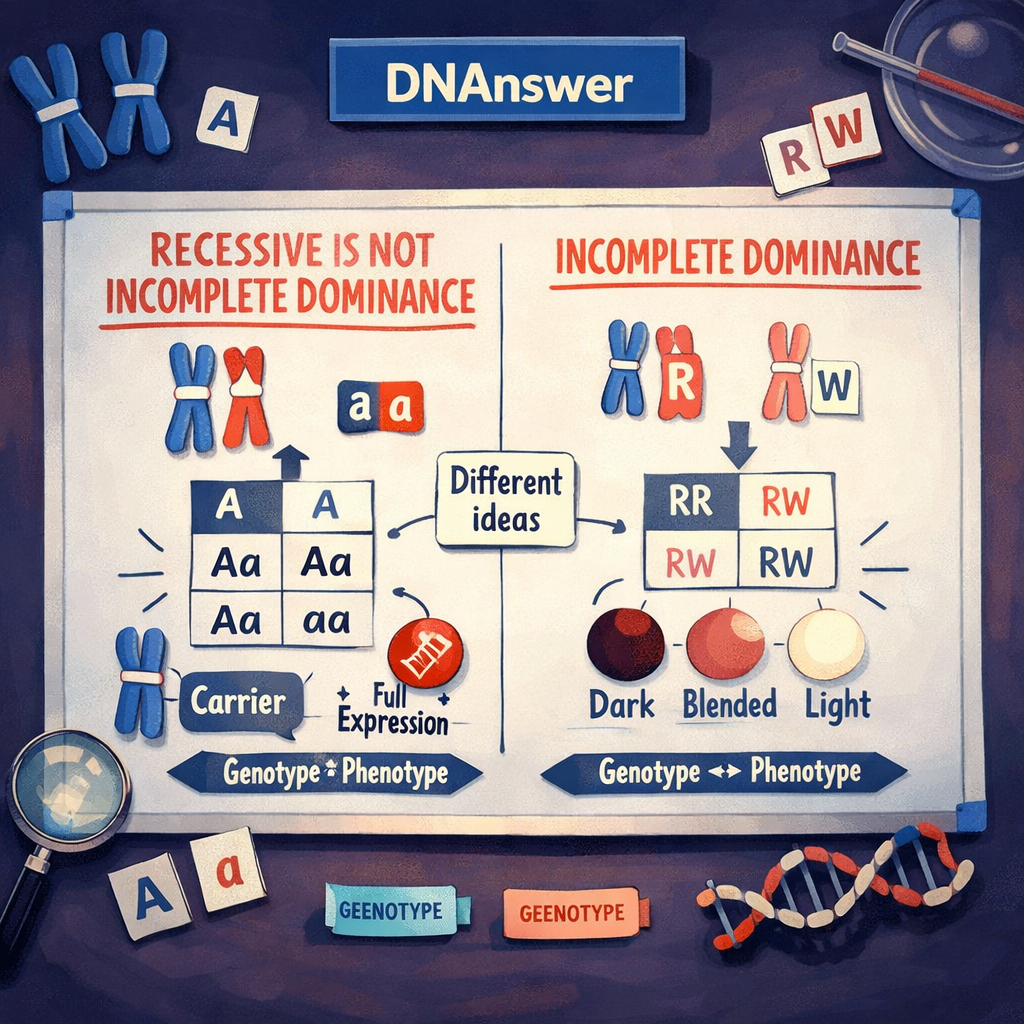
Recessive inheritance and incomplete dominance are two different mechanisms, and mixing them up leads to real misunderstandings about how traits blend — or don't. Recessive means one allele is fully masked. Incomplete dominance means neither allele fully wins, and the result is a blend somewhere in between.
People conflate these because both involve "not fully dominant" outcomes, and most biology classes rush through them in the same 15-minute stretch. If a heterozygous pea plant produces something that looks partway between its two parents' traits, it's tempting to call that "a mild recessive effect." It isn't — it's a different genetic rule entirely.
What Actually Happens in Incomplete Dominance
The textbook example is snapdragon flower color. Cross a red-flowered snapdragon with a white-flowered one, and the offspring aren't red or white — they're pink. Neither allele masks the other. Instead, the heterozygous genotype produces a visibly intermediate phenotype because there's only enough pigment-producing protein made to create a partial color, not a full red.
Compare that to true recessive inheritance, where a heterozygous person with one allele for attached earlobes and one for free earlobes doesn't end up with "medium" earlobes. They have free earlobes, full stop, because the dominant allele's protein output is enough to produce the complete dominant trait on its own.
Where Codominance Fits In
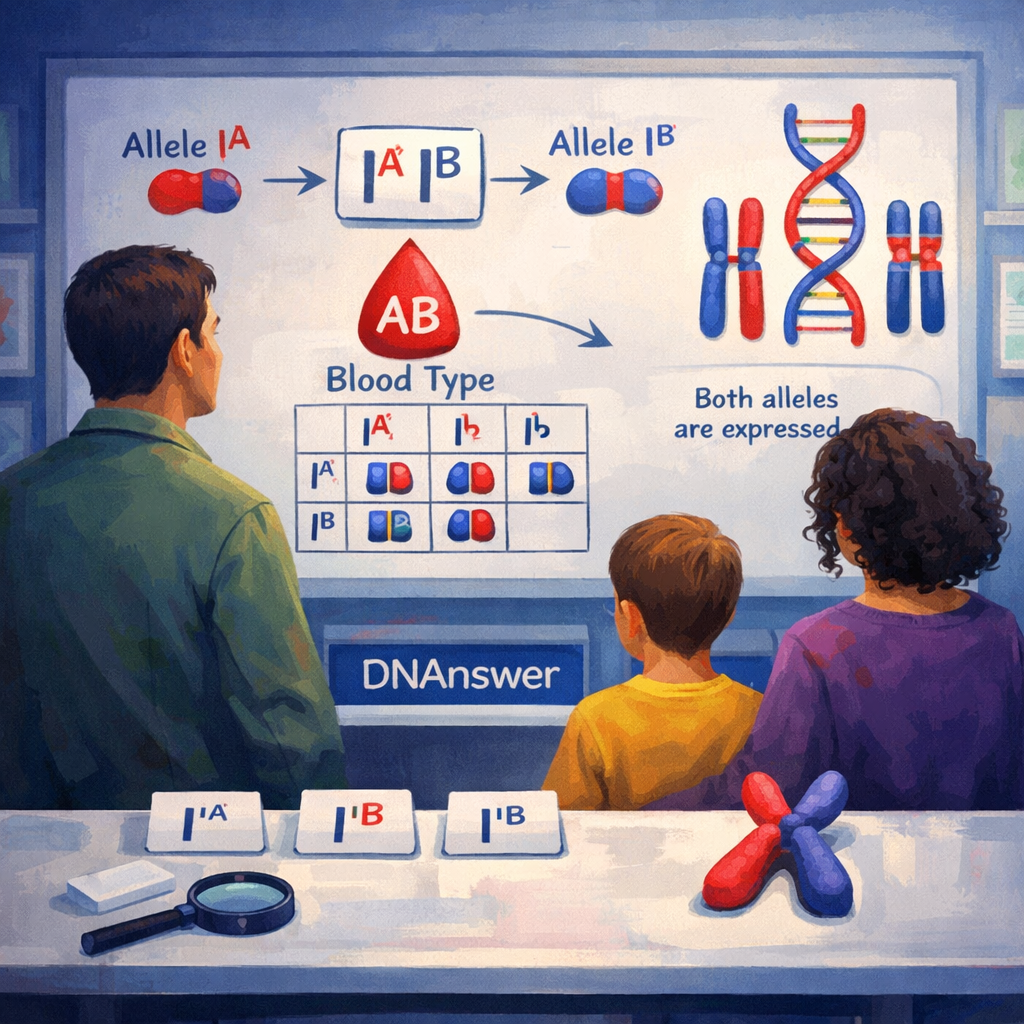
Codominance is a third, separate pattern, and human ABO blood type is the classic case. Someone with one A allele and one B allele doesn't show a blend — they show both traits fully and simultaneously, producing type AB blood with both A and B antigens present on their red blood cells. Nothing masks anything, and nothing blends. Both alleles get expressed at full strength, side by side.
Here's a clean way to keep all three straight:
- Recessive/dominant: one allele's effect is completely hidden by the other in heterozygotes (attached vs. free earlobes).
- Incomplete dominance: heterozygotes show a blended, intermediate trait (red x white snapdragon = pink).
- Codominance: heterozygotes show both traits fully and separately, with nothing blended or hidden (AB blood type).
- Polygenic traits (a related but distinct concept): multiple genes combine to produce a range of outcomes, like human height or skin tone, rather than one gene following a strict dominant/recessive rule.
Confusing these mechanisms leads people to wrongly predict how a trait will show up in kids — assuming a "50/50 blend" when the real answer is full masking, or assuming full masking when the real biology produces a blend. Knowing which mechanism you're dealing with changes what you'd actually predict on paper.
Myth: Only One Parent Needs to Carry the Recessive Allele
A recessive disorder can't be passed to a child unless both parents contribute a recessive allele. One carrier parent alone cannot produce an affected child — the math doesn't work, no matter how strongly the trait runs in that parent's family.
This myth shows up constantly in family conversations. Someone says, "My grandfather had cystic fibrosis, so my kids are at risk," without accounting for the other parent's genetics at all. It feels intuitive because the family history is real and the worry is genuine. But recessive inheritance is fundamentally a two-parent equation.
Reading a Punnett Square Correctly
A Punnett square is a simple grid geneticists use to predict the possible allele combinations offspring can inherit from two parents. Label the recessive allele lowercase (say, "c" for the cystic fibrosis allele) and the dominant, working allele uppercase ("C"). If both parents are carriers — genotype Cc — the grid produces four equally likely combinations for any given child: CC, Cc, Cc, and cc.
That means each child of two carrier parents has a 25% chance of being homozygous recessive (cc) and actually having the disorder, a 50% chance of being a carrier like their parents (Cc, unaffected but able to pass the allele on), and a 25% chance of inheriting two dominant alleles (CC) with no recessive allele at all. Notice something important: even in the highest-risk pairing possible — two known carriers — there's still a 75% chance any individual child won't have the disorder.
Now flip the scenario. If only one parent carries the recessive allele (Cc) and the other parent has two dominant alleles (CC), no child from that couple can ever be homozygous recessive. The math simply doesn't allow it. Every child gets at least one dominant allele from the CC parent, guaranteeing the dominant trait shows up, even though half the kids will be silent carriers themselves.
Why Genetic Counselors Ask About Both Sides of the Family
This is exactly why carrier screening for conditions like cystic fibrosis or Tay-Sachs disease tests both prospective parents, not just one. A single carrier parent poses no risk of an affected child on their own. Risk only enters the picture when both partners carry the same recessive allele, which is why genetic counseling and prenatal panels focus on couples rather than individuals.
If you've ever taken a consumer DNA test and seen "carrier status" listed for a handful of recessive conditions, this is exactly what that reflects — one allele, no symptoms, but a fact worth knowing before you're planning a family with someone who might carry the same one. Apps and quiz-based platforms like dnanswer.app cover exactly this kind of scenario with interactive Punnett square exercises, which is a genuinely useful way to see the 25/50/25 split play out with different starting genotypes instead of just memorizing the ratio.
What "Recessive" Actually Predicts About Your Genes
Recessive inheritance predicts probability, not certainty, for any individual person. It tells you the rules of the pairing game — but which specific cards get dealt to which specific child is still down to chance, reshuffled at every conception.
This distinction trips people up when they get genetic test results back. Seeing "carrier" next to a gene name on a report can feel alarming, as if something is wrong. In reality, most people carry several recessive alleles for various conditions without any effect on their own health whatsoever, because a single dominant allele from the other parent covers for it.
The Difference Between Genotype and Phenotype
Genotype is the actual genetic makeup — which two alleles a person carries for a given gene. Phenotype is what you can actually observe — eye color, an enzyme working or not working, a disorder present or absent. Recessive rules govern how genotype translates into phenotype. Two people can share the exact same phenotype (brown eyes, no cystic fibrosis) while having completely different genotypes (one homozygous dominant, one heterozygous carrier) — and you'd never know the difference without a genetic test.
Mendelian Inheritance Beyond Peas
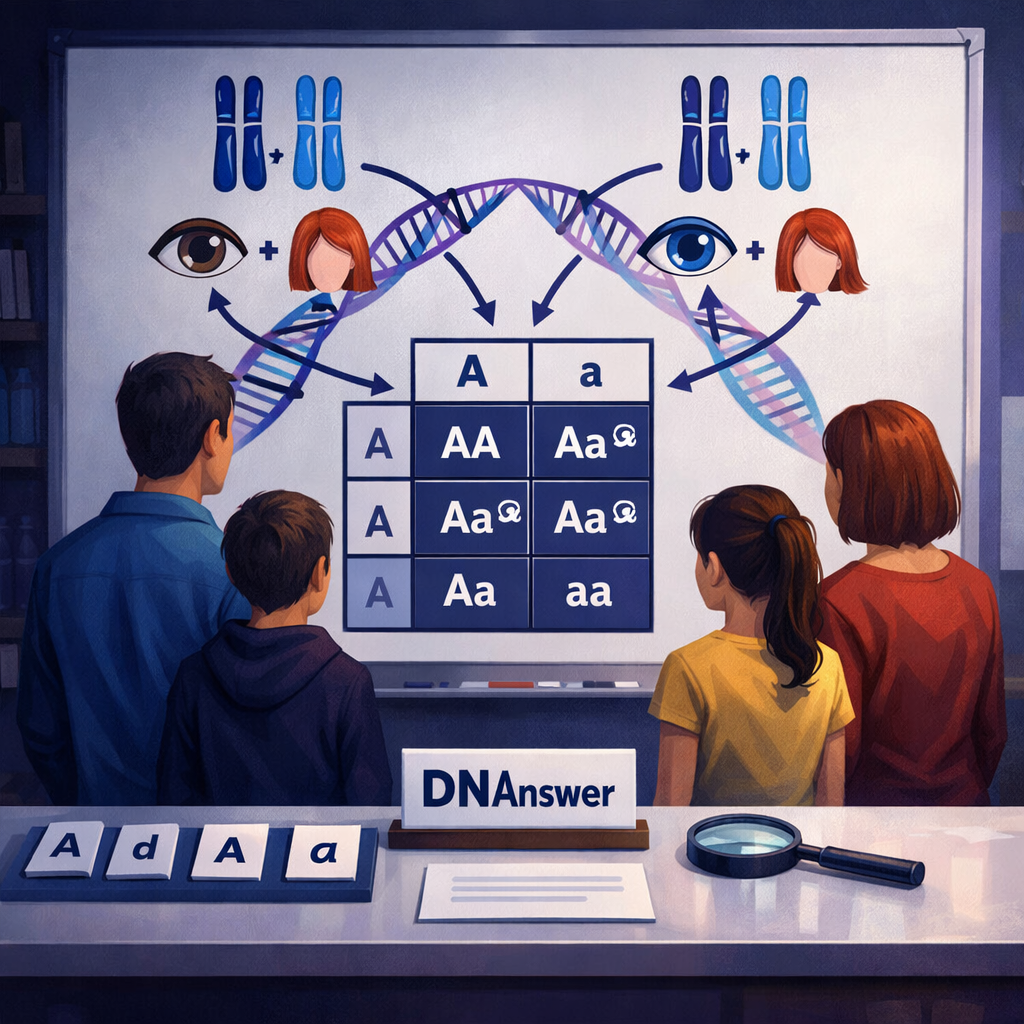
Gregor Mendel worked out these ratios using pea plants — testing traits like seed shape and flower color, without any knowledge of DNA, chromosomes, or molecular biology. His 3:1 ratios in the second generation of a cross became the foundation for what's now called Mendelian inheritance: traits controlled by a single gene with clear dominant and recessive versions.
Not every human trait follows Mendel's simple rules. Height, skin tone, and most behavioral traits are polygenic, controlled by dozens or hundreds of genes plus environmental input, producing a spectrum rather than a clean either/or outcome. But single-gene traits — including most of the classic recessive disorders and plenty of harmless family features — still follow Mendel's original math almost exactly, more than 150 years after he worked it out with pea plants in a monastery garden.
Conclusion
Once you define recessive biology correctly — a rule about masking, not weakness or rarity — family trait patterns stop looking random. Check both sides of a family tree before assuming risk, and treat a "carrier" result on a DNA test as useful information, not a diagnosis. The allele was always there. Now you know where to look for it.
Frequently Asked Questions
Does recessive mean a trait is more likely to disappear over time?
No. Without selection pressure or genetic drift, recessive alleles stay in a population at stable frequencies for generations, hiding in carriers even when the trait itself doesn't show up in every family line.
Can two parents without a genetic disorder have a child with that disorder?
Yes, if both parents are unaffected carriers (heterozygous) for the same recessive allele. Each child then has a 25% chance of inheriting two copies and showing the disorder, per standard Punnett square math.
Is a recessive trait always inherited from just one parent?
No. A person needs a recessive allele from both parents to show a recessive trait or disorder. One recessive allele from a single parent, paired with a dominant allele from the other, gets masked completely.
What's the difference between recessive and incomplete dominance in simple terms?
Recessive traits get fully hidden by a dominant allele in a heterozygote. Incomplete dominance produces a visible blend of both traits instead, like pink flowers from red and white parent plants.