RNA Splicing: Your Cells Edit Their Own Instructions Before Using Them
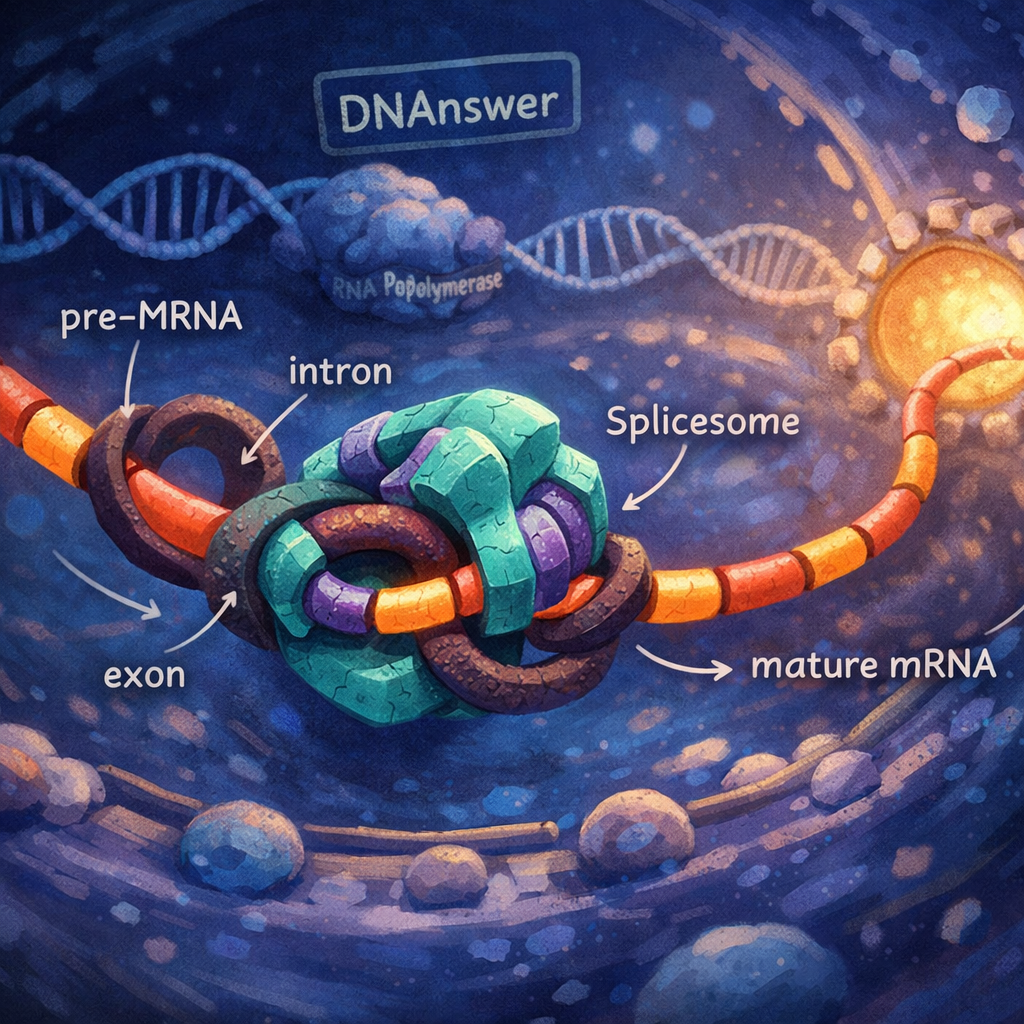
Your DNA doesn't decide which protein your cells make. Not by itself, anyway. Every gene gets copied into a rough-draft message first, and that draft goes through RNA splicing — an editing process that cuts out chunks and stitches the rest together — before your cell ever reads it. Most people never learn this step exists, which is exactly why so many myths about it stick around.
That gap in public understanding matters. If you think your genetic code is one gene, one fixed protein, one story, you miss where a huge share of hereditary disease actually starts. RNA splicing isn't a footnote to genetics. It's a second decision point where things can go right or catastrophically wrong, independent of the DNA sequence itself.
Key Takeaways
- RNA splicing edits a temporary RNA copy, never your actual DNA
- Introns aren't junk — many regulate genes or make new proteins possible
- Splicing is mandatory for nearly every human gene, not an optional extra
- One gene can produce dozens of different proteins through alternative splicing
- Splicing errors cause disease as often as DNA mutations do, maybe more
- CRISPR edits DNA permanently; splicing edits RNA temporarily, every single time
Myth: Splicing Edits Your DNA, Not a Disposable Copy
This is the biggest misconception, and it's an honest one. People hear "genetic editing" and assume it means DNA, because DNA is the word we've all absorbed as the genetic material. But RNA splicing never touches your DNA. It works exclusively on pre-mRNA, a temporary RNA copy of a gene that gets built, edited, used, and then broken down, often within hours.
Here's the actual sequence. Your DNA sits protected inside the cell's nucleus, holding the master blueprint. When a gene needs to be active, an enzyme called RNA polymerase reads that DNA and transcribes it into pre-mRNA — a molecule that mirrors the gene's sequence but is chemically distinct and disposable. Splicing acts on this copy, removing sections and joining the remainder into a finished messenger RNA (mRNA), which then leaves the nucleus and gets translated into protein.
The DNA original stays completely untouched through this entire process. That's the whole point of using a copy: your genome can get read over and over, in different ways, in different cells, without ever risking damage to the one master template you inherited.
Why the Confusion Happens
Movies and news coverage often blur "genetic" language together. Headlines about gene therapy, gene editing, and RNA-based medicine get mentally filed under one folder: "science changes your genes." Splicing gets swept into that folder even though it's operating one level removed from the genome.
There's also a real mechanism that adds to the confusion: reverse transcriptase, an enzyme (used by some viruses, and by lab tools) that can copy RNA back into DNA. That process exists, but it's not splicing, and it doesn't happen during normal gene expression in your cells.
What This Means for You
Splicing is temporary and reversible by nature — a new pre-mRNA molecule gets made and reprocessed every time a gene switches on. Nothing about it is written permanently into your genome. If you take away one fact from this section, take this: your genetic risk from splicing comes from how your DNA tells the splicing machinery to behave, not from splicing altering the DNA itself.
Myth: Introns Are Junk DNA With No Real Job
People believe introns are useless leftover sequence, spliced out and thrown away like packaging material. The honest origin of this idea goes back decades, to when scientists first discovered that genes contain non-coding stretches and assumed, reasonably at the time, that anything not coding for protein must be evolutionary debris.
The term itself set up the myth. Introns (short for "intervening sequences") sit inside genes, interrupting the coding regions called exons ("expressed sequences"). Since introns get cut out and don't end up in the final protein-building message, it was easy to assume they don't do anything. For a while, "junk DNA" was even the accepted term in textbooks.
That assumption has aged badly. Introns often contain regulatory sequences that control when and how strongly a gene gets expressed. Some contain smaller functional RNA molecules that get produced as byproducts of splicing. And the boundaries between introns and exons — specific short sequences the spliceosome recognizes — are themselves a layer of information your cell depends on to splice correctly.
A gene is not simply a stretch of DNA that codes for one protein. It's a segmented instruction set where the non-coding intervening sequences (introns) can carry regulatory signals essential to how, when, and where the gene gets expressed.
The Kernel of Truth Worth Keeping
Not every base pair inside an intron is doing something important. Large stretches probably are close to inert, and mutations there often have no detectable effect. The mistake isn't noticing that introns are less constrained than exons — it's assuming less constrained means worthless.
Why It Actually Matters to You
Introns make alternative splicing possible in the first place. Without intervening sequences to cut and rearrange, your cells would be stuck making one rigid protein per gene, with none of the flexibility that lets a single gene serve multiple jobs in different tissues. The "junk" turned out to be part of the toolkit.
Myth: RNA Splicing and CRISPR Do the Same Kind of Editing
They don't, and the difference is about as big as it gets in molecular biology. CRISPR is a gene editing tool that changes the permanent DNA sequence in a cell — a deliberate, lab-directed intervention. RNA splicing is a natural, constant process every cell runs on its own, editing a temporary RNA message, not the genome.
The confusion is understandable given how both terms get used in casual science writing. Both involve "cutting." Both involve "editing." Both show up in headlines about gene therapy breakthroughs. If you only skim headlines, they can start to sound like variations of the same idea.
They're not close. CRISPR relies on a bacterial-derived enzyme (commonly Cas9) guided by a piece of RNA to find a specific DNA sequence and cut both strands, after which the cell's repair machinery makes a permanent change. That change gets copied into every future cell division. RNA splicing, on the other hand, uses a completely different machine called the spliceosome — a complex of small RNA molecules and proteins — to cut and rejoin RNA, and it happens fresh every single time a gene is transcribed. Nothing about it persists past the life of that RNA molecule.
Different Machines, Different Purposes
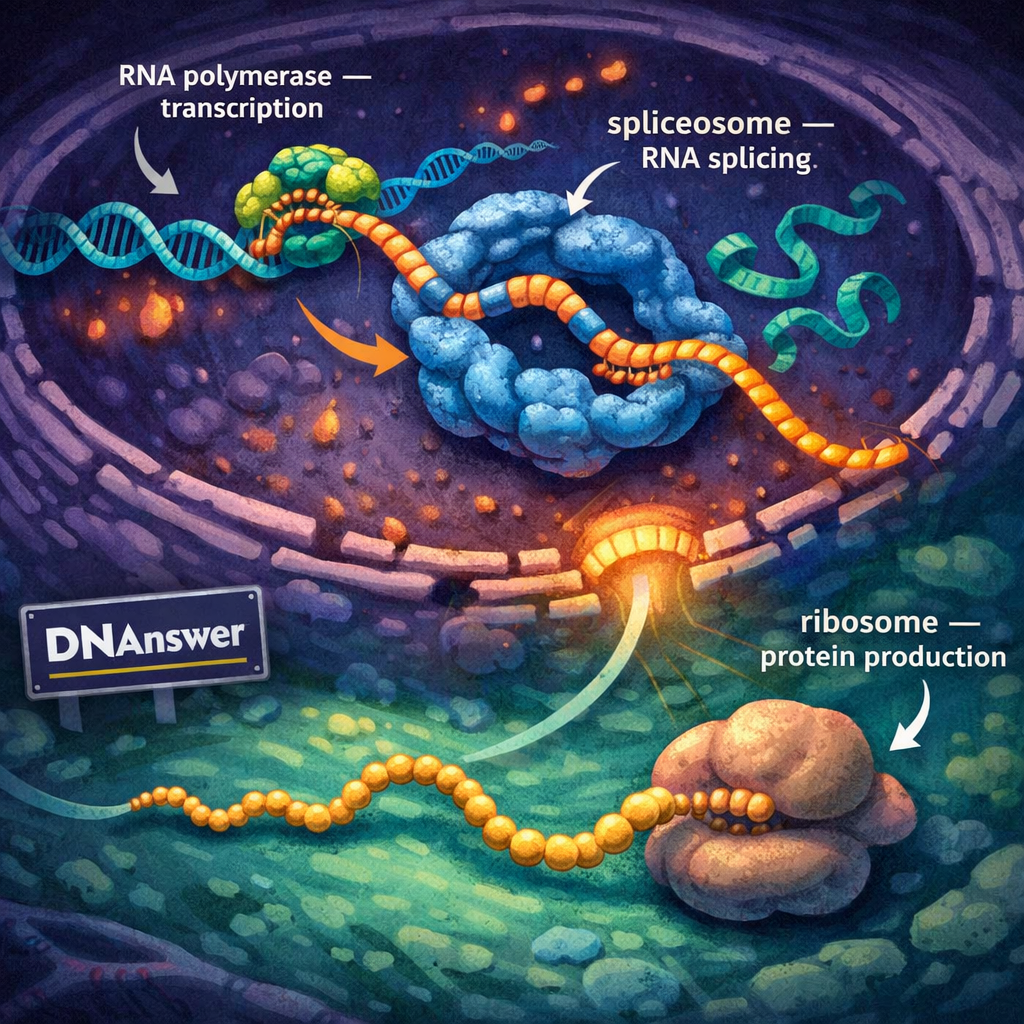
- CRISPR targets double-stranded DNA; the spliceosome targets single-stranded pre-mRNA.
- CRISPR is a human-designed lab and clinical tool; splicing is a built-in cellular process running in nearly every cell, all the time.
- CRISPR edits are permanent and heritable in future cells (or offspring, in germline editing); splicing edits reset with every new transcript.
- CRISPR uses a guide RNA plus an enzyme like Cas9; splicing uses small nuclear RNAs (snRNAs) bundled with proteins.
- CRISPR mistakes cause permanent mutations; splicing mistakes usually just produce a faulty, short-lived RNA that gets degraded.
The Practical Takeaway
If a headline says scientists "edited RNA splicing" to treat a disease, they usually mean they used a drug (often an antisense oligonucleotide, a short synthetic strand of genetic material that binds RNA and blocks or redirects splicing) to nudge the natural splicing process toward a healthier outcome. That's fundamentally different from rewriting the genome, and it's often reversible if the drug is stopped.
Myth: One Gene Always Makes One Protein
This one is probably the most consequential myth for understanding modern genetics, and it used to be taught as settled fact. The "one gene, one protein" idea (originally "one gene, one enzyme," proposed by geneticists George Beadle and Edward Tatum in the 1940s) was a genuine breakthrough for its time. It gave scientists a clean, testable model connecting genes to biological function.
The kernel of truth is real: many genes do produce one dominant protein, and the basic logic — gene leads to RNA leads to protein — is still the backbone of the central dogma of molecular biology. That framework isn't wrong. It's incomplete.
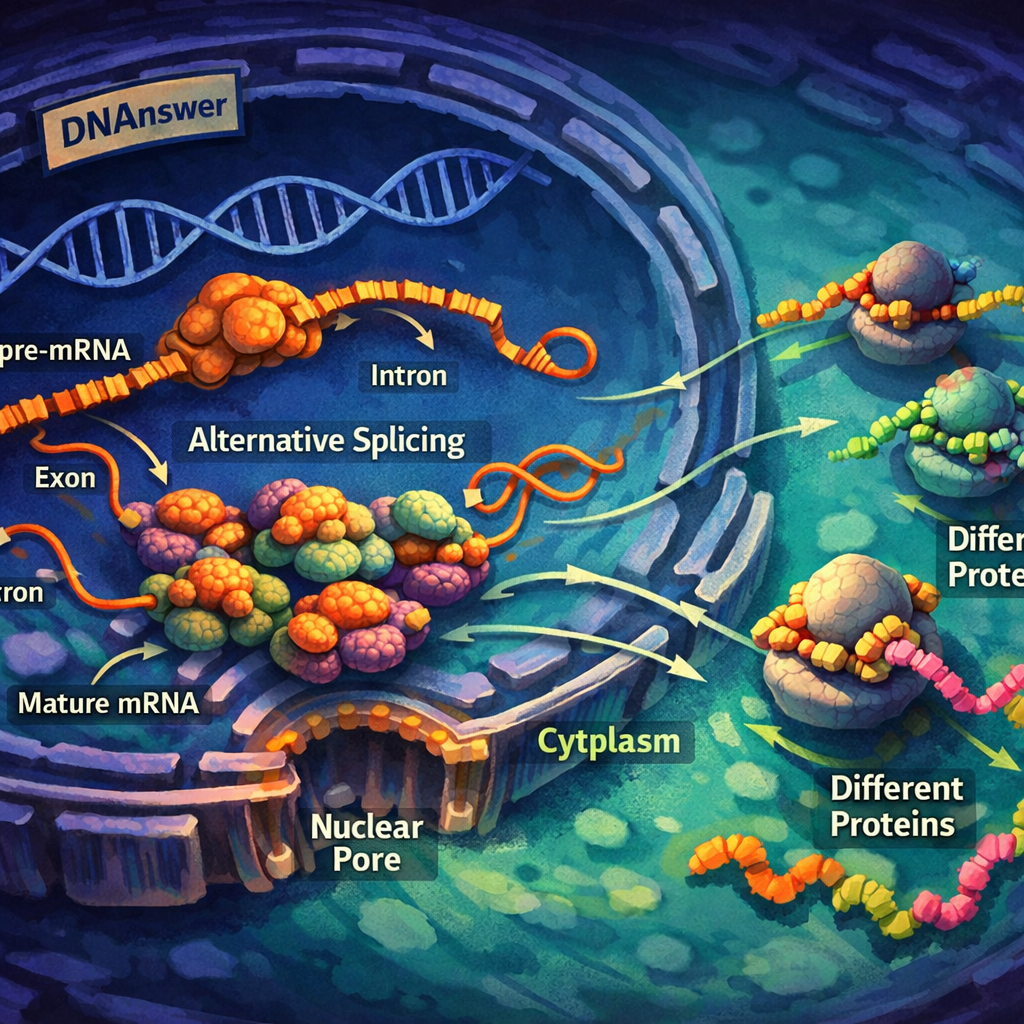
What actually happens is called alternative splicing: the same pre-mRNA can be cut and joined in multiple different ways, including or excluding different exons, to produce multiple distinct mature mRNAs from a single gene. Each version can code for a structurally different protein, sometimes with different functions entirely.
How Common Is This, Really?
Alternative splicing isn't a rare exception. Large-scale genome studies over the past two decades have estimated that the large majority of multi-exon human genes undergo some form of alternative splicing. That single mechanism helps explain a puzzle that stumped researchers after the Human Genome Project: humans have roughly 20,000 protein-coding genes, a number not wildly higher than far simpler organisms, yet human cells produce a much larger and more varied set of proteins.
What This Changes About How You Think About Genes
Stop picturing a gene as a fixed recipe for one dish. Picture it closer to a modular recipe card where certain ingredient lines can be swapped in or left out, depending on which tissue is cooking and what it needs that day. A gene expressed in your heart muscle can get spliced differently than the same gene expressed in your brain, producing tissue-specific protein versions tailored to local function. That flexibility is a feature, not a loophole.
Myth: Splicing Is Optional or Only Matters When Something Goes Wrong
Some people assume splicing is a rare edge case — something that only shows up when scientists talk about genetic disorders, rather than a routine step every cell performs constantly. That belief usually comes from how splicing gets introduced: almost always in the context of disease, never in the context of ordinary, everyday gene expression (the whole process of turning a gene's information into a functional product).
Here's the corrective fact, plainly: splicing is required for the expression of nearly every human gene that contains introns, and the vast majority of human genes do. Skipping this step isn't an option your cells have. Without a working spliceosome, most pre-mRNAs would never become usable messenger RNA at all, and the proteins they encode simply wouldn't get made.
The mechanics explain why it's mandatory rather than optional. The spliceosome has to recognize precise short sequences marking the start and end of each intron, cut at exact points, and rejoin exons with near-perfect accuracy. A single base pair thrown off at a splice junction can shift the entire reading frame downstream, garbling the genetic instructions from that point forward.
Where People Get This Wrong Most Often
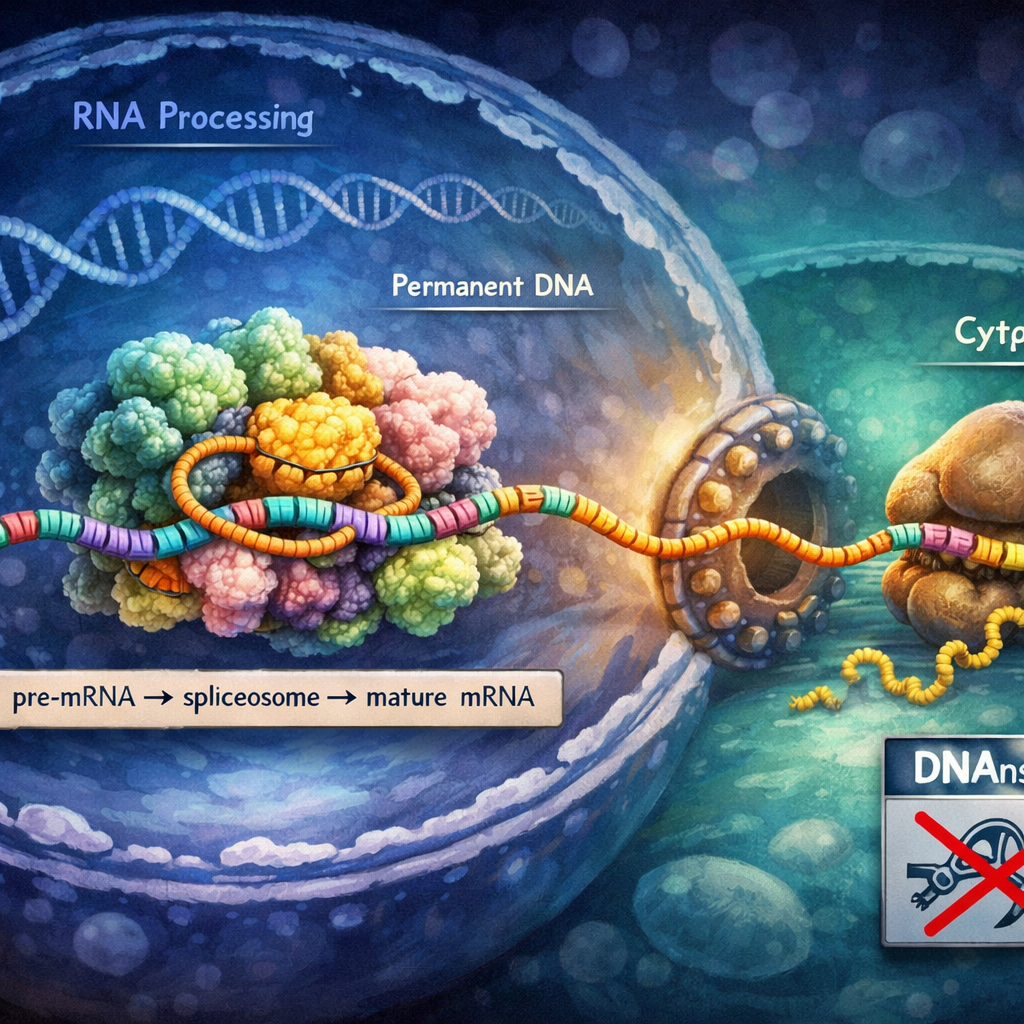
Textbook diagrams share some of the blame. Simplified versions of the central dogma often show DNA to RNA to protein as a straight, unbroken arrow, with splicing left out entirely or shrunk into a tiny side note. That visual shorthand is fine for a first introduction, but it quietly teaches that splicing is a minor detail rather than a load-bearing step.
Why Treating It As Routine Changes the Picture
Once you accept that splicing happens continuously, in every cell, for nearly every gene, it stops looking like an obscure biology footnote and starts looking like what it actually is: a second layer of gene regulation running underneath the one most people learn about in school.
Splicing Errors: The Hidden Root Cause Behind Genetic Disease
Most people, when they think about genetic disease, picture a single wrong letter in the DNA code — a mutation that changes one amino acid and breaks a protein. That picture is accurate for some conditions, but it leaves out a huge, underappreciated category: diseases caused by mutations that don't change a protein directly at all. Instead, they change how a gene gets spliced.
A mutation sitting at or near a splice site — the exact sequence the spliceosome uses to find where an intron starts or ends — can cause the spliceosome to skip an exon entirely, include an intron that should have been removed, or cut in the wrong place. The DNA letter that changed might not even sit inside the region that codes for protein. It just quietly breaks the machinery's ability to read its own instructions correctly.
Researchers studying human disease genetics have found that a meaningful share of disease-causing mutations act this way, disrupting splicing rather than directly altering a protein-coding sequence. Spinal muscular atrophy, a severe inherited neuromuscular disease, is a well-documented example: it largely results from a splicing defect in a backup gene (SMN2) that would otherwise compensate for a missing gene (SMN1), and a splicing-correcting drug called nusinersen (brand name Spinraza) works by changing how that backup gene gets spliced, not by editing DNA at all.
Why This Layer Gets Missed
Genetic counseling and consumer genetics coverage tend to focus on protein-coding changes because those are easier to explain and, historically, easier to detect with older sequencing methods. Splicing effects require looking at RNA itself, or predicting splice-site disruption computationally, which is a newer and more technically demanding kind of analysis.
What Changes If You Understand This
Genetic risk isn't only "did my DNA sequence change my protein." It's also "did my DNA sequence change how my cell processes the RNA in between." That reframing matters if you're ever reading about a genetic test result, a rare disease diagnosis, or a new RNA-targeted therapy, because it explains why some treatments (like antisense oligonucleotides) work by correcting splicing instead of editing genes outright. If you want to test how well this distinction has actually stuck, a short gene expression quiz on a platform like dnanswer.app is a decent way to check whether the difference between DNA-level and RNA-level disease mechanisms has really clicked.
Conclusion
Treat RNA splicing as a working part of your biology, not a technical footnote. When you read about a genetic disease, ask whether the cause is a broken protein or a broken splicing instruction — the two demand different treatments entirely. Antisense drugs, splice-modulating therapies, and RNA diagnostics are already built on that distinction, and more will follow.
Frequently Asked Questions
Does RNA splicing change your DNA permanently?
No. Splicing only edits pre-mRNA, a temporary RNA copy of a gene. Your DNA sequence stays exactly the same before and after splicing occurs, every single time.
Can splicing errors be inherited by your children?
Yes, if the underlying DNA mutation that disrupts a splice site is present in reproductive cells, it gets passed down. The splicing error itself resets each time, but its DNA cause is heritable.
Is alternative splicing the same thing as a mutation?
No. Alternative splicing is a normal, regulated process cells use deliberately to make different proteins from one gene. A mutation is an unplanned change to the DNA sequence, which can sometimes disrupt normal splicing.
How many proteins can one gene actually produce through splicing?
It varies enormously by gene. Some genes produce only one or two versions; others, like certain genes involved in nerve cell wiring, have been documented producing thousands of distinct spliced variants.