What Is the Difference Between DNA and RNA?
Why does your body keep DNA for a lifetime but destroy most RNA within minutes or hours? Because the difference between DNA and RNA is not quality, it is job description. DNA (deoxyribonucleic acid) is a double-stranded molecule that stores your genetic information for the long term. RNA (ribonucleic acid) is usually single-stranded and works as a short-lived working copy that carries instructions and helps build proteins.
Five common myths blur that picture. Fixing them changes how you read every news story about mRNA vaccines, viruses and gene tests.
Key Takeaways
- DNA archives instructions; RNA is a disposable, versatile working molecule.
- Three chemical differences: sugar, one base (T vs. U), strand count.
- DNA never builds proteins directly. RNA always sits in between.
- Three RNA types, three jobs: mRNA, tRNA, rRNA.
- Strand rules have exceptions: some viruses use single-stranded DNA or double-stranded RNA.
Myth 1: "RNA Is Just a Cheap Photocopy of DNA"
The popular picture is simple. DNA is the blueprint, RNA is the photocopy, and a photocopy is a lesser object. That picture is not silly. It captures the real workflow: a cell copies a stretch of DNA into RNA, then reads the copy. Britannica-style summaries even call DNA the master blueprint for life.
The trouble is the word "just." RNA does far more than relay messages.
RNA is a toolkit, not a copy
RNA can store information (some viruses use it as their only genetic material). It can switch genes on and off. It can even act as an enzyme, a molecule that speeds up a chemical reaction. Inside the ribosome, the cell's protein factory, ribosomal RNA does the chemistry that links amino acids together. A protein is not doing that job. RNA is.
Why the "weakness" is the point
RNA breaks down quickly. That looks like a flaw until you ask what a cell needs. If a message lasted forever, the cell would keep making that protein forever. Fast breakdown lets a cell turn production down within hours by simply not making more copies.
Think of DNA as the sealed master recipe book in a restaurant's office. RNA is the order ticket on the kitchen counter. You want the ticket to be cheap, readable and easy to throw away. You never want the cook scribbling on the master book.
Scientists have a long-standing idea, the RNA world hypothesis, that early life ran on RNA alone, since it can both hold information and speed up reactions. If that is right, DNA arrived later as the stable archive, and RNA kept the jobs that suit a flexible molecule.
What to do with this: when you read "RNA copies DNA," add "and then does real work." That second half is where most modern drug research sits.
Myth 2: "DNA Builds Proteins Directly"
You might picture a gene reaching out and assembling a protein. It is a natural shortcut. Genes are described as "coding for" proteins, and the phrase suggests a direct line.
There is no direct line. DNA stays in the nucleus, the cell's central compartment in humans and other complex organisms. The protein factories, the ribosomes, sit outside it in the cytoplasm, the fluid filling the rest of the cell. Something has to carry the instructions across. That something is RNA.
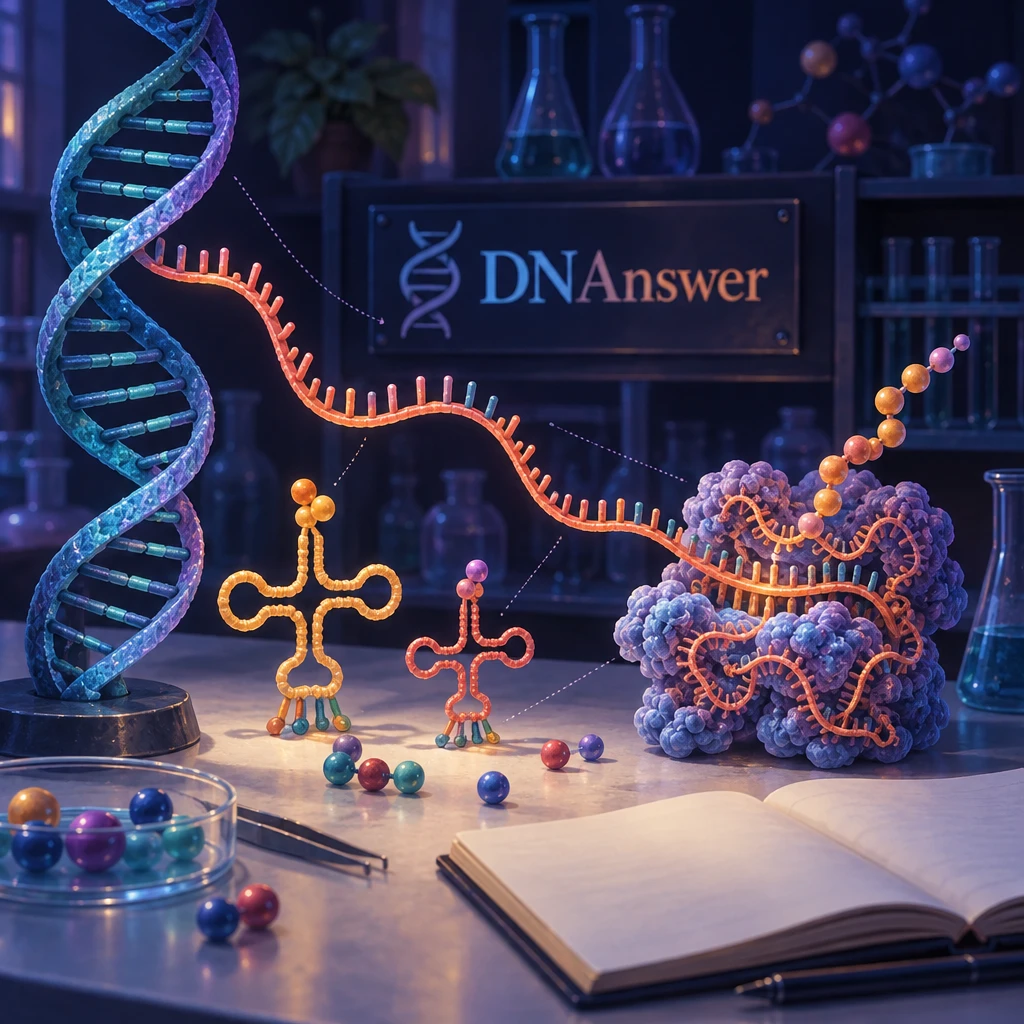
The flow of information runs DNA to RNA to protein. Biologists call this the central dogma, the basic rule for how genetic information moves in a cell. It has two steps, and each has a name.
- Transcription: an enzyme called RNA polymerase reads a gene and builds a matching RNA strand from it.
- Processing and export: the RNA message leaves the nucleus and travels toward a ribosome.
- Translation: the ribosome reads the message three letters at a time and strings together amino acids, the building blocks of proteins.
- Breakdown: enzymes chop up the RNA once the cell has made enough protein.
- Folding: the new chain of amino acids folds into a working protein.
The "dogma" label oversells it a little. RNA viruses, for instance, can copy RNA into more RNA, and retroviruses such as HIV copy RNA back into DNA. The central dogma describes the main route in cells, not a law with no exceptions.
The practical payoff is large. Because RNA is the go-between, you can instruct a cell without touching its DNA. That is exactly how the COVID-19 mRNA vaccines work: they deliver a small piece of viral RNA, your cells make a viral protein from it, and your immune system learns to recognize that protein. Your DNA stays untouched.
Myth 3: "The Only Difference Is the Shape"
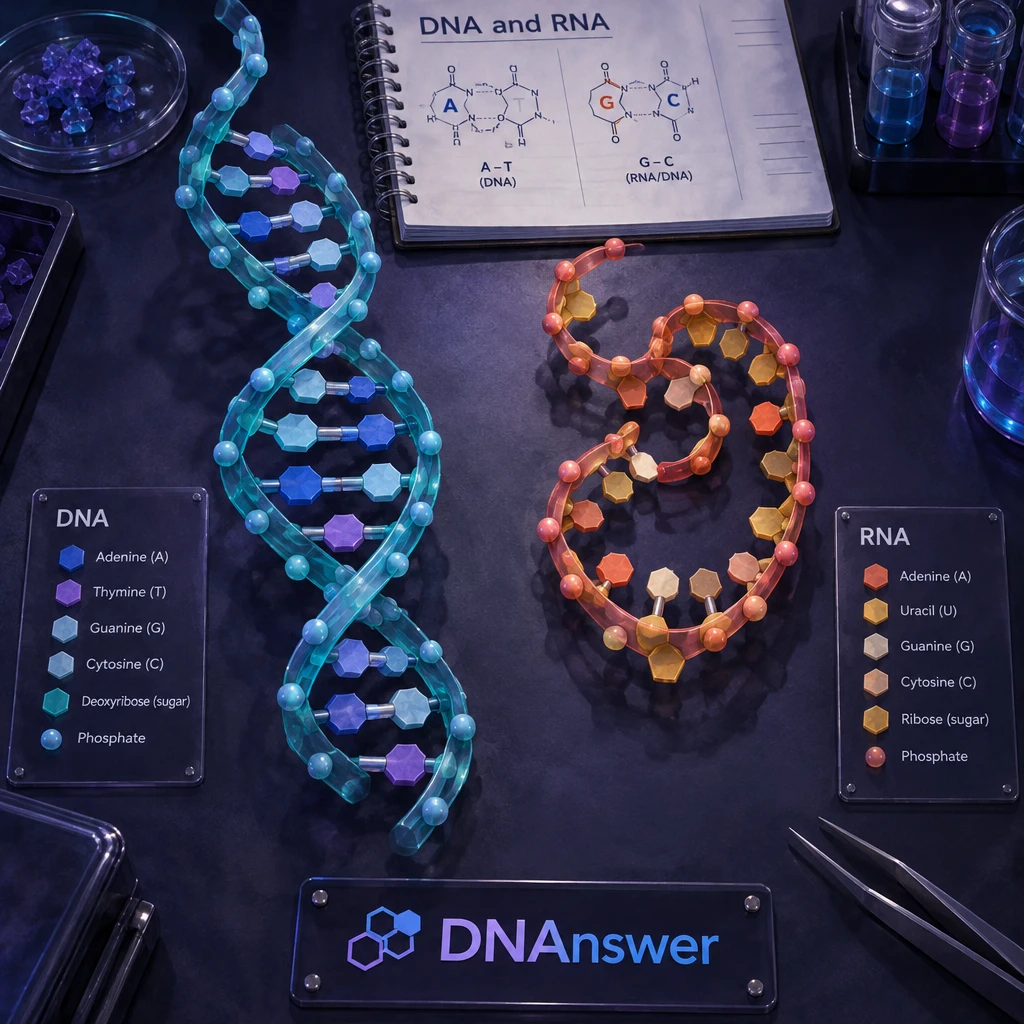
Ask most people and you hear one answer: DNA has two strands, RNA has one. It is the difference you can see in textbook drawings, so it sticks. And it is a real difference.
But shape is only one of at least four. Sugar, base, stability and role all differ too, and they are linked. Here is the full comparison in plain prose.
Sugar: one oxygen atom
Every nucleotide, the repeating building block of a nucleic acid, has three parts: a sugar, a phosphate group and a nitrogen-containing base. DNA uses deoxyribose. RNA uses ribose. The prefix "deoxy" means "missing an oxygen," and that is the whole difference: ribose has an extra hydroxyl group (an oxygen bonded to a hydrogen) that deoxyribose lacks.
That one extra group matters a lot, as the stability section below shows.
Bases: T versus U
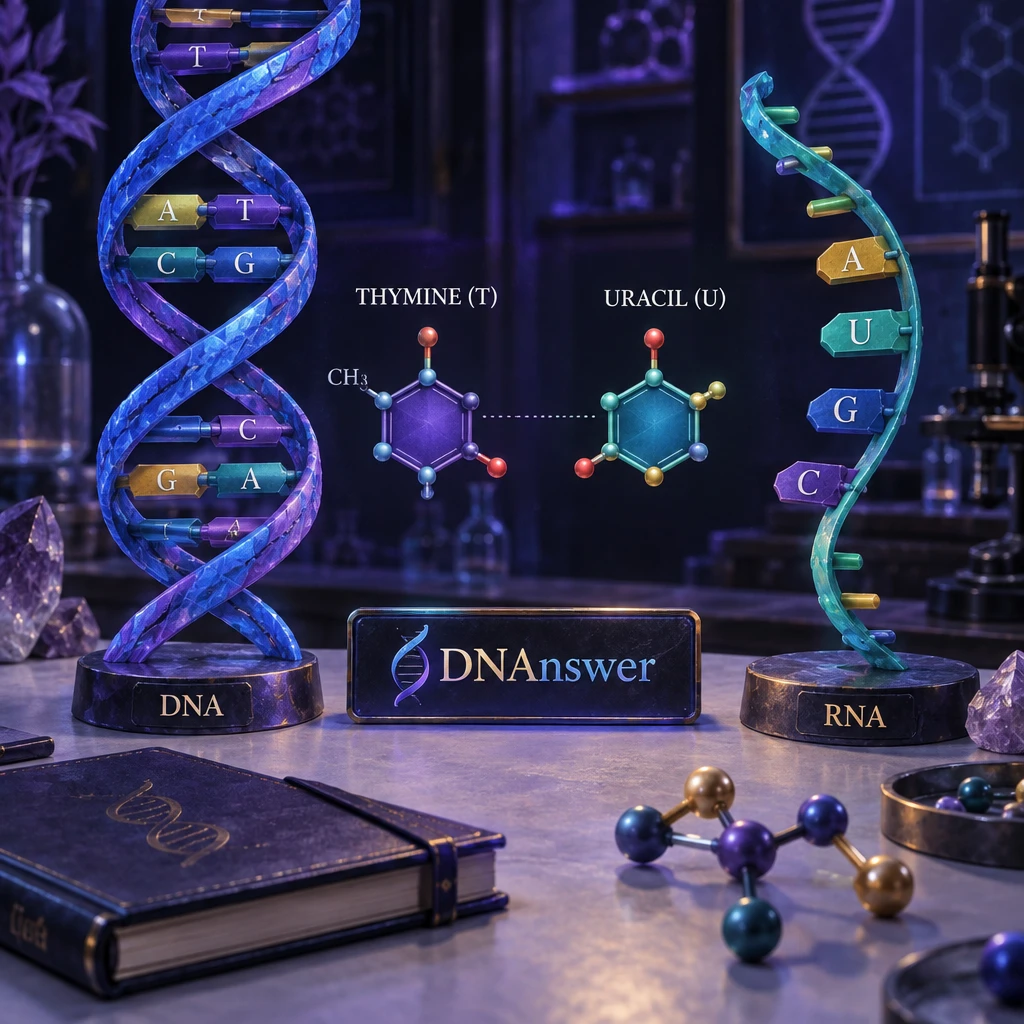
Both molecules use four letters. DNA's are adenine (A), guanine (G), cytosine (C) and thymine (T). RNA swaps thymine for uracil (U). In DNA, A pairs with T and C pairs with G. In RNA, A pairs with U instead.
Why did DNA keep thymine? The usual explanation is error repair. Cytosine slowly turns into uracil on its own, a common chemical accident. If DNA used uracil naturally, a repair crew could not tell a mistaken U from a proper one. Because DNA uses thymine, any U in DNA is clearly damage, and enzymes cut it out. RNA is short-lived, so it can afford the cheaper letter.
Strands and location
DNA is a double helix, two chains twisted together like a ladder with rungs. RNA is usually a single chain that folds back on itself into loops and shapes. Most of your DNA sits in the nucleus, with a small amount in the mitochondria, the cell's power plants. RNA is made in the nucleus and then works largely in the cytoplasm.
Read the differences as a package. A single, flexible strand with a reactive sugar is ideal for a short-lived worker that can fold into useful shapes. A paired, sturdy strand is ideal for an archive.
Myth 4: "DNA Is Always Double-Stranded and RNA Is Always Single"
This one comes from every diagram you have ever seen. Textbooks show the double helix for DNA and a lone squiggle for RNA, and the rule works for nearly everything you will meet in a human cell. It is a good first rule.
It is a tendency, not a law. Viruses break it constantly.
Some viruses carry single-stranded DNA. Others, including rotaviruses (a common cause of childhood stomach illness), carry double-stranded RNA. Many other viruses, such as influenza and SARS-CoV-2, use single-stranded RNA as their entire genome. Your cells even treat double-stranded RNA as an alarm: it rarely appears in healthy cells, so sensors flag it as a sign of viral infection. Research on dengue, Zika and influenza has traced how those sensors cluster on viral double-stranded RNA and trigger an enzyme, RNase L, that degrades the cell's messenger RNA to slow the invader.
RNA also pairs with itself. A single strand can fold so that one stretch sticks to another, forming short double-stranded patches. Transfer RNA, for example, folds into a shape often compared to a cloverleaf because of those patches.
The practical lesson: treat strand count as a clue, not a verdict. If a quiz or exam question asks which molecule a virus carries, do not assume DNA, and do not assume single-stranded.
Myth 5: "RNA Is One Thing"
When people say "RNA," they usually picture messenger RNA, since it gets the most attention. That is understandable. Messenger RNA is the type that makes headlines through vaccines, and it matches the "copy of DNA" story.
But your cells make several kinds of RNA, and each does a different job. Three matter most for protein building.
Messenger RNA (mRNA) is the instruction slip. It is a copy of one gene, built during transcription, and it carries the recipe to the ribosome. Its sequence is read in three-letter groups called codons, and each codon names one amino acid.
Transfer RNA (tRNA) is the delivery driver. It is small, typically 70 to 90 nucleotides long, and folds into that cloverleaf shape. One end holds a specific amino acid. The other end carries an anticodon, a three-letter tag that matches a codon on the mRNA. That match makes sure the right amino acid lands in the right place.
Ribosomal RNA (rRNA) is the factory itself. Ribosomes are built from rRNA and proteins. The rRNA holds mRNA and tRNA in position and catalyzes the bond between amino acids. Without it, no protein gets made.
Phosphodiester bonds in DNA are about 200 times more stable than similar bonds in RNA, at neutral pH and normal magnesium levels. — Lindahl and colleagues, as cited in a 2024 review of RNA stability
Other RNAs exist too, including small ones that regulate genes. The three above are only the best-known crew. Next time you read about an "RNA therapy," ask which type it uses, because mRNA, regulatory RNA and others behave very differently.
Why DNA Lasts and RNA Doesn't
The quote above comes down to chemistry, and it is worth seeing why. The backbone of both molecules is a chain of sugars linked by phosphate groups. The links are called phosphodiester bonds. In RNA, the extra hydroxyl group on ribose can attack its own backbone, snapping the chain. DNA's deoxyribose has no such group, so its backbone sits quietly.
Two more details help DNA. Its two strands protect each other, with the reactive parts tucked inside the helix. And it is wound tightly and stored inside the nucleus, away from most of the cell's destructive enzymes. RNA's single strand leaves more of itself exposed, and its folded shapes give enzymes more places to grab.
One surprise runs the other way: RNA withstands ultraviolet light better than DNA does. Stability is not one number. DNA wins on chemical durability, and RNA wins on a few specific stresses.
Different RNAs last for different times. Many mRNAs survive minutes to hours, while rRNA in ribosomes lasts much longer. That matters in medicine. Vaccine makers must protect fragile mRNA, which is why COVID-19 mRNA vaccines were packaged in tiny fat bubbles and kept cold.
Here is the short DNA-versus-RNA summary in prose. DNA: deoxyribose sugar, bases A, T, C and G, usually two strands, a long-term archive, mostly in the nucleus. RNA: ribose sugar, bases A, U, C and G, usually one strand, a working copy and toolkit, active mostly in the cytoplasm. What they share is just as important: both are nucleic acids (molecules that carry information in a chain of nucleotides), both use four letters, and both are built from the same type of chemical backbone.
If you like testing yourself on this, DNAnswer has free molecular biology quizzes where you can practice the DNA and RNA distinctions and earn XP as you go.
Conclusion
Choose the "archive and working copy" model if you need a quick answer, and add the exceptions when accuracy matters. If a question mentions long-term storage, think DNA. If it mentions instructions, protein building or gene control, think RNA. For anything about viruses, check the strand type before you answer. Then read the next mRNA headline with one question: which RNA, doing which job?
Frequently Asked Questions
What is the difference between DNA and RNA in simple terms?
DNA is the long-term, double-stranded storage of your genetic instructions. RNA is a short-lived, usually single-stranded working copy that carries those instructions to the protein factories. They also differ in sugar (deoxyribose vs. ribose) and one base (thymine vs. uracil).
What do DNA and RNA stand for?
DNA stands for deoxyribonucleic acid, and RNA stands for ribonucleic acid. "Deoxy" means the sugar is missing one oxygen atom. "Nucleic" refers to the nucleus, where scientists first found these molecules.
How would you explain RNA to a child?
Say that DNA is a giant recipe book kept safe in a locked room. RNA is a note someone copies from one recipe and carries to the kitchen. The cooks use the note to make the dish, then throw it away.
Why does RNA use uracil instead of thymine?
Uracil is cheaper for a cell to make, and RNA does not need to last. DNA uses thymine so repair enzymes can spot uracil that appears by accident when cytosine decays, and fix it.