Transcription: How Your Cells Copy the Right Gene at the Right Time
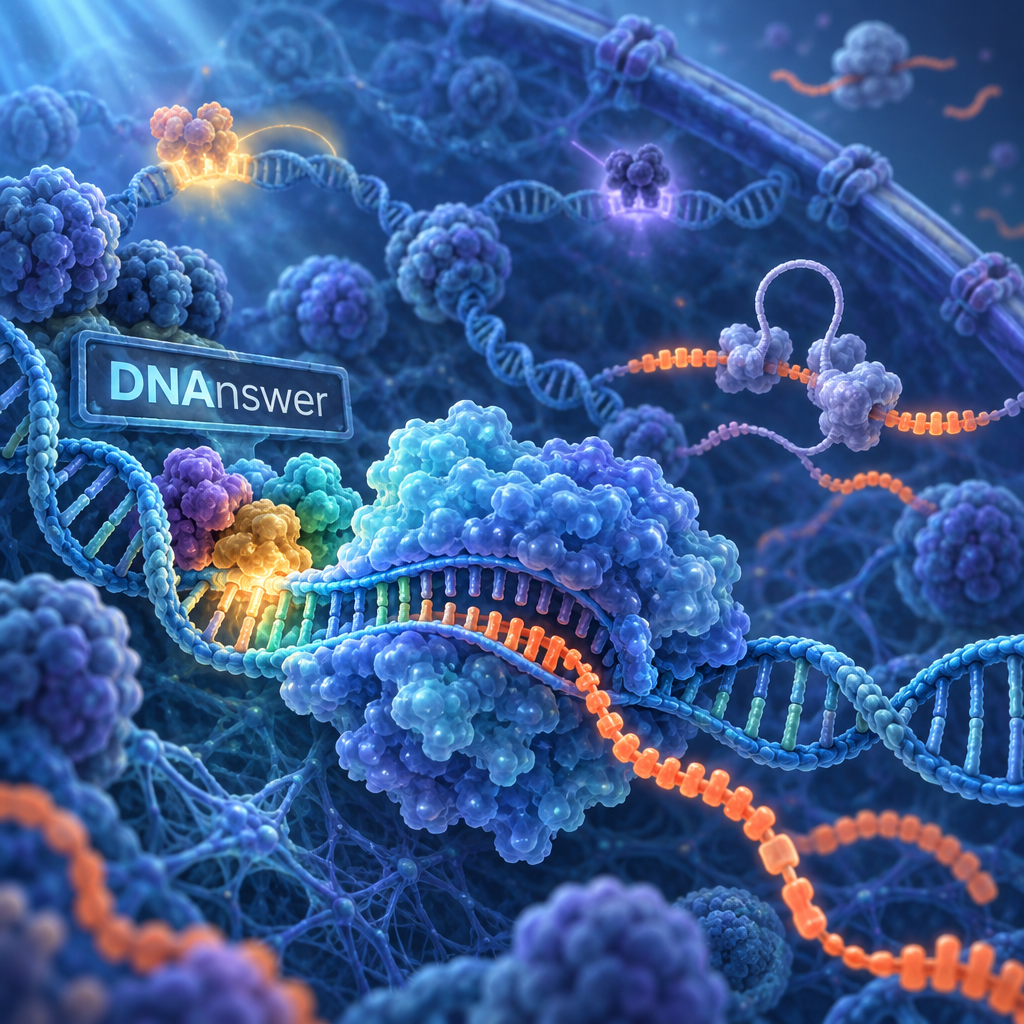
Your muscle cells and your brain cells carry the exact same DNA. So why does one twitch and the other think? The answer has almost nothing to do with what genes a cell has and everything to do with which genes it reads. That reading process is transcription — the step where a cell copies a gene's DNA into a portable RNA message. Most explanations stop at "RNA polymerase copies DNA," which is true but misses the actual story: gene expression is a timing problem, not a copying problem, and most of what people think they know about how transcription works is slightly, confidently wrong.
Key Takeaways
- Transcription copies DNA into RNA; translation reads RNA to build protein — different jobs, different machines
- RNA polymerase reads the template strand, not the coding strand, to make a matching mRNA copy
- Only a fraction of genes in any cell are being transcribed at a given moment
- Transcription factors, enhancers, and silencers control timing, not just DNA sequence
- Most human RNA gets edited (spliced) before it's a working message
- DNA polymerase and RNA polymerase share a name pattern but do very different jobs
Myth One: Transcription and Translation Are the Same Step
They're not, and mixing them up is the single most common mistake people make when talking about gene expression. Transcription copies DNA into RNA. Translation reads that RNA to build a protein. They happen in different places, use different machinery, and produce different molecules entirely.
It's an easy mix-up to make. Both words start with "trans," both show up in the same paragraph of every biology textbook, and both are steps in the same overall pathway — the one biologists call the central dogma: DNA makes RNA, RNA makes protein. If you've only seen a simplified diagram with three boxes and two arrows, the middle arrow and the final arrow blur together fast.
Here's what actually happens. Transcription takes place inside the nucleus (the membrane-bound compartment holding your DNA) in human cells. An enzyme called RNA polymerase unwinds a short stretch of DNA and builds a matching RNA strand, called messenger RNA or mRNA, one base at a time. That mRNA then leaves the nucleus. Translation happens outside, on a structure called a ribosome, which reads the mRNA in three-letter chunks called codons and strings together amino acids to build a protein.
Think of it like a recipe stored in a locked archive. Transcription is a librarian photocopying one recipe page so it can leave the building. Translation is the cook in the kitchen following that photocopy to actually make the dish. The original recipe book (your DNA) never leaves the archive. The copy (mRNA) is disposable — it gets used and then broken down, often within hours.
Why the Distinction Actually Matters
This isn't just vocabulary policing. Drugs and vaccines target one step or the other, and confusing them leads to real misunderstandings. mRNA vaccines, for example, deliver a synthetic mRNA molecule that skips transcription entirely and goes straight to translation in your cells. Some antibiotics work by jamming bacterial ribosomes, blocking translation without touching transcription at all.
A Quick Gut-Check
If someone says "the DNA is being read to make protein," ask which step they mean. If DNA is being copied into RNA, that's transcription. If RNA is being read to assemble amino acids into a chain, that's translation. Keeping the two straight is the one habit that makes everything else in this article click faster.
Myth Two: RNA Polymerase Works Like DNA Polymerase, Just for RNA
RNA polymerase and DNA polymerase share a family name, but they don't do the same job, and treating them as interchangeable copy machines misses why cells need two separate systems at all. DNA polymerase copies the entire genome, letter for letter, once per cell division. RNA polymerase copies short stretches of specific genes, over and over, on demand.
The confusion comes from the shared word "polymerase," which just means an enzyme that builds a polymer — a long chain made of repeating units. Both enzymes build chains using a DNA template. That surface similarity makes it tempting to assume they're doing the same task at different scales.
They're not. DNA replication (DNA polymerase's job) has to be nearly perfect, because a mistake gets passed to every future cell. DNA polymerase has built-in proofreading and makes roughly one error per billion bases copied. Transcription doesn't carry that same burden. An RNA molecule is temporary. If a transcript has a small error, the cell just makes another one. RNA polymerase is faster to start and less obsessed with perfection, and it doesn't need the elaborate proofreading machinery DNA replication relies on.
There's a bigger functional difference, too: DNA polymerase copies practically the whole genome in one long continuous pass during cell division. RNA polymerase copies one gene, or a small cluster of genes, at a time, and it can do this thousands of times for a gene the cell needs a lot of, and zero times for a gene it doesn't need right now. That selectivity is the whole point. Your genome holds around 20,000 protein-coding genes, but no single cell transcribes anywhere near all of them at once — a liver cell and a skin cell are running two very different subsets of that same list.
Humans also have more than one RNA polymerase. RNA polymerase II handles most mRNA production and is the one people usually mean when they say "RNA polymerase" in casual conversation. RNA polymerase I and III handle other RNA types, including the RNA used to build ribosomes themselves. DNA polymerase, by contrast, doesn't have this kind of division of labor for the human genome's basic replication.
Myth Three: The RNA Copy Matches the Coding Strand, Not the Template
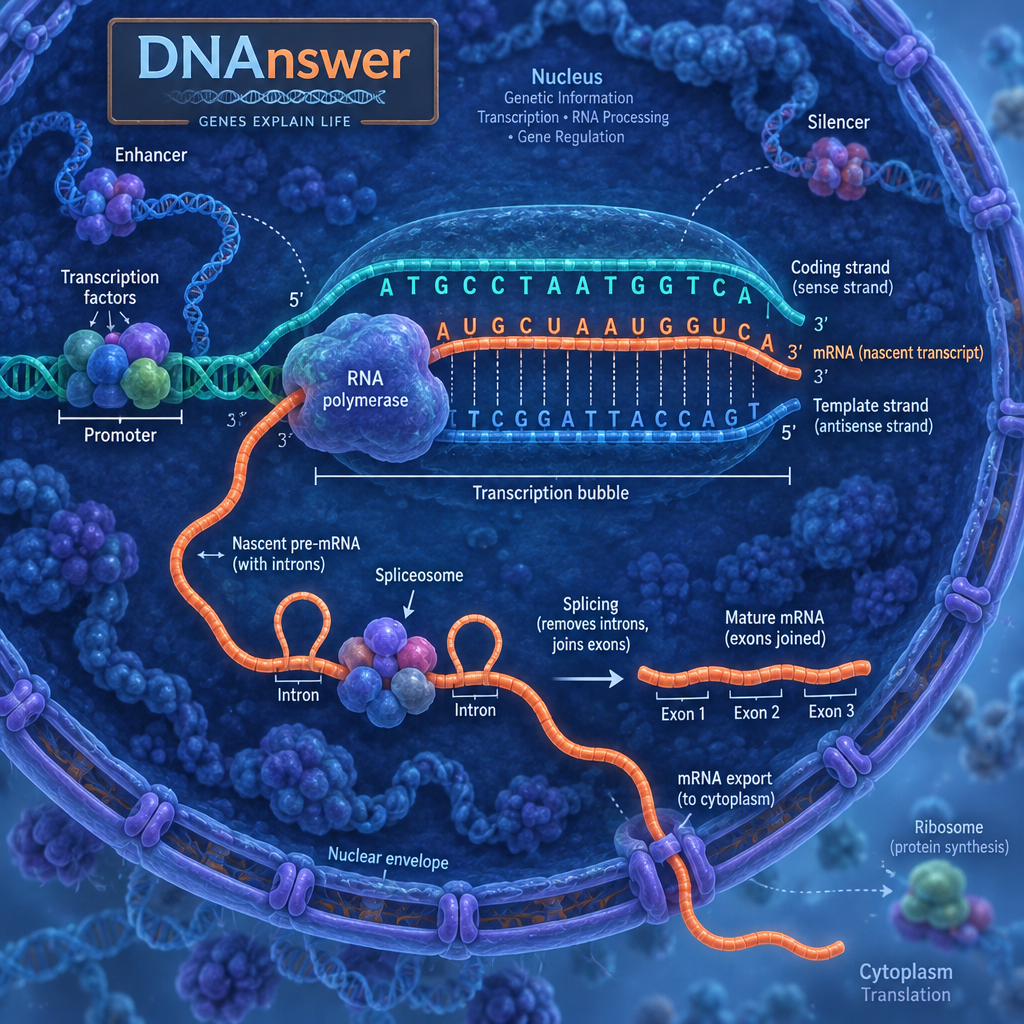
This one trips up almost everyone the first time they see a transcription diagram, because it's genuinely counterintuitive. DNA is double-stranded. One strand is called the coding strand because its sequence reads almost identically to the final RNA (with one small swap, explained below). The other is the template strand. RNA polymerase actually copies from the template strand — not the one that looks like the final answer.
The origin of the confusion makes sense once you see it: textbooks show you the coding strand because it's easier to read and compare to the final mRNA. So learners naturally assume that's the strand doing the work. It isn't. RNA polymerase physically attaches to the template strand and builds a new RNA molecule that is complementary to it, base by base.
Here's the mechanism. DNA bases pair in a fixed way: adenine (A) with thymine (T), and guanine (G) with cytosine (C). RNA polymerase reads the template strand and builds an RNA strand using complementary bases — except RNA swaps thymine for a similar base called uracil (U). So if the template strand reads T-A-C-G, the RNA polymerase builds A-U-G-C. Because that RNA sequence pairs opposite the template, it ends up matching the coding strand almost exactly — same letters, except every T becomes a U.
A clean definition worth keeping: the template strand is the DNA strand RNA polymerase reads to build mRNA; the coding strand is the DNA strand whose sequence matches the mRNA output (with U replacing T).
Why keep two strands around at all instead of just one? Because different genes on the same chromosome can be transcribed off different strands. One gene might use the top strand as its template; the gene sitting right next to it might use the bottom strand. This is one reason a single chromosome can pack in genes going in opposite "directions," which matters for how densely a genome can store information.
Getting this backwards doesn't just cost you a quiz question. If you're trying to predict a protein sequence from a stretch of DNA, using the wrong strand gives you a completely wrong, sometimes nonsensical, answer. Always confirm which strand is the template before you translate anything by hand.
Myth Four: All Genes in a Cell Are Being Transcribed All the Time
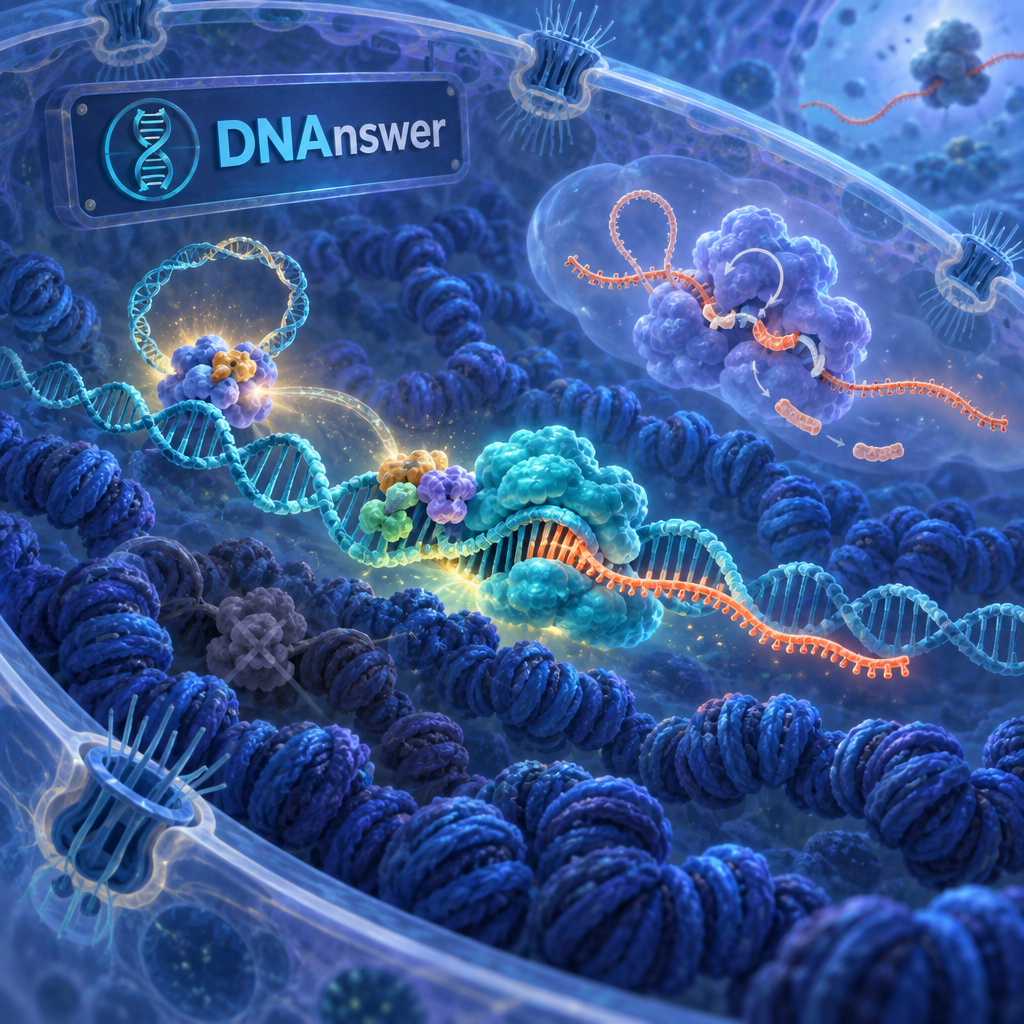
This is the myth that quietly undercuts everything else, because it's the one that actually explains why you have different cell types at all. A given human cell typically has only a fraction of its roughly 20,000 genes actively transcribed at any moment — everything else is switched off, dialed down, or waiting for a signal.
People believe this because the phrase "your DNA has the instructions for your whole body" gets repeated so often that it starts to sound like every instruction runs constantly, like a computer executing every line of code in a program simultaneously. That's not how it works. DNA is closer to a reference library than a running program — most of the shelves stay closed most of the time.
What Actually Controls Whether a Gene Gets Read
Three layers decide whether RNA polymerase ever touches a given gene.
- The promoter region. Every gene has a stretch of DNA just before its start called the promoter, where RNA polymerase and its helper proteins first assemble. No promoter access, no transcription.
- Transcription factors. These are proteins that bind DNA near a gene and either help RNA polymerase load on or block it. A cell's identity is basically defined by which transcription factors it has active.
- Enhancers and silencers. These are DNA segments, sometimes far from the gene itself, that boost or suppress transcription when the right proteins bind them. DNA can loop so a distant enhancer physically touches a promoter.
- Chromatin packaging. DNA wraps around proteins called histones to form a structure called chromatin. When chromatin is tightly packed, RNA polymerase can't reach the DNA at all, regardless of what transcription factors are floating around.
- Epigenetic marks. Chemical tags added to DNA or histones — like methylation — can silence a gene for the cell's entire lifetime, or even get passed to daughter cells, without changing the underlying DNA sequence at all.
A muscle cell and a skin cell share identical DNA but keep almost entirely different sets of genes unlocked. Muscle cells keep genes for contractile proteins like actin and myosin wide open and keep skin-specific keratin genes buried in tightly packed chromatin. Skin cells do the reverse. Neither cell type deleted the genes it doesn't use — it just never lets RNA polymerase near them.
Timing Adds Another Layer
Gene expression isn't only about which genes are on or off — it's also about rate and timing. Some genes get transcribed constantly at low levels ("housekeeping genes" that keep basic cell functions running). Others switch on in bursts triggered by a hormone, a stress signal, or even the body's internal clock. Genes tied to circadian rhythm, for instance, get transcribed at higher rates at certain times of day and dial down at others — which is part of why shift work and jet lag mess with more than just your sleep.
This is the real headline most simplified explainers skip: transcription isn't a single on/off mechanical event. It's a rate that a cell adjusts constantly, in response to what's happening around it and inside it.
Myth Five: The RNA Copy Is the Final, Finished Message
If you learned transcription as "DNA in, mRNA out, ready to use," you learned an oversimplified version. Most human RNA transcripts get edited before they're functional — a process called RNA processing, and splicing is the biggest part of it.
This myth persists because early diagrams of transcription (and a lot of bacterial biology, where this step barely exists) show a straight line from DNA to a finished mRNA. In bacteria, that's roughly accurate — their genes don't usually get chopped up. Human genes are messier, and that mess is the point.
Here's the honest picture. Human genes contain coding sections called exons and non-coding sections called introns, often interspersed like paragraphs mixed with unrelated filler text. The raw transcript RNA polymerase first produces — called pre-mRNA — includes both. Before that RNA can leave the nucleus, a molecular complex called the spliceosome cuts out the introns and stitches the exons together. Only after splicing does the molecule become mature mRNA, ready for translation.
Splicing also explains something that seems almost impossible at first: one gene can produce multiple different proteins. Through a process called alternative splicing, a cell can include or skip certain exons depending on which protein version it needs. A single gene, spliced two different ways in two different tissues, can end up producing two proteins with meaningfully different jobs. This is a major reason humans can build the estimated hundreds of thousands of distinct proteins in the body from a genome of only around 20,000 protein-coding genes.
Two more edits happen before an mRNA is considered finished. A protective cap gets added to the front end, and a long tail of repeated adenine bases (a poly-A tail) gets added to the back end. Both protect the molecule from being degraded too quickly and help the ribosome recognize it later during translation.
Skipping this step in your mental model has a real cost: it makes RNA processing errors invisible as an explanation for disease. Several genetic disorders trace back not to a broken gene sequence, but to a splicing error — the right gene, cut in the wrong place. Some cases of the disorder spinal muscular atrophy, for example, are tied to a faulty splicing step rather than a missing gene entirely, which is part of why some modern treatments target splicing directly instead of the DNA itself.
The Three Working Stages: Initiation, Elongation, Termination
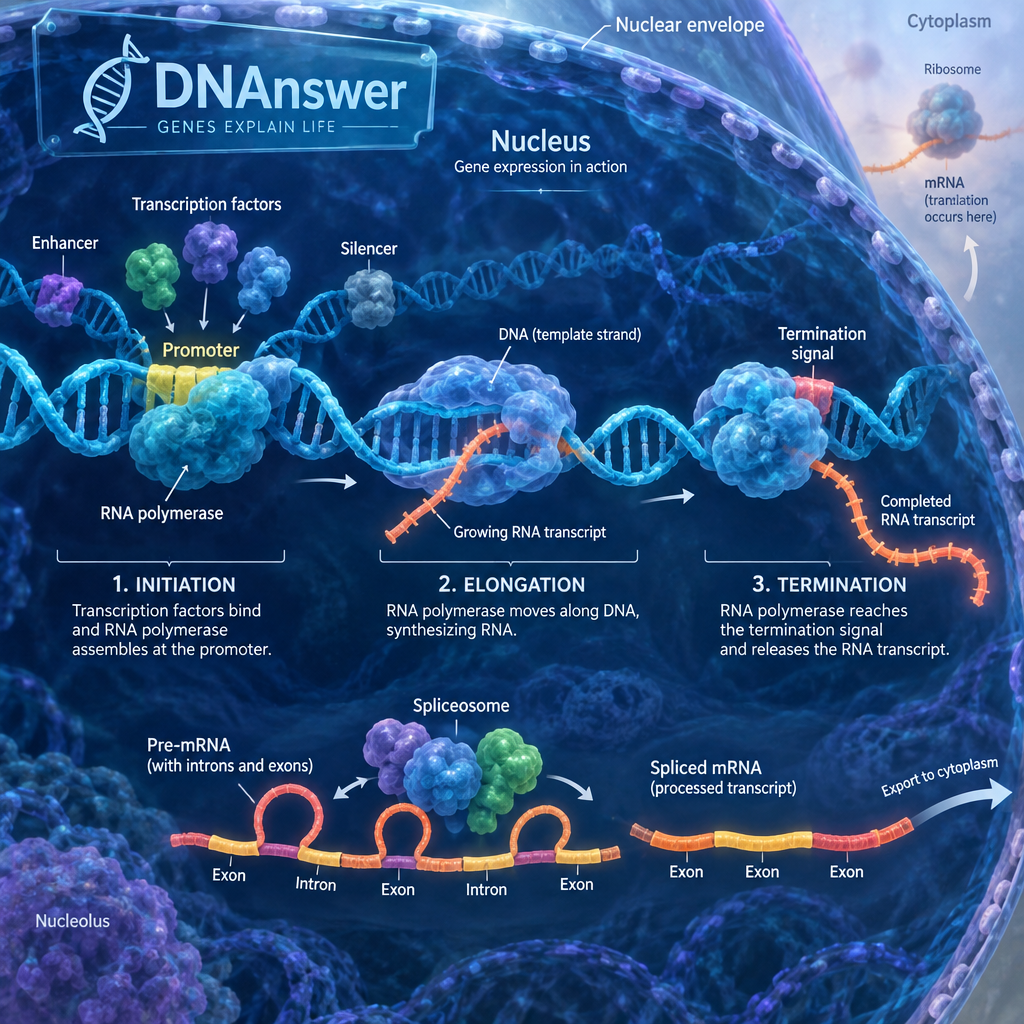
Once you strip away the myths, the actual mechanical process of transcription breaks into three clean stages, and each one is a separate control point where a cell can speed things up, slow them down, or stop entirely.
- Initiation. Transcription factors bind the promoter region and help position RNA polymerase at the correct starting point on the template strand. This is the slowest, most heavily regulated stage — it's where enhancers, silencers, and chromatin packaging exert most of their influence.
- Elongation. RNA polymerase moves along the template strand, unwinding DNA just ahead of it and building the RNA chain base by base behind it. This stage can run at a fairly steady clip once it gets going, though certain sequences can cause brief pauses.
- Termination. RNA polymerase reaches a specific DNA sequence that signals "stop," releases the finished RNA transcript, and detaches from the DNA. The DNA then re-winds back into its normal double-helix shape.
- Processing. As covered above, the raw transcript often gets capped, spliced, and tailed before it's usable.
- Export. The finished mRNA moves through pores in the nuclear membrane into the main body of the cell, where ribosomes are waiting.
Initiation is where most of the interesting biology lives, because it's the stage transcription factors and enhancers actually act on. A gene can have a perfectly intact promoter and still never get transcribed if the right transcription factor never shows up. This is also the stage most disrupted by mutations that cause disease — not because the gene itself is broken, but because the switch controlling it is.
Elongation and termination matter too, just less dramatically. Some regulation happens mid-elongation, where RNA polymerase can pause and wait for a signal before continuing — a mechanism cells use for genes that need to respond fast, like some involved in stress and immune response.
Transcription vs. Replication: Same Toolkit, Different Mission
It's worth separating transcription clearly from DNA replication, since both processes copy genetic information and both get called "copying" in casual conversation. Replication makes a full duplicate of the entire genome so a cell can divide into two. Transcription makes a short-lived RNA copy of one gene so the cell can use that gene's instructions right now.
Replication happens once per cell cycle, is extremely accurate, and touches the whole genome. Transcription happens constantly, at different rates for different genes, and only touches the specific stretch of DNA a cell needs at that moment. A skin cell replicates its DNA only when it's about to divide — maybe every few weeks depending on the tissue. That same skin cell is transcribing genes every minute of every day, adjusting rates as conditions change.
If replication is like printing a brand-new copy of an entire book because the library is opening a second branch, transcription is like photocopying just chapter twelve because someone at the front desk asked for it right now. Different tools, different urgency, different frequency.
Getting comfortable with all five distinctions above — transcription vs. translation, RNA polymerase vs. DNA polymerase, template vs. coding strand, constant vs. selective gene activity, and raw vs. processed RNA — puts you in a genuinely small group. If you want to see how well it's actually stuck, dnanswer.app runs a gene expression quiz that scores you against these exact mix-ups, which is a faster gut-check than rereading a textbook chapter.
Conclusion
Once you separate copying from control, the real story of transcription is timing: the same DNA produces wildly different outcomes depending on which genes get switched on, when, and how much. Next time you read a headline about a gene "causing" a disease, ask whether the problem is the gene itself or when and how much it gets transcribed. Often, it's the second one.
Frequently Asked Questions
Does transcription happen in every cell of the body?
Yes, every cell with a nucleus transcribes genes, but each cell type transcribes a different subset. A neuron and a liver cell share identical DNA yet keep almost entirely different genes switched on.
How is mRNA different from the DNA it came from?
mRNA is single-stranded, shorter, uses uracil instead of thymine, and gets edited through splicing before use. DNA stays double-stranded and permanent; mRNA is temporary and often degraded within hours.
What triggers a gene to start being transcribed?
Usually a signal — a hormone, a stress cue, a developmental trigger — activates transcription factors that bind the gene's promoter or an enhancer, letting RNA polymerase load on and begin.
Can transcription go wrong, and does that cause disease?
Yes. Errors in promoters, transcription factors, or splicing can leave a gene stuck on, stuck off, or producing the wrong protein version, contributing to conditions ranging from cancers to inherited disorders.