What Causes DNA Mutations? Copying Errors, Damage and Frameshifts
Why does a cell that copies its DNA almost perfectly still end up with mutations? Because a mutation is rarely the original mistake. It is the leftover of a mistake that escaped repair.
What causes DNA mutations comes down to three sources: errors when the copying enzyme (DNA polymerase) duplicates DNA, damage from chemicals, UV light and unstable DNA chemistry, and faulty repair of that damage. Most errors get fixed. The few that slip through become permanent, and some, called frameshifts, scramble everything after them.
Key Takeaways
- A mutation is a mistake that escaped repair, not the mistake itself.
- Polymerase errs about once per 100,000 bases, then repair catches most.
- Mutations happen with no outside cause, through copying slips and unstable chemistry.
- Damage is not mutation: under 1 in 1,000 chemical lesions becomes permanent.
- Frameshifts shift the reading frame and scramble every codon downstream.
- Mutations can be harmful, neutral or occasionally helpful.
The Pipeline: Why a Mutation Is the Last Step, Not the First
Picture a document with a typo. Someone has to make the typo, a proofreader has to miss it, and then it gets printed. Only the printed typo counts. DNA works the same way, in three layers.
First comes a lesion, which is any damaged or mismatched spot in the DNA. It might be a wrong base added during copying, or a base chemically altered by sunlight. Second, repair crews inspect the DNA and fix most of these spots. Third, if a lesion survives to the next round of copying, the cell records it as the new normal. That is the permanent mutation.
This pipeline reframes the whole topic. When you hear "radiation causes mutations," the more accurate version is "radiation causes damage, and a small share of that damage becomes mutation." The cost of getting this wrong is real: you may fear every trace exposure while ignoring the quieter, constant sources inside your own cells.
Why the distinction matters
A cell with damaged DNA is not a cell with a mutation. Damage can be repaired. A mutation can't, because the cell no longer sees anything wrong. The altered letter now looks like the original.
The numbers behind the filter
The research is clear on the scale. Chemically induced lesions become permanent mutations fewer than 1 time in 1,000. Replication errors face similar odds. The system is a sieve with very fine holes, and it still lets a trickle through.
Myth: Mutations Come Only From Radiation and Toxic Chemicals
You have probably heard that mutations are what happens when something goes wrong in the environment: X-rays, cigarette smoke, industrial waste. It is a reasonable belief. Those things do cause mutations, and the news mostly covers them.
But many mutations need no outside push at all. Biologists call these spontaneous mutations, meaning changes that occur without chemical, radiation or other environmental damage. They are probably the majority of what matters for evolution. Two engines drive them: copying slips and unstable chemistry.
Copying slips
Every time a cell divides, it copies its entire genome. The enzyme doing the work, DNA polymerase, is picky about which letters it adds. Yet it still picks a wrong one roughly once per 100,000 bases. A human cell holds about 6 billion base pairs, so that works out to about 120,000 mistakes per division if nothing checked the work.
One cause is wobble, where two normal bases pair in a slightly shifted position, such as an A with a G instead of a T. The double helix is flexible enough to tolerate that misfit briefly. Another cause is a base that temporarily takes a slightly different chemical form, with an extra proton, which changes what it bonds with.
Unstable chemistry
DNA is a molecule, and molecules react with water. Over time, bases lose chemical groups in a process called deamination. A common example is cytosine turning into uracil, a letter that belongs in RNA, not DNA. If the cell copies the DNA before repair spots that, the uracil pairs with an A, and the original C-G pair eventually becomes T-A.
Non-dividing cells are not safe either. Reactive oxygen molecules, byproducts of normal metabolism, nick and alter their DNA constantly.
What to do with this: drop the idea that avoiding toxins would give you a mutation-free genome. You can lower outside exposure, and you should. You cannot reach zero, because the biology itself is the source.
Myth: DNA Polymerase Is Sloppy
If polymerase makes 120,000 mistakes per division, it sounds careless. That is the argument, and the arithmetic is right. So where is the flaw?
The flaw is the denominator. One error per 100,000 bases is the raw rate of the enzyme's first pass, and for a molecular machine copying at speed, that is remarkably accurate. It is also only the first layer. Polymerase has a built-in proofreading function: when it adds a wrong base, it can back up, snip it out and try again. After that, a separate crew called mismatch repair scans the new strand for bases that do not pair properly. It cuts out the wrong stretch and refills it correctly.
Together, these layers cut the final error rate to a tiny fraction of the raw one. Per base pair and per generation, the finished human rate of single-letter changes is on the order of one in 100 million (about 10⁻⁸), with small insertions and deletions roughly ten times rarer. The precise figures differ by study, so treat them as ballpark.
Replication errors that evade repair become permanent mutations, and they can pass to later cell generations. If they arise in cells that make eggs or sperm, they can pass to the next generation of the organism. — Nature Education, Scitable
Here is the practical point. When a news story says a mutation "just happened" in a cell, the right reading is that a very accurate process produced a rare miss. Billions of copy events, multiplied across trillions of cells, guarantee some misses. Nobody did anything wrong.
Myth: DNA Damage and Mutation Are the Same Thing
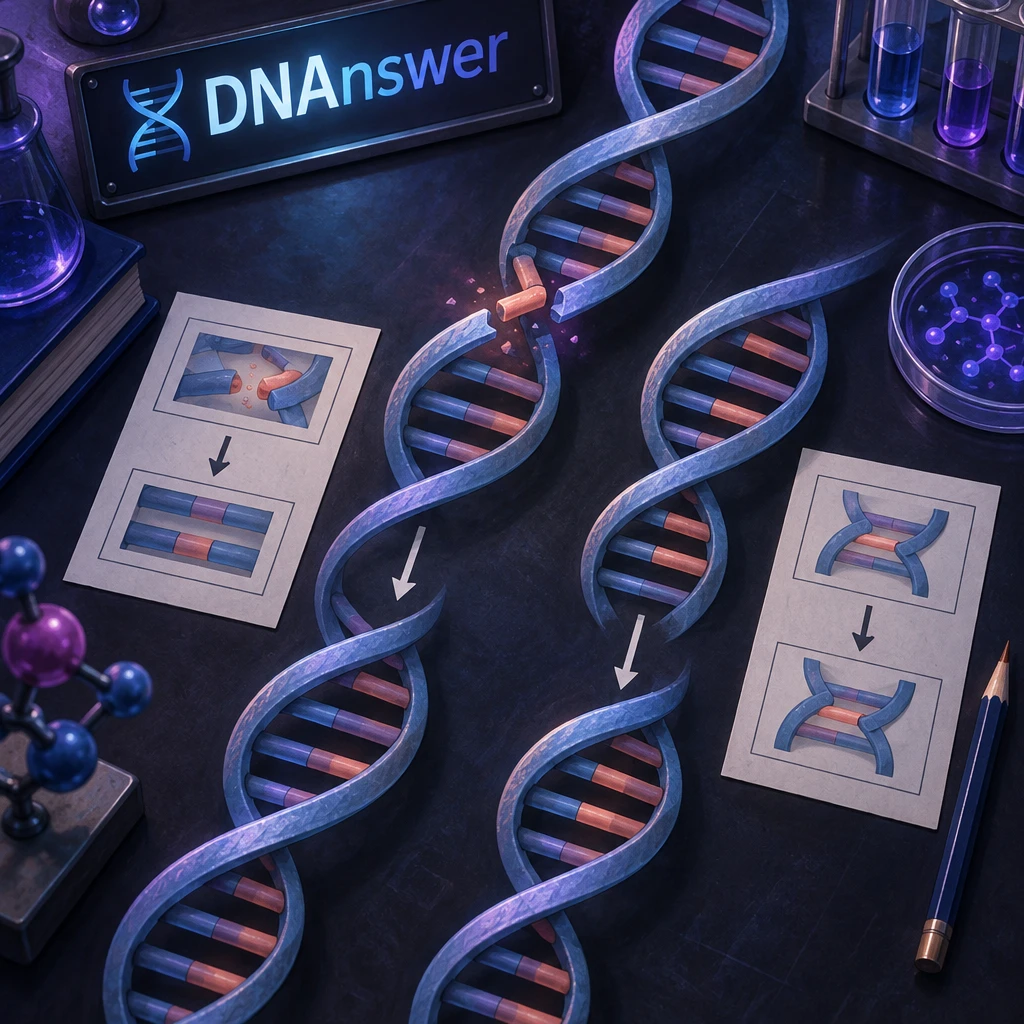
Surely damaged DNA is mutated DNA? The words feel interchangeable, and plenty of textbooks blur them in passing. But the difference decides whether the damage matters.
Damage is a physical change to the DNA molecule that the cell can still detect. A mutation is a change in the sequence that the cell now treats as correct. Damage is a problem waiting to be solved. A mutation is a problem that has been filed as solved.
UV light and thymine dimers
Sunlight is the classic example. UV photons make two neighboring pyrimidine bases (thymine or cytosine, the single-ring letters) bond to each other. The most common product is a thymine dimer, two Ts fused side by side. The fusion kinks the helix, and polymerase stalls or guesses when it meets the kink.
Skin cells run a repair process called nucleotide excision repair, which cuts out the kinked stretch and rebuilds it. Most dimers vanish that way. Those that survive to copying can leave a mutation behind, which is why UV signature mutations appear in skin cancers. People with the rare inherited disorder xeroderma pigmentosum have a faulty version of this repair and develop severe sun damage and skin cancers.
Chemical mutagens
Tobacco smoke adds bulky chemical attachments, called adducts, to DNA bases. They distort the helix much like thymine dimers do. Other genotoxins (chemicals that damage DNA) include certain industrial compounds and some chemotherapy drugs, which damage DNA on purpose to kill fast-dividing cancer cells.
Faulty repair as its own source
Repair itself can create mutations. When a cell suffers a double-strand break, where both strands of the helix snap, it has to rejoin the ends fast. One rescue route, non-homologous end joining, glues the ends together without a template. It works, but it often adds or deletes a few letters at the join.
Research on primates points the same way: sloppy repair of damaged DNA in sperm and eggs appears to be a major source of the new mutations that children are born with, and the count rises with the parents' ages.
What to do differently: protect against damage (sunscreen, not smoking), because every lesion you prevent is one repair never has to handle. Do not assume that exposure automatically means a mutation, either. The odds are low per lesion, but they add up over decades.
Where Insertions and Deletions Come From
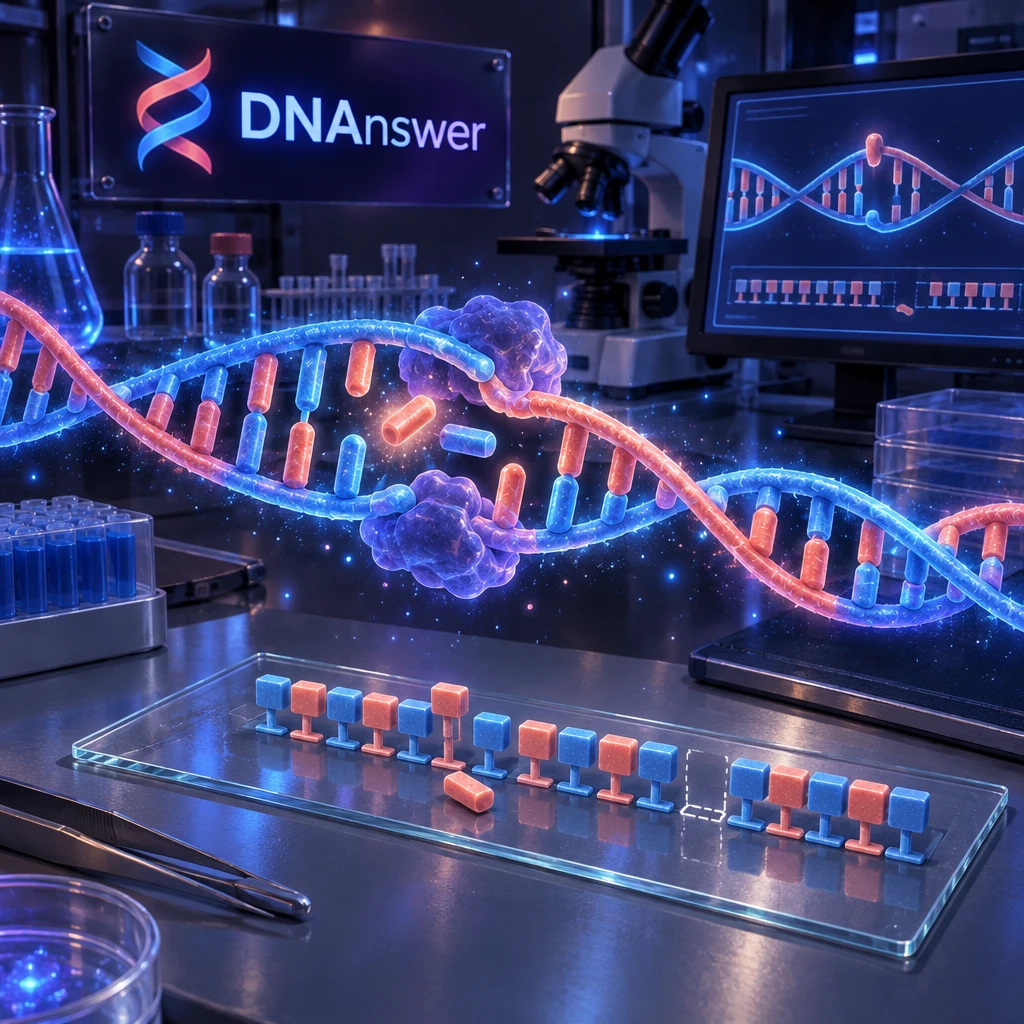
Not every mutation swaps one letter for another. Some add or remove letters. Before we get to why those are so destructive, it helps to know how they start.
The best-known trigger is polymerase slippage. Where DNA contains a run of the same letter, or a short repeating pattern like CACACA, the copying enzyme can lose its place. The template strand and the new strand briefly loop out and re-pair with a shift. If the new strand loops, a letter or two gets added. If the template loops, letters get skipped.
Repeats are slippage hot spots because the shifted pairing still matches almost perfectly, so mismatch repair has a harder time noticing. Frameshifts also tend to cluster in AT-rich stretches. Deletions are the more common route to a frameshift than insertions.
The second source is the repair route above: error-prone joining of broken ends. A stalled or collapsed replication fork (the Y-shaped spot where the helix is unzipping and being copied) can produce those breaks.
Rates are lower than for single-letter swaps. Small insertions and deletions of 1 to 3 base pairs occur at about 0.6 and 0.3 per billion base pairs per generation, respectively. Larger deletions are rarer still, and they remove about 800 bases on average, though sizes vary enormously.
Myth: A Frameshift Is Just Another Point Mutation
A point mutation changes one letter. A frameshift also changes the number of letters. It sounds like a small difference, so why make a fuss? Because of how cells read genes.
Cells read a gene in three-letter words called codons, each of which specifies one amino acid (a building block of proteins). The reading starts at a fixed point and moves in steps of three. That fixed grouping is the reading frame.
The sentence analogy
Take this sentence of three-letter words: THE CAT SAW THE DOG RUN. Now swap one letter, a point mutation: THE CAT SAW THE DIG RUN. One word changes, and you can still read the rest.
Now delete the first E, a frameshift: THC ATS AWT HED OGR UN. Every word after the deletion is different, and the sentence is gibberish. Nothing else was touched. The grouping moved.
A frameshift mutation is an insertion or deletion of nucleotides, in numbers that are not multiples of three, that shifts the reading frame of the codons. — paraphrasing the standard definition
Why the damage runs so deep
In a real gene, a shifted frame changes every amino acid from the mutation to the end of the gene. It often also produces an early stop signal, because stop codons appear by chance in the wrong frame. The cell then builds a short, useless protein, or none at all.
Tay-Sachs disease, which damages nerve cells, is one example linked to a frameshift in a gene. Sickle cell disease, by contrast, is a classic point mutation, a single-letter change in the beta-globin gene.
Insertions or deletions in multiples of three are different. Lose three letters and you lose one whole word, but the rest stays readable. Occasionally one frameshift is cancelled by a second nearby one that restores the frame.
Point Mutations: Silent, Missense and Nonsense
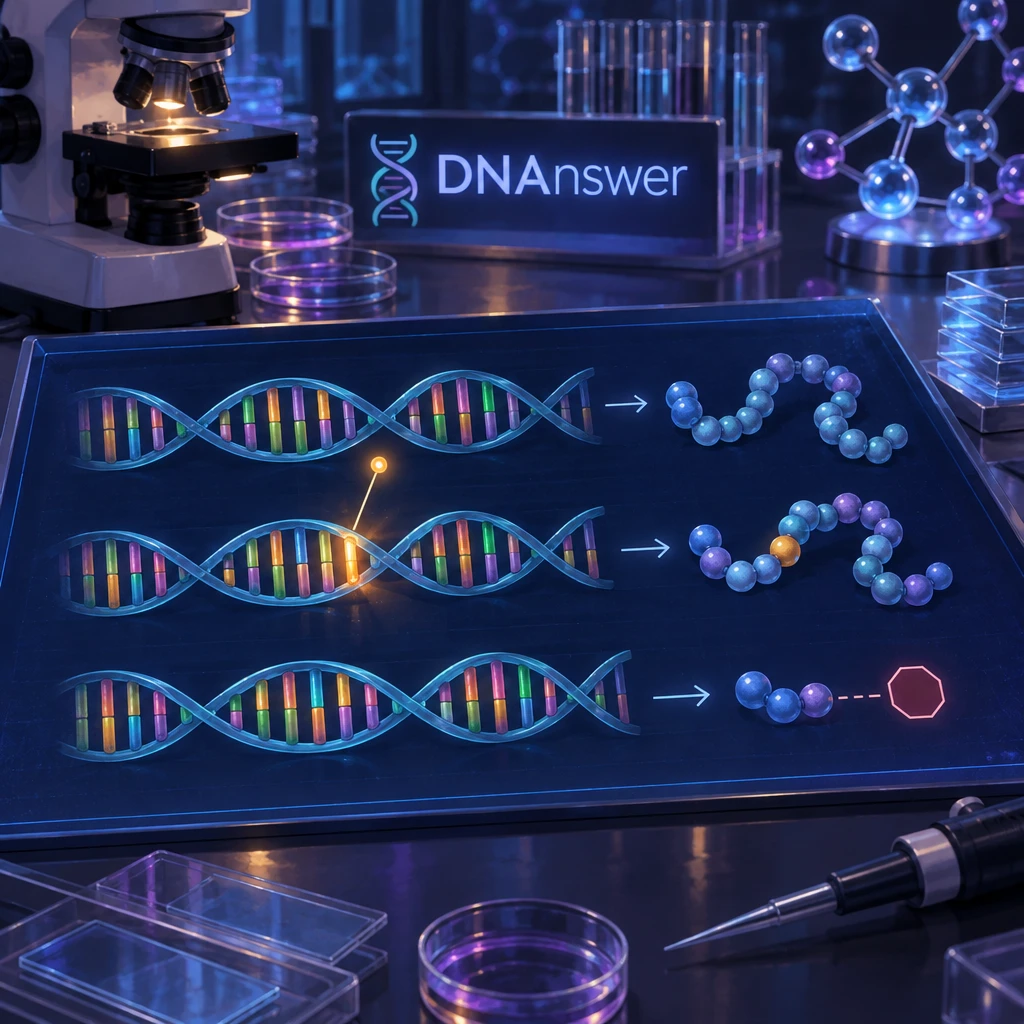
Single-letter swaps are the most common mutation type, and they come in three flavors. Their effects range from nothing to severe.
- Silent: the new codon codes for the same amino acid. Several codons often mean the same thing, so the protein is unchanged.
- Missense: the new codon codes for a different amino acid. The effect depends on where the swap lands and how different the new amino acid is.
- Nonsense: the new codon is a stop signal, so the protein is cut short.
Sickle cell disease is a missense case. One swapped amino acid makes hemoglobin clump under low oxygen. A nonsense mutation typically hits harder than a missense one, because the protein is truncated from that point on. A frameshift is often worse than either, since it alters the whole stretch after the change.
Myth: Every Mutation Is Harmful
Movies treat mutation as a synonym for disaster. That image has a basis: mutations in genes that stop tumors, such as TP53, or that drive growth, such as KRAS, help cause cancer. Inherited mutations also cause many genetic disorders.
But the full picture has three outcomes. Many mutations are neutral. Most of the genome does not code for protein, and silent changes alter nothing. Some are harmful. A few are beneficial, and those are the raw material of evolution. Without new variants, populations could never adapt.
Germline versus somatic
Where a mutation happens matters as much as what it is. A somatic mutation occurs in a body cell, such as skin or liver. It affects that cell and its descendants, and it stops with you. A germline mutation occurs in cells that make eggs or sperm. It can pass to children and appears in every cell of theirs.
That is why a UV-induced skin mutation can contribute to your melanoma but cannot pass to your kids, while a germline change can.
Practical takeaway: judge a mutation by its location and effect, not by the word itself. Everyone carries dozens of new mutations that their parents lacked, and almost all of them do nothing noticeable.
Conclusion
Next time you read that something "causes mutations," ask which layer it touches: does it add damage, strain the copying, or weaken repair? Cut damage with sunscreen and by not smoking, because that leaves repair less to handle. Accept that some mutation is built into life. If you want to test your grasp of replication and repair, DNAnswer has free quizzes on exactly these steps.
Frequently Asked Questions
What causes DNA copying errors?
Copying errors come mainly from polymerase adding a mismatched base, often through wobble pairing or a temporary chemical form of a base. Repeated sequences also cause slippage. Proofreading and mismatch repair catch most of these errors.
What is the cause of frameshift mutations?
Frameshifts come from insertions or deletions that are not a multiple of three letters. Polymerase slippage in repeats is one common cause. Error-prone rejoining of broken DNA ends is another.
Does DNA damage always lead to a mutation?
No. Repair fixes most damage. Fewer than 1 in 1,000 chemically induced lesions becomes a permanent mutation. Damage turns into a mutation only if the cell copies it or repairs it wrongly.
Can mutations happen without any outside cause?
Yes. Spontaneous mutations arise from copying slips and from DNA's own chemical instability, such as deamination. They happen in every dividing cell, with no radiation or toxin involved.