What Is DNA Methylation? A Clear Biology Guide
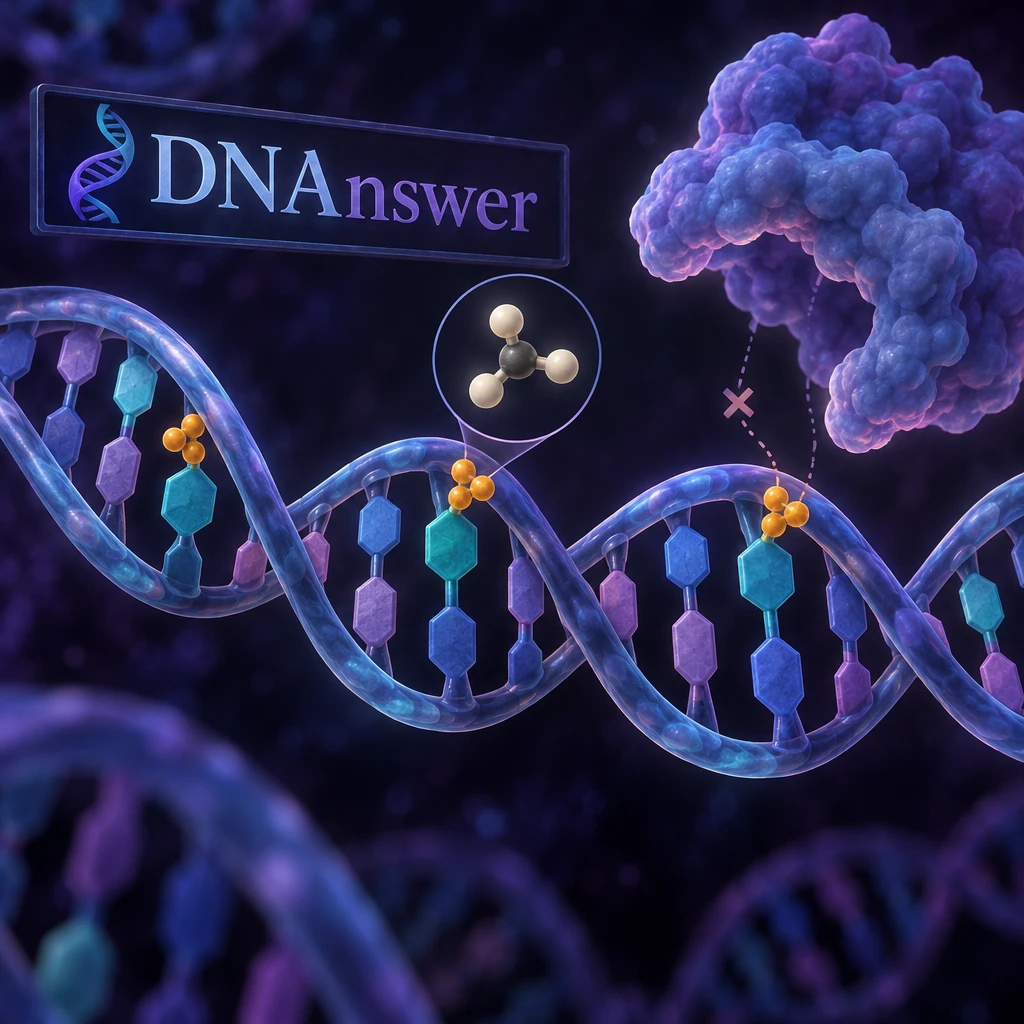
Does DNA methylation change your genes? No. Your DNA letters stay exactly the same. Methylation adds tiny chemical tags on top of those letters, and the tags change how your cells read them. Think of sticky notes on a cookbook. The recipes stay put. The notes tell the cook which pages to skip.
That's what DNA methylation is in simple words: a tagging system your cells use to decide which genes stay active. It sounds simple. The details get much stranger, and the most popular shortcuts about it are wrong in ways that matter.
Key Takeaways
- Methyl tags sit on DNA without changing its letter sequence.
- Location decides the effect: silencing at promoters, other jobs elsewhere.
- Too much or too little methylation can both drive disease.
- Cells copy most tags at division, and some tags shift over time.
- Epigenetic clocks measure patterns. They don't prove rejuvenation.
The sticky-note model, explained in five terms
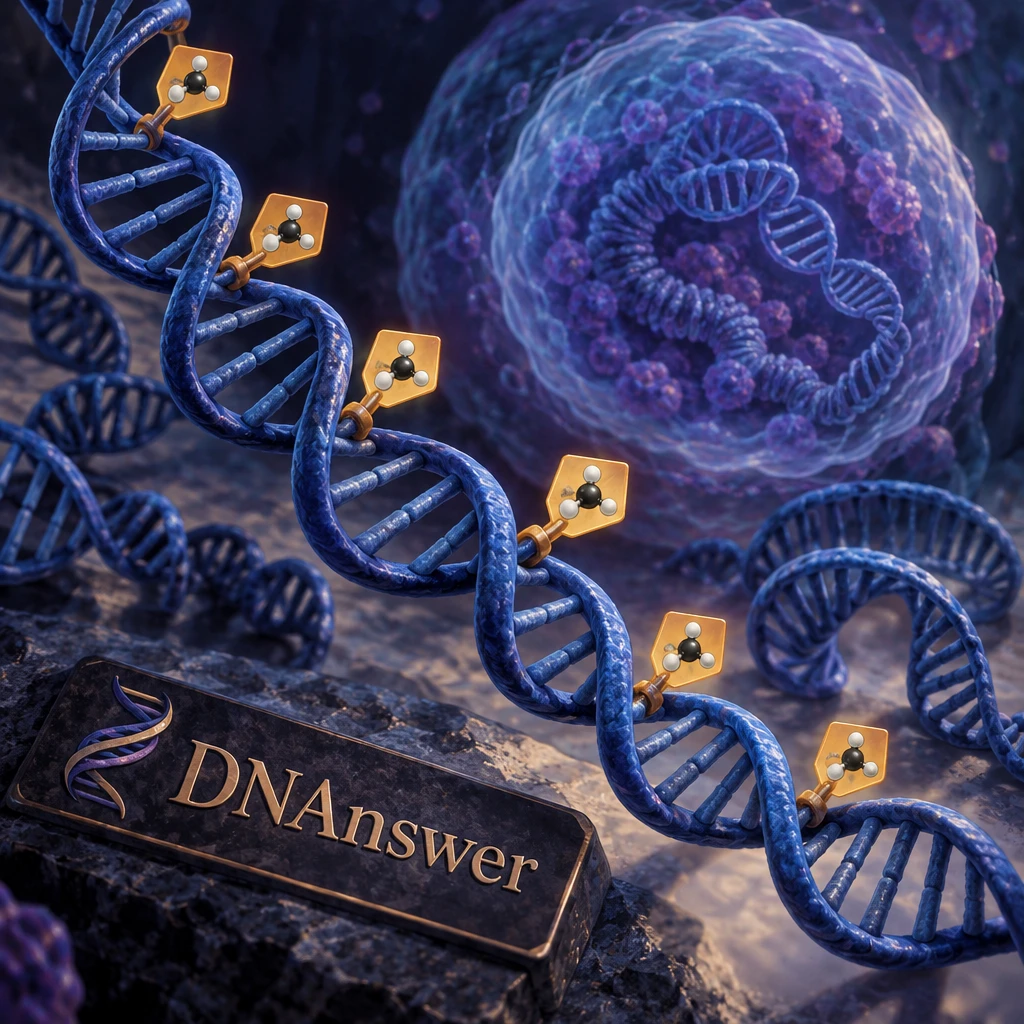
Start with the parts. Each one is small, and you can picture each one.
The tag and the letter
A methyl group is one carbon atom attached to three hydrogen atoms. It's one of the smallest chemical units in biology. Your DNA spells its instructions with four letters: A, T, G and C. Methyl tags usually land on C, which stands for cytosine. They attach at a specific spot on the cytosine ring, called the fifth carbon. A tagged cytosine (5-methylcytosine) shows up so often that some researchers call it the "fifth base" of DNA.
Where tags land
In humans, most tags sit at CpG sites. These are places where a C sits directly before a G on the same strand. Your genome holds about 28 million CpG sites. Enzymes called DNA methyltransferases (DNMTs) add the tags. The tag's raw material comes from a molecule called SAM. Your body makes SAM with help from folate, vitamin B12 and vitamin B6.
Epigenetics: changes in how your cells use DNA that don't alter the DNA sequence itself. DNA methylation is the best-studied example.
Why the tags matter
Gene expression means how much a cell actually uses a gene, usually to make a protein. Every cell in your body carries the same DNA, roughly. A neuron and a liver cell still behave very differently because they express different genes. Methylation patterns help lock in those choices. That makes them part of how each cell keeps its identity.
Myth 1: "Methylation switches genes off. That's all it does"
Picture a gene's promoter, the stretch of DNA just before a gene where the cell's reading machinery docks. Heavy methylation there usually shuts the gene down. Proteins called transcription factors can't bind properly, and the surrounding DNA packs into a tight, silent state. This picture is real. It also explains why the myth spread.
The original textbook story came from promoters, and the National Human Genome Research Institute's glossary still describes methyl groups turning a gene "on or off." So the belief has a solid kernel. The trouble starts when you assume it works the same way everywhere.
Location changes the meaning
Inside the body of an active gene, past the promoter, methylation is often high in genes that are busy. There, it isn't a mute button. It seems to help keep reading tidy and to stop the cell from starting transcription at the wrong place. Same tag, different spot, nearly opposite association.
Context changes it too
A CpG tag that silences a gene in your skin cells may sit on a gene your blood cells never use anyway. The tag's effect depends on which proteins in that cell can read it. Researchers keep finding important signals outside the classic promoter regions. In a November 2026 study of 98 patients with myelodysplastic syndromes (a group of blood cancers), some of the strongest predictive methylation signals came from regulatory regions beyond the parts of DNA scientists had traditionally focused on.
What to do with this
When you read "gene X is methylated," ask where. A headline that skips the location skips the meaning. Promoter methylation usually signals silence. Methylation elsewhere needs its own explanation.
Myth 2: "Methylation is bad, so less is better"
This myth often arrives through wellness marketing, and it borrows a real finding. Cancer cells frequently gain methylation at the promoters of tumor-suppressor genes, the genes that normally brake cell growth. Silence the brakes and growth runs unchecked. If methylation can do that, cutting it back sounds sensible.
It isn't. Your cells need the right amount in the right places. Both gains and losses can contribute to disease. Cancer shows both at once: tumors often lose methylation across large stretches of the genome while gaining it at specific promoters. Each change causes its own damage.
The everyday jobs you'd lose
Methylation does constant maintenance work you never notice. Here are four examples:
- Taming jumping genes. Transposable elements are DNA sequences that can copy or move themselves around the genome. They make up a large share of your DNA. Methylation keeps most of them quiet, so they can't hop into important genes.
- Genomic imprinting. For a small set of genes, your cells use only the copy from one parent. Methylation marks which copy stays silent. When imprinting fails, disorders such as Prader-Willi syndrome and Angelman syndrome can result.
- Locking cell identity. Methylation helps a skin cell stay a skin cell through decades of division.
- X-chromosome silencing. In female cells, methylation helps keep one of the two X chromosomes switched off.
Bacteria use it too
Bacteria run their own version as a defense system. Some species tag the sequence GAATTC on their own DNA. Their cutting enzymes then chop up unmarked, invading DNA from viruses and spare the cell's own genome. Methylation started out as a security badge long before it became a gene regulator.
The practical point is simple. Treat any product or claim that promises to "reduce methylation" as a red flag. Healthy biology depends on balance, not on minimizing the tags.
Myth 3: "Methylation is either permanent or totally random"
You'll hear two opposite claims. One says your methylation pattern is fixed, a second genome you can't touch. The other says it shifts with every meal and mood. Each side has evidence. Neither has the full picture.
What stays stable
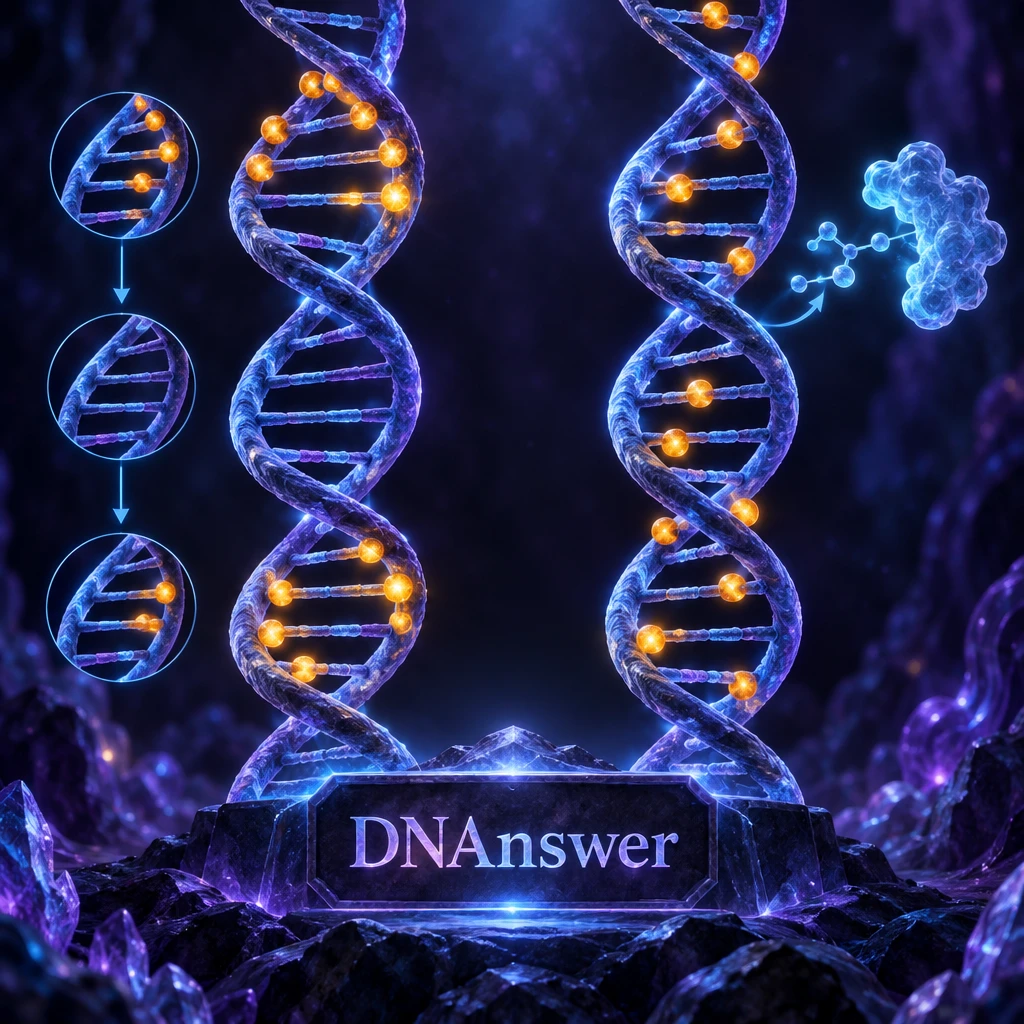
Every time a cell divides, it copies its DNA. The new double strand starts out with tags on the old strand only, a state called hemimethylated. An enzyme called DNMT1 spots these half-marked sites and adds the missing tag to the new strand. That's how the pattern passes from cell to daughter cell. Most marks stay put across your life, with small changes that depend on the tissue.
What changes
Two other enzymes, DNMT3A and DNMT3B, place brand-new tags (scientists call this de novo methylation). They work hardest in early development, when the embryo writes its patterns from scratch. Cells can also remove tags. If DNMT1 doesn't copy the marks, they fade with each division. That's the passive route. In the active route, a family of enzymes called TET (TET1, TET2 and TET3) changes the methyl group step by step. A repair system then swaps in a clean cytosine.
The overall picture: most methylation marks stay stable, but about 10% to 20% vary over time, on average. So your cells hold a durable memory with room for editing. When a claim treats your methylation as either frozen or freely adjustable, you can file it as too simple.
Myth 4: "A younger epigenetic age means you're aging backward"
Suppose you take a methylation-based age test and get a biological age five years below your actual age. Six months later, after a new routine, it reads seven years below. The obvious conclusion is that you reversed two years of aging. That conclusion goes too far.
The tests are built on real science. Certain CpG sites gain or lose methylation in strikingly predictable ways as people get older. Statistical models called epigenetic clocks combine hundreds of these sites to estimate age, often within a few years. Some versions track health risks better than calendar age does. So the belief has substance behind it.
Measuring a pattern isn't changing aging
A clock reads a pattern that tends to go along with aging. It doesn't show that the pattern drives aging. Compare gray hair. It tracks age well, and dyeing it doesn't make you younger. If an intervention shifts the clock reading, you know the measured CpG sites changed. You don't yet know whether your tissues work any better, or whether you'll live longer.
Why the numbers wobble
Readings depend on which tissue the lab samples (blood and saliva can disagree), which clock it uses, and how it processes the data. A two-year shift can sit inside the normal variation of a test.
Read a clock result as an interesting snapshot, not a verdict. Clinical outcomes still decide whether anything really slowed aging: strength, disease rates, survival. Methylation estimates describe patterns. They don't establish rejuvenation.
Myth 5: "Scientists can read every methylation tag in one easy test"
Genome sequencing has gotten fast and cheap, so it seems natural that methylation would just come along with it. It doesn't, at least not by default. Standard sequencing reads A, T, G and C. A methylated C reads as a plain C.
The bisulfite trick
The classic workaround treats DNA with sodium bisulfite. This chemical converts unmethylated C into a different letter (uracil, which sequencing reads as T). Methylated C stays as C. Compare the treated sequence with the original, and every C that survived was tagged. Whole-genome bisulfite sequencing is the gold standard. It can map all ~28 million CpG sites.
The catches
That full map costs a lot and needs heavy computing. Bisulfite also damages DNA, with degradation that can reach 90%, and roughly 10% of CpG sites become hard to match back to the genome afterward. Many large studies use arrays instead. Arrays cost less, but they cover only about 4% of CpG sites. Newer chemistries, such as Illumina's 5-base approach, convert only the methylated C and avoid the damage. That lets one test read the four regular letters and the methyl tags together.
The takeaway for you: when a study or a test reports "genome-wide methylation," check whether it means 4% of sites or all of them. The answer shapes how much the result can tell you.
Where methylation meets medicine

Methylation already shapes treatment. Drugs called DNA methyltransferase inhibitors, such as azacitidine, block the tagging enzymes. Doctors use them for myelodysplastic syndromes, where too much methylation silences useful genes. Not every patient responds, and doctors have lacked a reliable way to predict who will.
That's where the November 2026 study comes in. It grouped its 98 patients into seven clusters by methylation pattern. One group, labeled Cluster VI, carried relatively few DNA mutations and showed a 71% response rate. Methylation predicted response better than gene activity alone. The researchers were clear, though: more work comes before routine use.
That's typical for this field. Methylation signals look promising for diagnosis, prognosis and drug choice. Most of them are still being tested.
Your next move
Keep the sticky-note model. Then always ask two follow-up questions: where on the DNA, and in which cell? Those two questions handle most of the confusion in methylation headlines. If you want to see whether the model held up, try DNAnswer's molecular biology quizzes. No account is needed to start.
Frequently Asked Questions
What is DNA methylation in simple words?
DNA methylation is a tiny chemical tag that your cells attach to DNA, usually on the letter C. It doesn't change your genetic code. It changes how your cells read that code, often turning genes down or off.
Is DNA methylation good or bad?
It's neither. It's essential. Your cells use it to silence jumping genes, maintain cell identity and control imprinted genes. Problems start when patterns go wrong, with too much methylation in some places or too little in others.
Can diet change your DNA methylation?
Partly. The tags' raw material, SAM, depends on folate, vitamin B12 and vitamin B6, so severe deficiencies can affect methylation. A normal varied diet usually covers this, and supplements haven't been shown to fine-tune specific genes.
Is DNA methylation inherited from your parents?
Mostly, no. Embryos erase and rewrite most methylation early in development. Imprinted genes are the main exception. They keep a parent-specific mark, so a gene's activity can depend on whether it came from your mother or your father.