What Is Genetic Recombination? How Chromosomes Shuffle Your DNA
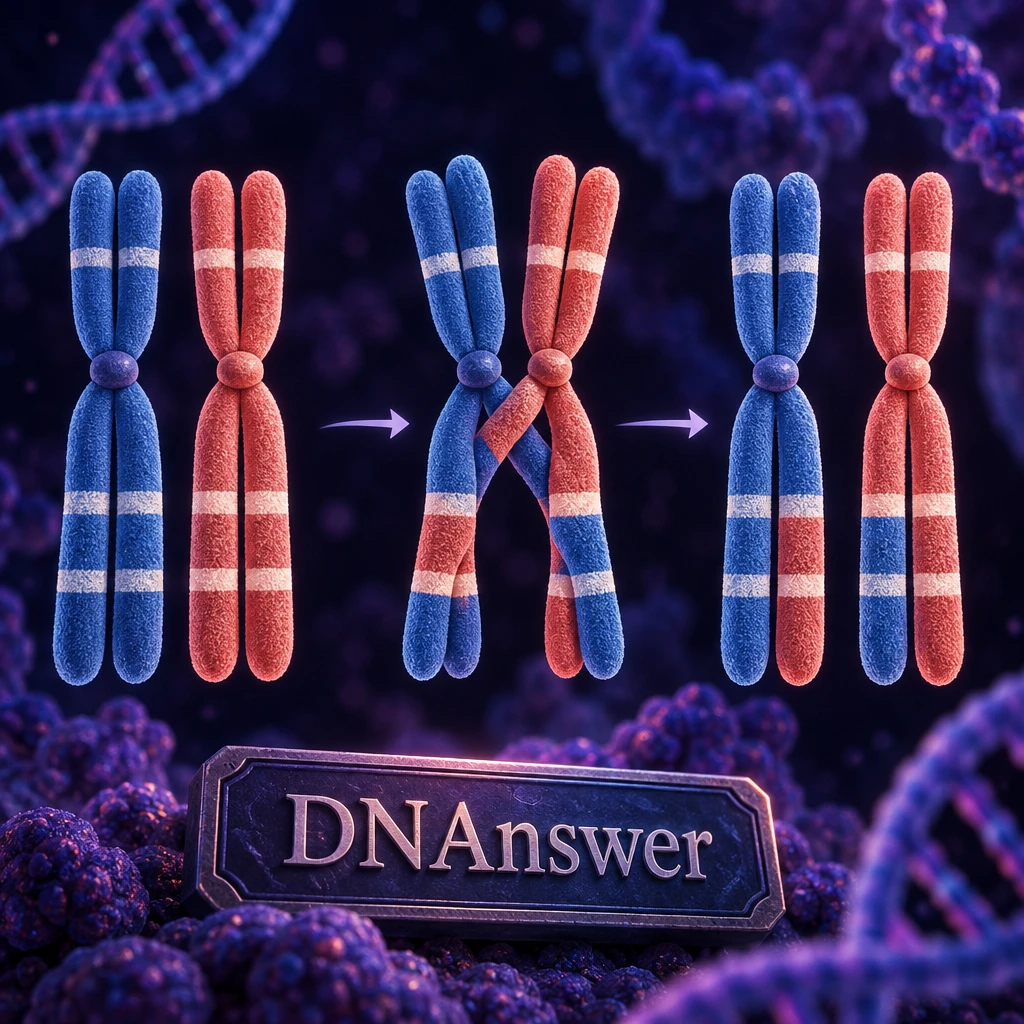
Why aren't you a perfect 50-50 blend of your parents? You got half your DNA from each of them, so in theory you should be a neat average. You're not, and neither is your sibling.
The answer is genetic recombination. It means rearranging DNA so that old pieces end up in new combinations. Before your mother made the egg that became you, her own chromosomes swapped stretches with each other. Your father's did the same in sperm. So you carry DNA from all four grandparents, cut and spliced in a pattern nobody had before you.
Key Takeaways
- Recombination rearranges existing DNA. It doesn't rewrite the sequence.
- Crossing over happens in prophase I of meiosis.
- Humans average about 2-4 crossovers per chromosome.
- Your cells also use recombination daily to repair broken DNA.
- X and Y swap DNA only at their matching tips.
- Faulty recombination repair, as with BRCA1/2, raises cancer risk.
Recombination in plain English
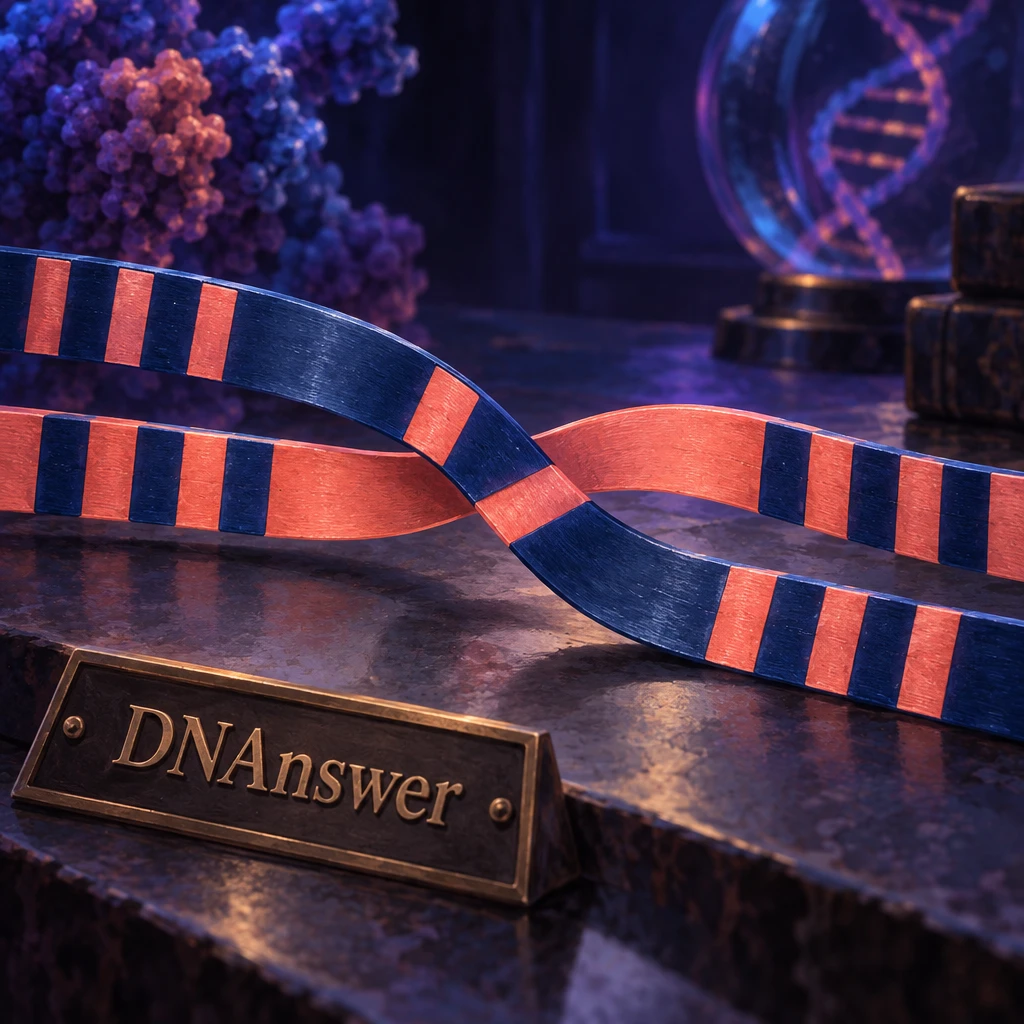
Picture two decks of cards, one from each grandparent. Before dealing a hand, you cut matching sections from each deck and swap them. The deck you hand down is new, but every card in it already existed.
That's recombination. Your DNA sits in chromosomes, which are long, tightly packed threads of DNA. You have 23 pairs, 46 in total. One chromosome in each pair came from your mother and one from your father. Scientists call the two members of a pair homologous chromosomes. That just means matching chromosomes: same genes in the same order, but possibly different versions of those genes.
Recombination swaps corresponding stretches between those matching chromosomes. The result is a chromosome that is part grandma and part grandpa, glued together seamlessly.
Homologous recombination: an exchange of DNA between two similar or identical DNA molecules. During egg and sperm formation, it is an important source of the variation seen among siblings. (Definition based on the National Human Genome Research Institute's genetics glossary.)
How crossing over actually works
Crossing over is the best-known form of recombination. It happens during meiosis, the special cell division that makes eggs and sperm. Meiosis only happens in the ovaries and testes.
The setup
Meiosis has to halve your chromosome count. If an egg and a sperm each carried 46 chromosomes, the baby would end up with 92. So each one carries 23, one from every pair.
Before dividing, the cell copies every chromosome. Each copy stays attached to its original, so each chromosome now looks like an X made of two identical arms. Each arm is a chromatid, a single DNA copy. Two copies of the same chromosome are sister chromatids. Copies from the two different matching chromosomes, one maternal and one paternal, are nonsister chromatids. That distinction matters for the next step.
The swap, step by step
- Pairing. In prophase I, the first stage of meiosis, each maternal chromosome finds its paternal partner. The two line up gene by gene, held together by a protein scaffold.
- Cutting. A protein called Spo11 cuts both strands of the DNA on purpose. This is called a double-strand break.
- Matching. The broken ends search the partner chromosome for the matching sequence.
- Swapping. The cell repairs the break using the partner as a template. Sometimes it joins the pieces across, so a stretch of a maternal chromatid ends up on a paternal one, and the reverse.
- Holding on. The crossover points, called chiasmata, keep the pair physically linked until the cell pulls them apart.
The main swapping window is a sub-stage called pachytene. It lasts hours to days in mammals.
How often it happens
In humans, each chromosome typically gets about 2-4 crossovers per meiosis. They can land almost anywhere along the chromosome arms, but the cell blocks them near the centromere, the pinched middle that the cell grabs to pull chromosomes apart. Crossovers there make chromosomes split up wrongly. Some spots, called recombination hotspots, get far more crossovers than others.
Those 2-4 crossovers do a second job. Pairs that fail to cross over often separate badly, and the egg or sperm can end up with too many or too few chromosomes. Down syndrome, for example, comes from an extra copy of chromosome 21.
Myth 1: "Recombination only happens when you make eggs or sperm"
This myth makes sense. Nearly every textbook introduces recombination inside a chapter on meiosis and sex. If that's the only place you've met it, it's natural to file it there.
But your skin, gut and blood cells use recombination every day, mostly for repair. When both strands of a DNA molecule snap, the cell has a problem. Radiation, some chemicals, or simply copying DNA can all cause these breaks. Gluing the ends back together blind can lose or scramble letters.
The safer fix is homologous recombination repair, which repairs DNA using a matching template. After a cell copies its DNA and before it divides, every chromosome has an identical sister chromatid sitting right beside it. The cell trims the broken end, lets it invade the intact sister, reads the correct sequence and rebuilds the gap. It's the same search-and-copy trick that drives crossing over, just used for repair instead of shuffling.
Look closely and the two jobs turn out to be the same machine. Meiosis even starts crossing over by breaking DNA on purpose and then "repairing" it from the partner chromosome.
So think of recombination as a toolkit your whole body runs, not a reproductive event. That shift makes the cancer link in Myth 5 make sense.
Myth 2: "Recombination is the same thing as mutation"
You can see where this one comes from. Both make your DNA different from your parents', both create genetic diversity, and both get called "changes to your genes." Many people treat them as synonyms.
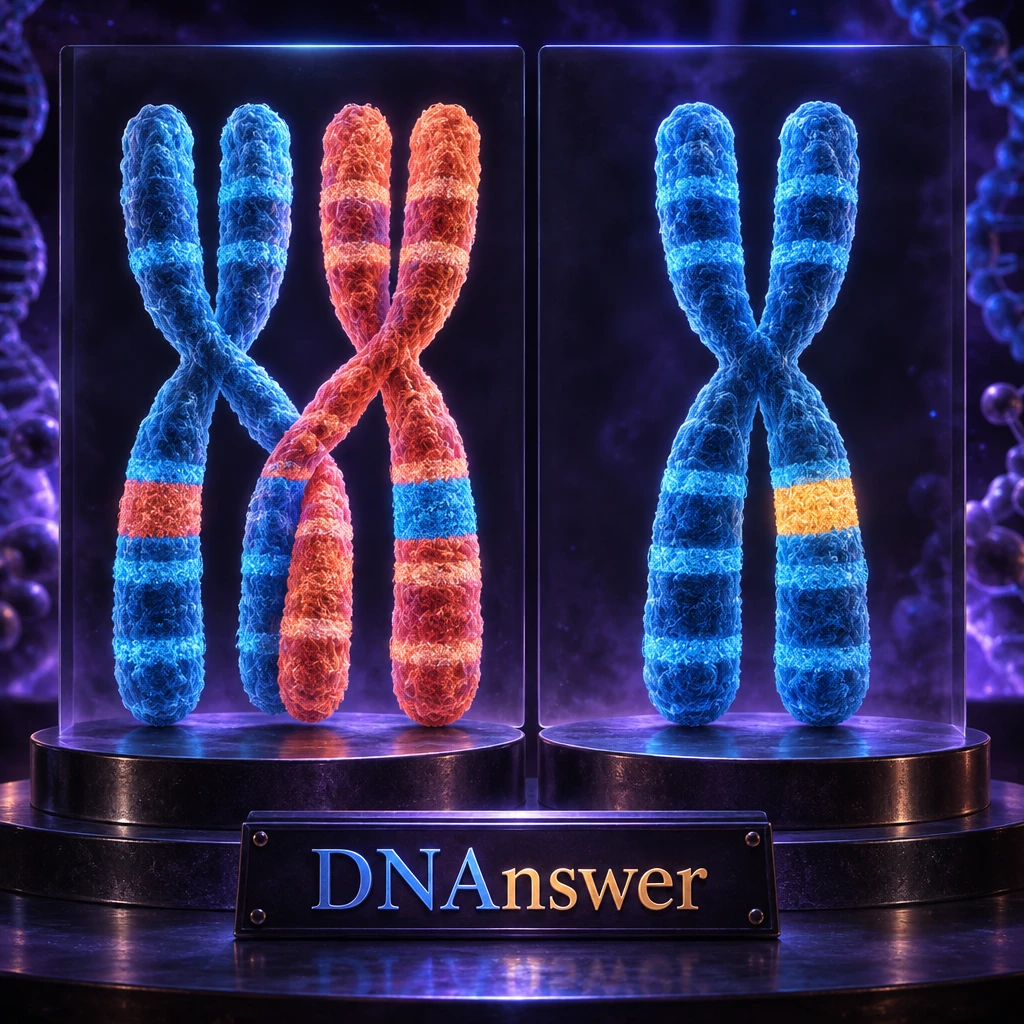
The difference is what changes. A mutation changes the DNA sequence itself. A letter flips from A to G, or a few letters drop out. Recombination keeps the letters. It changes which existing versions sit together on the same chromosome.
Back to the cards. A mutation is a printing error that turns a seven of hearts into an eight. Recombination is a reshuffle. Every card is genuine, but the hand is new.
Take two genes that sit near each other on chromosome 15. Grandma had version A of one gene and version B of the other. Grandpa had a and b. Without recombination, your mother could only pass on AB or ab. After one crossover between them, she can pass on Ab or aB. No letter changed, yet that combination never existed before.
Each child also carries a small number of brand-new mutations that arose while the egg or sperm formed. They're real, but they're a separate process.
This matters in practice. If a genetic report says you carry a "variant," that's about sequence. If a family tree puzzle asks why you and your sibling inherited different traits, that's mostly about shuffling.
Myth 3: "Crossing over is why every egg and sperm is different"
Crossing over gets so much attention that people assume it's the whole story. It's dramatic, it's visible under a microscope as chiasmata, and it's what most diagrams show.
But there's a second shuffle, and in one sense it's bigger.
Independent assortment shuffles whole chromosomes
During the first split of meiosis, each matching pair lines up in the middle of the cell. Which member goes to which side is random, and each of the 23 pairs decides on its own. That's independent assortment: chromosome pairs sort into eggs or sperm separately from each other.
Do the math. Each pair has 2 options, so 23 pairs give 2 × 2 × ... 23 times, which equals 8,388,608 possible combinations. That's more than 8 million different eggs or sperm per person before a single crossover happens.
Crossing over shuffles within chromosomes
Independent assortment moves whole chromosomes around like dealing whole decks. Crossing over cuts and splices inside each chromosome. Together they make the number of possible eggs or sperm effectively endless.
Keeping the three straight
- Mutation: changes the DNA letters.
- Crossing over: swaps stretches between matching chromosomes in prophase I.
- Independent assortment: randomly sorts whole chromosomes into eggs or sperm.
- Fertilization: combines one random egg with one random sperm.
When you explain why siblings differ, name both shuffles. Otherwise you're crediting crossing over with work that random sorting does.
Myth 4: "X and Y don't recombine, so they decide sex by chance"
Here's the reasoning behind this one. The X and Y look nothing alike. The X is large and carries hundreds of genes. The Y is small and carries few. So it seems obvious they can't pair up, can't swap DNA, and must drift into sperm somehow.
Half of that is true. Most of the Y has no matching partner on the X, so it doesn't recombine. That's why the Y passes from father to son almost unchanged, which makes it so useful for tracing paternal ancestry.
The other half is wrong. The tips of the X and Y share matching sequences called pseudoautosomal regions. In sperm formation, the X and Y pair up at those tips and usually cross over there. That small exchange matters. It holds the two together so the cell can separate them properly.
Which one a sperm gets has nothing to do with recombination. It comes down to separation. In the first split of meiosis, the X goes to one side and the Y to the other. After the second split, you get four sperm: two carrying an X and two carrying a Y. An egg always carries an X, so the sperm decides the baby's sex.
When this goes wrong, it shows. If X and Y fail to separate, a sperm can carry both or neither. That error is one route to conditions such as Klinefelter syndrome (XXY).
Myth 5: "Recombination has nothing to do with cancer"
It's a fair assumption. Cancer comes from mutations, and recombination isn't mutation, as Myth 2 explained. So why connect them?
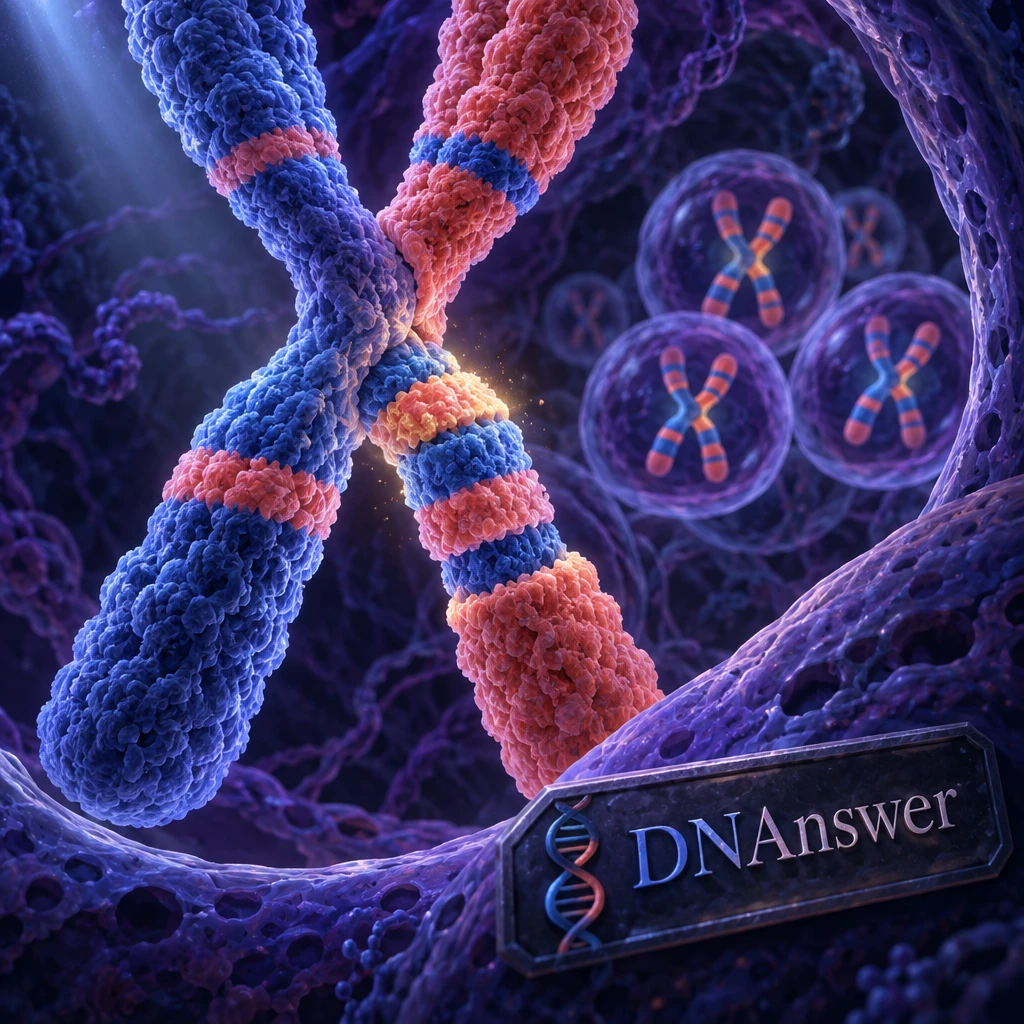
Because recombination repair is one of your main defenses against mutation. Remember the repair crew from Myth 1. When it works, a double-strand break gets fixed with the correct sequence. When it doesn't, the cell falls back on sloppier repair that loses and scrambles DNA. Damage then piles up, and some of it lands in genes that control cell growth.
The best-known example involves two genes, BRCA1 and BRCA2. Their proteins help run homologous recombination repair. People who inherit a faulty copy have a much higher lifetime risk of breast and ovarian cancer, and a raised risk of prostate and pancreatic cancer too. Repair is impaired, so errors build up faster.
Medicine has turned this weakness into a target. Drugs called PARP inhibitors block a backup repair route. Healthy cells survive because they still have recombination repair. Tumor cells that lack working BRCA repair lose both routes and die. Doctors call this synthetic lethality, meaning two hits together kill a cell when either alone wouldn't.
So the link is real. If cancer runs in your family, especially breast or ovarian cancer on one side, ask a genetic counselor about BRCA testing. A blood or saliva test can show whether you carry a variant.
Test what you just learned
You now know recombination as a card shuffle, a repair kit, and the reason you're one of a kind. If you want to check that it stuck, take the free molecular biology quizzes on DNAnswer and see where you land on the leaderboard.
Then try one thing on your own. Pick one trait you share with a grandparent but not your parent, and trace which shuffle could explain it.
Frequently Asked Questions
What is genetic recombination, in simple terms?
Genetic recombination is the rearranging of existing DNA into new combinations. In egg and sperm formation, matching chromosomes from your parents swap stretches, so each child gets a unique mix from all four grandparents.
When does crossing over happen?
Crossing over happens in prophase I, the first stage of meiosis, mainly during a sub-stage called pachytene. It doesn't happen in ordinary cell division, though your body cells use related recombination machinery to repair broken DNA.
Can recombination cause genetic disorders?
Yes, when it goes wrong. Too few crossovers can make chromosomes separate badly, leading to conditions like Down syndrome. Crossovers between similar but mismatched stretches can also delete or duplicate genes.
Do siblings share exactly 50% of their DNA?
Not exactly. Siblings share about 50% on average, but real pairs vary around that figure because crossing over and independent assortment deal each child a different hand. Only identical twins share essentially all of it.