Do Humans Share DNA With Bananas? What the Similarity Means
Your cells, the tiny living units that make up your body, use molecular tools related to those in a banana plant. So, do humans share DNA with bananas? Yes. DNA, the molecule that stores biological instructions, carries traces of that ancient connection.
The familiar 50% and 60% claims do not describe a letter-for-letter match across all your DNA. They usually concern genes, stretches of DNA that help cells function, or the molecules those genes help produce. The distinction changes what you can reasonably conclude from that surprising percentage.
Key Takeaways
- Gene counts and DNA letter matches measure different things.
- Every percentage needs a clear total and matching rule.
- Shared cellular tools reflect ancient common ancestry.
- Chimpanzees and bonobos are your closest living relatives.
- Fruit rankings need consistent comparison methods.
Myth: Half your complete DNA matches a banana
Imagine highlighting half the letters in your DNA and finding the same sequence in a banana. The viral statistic invites that picture. Neither 50% nor 60% establishes that kind of whole-DNA match.
Your genes and your genome describe different things
Your genome, your complete set of DNA, contains much more than instructions for making proteins. Proteins are molecules that build structures, carry signals, and perform much of a cell’s work.
Protein-coding genes contain instructions for making proteins. The portions that directly specify protein building blocks account for about 2% of your genome. Genes also contain other sections, so describing all genes as just 2% of your DNA oversimplifies the picture.
Other DNA helps control when and where cells use those instructions. Some sections support chromosome structure, the organization of DNA into long packages. Much of your DNA does not directly specify proteins, and scientists continue to investigate what different sections do.
A comparison of protein-coding instructions therefore samples a particular part of your biology. It leaves much of your complete DNA outside the calculation.
What the familiar banana statistic counted
A 2013 comparison by Lawrence Brody at the National Human Genome Research Institute helped popularize the banana connection through a museum video. The work compared predicted proteins from banana genes with human proteins.
The widely circulated 60% result concerned banana genes whose protein products had recognizable human counterparts under that comparison’s rules. A counterpart here means a related molecule that researchers can identify through meaningful similarities.
That makes the original question narrower: how many banana protein products have a recognizable relative among human proteins?
When you encounter the 50% version, you still need that same context. Rounding or retelling a gene comparison cannot turn it into a measurement of every DNA letter. Keep the interesting biological connection; ask for the actual comparison before repeating the percentage.
Myth: A shared gene means identical DNA
Find a human gene and a banana gene that perform related jobs, and you have a real biological connection. You have not yet shown that their DNA letters match throughout. A recognizable relationship and an exact sequence match answer different questions.
Related instructions can contain different letters
DNA uses four chemical building blocks, which scientists represent with the letters A, T, C, and G. A sequence means the order of those letters.
Over generations, changes can alter a gene’s sequence while leaving much of its function intact. Some DNA changes even preserve the protein instruction because several different DNA letter combinations specify the same protein building block.
Proteins have their own sequences. Their building blocks, amino acids, join in chains that fold into working shapes. Researchers can compare those chains directly, even when the DNA instructions show additional differences.
Sequence identity measures the fraction of compared positions that contain exactly the same letter or building block.
That definition adds an essential boundary: the stretch you compare. A high identity score for one protein, or part of one gene, tells you about that particular stretch.
Evolutionary counterparts need their own definition
Researchers call genes orthologs when those genes descend from the same gene in the common ancestor of two species. This label describes their evolutionary relationship. It does not promise identical instructions or exactly identical jobs.
For distant relatives such as you and a banana plant, researchers often compare proteins because protein similarities can preserve useful clues across long periods of change.
You also cannot calculate your whole-DNA similarity by multiplying a gene-match percentage by the protein-coding share of your genome. Genes have different lengths, and a recognizable counterpart can contain many different letters. Those measurements count different things.
Before you interpret “shared,” decide whether the claim means a related gene, an exact DNA match, or similarity between proteins.
Myth: Different percentages mean someone got the biology wrong
Search for the banana statistic and you will encounter conflicting numbers. That looks suspicious for an honest reason: percentages usually sound precise. Yet researchers can produce different, valid answers when they ask different questions.
A stricter search counts a different kind of relationship
A comparison using OMA, a database that identifies genes with shared evolutionary origins, found banana counterparts for about 25% of human genes. That result used evolutionary gene relationships rather than simply accepting every recognizable protein similarity.
The rounded counts make the calculation concrete: about 5,000 matching human genes out of about 20,000 human genes gives about 25%.
That figure does not replace every other banana number. It answers a particular question with a particular method. A broad search for related proteins and a stricter search for evolutionary counterparts can draw different boundaries around a match.
The comparison’s direction matters, too. Starting with human genes asks what fraction have banana counterparts. Starting with banana genes asks the reverse. Species have different numbers of genes, and one gene in one species can correspond to several related copies in another.
Read a percentage in three steps
Before sharing a claim, work through these questions:
- What did researchers count? Look for DNA letters, genes, or protein building blocks. Each describes a different level of biological information.
- What total did they use? The denominator, the total beneath a fraction, might include every gene they searched or only the stretches they could meaningfully compare.
- What qualified as a match? Exact letters, recognizable protein similarity, and a specific evolutionary relationship need different rules.
Here is a deliberately simplified example. Suppose you examine 100 genes and identify counterparts for 60. Your gene-match result equals 60%.
Now compare a 100-letter stretch from one matched pair. If 80 positions contain the same letter, that stretch has 80% sequence identity. Both results can describe the same project without any contradiction.
Neither number tells you the identity across the complete genomes. The first counts genes; the second counts positions within one selected stretch.
Database updates and different records of which genes a species has can also change results. A useful explanation makes those choices visible. When a post gives only a percentage, treat it as an unfinished claim rather than a complete measurement.
Myth: Shared genes make you partly banana
If you hear that you share a large fraction of your genes with a banana, “part banana” sounds like a reasonable joke. You already associate DNA with ancestry and identity. Across species, though, shared genes reveal the history of cellular tools, not ingredients in a biological recipe.
You share the jobs that keep cells alive
Picture a small scrape on your skin. Nearby cells copy their DNA and divide as your body repairs the surface. A growing banana root also needs cells to copy DNA accurately and divide.
Both organisms inherited versions of ancient machinery for those jobs. Researchers describe many such tasks as housekeeping functions, the routine work that keeps cells running.
Your cells and banana cells both need to:
- Copy DNA. Before division, a cell prepares another set of biological instructions.
- Repair damage. Cellular tools detect and correct many problems in DNA.
- Use chemical energy. Cells break down food molecules to power their work.
- Build and maintain proteins. Cells assemble working molecules and manage damaged ones.
Those shared demands explain why researchers keep finding related genes in organisms that look completely different.
The same tools can support different bodies
You cannot predict an organism’s shape by counting shared tools alone. You also need to understand when cells use each tool, how much they produce, and how the tools interact.
Gene regulation, the control of when and how strongly cells use genes, helps create those differences. Your nerve cells and skin cells contain largely the same DNA, yet they use different sets of instructions.
Across species, differences also involve additional genes, altered protein functions, and different patterns of growth. A banana plant has machinery for photosynthesis, the process that captures light energy to help make sugars. Your body relies on food for that chemical energy.
When you read a shared-gene claim, connect it to a job. “Both organisms need to copy DNA” tells you far more than treating a percentage as a measure of how banana-like you are.
Myth: You share nearly as much DNA with bananas as with monkeys
Place a banana percentage beside an animal percentage, and the gap can look smaller than you expect. The comparison feels fair because both numbers carry percent signs. First, establish whether they measure the same thing.
You share a much more recent common ancestor with other primates, the animal group that includes monkeys and apes, than with plants. Your closest living relatives include chimpanzees and bonobos. Both belong to the apes, as you do.
Human and chimpanzee lineages separated roughly 6 million years ago. The ancestors of your lineage and the banana lineage separated roughly 1.5 billion years ago. That enormous difference gave the human and plant branches far more time to change independently.
A broad human–chimpanzee DNA comparison gives about 96% similarity when it accounts for several kinds of sequence differences. Comparisons that focus only on stretches researchers can line up directly can produce higher percentages.
For close relatives, researchers can compare long stretches of DNA in corresponding positions. Between humans and bananas, many stretches have changed so much that researchers instead focus on recognizable genes or proteins. Putting those results in one ranking mixes different measurements.
You also share far more recent ancestry with monkeys than with bananas. Chimpanzees and bonobos are your relatives, rather than ancestors you descended from; your lineages share earlier ancestors.
The same reading rule applies to claims that you share 70% or 90% of your DNA with another animal. Look for the measurement before interpreting the number. A percentage of genes with counterparts cannot serve as a substitute for a percentage of matching DNA letters.
Myth: One fruit must share the most DNA with you
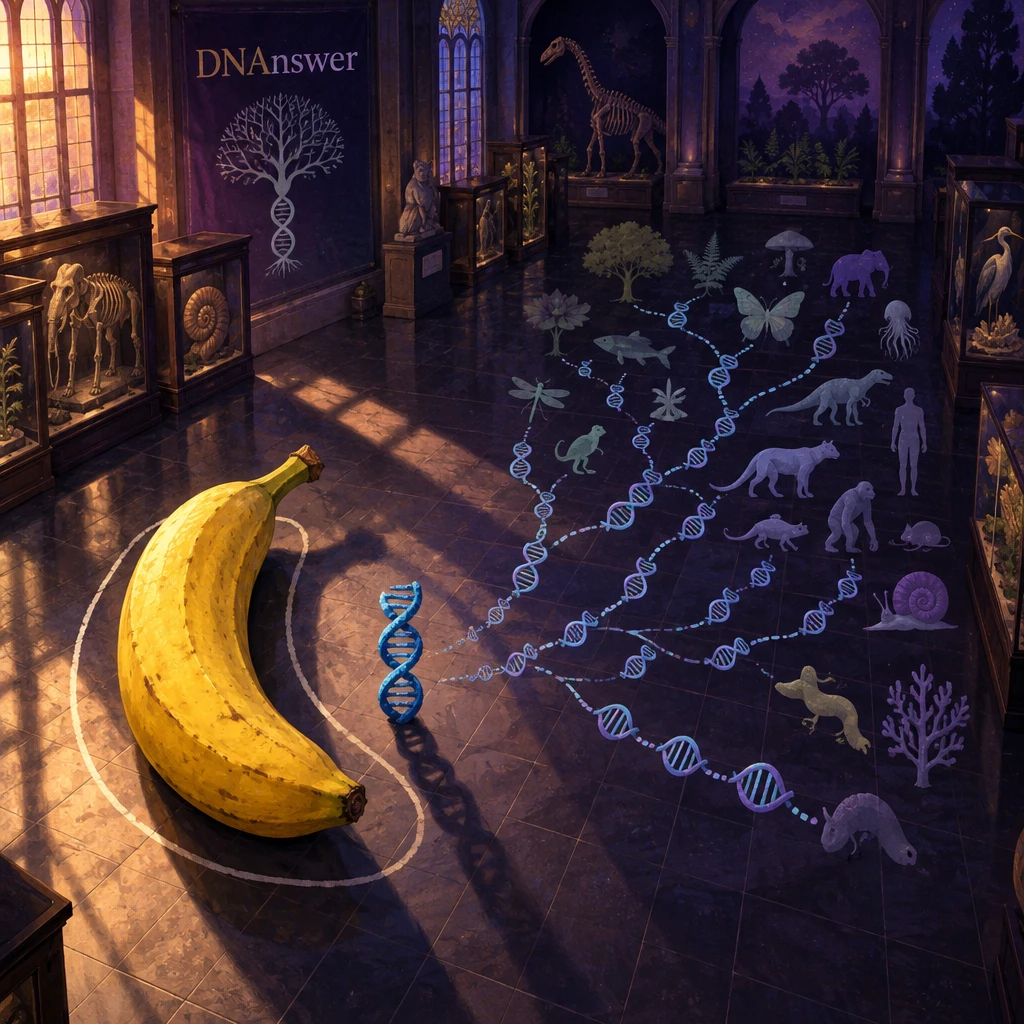
Once you accept the banana connection, the next question follows naturally: which fruit wins? Apples, grapes, and bananas invite a ranking. A meaningful ranking needs a fixed comparison method, and the result would describe that measurement rather than identify your closest fruit relative.
A fruit is one part of a plant. Researchers compare the plant’s genetic information with yours, even when a headline names the fruit you eat.
All living plants share a common ancestor with you that predates their later branching into different plant groups. A banana plant does not become your closer evolutionary relative simply because one analysis finds more matching genes in its genome.
Gene copying can complicate a tally. The Banana Genome Hub documents several ancient rounds of whole-genome duplication, events in which a lineage gained another copy of its complete DNA set. Later generations retained some extra gene copies and lost others.
Counting every retained copy can produce a different result from counting each gene family, a group of genes that arose through copying and change, once. Researchers also need comparable genome records and matching rules across all the plants they test.
You could reasonably ask which plant has the most recognizable counterparts to a selected set of human genes. You could also ask which plant proteins most closely match particular human proteins. Those questions might produce different winners.
Skip the universal fruit leaderboard. For a claim about the “most similar” plant, ask what the study compared across every candidate. That turns a catchy ranking into a biological question you can actually evaluate.
Try the denominator test
Next time you see a genetic similarity claim, rewrite it in this form: “Researchers found this kind of match in this fraction of the material they examined.”
Fill in what they counted, their total, and their matching rule. If the post leaves one blank, keep the claim provisional. You now have a practical way to distinguish an interesting evolutionary connection from a percentage that says more than its calculation supports.
Frequently Asked Questions
Do you really share 50% or 60% of your DNA with bananas?
Those figures do not establish that half or more of your complete DNA sequence matches a banana’s. They generally concern recognizable gene or protein counterparts, and you need the method and total to interpret them.
How much DNA do you share with chimpanzees?
About 96% similarity describes a broad comparison that includes several kinds of DNA differences. You may encounter higher figures when researchers examine only corresponding stretches, so keep the comparison method attached to the number.
Which fruit shares the most DNA with humans?
You cannot name a meaningful universal winner without choosing a consistent measurement. A ranking based on related genes can differ from one based on exact protein matches, and neither changes your evolutionary relationship to plants.
Does eating a banana change your DNA?
Eating a banana does not merge its genome with yours. Your digestive system breaks most food DNA into smaller components, which your body can process like other nutrients; the shared genes discussed here reflect ancient ancestry, not your breakfast.