Cellular Respiration Equation: How Your Cells Turn Glucose Into ATP
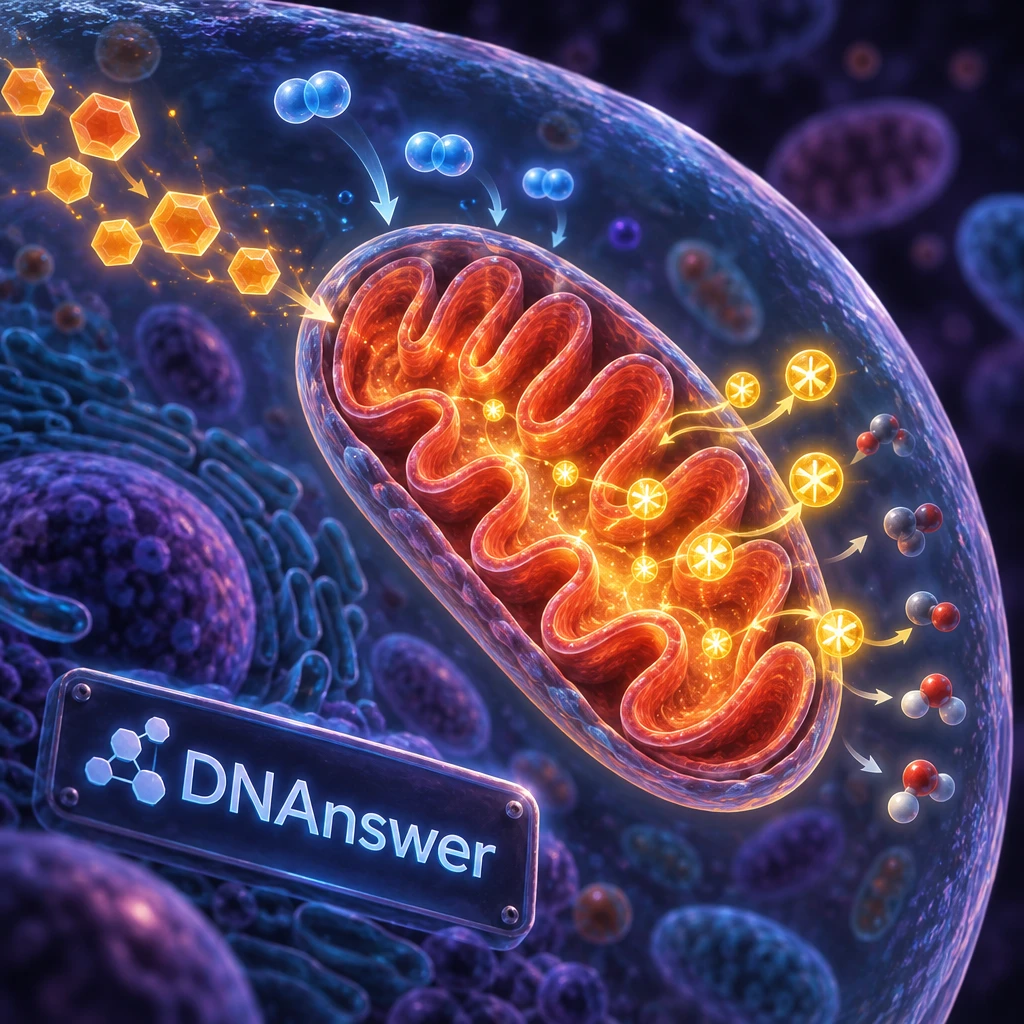
Does the one-line equation actually explain how your cells make energy? It doesn't. C6H12O6 + 6O2 → 6CO2 + 6H2O + energy only lists what goes in and what comes out. Glucose and oxygen go in. Carbon dioxide and water come out. The energy released gets stored in ATP (adenosine triphosphate, the cell's rechargeable energy currency). Textbooks say 30 to 38 ATP per glucose, but current estimates sit near 29 to 30.
Key Takeaways
- The equation is a summary of four stages, not one reaction.
- Exhaled CO2 comes from glucose carbon, not the oxygen you inhale.
- Energy is released from glucose bonds, then stored in ATP.
- Real yield is about 29-30 ATP per glucose, not 38.
- Plants respire too, all day and all night.
Myth 1: The Equation Is One Reaction That Makes ATP
Your cells never run the equation in one step. If they did, all the energy in a glucose molecule would burst out as heat, like a tiny fire. The equation is a bookkeeping total. It sums up four stages and dozens of enzyme-driven steps.
Why the myth makes sense
Textbooks print the equation in big letters, with an arrow in the middle. An arrow looks like a single event. It also balances perfectly: six carbons, twelve hydrogens and eighteen oxygens on each side. A tidy equation feels like a full explanation.
What the equation hides
Here is a chemical reaction in plain terms: atoms rearrange into new molecules. The equation tells you which atoms start and finish. It says nothing about the route. Between glucose and carbon dioxide, your cells pass atoms through about 30 distinct steps, each run by its own enzyme (a protein that speeds up one specific reaction).
The slow route is the point. Small releases of energy are easy to capture. One big release is not. Burn a sugar cube in a flame and you get the same products, but you capture nothing useful. Your cells get the same products and capture about 40 percent of the energy as ATP, with the rest leaving as body heat.
What to do with this
Treat the equation as a receipt, not a recipe. A receipt tells you what you bought and what you paid. A recipe tells you how to cook. When you see the equation on an exam or an Instagram slide, ask: which stage does this total hide?
Myth 2: The Carbon Dioxide You Exhale Comes From the Oxygen You Inhale
Every CO2 molecule you breathe out got its carbon from food. None of it came from the air you just breathed in. This surprises most people, because breathing in and breathing out feel like one loop.
The honest reason people believe it
You inhale oxygen. Seconds later you exhale carbon dioxide, which contains oxygen atoms. The simple story is that your lungs swap one for the other. That story is almost right about the gas swap, which happens in your lungs. It is wrong about where the atoms come from.
Tracking the atoms
Here is the bookkeeping. Glucose has six carbon atoms. Your cells strip them off one at a time as CO2. Two come off during pyruvate oxidation (the step that prepares glucose fragments for the next cycle), and four come off in the citric acid cycle. Six carbons in, six CO2 out.
The oxygen you inhale takes a different path. It travels to your mitochondria and picks up electrons and hydrogen at the very end of the process. Its product is water. So the inhaled oxygen ends up in H2O, and the exhaled CO2 carries oxygen mostly from glucose and water inside the cell.
Body mass follows the atoms: researchers who tracked fat loss with this kind of accounting found that most lost fat leaves the body as exhaled carbon dioxide, with the rest leaving as water.
That result comes from a 2014 analysis in the BMJ by Ruben Meerman and Andrew Brown. It follows the same logic as the equation. The carbon in your stored fuel leaves through your lungs.
What to do with this
Keep two ledgers. Oxygen goes in and ends up in water. Carbon comes from food and leaves as CO2. Once you separate them, the equation reads very differently.
Myth 3: Cells Make 38 ATP From Each Glucose
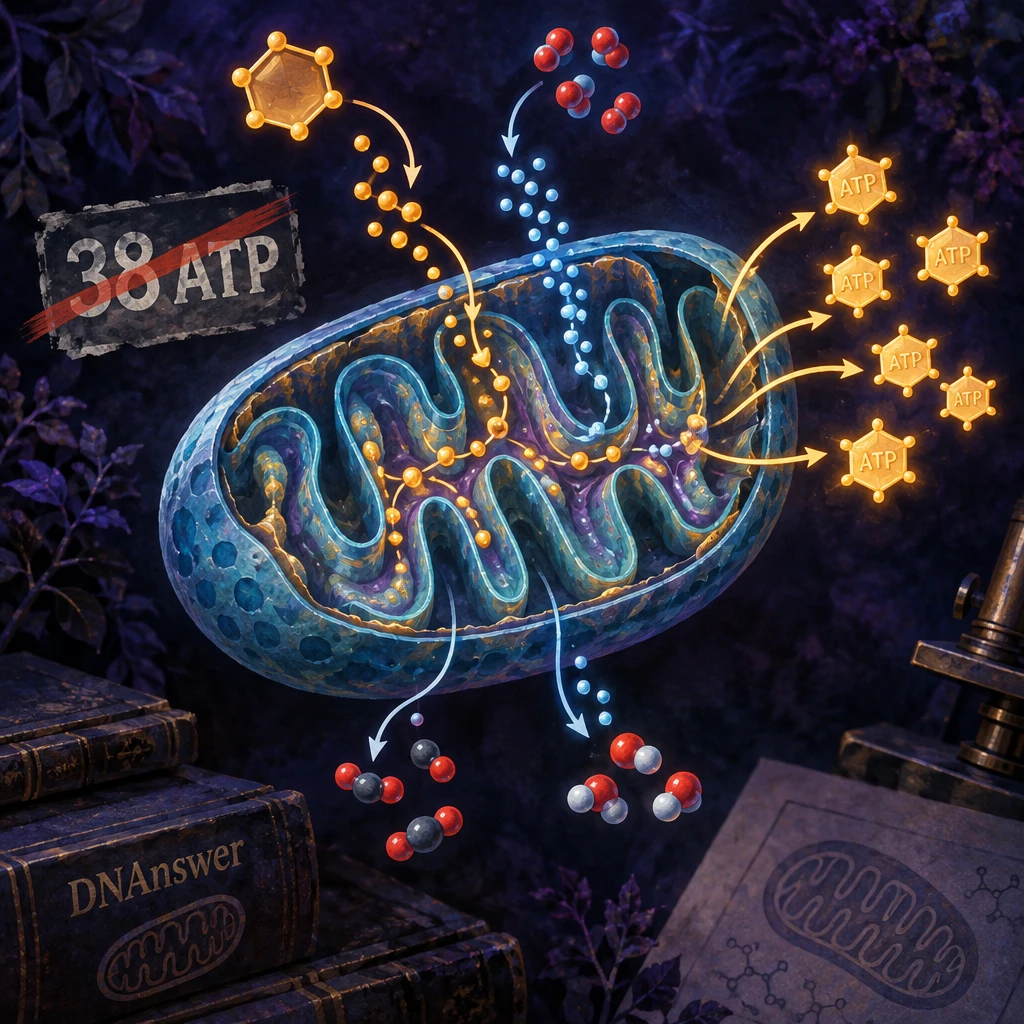
Textbooks printed "38 ATP" for decades. It is a clean, memorable number. It is also a theoretical ceiling that real cells never reach. Current estimates run from about 29 to 30 ATP per glucose, and some tallies give 30 or 32 depending on how NADH gets into the mitochondria.
Where 38 came from
The old tally was simple addition. Glycolysis gives 2 ATP. The citric acid cycle gives 2 more. The electron transport chain, the last stage, gives about 34. Total: 38. That math assumed every electron carrier pays out a whole number of ATP, and that nothing leaks.
Why real cells fall short
Real mitochondria have costs the old math ignored. The cell spends energy moving pyruvate, phosphate and ADP (the "empty" form of ATP) into the mitochondrial matrix, the inner compartment. Membranes also leak some protons, which wastes part of the gradient.
Newer measurements also changed the exchange rate. Each NADH (a carrier that hauls electrons) produces about 2.5 ATP, not 3. Each FADH2 (a second, smaller carrier) produces about 1.5, not 2. Add the glycolysis costs and the transport costs, and you land near 30.
How to use the number
Say "about 30." If a quiz or exam asks for the textbook figure, give the figure your course uses. If you're reading for understanding, remember that this number is an estimate and ranges between 29 and 32 depending on assumptions. A fixed figure would suggest the cell works like a vending machine. It works more like a busy city market, with fees and spillage.
The Four Stages: A Walkthrough That Tracks Every Carbon
The equation hides four stages. Follow one glucose through all four and you can see where each atom goes and where each ATP appears.
- Glycolysis (in the cytoplasm, the fluid outside the mitochondria). Glucose, a 6-carbon sugar, splits into two 3-carbon pyruvate molecules. The cell spends 2 ATP to start it and earns 4 back, so the net is 2 ATP and 2 NADH. No oxygen is needed.
- Pyruvate oxidation (in the mitochondrial matrix). Each pyruvate loses one carbon as CO2 and becomes a 2-carbon unit called acetyl-CoA. Two pyruvates give 2 CO2 and 2 NADH.
- Citric acid cycle, also called the Krebs cycle (in the matrix). Each acetyl-CoA feeds a loop of reactions that releases 2 more CO2. Per glucose, that adds 4 CO2, 6 NADH, 2 FADH2 and 2 ATP.
- Oxidative phosphorylation (on the inner mitochondrial membrane). NADH and FADH2 hand over their electrons to a chain of proteins. The chain pumps protons, and the protons flow back through an enzyme that builds most of the ATP.
Count the carbon. Six enter. Two leave in stage 2 and four leave in stage 3. Zero carbons reach stage 4. Stage 4 only handles electrons.
That last point catches many readers off guard. The citric acid cycle is not where most ATP appears. It is where most electron carriers get loaded.
How Electron Carriers and a Proton Gradient Actually Build ATP
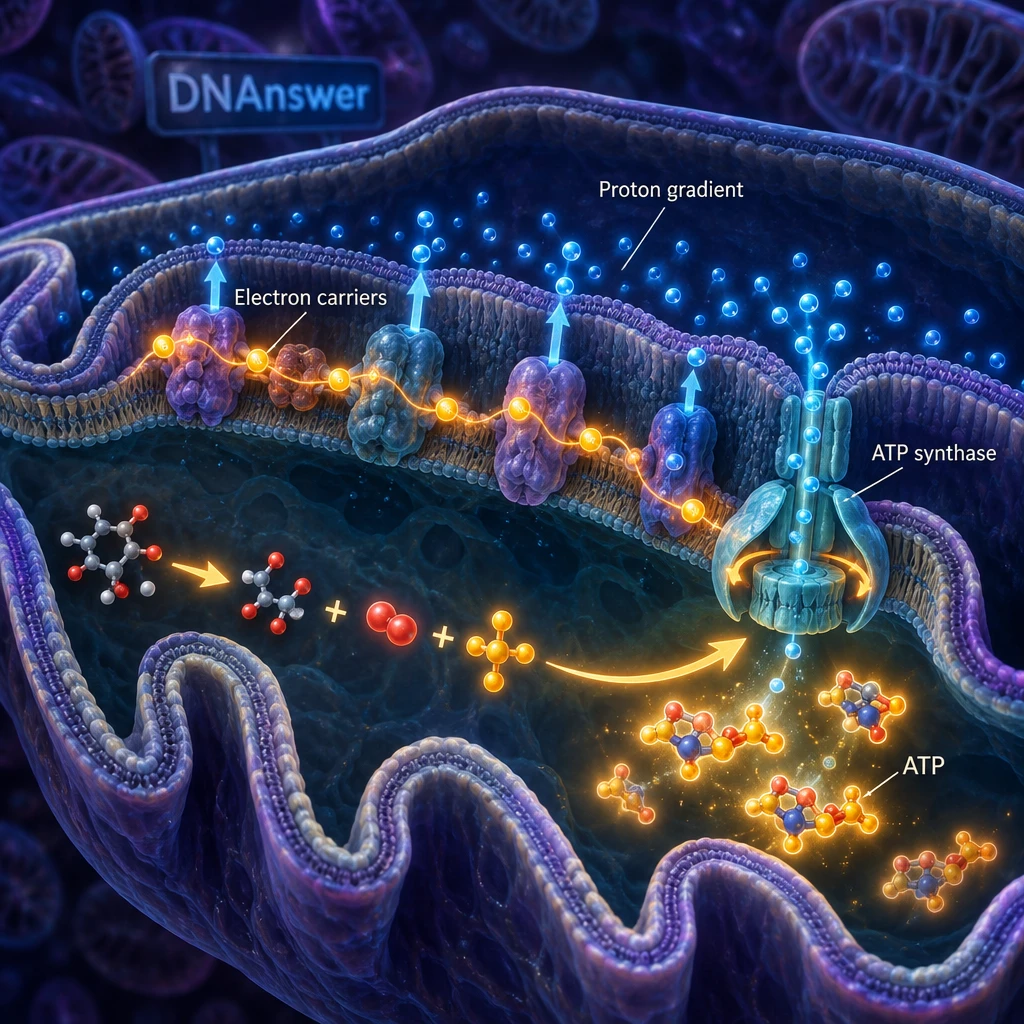
Most ATP does not come directly from glucose. It comes from a pressure difference. Your mitochondria build up protons on one side of a membrane, then let them rush through a molecular turbine. That turbine is the real ATP factory.
NADH and FADH2: the loaded shuttles
Glucose bonds hold energy in their electrons. Enzymes pull those electrons off glucose fragments and load them onto carrier molecules. Think of NADH and FADH2 as rechargeable battery packs. Stages 1 to 3 charge about 10 NADH and 2 FADH2 per glucose. Stage 4 empties them.
The electron transport chain
The electron transport chain is a line of four protein complexes embedded in the inner mitochondrial membrane. Electrons hop from one complex to the next, dropping in energy each time. The energy released pumps protons (hydrogen ions) out of the matrix into the narrow space between the membranes.
At the end of the line, oxygen waits. It accepts the electrons and grabs two protons to form water. This is the only job oxygen does in the whole equation. Without it, the chain jams, the carriers stay loaded, and the earlier stages stall.
ATP synthase: the turbine
Now protons crowd one side of the membrane, like water behind a dam. They flow back through ATP synthase, an enzyme shaped like a tiny rotor. Each turn snaps a phosphate onto ADP and makes ATP. Scientists call this idea chemiosmosis (using a proton gradient to drive work), and it explains why the energy count is not a clean whole number. In human mitochondria, the rotor ring has 8 subunits, so each ATP costs about 3.7 protons, including one proton for transport.
Myth 4: The Equation Shows Energy Being Made
Energy is never made. It moves. Glucose holds chemical energy in its bonds. Respiration releases that energy and parks part of it in ATP. The "+ energy" at the end of the equation is a withdrawal, not a creation.
The kernel of truth
Everyday speech says "make energy" all the time. Food labels, gym posters and even many science videos use it. The shorthand is harmless in daily life. It trips people in biology because the whole topic is about transfers.
The actual numbers
Fully oxidizing one mole of glucose (about 180 grams, or 6.3 ounces) releases about 2,880 kilojoules of free energy. Chemists call that a negative ΔG, meaning the reaction gives off usable energy and can run on its own. Glucose has more stored energy than CO2 and water do, so the reaction runs downhill.
Your cells catch some of that fall. ATP holds roughly 30 kilojoules per mole in its last phosphate bond, and 30 ATP at that price captures around 900 kilojoules. That is about a third of the total, with the rest lost as heat. This estimate is rough, because real cellular conditions shift the value, but the idea holds. Heat is the price of running the machine, and it is why your body stays near 98.6°F.
What to do with this
Swap "make energy" for "release and store energy" in your own head. It changes how you read questions like "where does the energy go?" The answer is always ATP, heat, or both.
Myth 5: Plants Photosynthesize Instead of Respiring
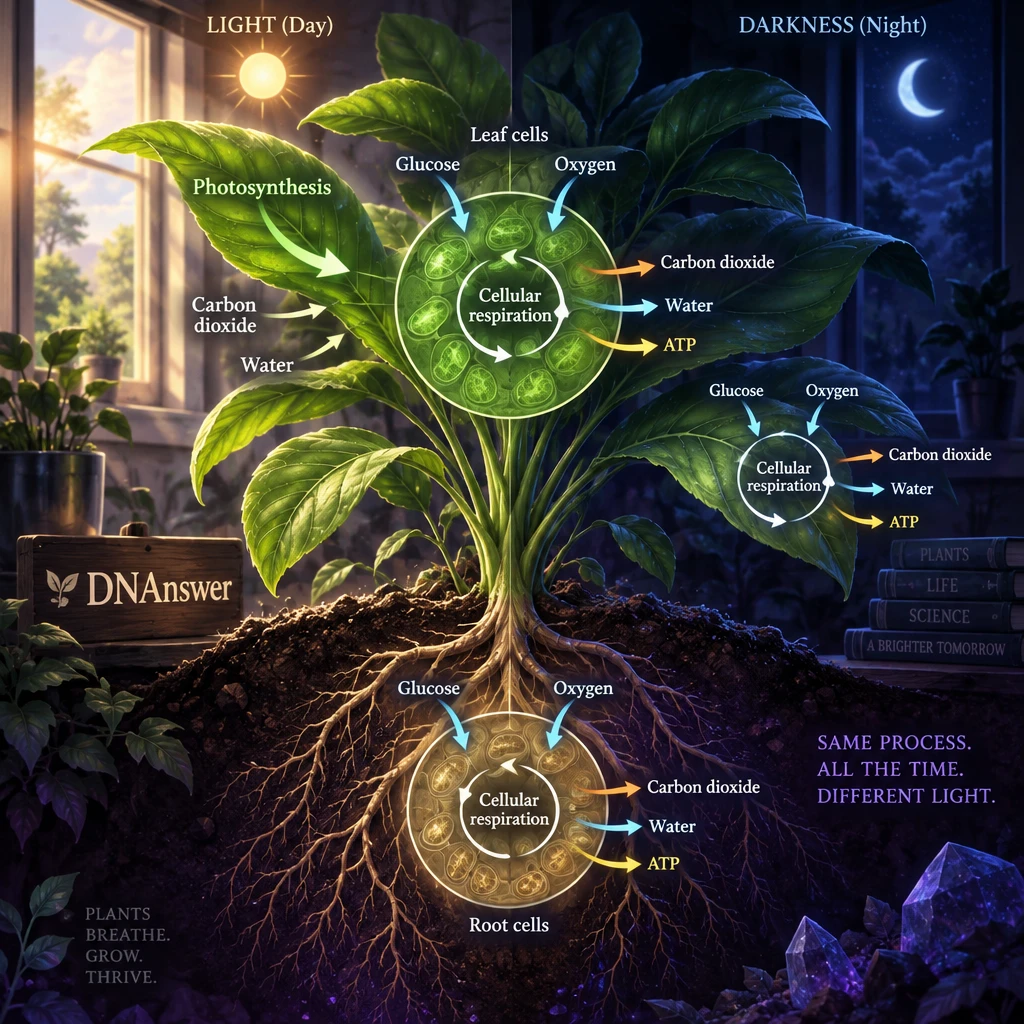
Plants respire constantly, in every living cell, day and night. Photosynthesis is an extra job they do in daylight, not a replacement for respiration.
Why the myth sticks
Many classes teach the two equations side by side, and they look like mirror images. Photosynthesis is 6CO2 + 6H2O + light → C6H12O6 + 6O2. Respiration reverses the arrow. It is easy to conclude that animals run one and plants run the other.
How plants really work
Photosynthesis builds glucose in chloroplasts, using light. Respiration burns glucose in mitochondria, and plant cells have plenty of them. A potato tuber, a root and a leaf at midnight all respire. Without respiration, the plant cannot turn sugar into ATP to grow roots, move nutrients or build new cells.
The mirror image is also misleading in one way. The two are not a single closed loop. Photosynthesis captures light energy. Respiration captures chemical energy. The atoms cycle, but the energy flows one way, from sunlight to heat.
What to do with this
When you water a houseplant, remember it uses oxygen in the dark. A leaf in daylight usually makes more oxygen than it uses, so the net result looks like oxygen release. At night, the net flips.
Where It Happens, and What Happens Without Oxygen
Cellular respiration runs in two places. Glycolysis happens in the cytoplasm. Everything after it happens in the mitochondria, the bean-shaped organelles (small structures inside cells) that give the process its energy punch.
Aerobic and anaerobic: a quick split
Aerobic respiration needs oxygen and produces the roughly 30 ATP. Anaerobic processes run without oxygen and produce about 2 ATP per glucose, because only glycolysis keeps working. The cell then needs a way to recycle its NADH, so it ferments.
Human muscle cells make lactate when oxygen runs short, such as during a hard sprint. Yeast makes ethanol and CO2, which is why bread dough rises and beer bubbles. Both are fermentation, a backup route that lets glycolysis keep running.
Why the gap matters
The difference between 2 and about 30 ATP explains why your body breathes harder during exercise. Your cells want the bigger payout. It also explains why mitochondria matter so much for organs that burn through ATP, such as your heart and brain. Researchers at the 17th World Conference on Targeting Mitochondria, held October 21 to 23, 2026 in Berlin and online, covered topics from ageing to brain health for exactly that reason.
If you want to test yourself on the stages, DNAnswer has free quizzes on molecular biology, including cellular respiration, with XP and leaderboards to track progress.
Conclusion
Next time you see the equation, read it as a receipt. Ask where each carbon went, where each electron travelled, and which stage paid out the ATP. Draw the four stages from memory, with 6 carbons in and 6 CO2 out. If you can do that, you understand respiration better than the one-line version ever allowed.
Frequently Asked Questions
What is the equation for the cellular respiration of glucose?
The equation is C6H12O6 + 6O2 → 6CO2 + 6H2O + energy. Glucose and oxygen are the reactants. Carbon dioxide, water and energy are the products. The energy is partly stored in ATP and partly lost as heat.
How many ATP does one glucose molecule make?
Current estimates are about 29 to 30 ATP per glucose, with some tallies giving 30 or 32. The old textbook figure of 38 is a theoretical maximum. Real cells lose energy moving molecules across membranes and through leaky proton channels.
Where does cellular respiration take place in the cell?
Glycolysis happens in the cytoplasm. Pyruvate oxidation and the citric acid cycle happen in the mitochondrial matrix. The electron transport chain sits on the inner mitochondrial membrane, where ATP synthase makes most of the ATP.
Is cellular respiration aerobic or anaerobic?
Both types exist. Aerobic respiration uses oxygen and yields about 30 ATP per glucose. Anaerobic respiration and fermentation work without oxygen and yield about 2 ATP, because only glycolysis runs.