Cellular Respiration and Photosynthesis: How They Connect
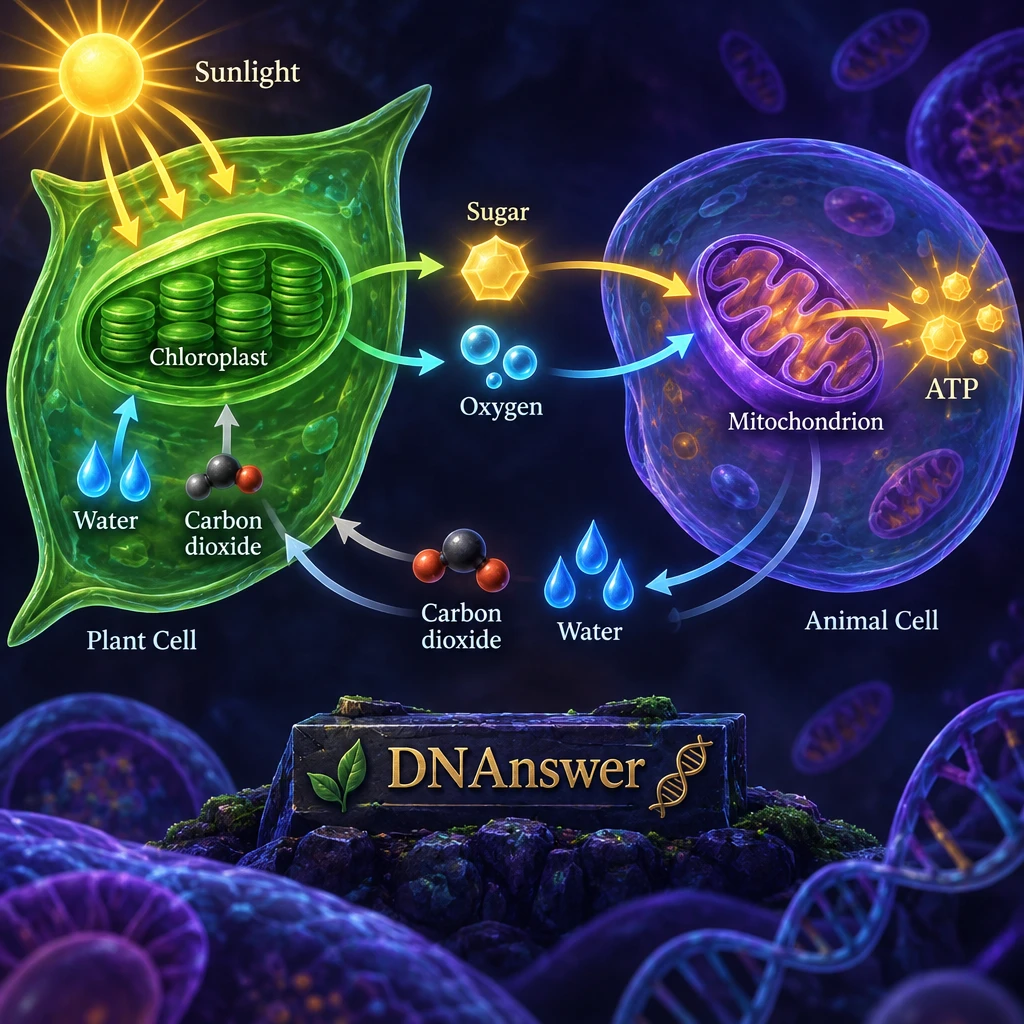
Is cellular respiration just photosynthesis running backward? That's the question most people land on after seeing the two equations side by side. The short answer is no. The inputs and outputs do flip, so atoms really do move in a loop between the two processes. The chemistry inside the cell is a different story, though.
Cellular respiration and photosynthesis share raw materials, and energy travels through both. But energy never goes around in a circle, plants never stop respiring, and the oxygen you breathe didn't come from carbon dioxide at all. Each of those points trips up even good students.
Key Takeaways
- Plants respire around the clock, not only at night.
- Matter cycles; energy flows one way and leaves as heat.
- Photosynthetic oxygen comes from water, not carbon dioxide.
- Mirror-image equations hide completely different molecular pathways.
- Sugar stores energy; ATP spends it.
Myth 1: Plants photosynthesize and animals respire
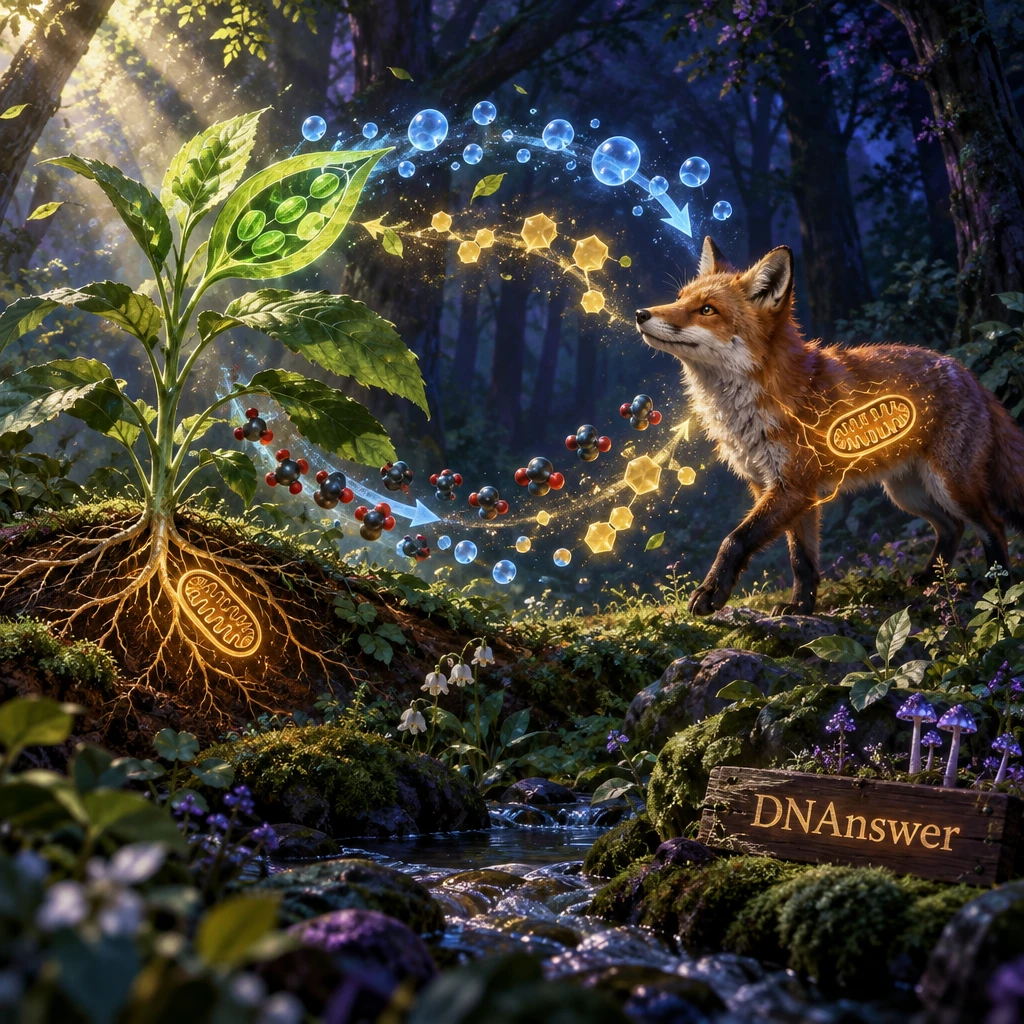
Picture a houseplant on your windowsill and a cat asleep beside it. The tidy story says the plant makes oxygen and the cat uses it. Plants make, animals burn.
That belief has an honest origin. Diagrams often draw a leaf on one side and a person on the other, with arrows trading oxygen and carbon dioxide. And the trade is real at the scale of a planet. Plants pull carbon dioxide out of the air, and animals put it back.
What plant cells actually do
Plants carry out both processes, every hour of their lives. A leaf cell holds chloroplasts (green structures that capture light and build sugar) and mitochondria (small structures that break that sugar down with oxygen). Roots, which never see light, contain mitochondria and no working chloroplasts. They survive entirely on respiration, using sugar shipped down from the leaves.
Why would a plant bother making sugar only to break it down again? Because sugar is a storage form. A cell can't spend it directly. It needs ATP (adenosine triphosphate, a small molecule that hands out energy for cellular jobs like building proteins or pumping nutrients). Respiration converts stored sugar into ATP, and plants need ATP just as much as cats do.
Why the trade still works
During daylight, a healthy leaf photosynthesizes much faster than it respires. So the plant releases more oxygen than it uses, and it absorbs more carbon dioxide than it gives off. The respiration is still happening. Photosynthesis simply hides it.
Across the whole globe, this balance between the two processes helps keep the levels of oxygen and carbon dioxide in the air stable. Ecologists call this part of the carbon cycle, the path carbon atoms take as they move between air, living things and soil.
So drop the plant-versus-animal split. Think of it as light-catchers versus everyone: plants do photosynthesis and respiration, while animals do respiration only.
Myth 2: Plants only respire at night
This one is a halfway step past Myth 1. Someone learns that plants respire, then hears that houseplants "give off carbon dioxide at night." The natural conclusion is that respiration switches on when the lights go out.
There's a real kernel here. At night you can measure a plant releasing carbon dioxide and taking in oxygen. During the day you measure the opposite. If you only watched the gas, you'd assume the process itself changed shifts.
Follow one plant for 24 hours
Take a tomato plant on a sunny July day.
- Dawn. Light hits the leaves. Photosynthesis starts up, while respiration keeps running at its steady pace.
- Midday. Photosynthesis runs at full speed. The plant's net gas exchange is oxygen out, carbon dioxide in.
- Dusk. Light fades, and at some point the two processes roughly cancel. Botanists call this the compensation point.
- Night. Photosynthesis stops. Respiration carries on, so the net exchange flips to carbon dioxide out, oxygen in.
Respiration never paused. What changed was photosynthesis. Daytime and nighttime gas readings show the net result, which means the total after both processes are added together.
The cactus exception
Some plants break the pattern. Cacti, pineapples and other bromeliads, and many succulents use CAM photosynthesis (crassulacean acid metabolism), a water-saving pathway. They keep their leaf pores closed through the hot day and open them at night to collect carbon dioxide. Britannica notes that these plants do release some oxygen at night, when their pores open and the gas can escape.
Here's the practical upshot. A few plants in your bedroom won't measurably change the air you breathe overnight. A person respires far more than a pothos does. The real lesson is about reading data: a gas measurement tells you the net balance, not which processes are running.
Myth 3: Energy cycles just like matter does
Diagrams of these two processes are usually drawn as a circle. Carbon dioxide and water go into the chloroplast. Sugar and oxygen come out and feed the mitochondrion, which returns carbon dioxide and water. It looks like a closed loop, and people assume energy rides around it too.
Half of that picture is right. Matter cycles. A carbon atom in the air today might sit in a maple leaf next spring, then pass through a caterpillar and a bird, and drift back into the air. The same atoms can repeat that loop for millions of years.
Energy does something else. It enters as sunlight, gets stored in sugar's chemical bonds, gets moved into ATP, and then gets spent on cellular work. At every step, some of it leaves as heat. The CK-12 Foundation's middle school text puts it plainly: part of the energy goes into making ATP in the mitochondria, and part escapes to the environment as heat. Heat can't be gathered back up and fed to a chloroplast. So the energy path is a one-way street, starting at the sun and ending as warmth released into the surroundings.
Matter cycles. Energy flows. Atoms are reused again and again, but every bit of usable energy in Earth's food chains started as light and ends as heat.
How to read the diagram correctly
When you see a connected diagram, trace two separate paths. Follow the molecules (carbon dioxide, water, sugar, oxygen) around the loop between chloroplast and mitochondrion. Then follow the energy as a straight arrow: sun into the chloroplast, into sugar, into ATP, and out as heat on every side. A good diagram draws the heat arrows leaving the loop. If yours doesn't, sketch them in yourself.
This is why life needs a constant supply of sunlight. If energy truly cycled, a sealed jar of plants and snails could run forever in the dark. It can't, because every organism keeps losing energy as heat, and only light tops it up.
Myth 4: Respiration is photosynthesis in reverse
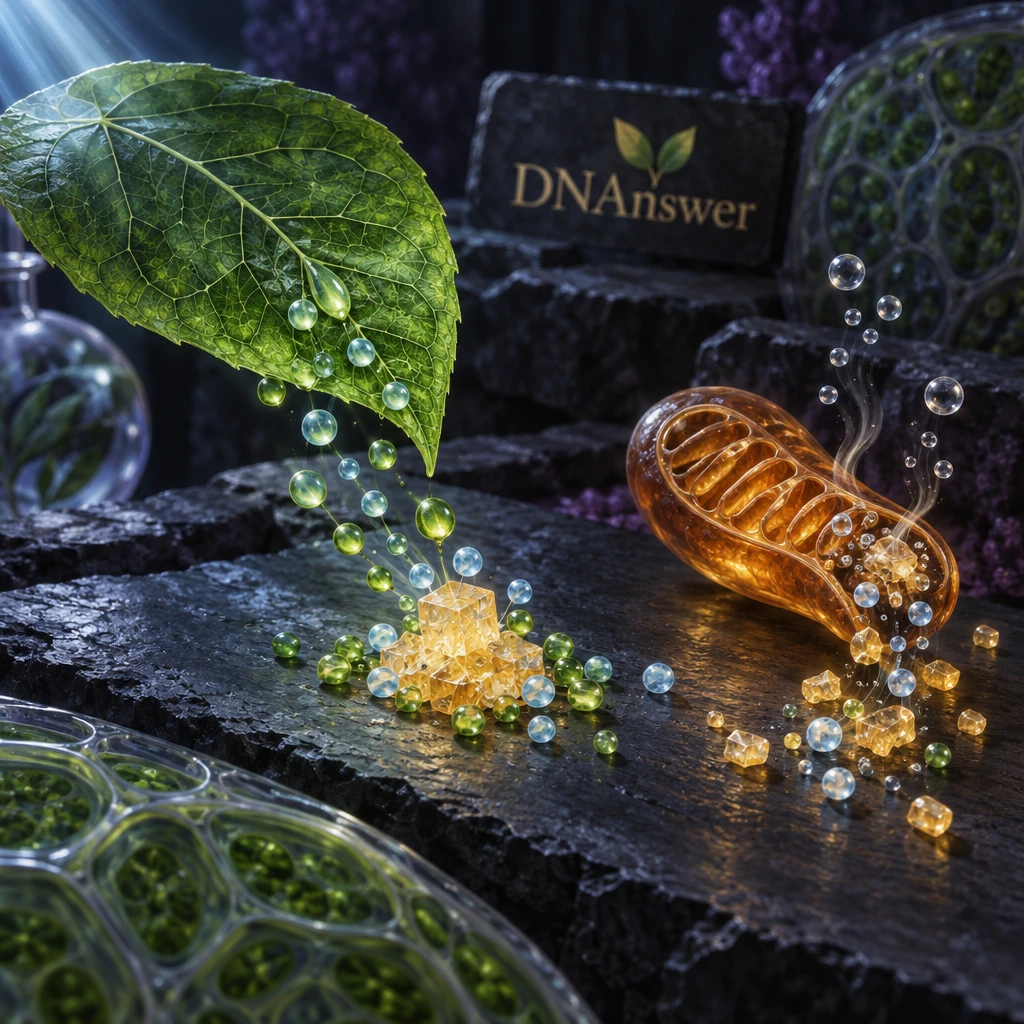
This is the myth the equations seem to prove. Write them out:
Photosynthesis: 6CO₂ + 6H₂O + light energy → C₆H₁₂O₆ + 6O₂
Aerobic respiration: C₆H₁₂O₆ + 6O₂ → 6CO₂ + 6H₂O + energy (captured as ATP, with the rest lost as heat)
Six carbon dioxide molecules and six water molecules become one glucose molecule and six oxygen molecules. Then the same molecules turn right back. Many textbooks even call the two "direct opposites." For inputs and outputs, that's accurate, and it's the cleanest way to see the link: the products of one are the reactants of the other.
Same summary, different machinery
A summary equation is like a receipt. It tells you what went in and what came out, not how the work got done. Inside the cell, the two processes take completely separate routes.
Photosynthesis runs in two stages in the chloroplast. The light-dependent reactions use light to split water and make ATP plus NADPH (a molecule that carries high-energy electrons). Then the Calvin cycle uses that ATP and NADPH to attach carbon dioxide to existing molecules and build sugar. A key enzyme there, RuBisCO, grabs carbon dioxide but sometimes grabs oxygen by mistake, which wastes energy.
Respiration runs in four stages, and they don't retrace those steps. Glycolysis splits glucose in the cytoplasm (the fluid interior of the cell). Then pyruvate oxidation and the citric acid cycle strip off carbon dioxide inside the mitochondrion. Finally, oxidative phosphorylation makes most of the ATP.
The shared trick that fools people
Here's where the similarity is real. Both processes use an electron transport chain, a relay of proteins built into a membrane. Electrons pass down the chain, and their energy pumps hydrogen ions across the membrane. Those ions then flow back through an enzyme called ATP synthase, which spins like a tiny turbine and makes ATP.
In chloroplasts, light energizes the electrons, which come from water. In mitochondria, the electrons come from food, and oxygen catches them at the end of the chain. Similar machinery, opposite direction of electron flow, different fuel, different enzymes. A hydroelectric dam and a water pump both use turbines, but nobody calls one the reverse of the other.
So compare the equations freely. Just don't expect respiration to run the photosynthesis steps backward. They're two separate assembly lines that happen to trade finished goods.
Myth 5: The oxygen plants release comes from carbon dioxide
Look at the equation again. Carbon dioxide goes in. Oxygen comes out. It feels obvious that a plant pulls the carbon off CO₂ and lets the O₂ go. Plenty of people, including some adults who studied biology, still picture it that way.
It's wrong. Every oxygen molecule a plant releases comes from water. During the light-dependent reactions, the plant splits water molecules to free their electrons. The hydrogen goes into making ATP and NADPH. The oxygen atoms pair up and drift out of the leaf as waste.
The carbon dioxide's oxygen atoms go somewhere else entirely. They end up in the sugar and in water made during the Calvin cycle. Researchers in the 1940s confirmed this by feeding plants water labeled with a heavy form of oxygen and tracking where it went. The labeled oxygen showed up in the released gas.
Respiration mirrors this neatly. At the end of the mitochondrial electron transport chain, oxygen picks up spent electrons and hydrogen and becomes water again. So the oxygen you inhale returns, atom by atom, to water inside your cells. Water becomes oxygen in a leaf, and oxygen becomes water in you. That's the real cycle, and it sits on top of the equations rather than inside them.
This also changes how you picture Earth's history. Tiny organisms called cyanobacteria began splitting water and releasing oxygen between 2.7 and 2.8 billion years ago. By about 2.45 billion years ago, oxygen had become a significant part of the atmosphere. Every breath you take traces back to that ancient water-splitting.
Myth 6: Sugar is the energy cells run on
You eat a banana for energy, so sugar must be the fuel your cells burn directly. Plants make glucose, glucose is energy, done.
The intuition is close. Glucose does hold a lot of chemical energy in its bonds, and it's the main fuel entering respiration. But cells don't spend glucose. They spend ATP.
Think of glucose as a $100 bill and ATP as quarters for a vending machine. The bill holds more value, but the machine only takes coins. Respiration is the change machine. It breaks one glucose molecule apart in controlled steps and converts its energy into many ATP molecules, which then power muscle contraction, nerve signals and protein building.
How many? The textbook maximum is about 38 ATP per glucose. In real cells the number runs lower, often around 30, because some energy leaks away and membranes aren't perfectly sealed. Without oxygen, cells fall back on glycolysis alone and get just 2 ATP per glucose, which is why oxygen matters so much.
Plants face the same rule. Photosynthesis does make ATP in the chloroplast, but the plant spends nearly all of it right there to build sugar. To power the rest of the cell, and the roots, it needs respiration. When you study this, label the two clearly: sugar for storage and transport, ATP for spending.
Similarities and differences at a glance
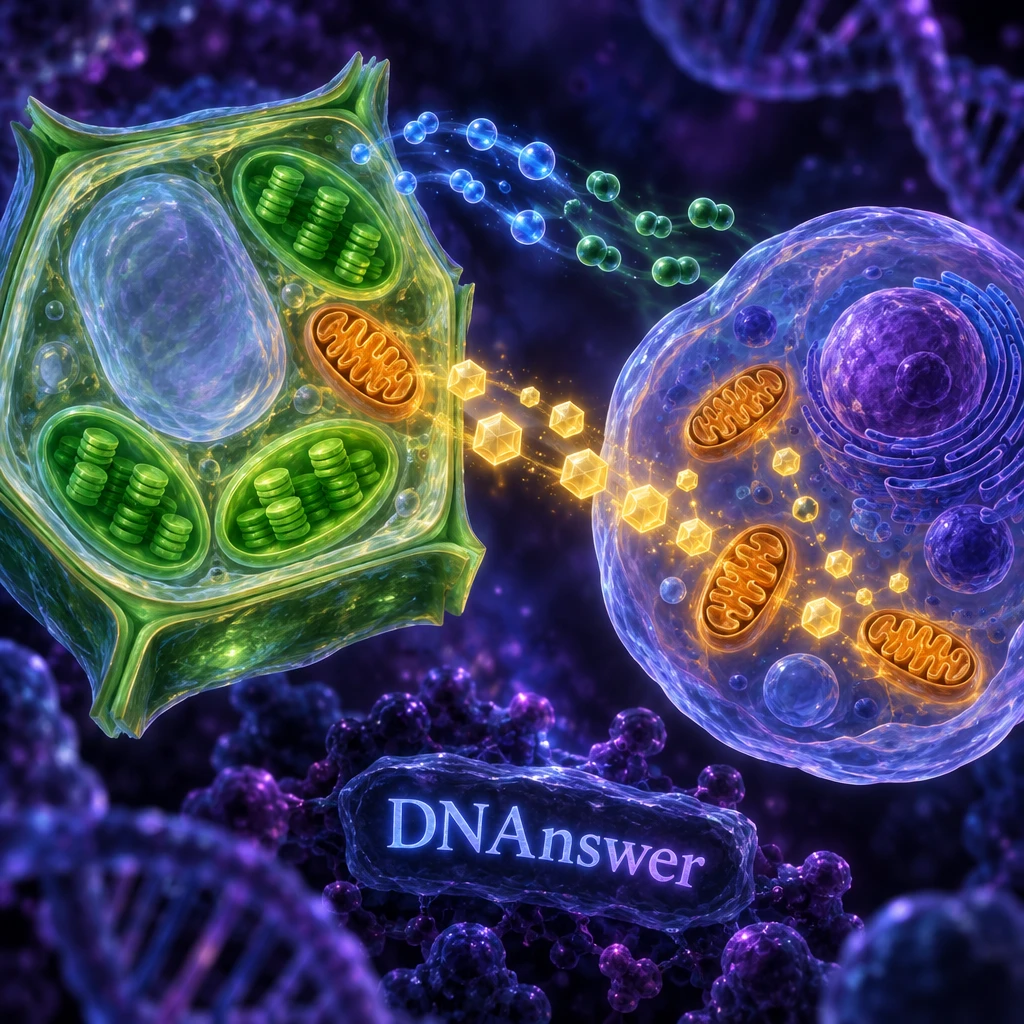
If you need a quick study list, here it is.
Two clear similarities:
- Both use electron transport chains and ATP synthase to make ATP.
- Both handle the same four molecules: carbon dioxide, water, glucose and oxygen.
Five clear differences:
- Location: photosynthesis happens in chloroplasts; aerobic respiration mostly in mitochondria, starting in the cytoplasm.
- Who does it: photosynthesis happens in plants, algae and some bacteria; respiration happens in nearly all living things.
- Energy direction: photosynthesis stores light energy in sugar; respiration releases it as ATP and heat.
- Gases: photosynthesis takes in carbon dioxide and gives off oxygen; respiration does the reverse.
- Timing: photosynthesis needs light; respiration runs day and night.
Test what you now know
Try explaining the night-time gas switch and the water origin of oxygen out loud, without notes. If both come easily, you've got the core. For a quick check, the quizzes on DNAnswer cover topics like this and are free to use. Then go look at any textbook diagram and draw in the missing heat arrows.
Frequently Asked Questions
How do cellular respiration and photosynthesis connect?
They trade materials. Photosynthesis turns carbon dioxide and water into sugar and oxygen, and respiration turns sugar and oxygen back into carbon dioxide and water. The atoms cycle, while energy enters as light and leaves as heat.
Do plants release oxygen and carbon dioxide at night?
Most plants release carbon dioxide at night and take in oxygen, because respiration continues while photosynthesis stops. CAM plants such as cacti and many succulents are the exception, releasing some oxygen at night when their pores open.
Why are photosynthesis and cellular respiration closely related?
Each one makes the raw materials the other needs. They also share the same basic energy machinery, an electron transport chain driving ATP synthase, which suggests both evolved from a common toolkit for handling electrons.
Do plants need cellular respiration if they make their own food?
Yes. Photosynthesis stores energy in sugar, but plant cells can only spend ATP. Respiration converts that sugar into ATP for every living cell, including roots and seeds that never photosynthesize.