Function of a Chloroplast: How It Makes Sugar From Light
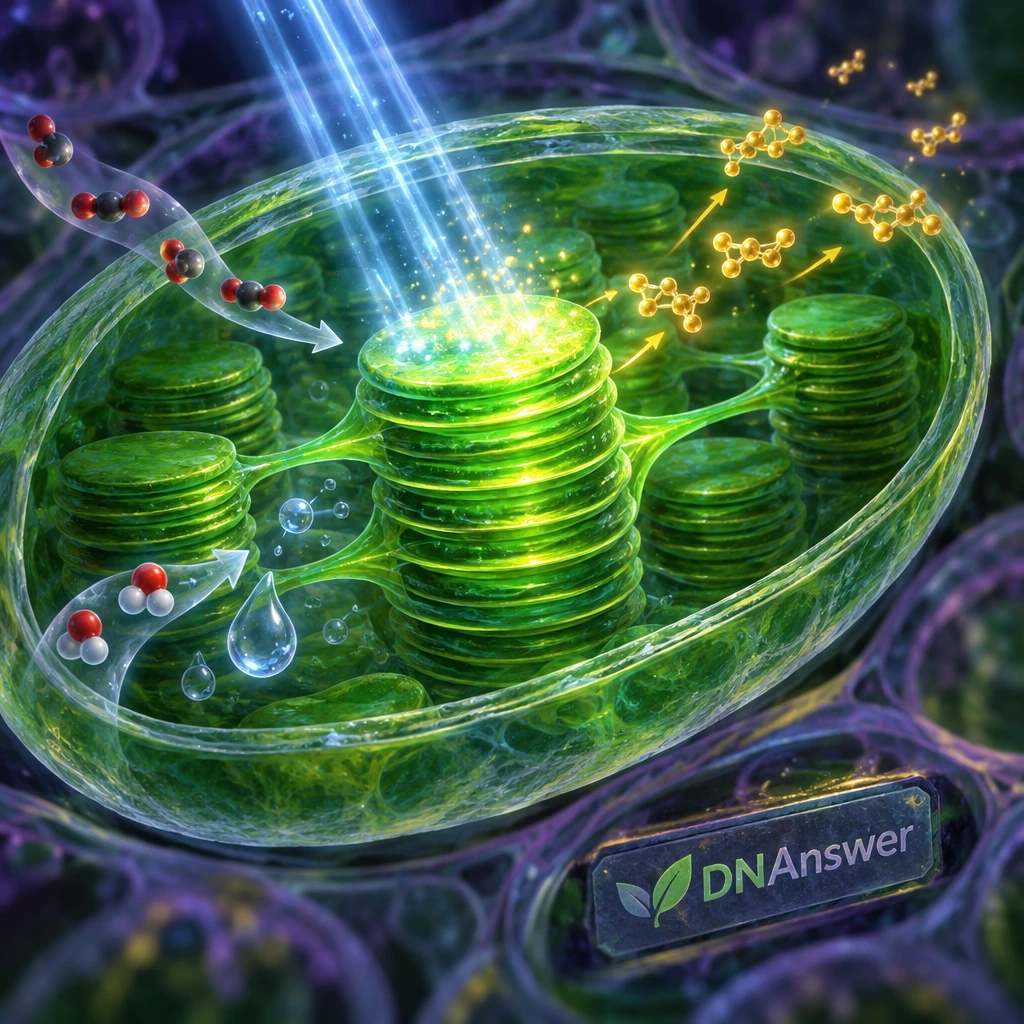
Does light really turn carbon dioxide and water into sugar? Not directly. Light never touches the sugar-building step at all. A chloroplast (the green compartment inside plant cells that runs photosynthesis) first uses light to split water and charge up two energy carriers, ATP and NADPH. Then it spends that stored energy, in a separate room, to build sugar from carbon dioxide. The textbook equation hides this two-stage design, and it breeds several myths.
Key Takeaways
- Chloroplasts work in two rooms: thylakoids charge batteries, the stroma builds sugar.
- Light's job is making ATP and NADPH, not sugar directly.
- Released oxygen comes from split water, never from carbon dioxide.
- The Calvin cycle needs light's products, so it stalls in darkness.
- Its direct output is a three-carbon sugar, G3P, not glucose.
- Mitochondria still burn plant sugar for ATP.
The Chloroplast as a Two-Room Factory
Picture a small factory with two rooms. In the first, solar panels charge batteries. In the second, workers use those batteries to assemble a product. The chloroplast works the same way.
The first room is the thylakoid system: flattened membrane sacs, often stacked like pancakes into piles called grana. The second room is the stroma, the thick fluid that surrounds the stacks. A double outer membrane wraps around both.
The equation you met in school, 6 CO₂ + 6 H₂O + light → C₆H₁₂O₆ + 6 O₂, is accurate as a bookkeeping total. It says nothing about how the work happens. It skips the batteries entirely, and that gap is where the myths below grow.
Where You Find Chloroplasts
Chloroplasts live in plant leaves and in many algae. A leaf cell typically holds dozens of them. Wikipedia's chloroplast entry gives a range from one in some single-celled algae to about 100 in plants like wheat.
They also carry their own small loop of DNA. Scientists think chloroplasts descend from a free-living cyanobacterium (a photosynthetic bacterium) that an early cell swallowed and kept. A plant cell cannot build a new chloroplast from scratch. Existing ones divide, and each daughter cell inherits some.
The Green Pigment and Where It Sits
Chloroplasts do contain chlorophyll, the green pigment that absorbs light. It sits in the thylakoid membranes, not in the stroma. That placement matters: the membranes are where light gets caught, so the room that runs on light is the room full of green.
Chlorophyll absorbs mostly red and blue light and reflects green. That is why leaves look green.
Myth 1: Light Turns Carbon Dioxide and Water Straight Into Sugar
The belief: sunlight hits a leaf, and sugar comes out, one step.
It is an easy belief to hold. Most diagrams draw one arrow from sunlight to glucose, and the summary equation has light written over a single arrow. Nothing in it suggests a middle stage.
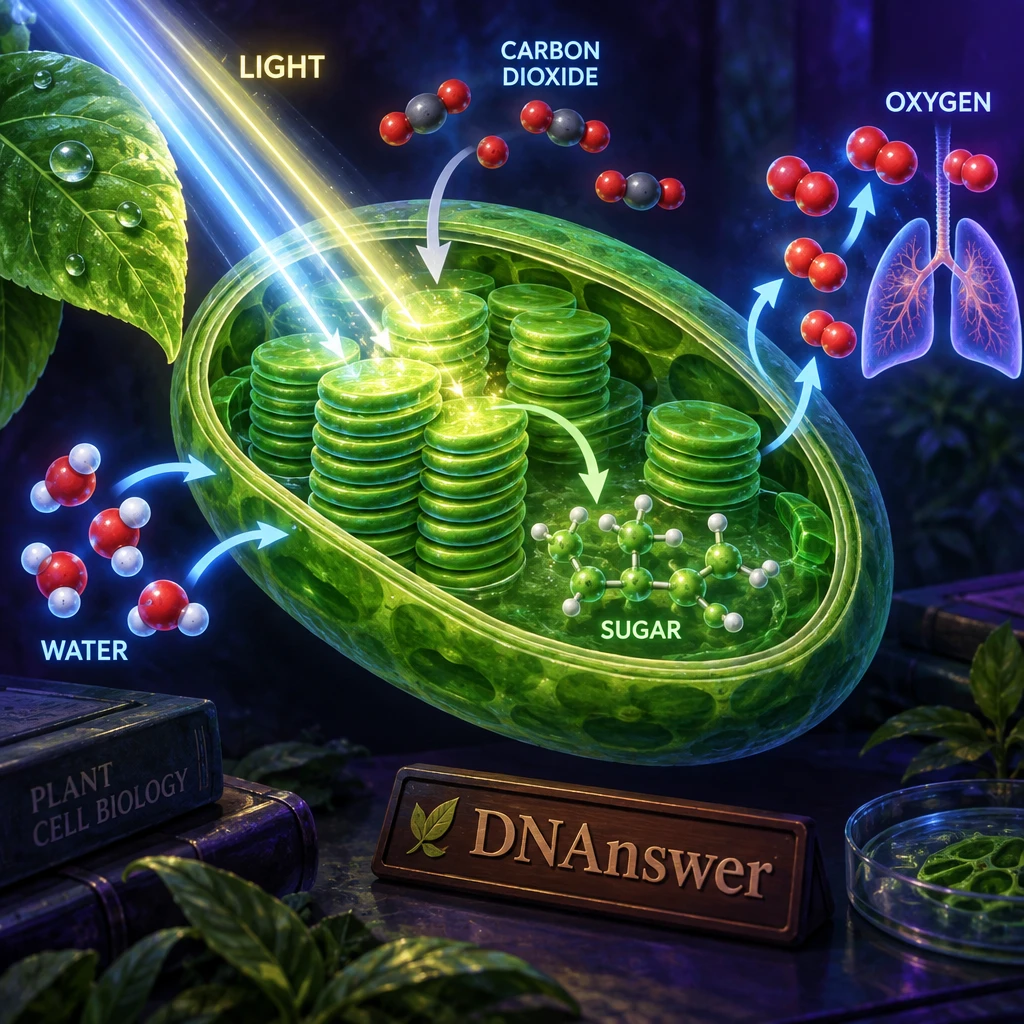
The reality: two stages run in sequence. In the light-dependent reactions, chlorophyll absorbs light and the energy gets stored in two molecules. ATP (adenosine triphosphate) is the cell's all-purpose energy currency. NADPH carries high-energy electrons, which are tiny charged particles that do chemical work when handed off. Then the Calvin cycle uses those two molecules to turn carbon dioxide into sugar.
Think of it as charging a phone and then using it. Light charges. The stroma spends.
What to do with this: when you read "photosynthesis makes sugar from light," mentally add "by way of ATP and NADPH." If you answer a biology question, name those carriers. They are the part most diagrams skip and most exams ask about.
How the Thylakoid Room Turns Light Into Batteries
This is the answer to what a chloroplast does during the light reaction. The light-dependent reactions happen in the thylakoid membrane, and they follow a clear order.
- Light hits a photosystem. A photosystem is a cluster of proteins and pigments built into the membrane. Pigments in its antenna region pass light energy to a special pair of chlorophyll a molecules in the reaction center.
- An electron jumps. The energy kicks an electron out of that chlorophyll pair. A nearby protein, the primary electron acceptor, grabs it.
- Water replaces the lost electron. In photosystem II, the cell splits water to refill the electron. This releases oxygen.
- The electron travels down a chain. It moves through a series of proteins called the electron transport chain, losing energy at each hand-off.
- That energy pumps protons. Protons (hydrogen ions) get pushed across the membrane and pile up inside the thylakoid. The pile acts like water behind a dam.
- ATP forms. Protons flow back out through an enzyme called ATP synthase, and the flow drives it to build ATP.
- Photosystem I recharges the electron. A second burst of light re-energizes it, and it ends up on NADP⁺ to make NADPH.
Two photosystems, two light hits, one chain. The output is ATP, NADPH, and oxygen as waste.
Why Two Photosystems
Photosystem II and photosystem I do different jobs. They pull electrons from different sources, respond to slightly different wavelengths of light, and send their electrons to different places. Photosystem II gets its electrons from water. Photosystem I gets its electrons from the chain that photosystem II feeds.
The setup resembles a relay race: each runner adds energy before passing the baton.
Myth 2: The Oxygen You Breathe Comes From Carbon Dioxide
The belief: the plant takes in CO₂, keeps the carbon, and releases the oxygen part.
This one is sensible on its face. Carbon dioxide has two oxygen atoms. Plants take it in and release O₂. A tidy swap seems obvious, and for a long time people assumed it.
The reality: the oxygen comes from water. In photosystem II, an enzyme complex splits water molecules to replace the electrons that light knocked loose. That leaves protons, which help build ATP, and oxygen atoms, which pair up into O₂ and leave the leaf. The oxygen atoms from CO₂ end up inside sugar and in water the plant makes.
Researchers worked this out in the mid-twentieth century by tracking heavy oxygen atoms, a labeled version of oxygen that scientists can follow. When the label went into water, it showed up in the oxygen gas. When it went into CO₂, it did not.
What to do with this: when you explain photosynthesis, say that oxygen is a byproduct of splitting water. It's waste from the battery-charging room, not a product of the sugar room. Water is the electron source, and oxygen is just what's left.
The Stroma Room: How Carbon Dioxide Becomes Sugar
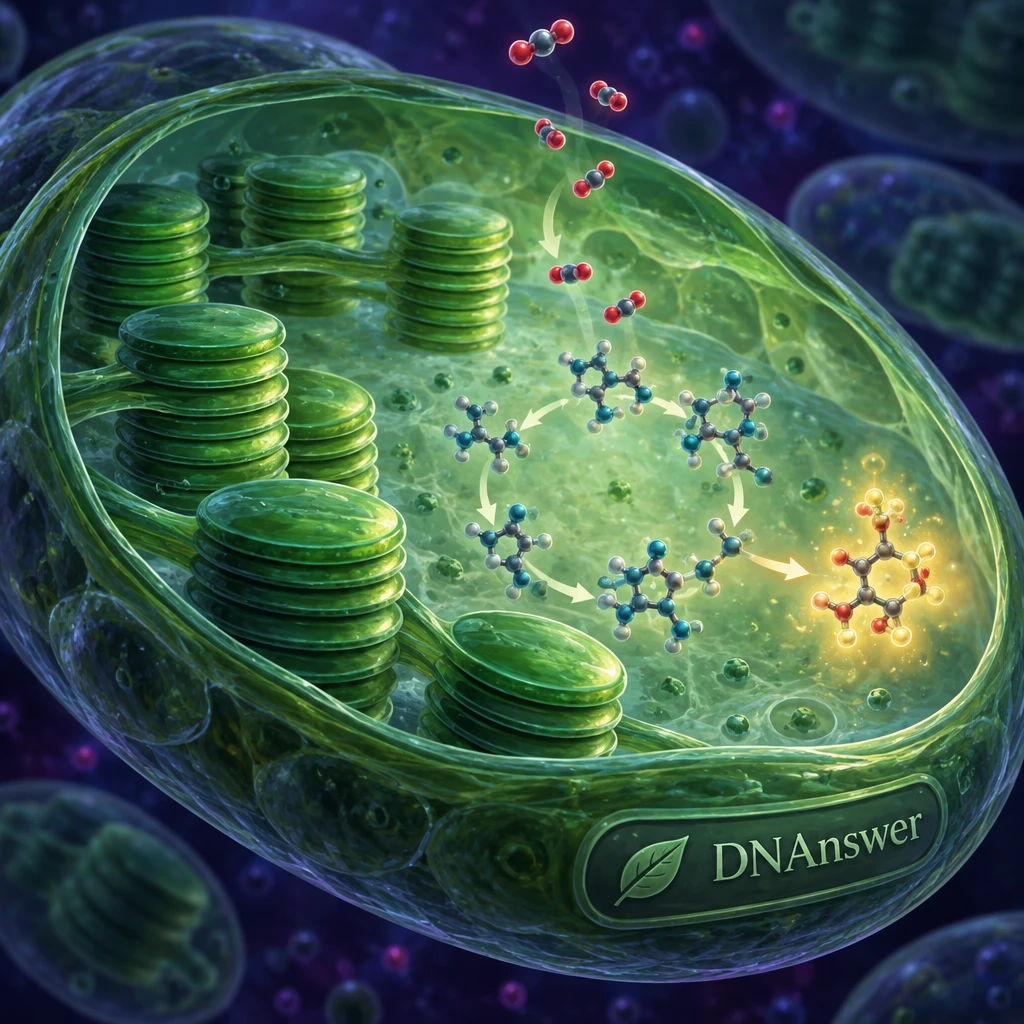
Now the second room. The Calvin cycle runs in the stroma, and it is where a chloroplast actually makes sugar. Plant biologists call this step carbon fixation (pulling carbon from a gas into a solid molecule).
The cycle has three phases.
Phase 1: Fix the Carbon
An enzyme called RuBisCO grabs a CO₂ molecule and attaches it to a five-carbon sugar called RuBP. The result splits into two three-carbon molecules. RuBisCO is slow and abundant, and it is often described as the most common protein on Earth. A plant packs in large amounts to make up for its pace.
Phase 2: Spend the Batteries
The cell uses ATP and NADPH to convert those three-carbon molecules into a higher-energy version called G3P (glyceraldehyde 3-phosphate). Here the stored light energy finally ends up inside a sugar. NADPH donates electrons, and ATP supplies the energy to drive the reaction.
Phase 3: Reset the Cycle
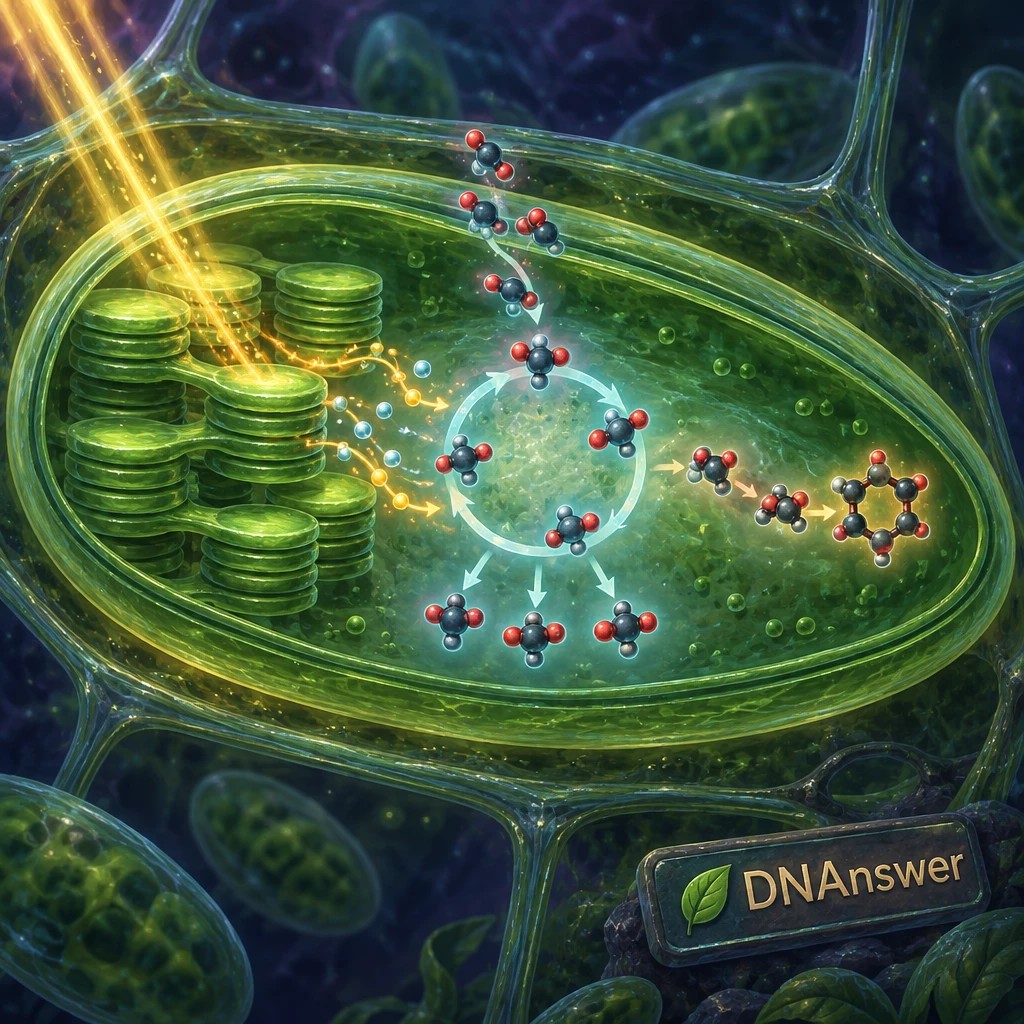
For every three CO₂ molecules fixed, six G3P molecules form. Only one leaves the cycle as net product. The other five get rearranged, with more ATP, back into RuBP so the cycle can grab more CO₂. That is why it is called a cycle: the starting molecule gets rebuilt every lap.
To net one G3P, the cycle fixes three CO₂ molecules. To net one six-carbon glucose, it needs two G3P, so six turns in total.
Myth 3: The Calvin Cycle Is the "Dark Reaction" That Runs at Night
The belief: light reactions happen by day, and the Calvin cycle takes over after sunset.
The old name caused this. Many textbooks labeled the Calvin cycle the "dark reactions" because it does not use light directly as an ingredient. If it needs no light, the logic goes, it must run in the dark.
The reality: the cycle needs the products of the light reactions, and those run out fast without light. ATP and NADPH are small, short-lived molecules, and the cell does not keep a big stockpile. When the sun goes down, the supply dries up and the cycle slows to a stop. Several Calvin cycle enzymes also switch on in light and switch off in darkness, so the plant shuts the cycle down on purpose.
The more accurate name is light-independent reactions, meaning the cycle does not absorb light itself. Even that name can mislead. Many biologists now prefer "Calvin cycle" or "carbon reactions."
The textbook line about it taking place "at day or night" is technically true in a narrow sense: no photon touches the cycle. In a living leaf, though, the cycle follows the light.
Light-independent reactions "do not use light as a reactant," yet they "require the products of the light-dependent reactions to function."
That is the idea in one line, paraphrasing how the standard open-access microbiology text from LibreTexts puts it.
What to do with this: drop "dark reaction" from your vocabulary. If a quiz asks whether the Calvin cycle needs light, answer that it needs light's products, so it indirectly depends on light.
Thylakoid vs. Stroma: What Happens Where
Seeing the two rooms side by side makes the design clear. Here is the comparison in plain terms.
The thylakoid membrane holds chlorophyll and the two photosystems. It takes in light and water. It produces oxygen, ATP, and NADPH. It stops without light.
The stroma holds RuBisCO and the other Calvin cycle enzymes. It takes in CO₂, ATP, and NADPH. It produces G3P sugar. It slows when light products run low.
The rooms trade materials. ATP and NADPH go out of the thylakoid room into the stroma. After the stroma spends them, the empty carriers, ADP and NADP⁺, drift back to be recharged. Nothing is wasted, and nothing is used up for good. It is a loop with light as the power source.
Myth 4: Glucose Is What the Calvin Cycle Makes
The belief: the chloroplast's product is glucose, full stop.
Every summary equation ends with C₆H₁₂O₆, and glucose is the sugar people know. It is natural to assume it is what the factory ships out.
The reality: the first sugar the cycle releases is G3P, a three-carbon molecule. Cells then build it into other things. Two G3P molecules can join to make glucose or fructose. Glucose units link into long chains to form starch, the storage carbohydrate, which many plants keep right inside the chloroplast during the day. Other G3P ends up as sucrose (table sugar), which the plant ships through its veins to roots, fruits, and growing tips. Some goes toward cellulose for cell walls, and some toward fats and amino acids.
Chloroplasts do more than make sugar. They also build fatty acids and amino acids, and they take part in plant immune responses.
What to do with this: write G3P when a question asks for the direct output of the Calvin cycle. Write glucose when it asks for the overall result of photosynthesis. The two answers are both right in their own context.
Myth 5: Chloroplasts Are the Plant's Only Power Source
The belief: animals have mitochondria for energy, plants have chloroplasts, and that is that.
It is a neat contrast, and many school summaries present it that way. The truth is a little less tidy.
The reality: plant cells have both. The chloroplast makes sugar. The mitochondrion (the organelle that extracts usable energy from fuel) then burns some of that sugar with oxygen to make ATP for the cell's everyday work. The reaction is the mirror image of photosynthesis: glucose plus oxygen gives carbon dioxide and water, plus ATP. Some of the energy is lost as heat.
Plants make more sugar than they burn, so they have a surplus to store and grow with. Still, a root cell with no light and no chloroplasts survives entirely on respiration.
The two processes also keep the planet's gases in balance. Photosynthesis pulls CO₂ out of the air and releases oxygen, and respiration, in plants and animals, does the reverse. The carbon atom in the CO₂ you exhale may well end up in a leaf.
What to do with this: treat chloroplasts as the builder and mitochondria as the burner. One stores light energy in sugar, and the other releases it. If you want to check your grasp of that link, DNAnswer has free photosynthesis quizzes that let you test yourself and track your progress.
Conclusion
Next time you see "light makes sugar," split it in two. Light charges ATP and NADPH in the thylakoids, and the stroma spends them on CO₂. Use that frame on any exam question or diagram. If a question asks where oxygen comes from, say water. If it asks about the dark reaction, say it depends on light's products. Two rooms explain nearly everything.
Frequently Asked Questions
How do chloroplasts make sugar?
Chloroplasts make sugar in two stages. Thylakoid membranes use light to build ATP and NADPH. The Calvin cycle in the stroma then uses those molecules to convert carbon dioxide into G3P, a three-carbon sugar that cells build into glucose and starch.
What is the main function of a chloroplast?
The main function of a chloroplast is photosynthesis: capturing light energy and storing it as chemical energy in sugar. It also releases oxygen as a byproduct. Chloroplasts additionally make fatty acids and amino acids.
Does the Calvin cycle need light?
Not directly, but it depends on light indirectly. The cycle needs ATP and NADPH from the light reactions, and those run out in darkness. Some Calvin cycle enzymes also switch on only in light, so the cycle slows at night.
Where does the oxygen released in photosynthesis come from?
It comes from water. Photosystem II splits water molecules to replace electrons that light knocks out of chlorophyll, which releases oxygen gas. The oxygen in carbon dioxide ends up in sugar and water, not in the oxygen you breathe.