Primer Molecular Biology: DNA and RNA Basics
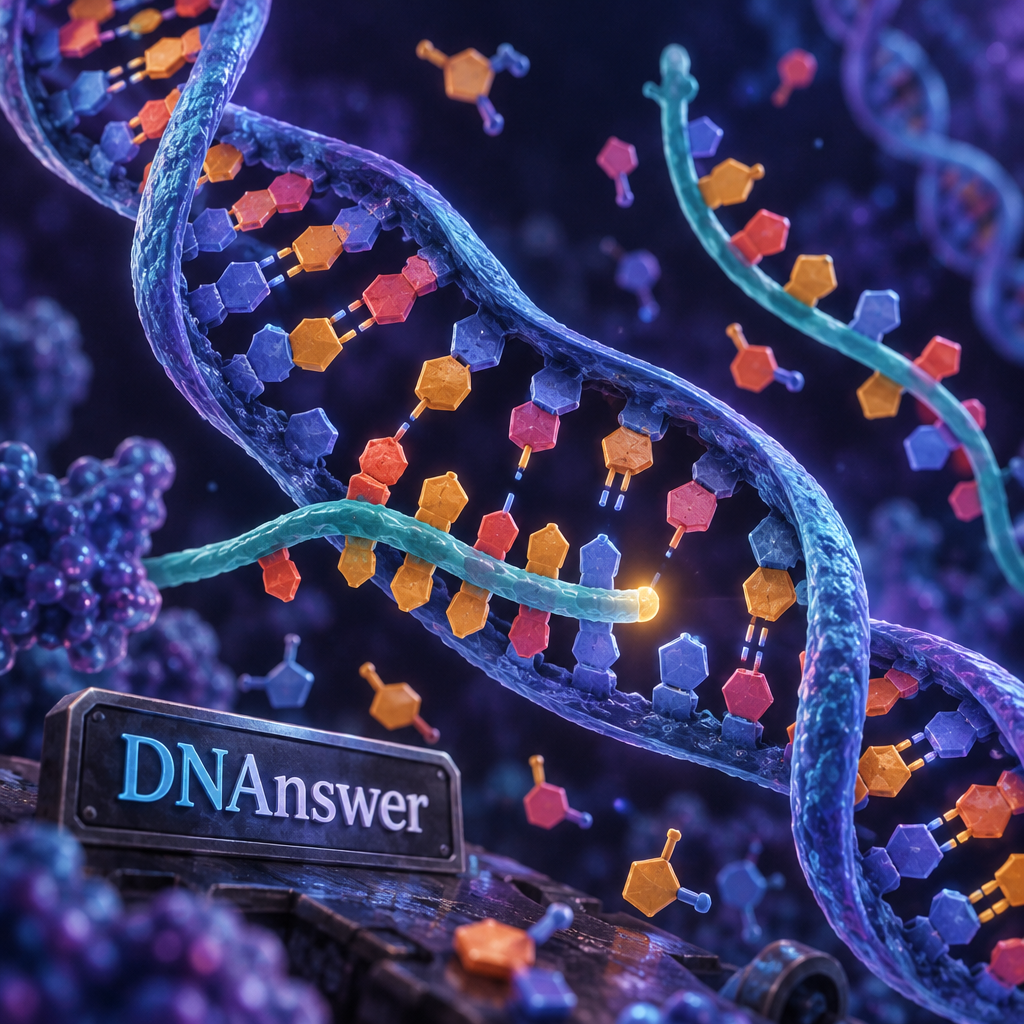
Your DNA doesn't copy itself from scratch. The enzyme that builds new DNA can't start a strand on its own, so it needs a tiny starter piece called a primer. That's the second meaning of the phrase "primer molecular biology": a beginner's guide, and a real molecule.
This article uses both meanings to fix five common myths about DNA and RNA. Each one changes how you read health news, ancestry reports, and headlines about gene editing.
Key Takeaways
- DNA polymerase can't start a new strand without a primer.
- Genes are only some DNA segments, about 1% of your genome coding for protein.
- RNA carries messages, builds proteins, and can even speed up reactions.
- Information flows beyond DNA to RNA to protein: viruses reverse it.
- Epigenetic tags change which genes run without changing the DNA letters.
Myth 1: DNA Is a Fixed Blueprint That Decides Your Traits
Picture two identical twins. They share nearly the same DNA sequence, yet by age 50 one may have developed a disease the other hasn't. If DNA were a rigid blueprint, that shouldn't happen.
The blueprint idea has an honest origin. Gregor Mendel's pea experiments in the 1860s showed traits passing down in predictable patterns. Some conditions, like cystic fibrosis, follow a single gene closely. For those cases, the blueprint picture works well.
Most traits don't work that way. Height, heart disease risk, and mood come from many genes plus diet, sleep, infections, and chance. DNA is better compared to a huge recipe book than a building plan. Every cell holds the whole book, but each cell reads only the pages it needs.
Epigenetics: the sticky notes on the recipe book
Epigenetics means chemical tags that sit on DNA or on the proteins it wraps around. These tags don't change the letters. They change whether a gene gets read. One common tag, a methyl group (a small cluster of carbon and hydrogen atoms), usually quiets the gene it sits on.
This is why a liver cell and a neuron behave so differently with identical DNA. Different pages are open in each.
What the evidence shows
A well-known case is the Dutch Hunger Winter of 1944 to 1945, when a famine hit the Netherlands. Researchers later found that people exposed to it before birth showed measurable differences in DNA methylation decades afterward. Scientists still debate how much of this affects health, so treat it as evidence that environment leaves molecular marks, not as proof of destiny.
Do this instead: read "gene for X" headlines as risk shifts, not verdicts. A drawback of this advice: it's less satisfying than a clear yes or no, but it matches how biology actually behaves.
Myth 2: Genes and DNA Are the Same Thing
"I got my DNA tested, so I know my genes." That sentence mixes two ideas. DNA is the molecule. A gene is one stretch of it that holds instructions for making a specific product, usually a protein.
The mix-up makes sense. Textbooks use the words interchangeably, and for decades people assumed most DNA must be genes. The Human Genome Project, which finished its draft in 2003, changed that picture. Your genome (all your DNA, about 3 billion base pairs) holds roughly 20,000 protein-coding genes. Those coding regions make up only about 1 to 2% of it.
So what is the rest doing?
For years people called the remainder "junk DNA." That label aged badly. Large parts of it act as switches that turn genes on and off, anchor structural pieces of chromosomes, or produce RNA molecules that never become proteins. Other parts are old viral remnants and repeated sequences with no known job.
The ENCODE project, a large public research effort led by the U.S. National Human Genome Research Institute, reported in 2012 that biochemical activity touched a large share of the genome. Researchers argued over what "activity" means, and they still do. Active doesn't always mean useful.
A quick structure check
DNA is built from nucleotides, which are small units made of a sugar, a phosphate, and one of four bases: A, T, C, and G. Two strands twist into the double helix. A pairs with T, and C pairs with G, which is why one strand predicts the other.
What this means for you: a consumer ancestry test such as AncestryDNA reads selected positions across your genome, not every letter. A medical report about a gene variant covers one small piece. Ask which positions were tested before drawing conclusions.
Myth 3: RNA Is Just a Disposable Copy of DNA
Here's a number that should bother the "DNA runs everything" crowd. Most of your genome gets copied into RNA at some point, yet only a small fraction of that RNA ever becomes protein. So what are the rest doing?
The copy-machine view has a fair origin. In the 1950s and 60s, researchers worked out that RNA carries DNA's message to the cell's protein factories. That story is true and tidy, so it stuck.
It's incomplete, though. RNA is chemically close to DNA but differs in three ways. It's usually single-stranded, its sugar is ribose instead of deoxyribose, and it uses uracil (U) where DNA uses thymine (T). That single-strand shape lets RNA fold into complicated 3D forms, which gives it abilities DNA lacks.
The three classic types
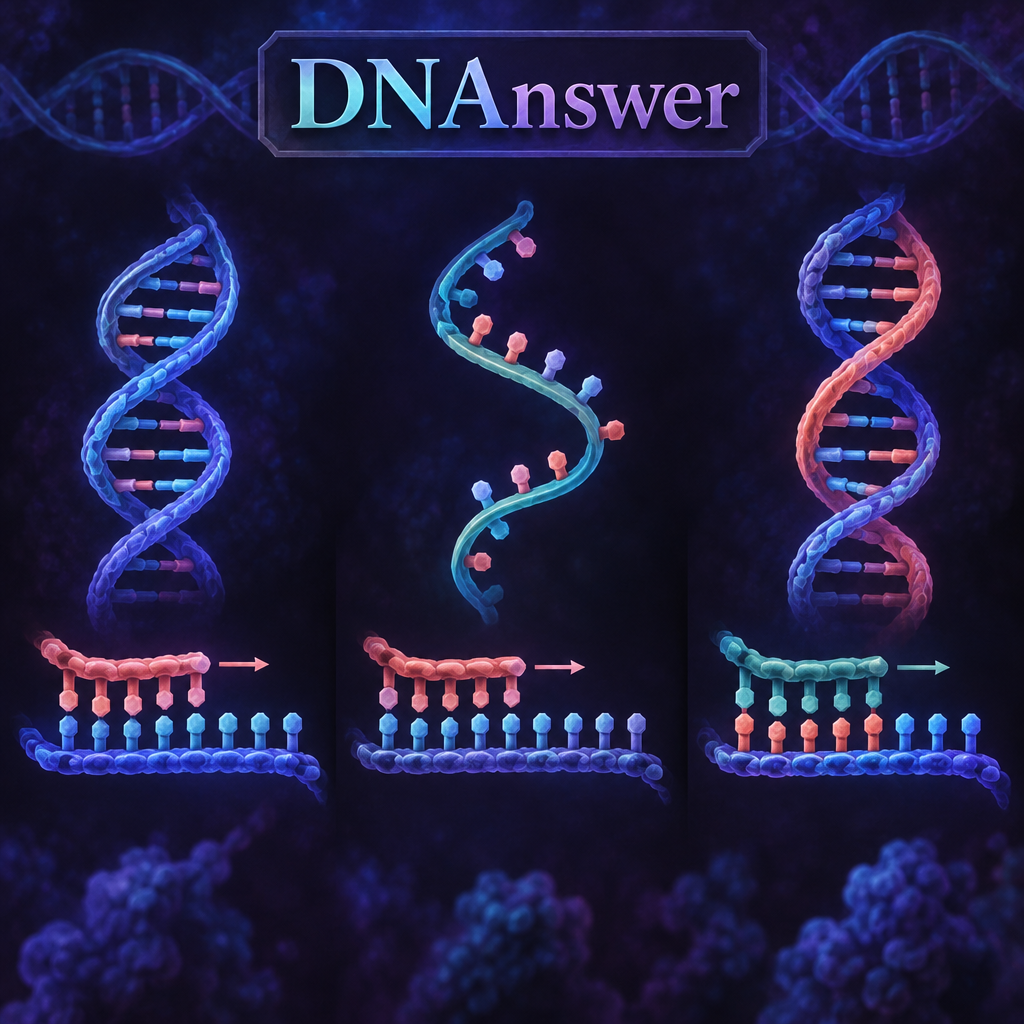
- mRNA (messenger RNA): carries the instructions for one protein from DNA to the ribosome.
- tRNA (transfer RNA): brings the matching amino acid, the building block of proteins, for each three-letter code word.
- rRNA (ribosomal RNA): forms the core of the ribosome, the machine that links amino acids together.
RNA that does the work
In the 1980s, Thomas Cech and Sidney Altman found RNA molecules that speed up chemical reactions, which earned them the 1989 Nobel Prize in Chemistry. Those are called ribozymes. Even more striking, the part of the ribosome that forms the bonds between amino acids is made of rRNA, not protein.
Other RNAs regulate genes. MicroRNAs, tiny strands about 22 letters long, bind to mRNA and block it from being used. Andrew Fire and Craig Mello won the 2006 Nobel Prize in Physiology or Medicine for showing how double-stranded RNA can silence genes.
You saw RNA's power directly in 2020 and 2021, when the Pfizer-BioNTech and Moderna COVID-19 vaccines delivered mRNA that told your cells to make one viral protein. RNA is a working molecule, not a photocopy.
Myth 4: Information Only Flows From DNA to RNA to Protein
Your textbook probably showed a neat arrow: DNA to RNA to protein. Francis Crick named it the central dogma in 1958. Many people took it to mean information can only travel one way.
That's not what Crick said. He ruled out one specific thing: information moving from protein back into DNA or RNA. Several other directions were left open, and nature uses some of them.
Running the arrow backward
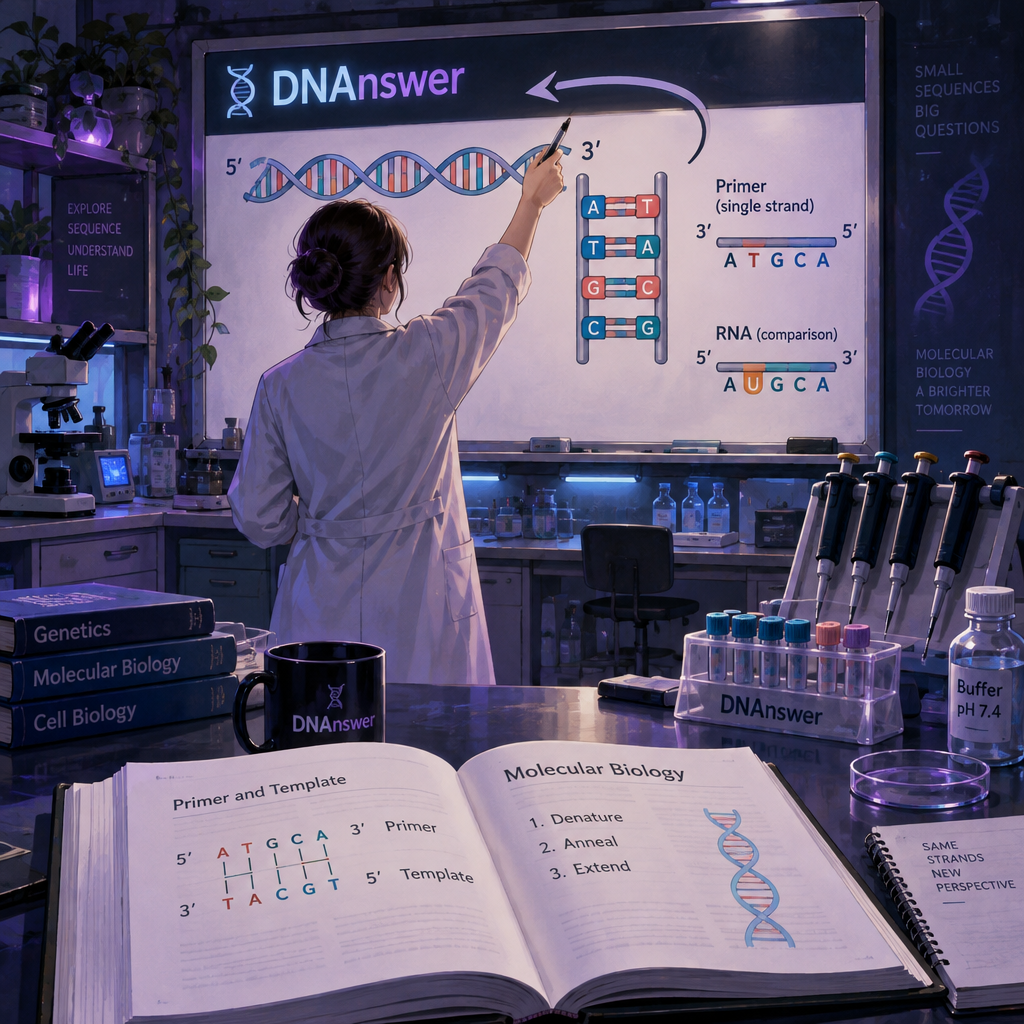
Retroviruses, such as HIV, carry RNA as their genetic material. When they infect a cell, they use an enzyme called reverse transcriptase to build DNA from that RNA. Howard Temin and David Baltimore discovered this in 1970, and they shared the 1975 Nobel Prize in Physiology or Medicine with Renato Dulbecco.
Reverse transcriptase now sits inside everyday lab tools. RT-PCR tests, including many COVID-19 tests, first turn viral RNA into DNA, then copy it until it's detectable.
The central dogma of molecular biology deals with the detailed residue-by-residue transfer of sequential information. It states that such information cannot be passed back from protein to either protein or nucleic acid. — Francis Crick, Nature, 1970
Why the dogma still holds up
The dogma survived because it describes a real limit. The genetic code can't be read backward from a protein, partly because several code words map to the same amino acid. That's why you can't take a protein and perfectly rebuild the gene sequence.
Prions (misfolded proteins that cause diseases like mad cow disease) are the edge case people raise. They spread by making other proteins misfold, which transfers shape, not sequence information. So they don't break Crick's rule.
Practical takeaway: treat the arrow as a main road with a few well-mapped side streets. When someone says a finding "breaks the central dogma," ask which version they mean.
Myth 5: A Primer Is Only a Beginner's Guide
You've come this far in a primer, and the second meaning of the word is still waiting. In the lab, a DNA primer is a short strand of nucleotides, usually 18 to 25 letters long, that gives copying enzymes a place to start.
Why does copying need one? DNA polymerase, the enzyme that builds new DNA, can only add nucleotides to the end of an existing strand. It can't begin from nothing. So the cell makes a short RNA primer first, using an enzyme called primase, and polymerase extends from there.
That detail surprises people. Your cells start DNA copying with a piece of RNA.
How replication uses primers
Replication happens when a cell divides. An enzyme called helicase unzips the double helix, and each strand becomes a template (a pattern to copy). One strand, the leading strand, gets copied smoothly with one primer. The other, the lagging strand, gets copied in short chunks called Okazaki fragments, each needing its own primer. A human cell makes millions of them.
How PCR borrows the trick
PCR (polymerase chain reaction) copies a chosen stretch of DNA millions of times. Kary Mullis developed it in 1983 and won the 1993 Nobel Prize in Chemistry. Scientists design two primers that match the two ends of the target, so only that region gets copied.
A typical PCR run goes like this:
- Heat the sample to about 203°F (95°C) so the double helix separates.
- Cool it to roughly 122-140°F (50-60°C) so primers stick to the matching ends.
- Warm it to about 162°F (72°C) so a heat-tolerant polymerase extends each primer.
- Repeat the cycle 25 to 35 times, doubling the target each round.
- Check the result, often by running it through a gel.
The heat-tolerant polymerase comes from Thermus aquaticus, a bacterium found in Yellowstone hot springs. It survives the heating step that would destroy most enzymes.
Why it matters: a poorly designed primer can bind the wrong spot and copy the wrong thing, which is one reason labs run controls. The drawback of PCR's sensitivity is that it can also amplify tiny amounts of contamination.
From Code to Protein: What Actually Happens Between Gene and Result
All five myths come back to the same pipeline, so it helps to see it in motion. Take insulin, the hormone that controls blood sugar. Its gene sits in your DNA in pancreatic cells, in the same form as in every other cell you have.
Transcription
Transcription is the step where an enzyme called RNA polymerase reads a gene and builds a matching mRNA strand. Unlike DNA polymerase, it doesn't need a primer. It starts at a marker region called a promoter.
In humans, the raw RNA gets edited before use. Non-coding chunks called introns are cut out, and the coding pieces, exons, are joined. Cutting them in different combinations lets one gene make several proteins.
Translation
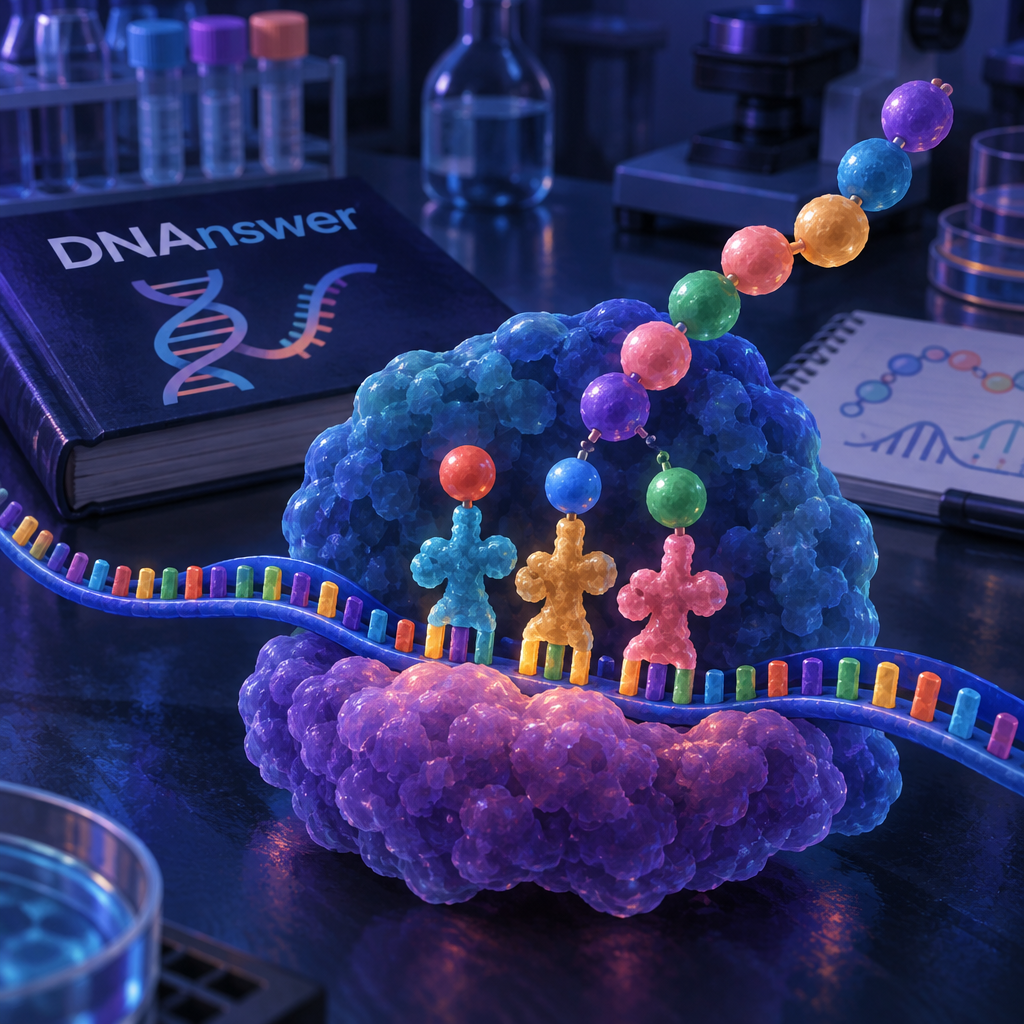
Translation happens at the ribosome, which reads the mRNA three letters at a time. Each three-letter group, a codon, matches one amino acid. There are 64 possible codons for 20 amino acids, so the code has built-in redundancy.
The start codon AUG tells the ribosome to begin, and three stop codons tell it to finish. The chain of amino acids then folds into a protein with a specific shape and job.
Where mistakes enter
A mutation is a change in the DNA sequence. Many do nothing, thanks to the redundant code. Others change an amino acid, and a few break a protein entirely. Sickle cell disease comes from one changed letter in the hemoglobin gene, which swaps one amino acid.
Cells proofread constantly. DNA polymerase checks its own work and fixes most errors, leaving roughly one error per billion letters copied. Those rare misses are the raw material for both disease and evolution.
If you want to test yourself on codons and base pairing, the quizzes at dnanswer.app give you a quick way to practice.
Conclusion
Choose your next step by what you want. If you read health news, ask whether a claim describes DNA sequence, gene activity, or RNA. If you want hands-on understanding, trace one gene, such as insulin, from DNA to protein and note where regulation changes the outcome. Biology rewards asking "who switches this on?" more than "what does the DNA say?"
Frequently Asked Questions
What is a primer in molecular biology?
A primer is a short strand of nucleotides, usually 18 to 25 letters long in PCR, that gives DNA polymerase a starting point. Cells use short RNA primers during replication, while labs use synthetic DNA primers, often ordered online from custom suppliers for a few dollars each.
What is the difference between DNA and RNA?
DNA is double-stranded, uses deoxyribose sugar, and has the base thymine. RNA is usually single-stranded, uses ribose, and has uracil instead. DNA stores information long term, while RNA also carries messages, builds proteins, and regulates genes.
Can your environment change your genes?
Environment doesn't usually change your DNA letters, but it can change which genes are active through epigenetic tags. Some exposures, like UV light or tobacco smoke, can also cause real DNA mutations in the cells they hit, though those changes generally don't pass to your children.
Why does PCR need two primers?
Two primers mark both ends of the target region, one on each strand. Polymerase extends from each toward the other, so only the stretch between them gets copied. With a single primer, copying would grow only linearly, not double each cycle.