The Central Dogma of Biology Has an Exception Nobody Taught You
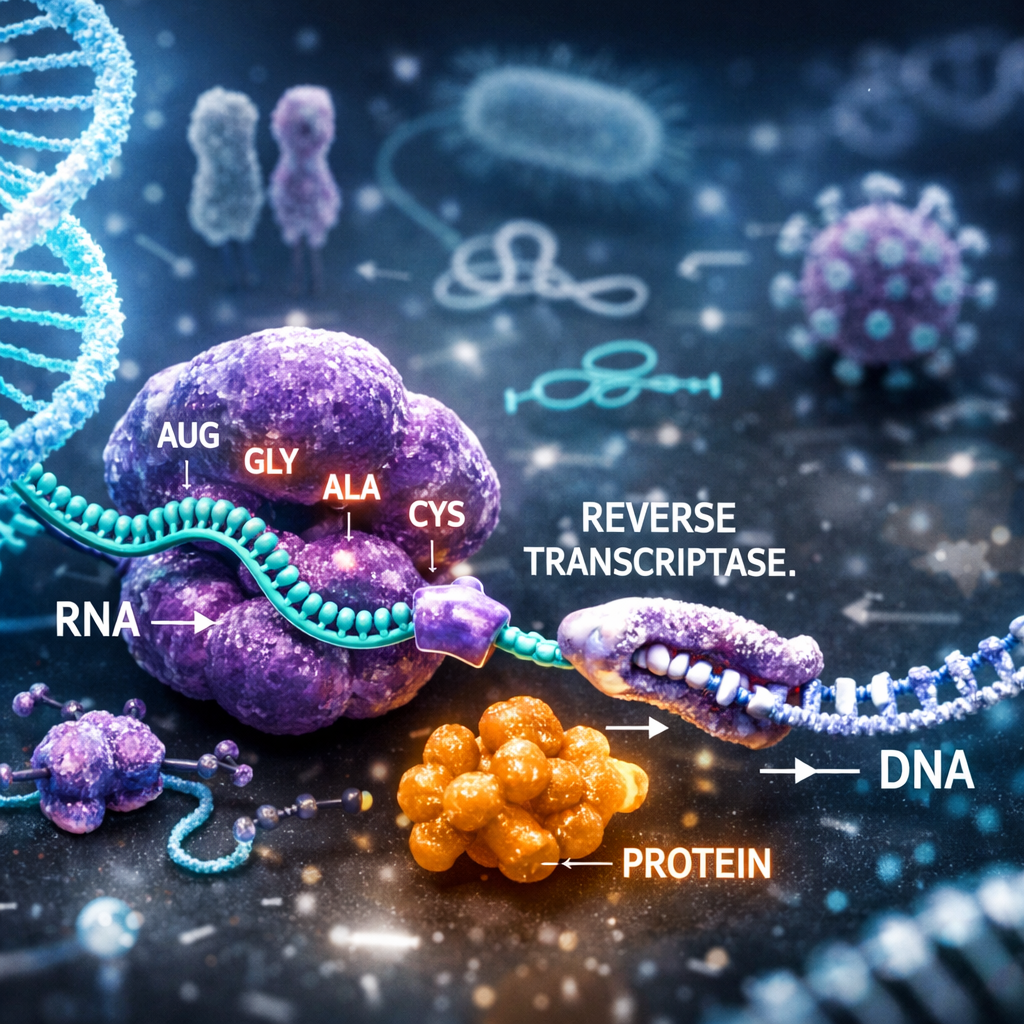
Your biology teacher drew an arrow. DNA → RNA → Protein. One direction. No exceptions. That arrow was always incomplete. And in April 2026, it got a lot more complicated. The central dogma of biology exceptions matter because the diagram can make you misread viruses, noncoding RNA, prions, and a newly identified bacterial defense system.
The correction is sharper than “biology breaks its rules.” Most unusual pathways expand the map without violating Francis Crick’s central claim: protein does not normally transfer its sequence information back into DNA or RNA. One discovery now forces scientists to examine that boundary more closely.
Key Takeaways
- DRT3 links protein structure to new DNA synthesis
- Reverse transcription does not disprove Crick’s central dogma
- RNA viruses copy RNA with RNA-dependent RNA polymerase
- Many RNA molecules never become proteins
- Prions alter protein shape, not DNA sequence
- Information flow differs from molecule movement
The Classroom Arrow Was a Shortcut, Not the Whole Rule
The familiar diagram describes a common route inside your cells. DNA stores a sequence, transcription copies that sequence into RNA, and translation reads messenger RNA to assemble a protein. That route remains the dominant pattern for gene expression in organisms such as humans.
But the arrow diagram compresses two different ideas into one picture. One idea concerns molecular traffic: which molecule helps produce another molecule. The other concerns sequence information: whether the instructions in one molecule can determine the sequence of another.
That distinction explains why the phrase “central dogma” causes so much confusion.
What Crick Actually Proposed
Francis Crick introduced the central dogma of molecular biology in 1958. His claim did not mean that DNA → RNA → protein describes every chemical reaction in a cell. It addressed the possible transfer of sequence information between biological molecules.
A protein can influence which genes turn on. It can cut DNA, fold RNA, or alter another protein. Those actions move molecules and change cell behavior. They do not mean the protein’s amino-acid sequence has become a readable DNA or RNA sequence.
Francis Crick’s central-dogma rule: sequence information cannot transfer from protein back into nucleic acid.
DNA and RNA are nucleic acids. Proteins are built from amino acids. Their alphabets differ, and cells do not possess a general molecular machine that reads an amino-acid sequence and writes the corresponding nucleotide sequence.
Why the Diagram Still Helps
For a student learning gene expression, DNA → RNA → protein gives you a useful first model. It explains why a mutation in DNA can change a protein, why transcription happens in the nucleus of a human cell, and why ribosomes translate messenger RNA in the cytoplasm.
The problem begins when you treat the model as a complete inventory. A subway map can show the main line without showing every branch. It does not become false because another train exists.
The practical fix is simple: keep the arrow, then add the documented routes and ask what kind of information each route transfers.
Myth: DNA Always Starts the Process
You may have learned that every biological instruction begins in DNA. That belief has a reasonable origin: your genome stores the long-term information needed to build and maintain a human body, and DNA-to-RNA transcription begins most textbook explanations of gene expression.
For many human genes, the sequence does begin there. RNA polymerase reads a DNA template and produces an RNA molecule with a complementary sequence. If that RNA becomes messenger RNA, a ribosome reads its codons and links amino acids into a protein.
Viruses expose the missing context.
RNA Can Carry the Starting Instructions
Some viruses store their genomes as RNA instead of DNA. An RNA virus entering a cell brings genetic information in a form that can be copied or translated directly, depending on the virus.
RNA-dependent RNA polymerase makes the relevant connection. This enzyme uses RNA as a template to synthesize more RNA. It does not need to copy RNA into DNA first.
That pathway belongs on an expanded map:
| Information route | Molecular machinery or example | What the route means |
|---|---|---|
| DNA → RNA | RNA polymerase | Transcription |
| RNA → Protein | Ribosome | Translation |
| RNA → DNA | Reverse transcriptase | Common in retroviruses |
| RNA → RNA | RNA-dependent RNA polymerase | Used by RNA viruses |
| Protein → DNA | Drt3b in DRT3 | Confirmed protein-templated DNA synthesis |
| Protein → Protein | Prion conformational templating | Shape transmission, not sequence copying |
The table separates routes that students often collapse together. “RNA virus” does not automatically mean “retrovirus.” A retrovirus uses reverse transcriptase to make DNA from an RNA template; many other RNA viruses copy RNA directly.
You should also separate genome storage from gene expression. A virus with an RNA genome can still produce proteins through ribosomes. Its genome starts as RNA, but translation still follows the RNA → protein route.
The classroom rule needs an added branch, not a funeral.
Myth: Reverse Transcription Disproves the Central Dogma
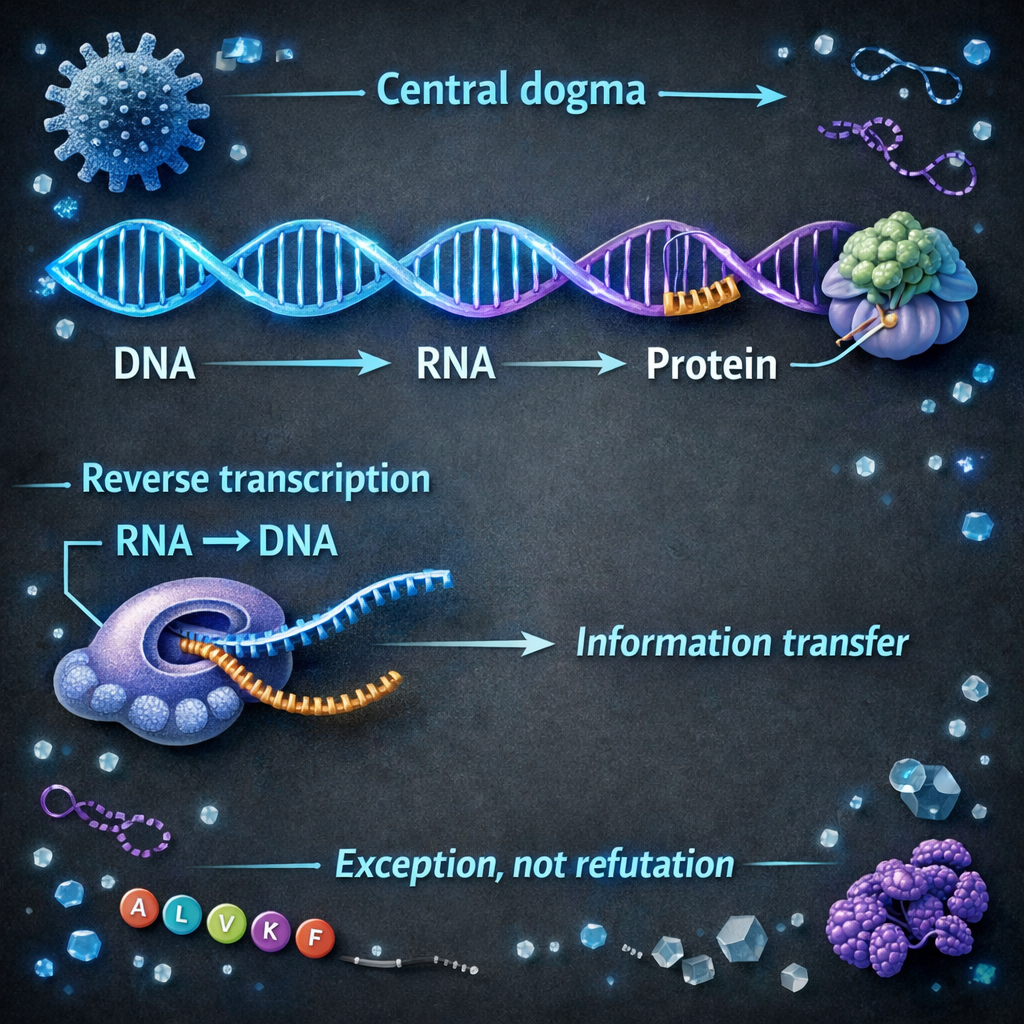
Reverse transcription looks like a direct challenge to the arrow. RNA becomes DNA. The reaction exists, it matters in human disease research, and scientists recognized the mechanism in retroviruses during the 1970s. So the objection sounds fair: if information can travel backward, why keep calling the dogma a rule?
Because the dogma never banned RNA → DNA information transfer.
The 1970 Discovery Changed the Diagram
In 1970, researchers associated with the study of retroviruses identified reverse transcriptase. The enzyme copies information from an RNA template into DNA. HIV, a retrovirus, uses this strategy: after entering a host cell, it makes a DNA copy of its RNA genome and inserts that DNA into the host genome.
The term reverse describes the direction relative to DNA → RNA transcription. It does not describe a violation of Crick’s information rule.
A useful distinction looks like this:
- DNA stores a sequence.
- RNA carries or supplies a sequence.
- Reverse transcriptase copies RNA information into DNA.
- The new DNA can direct RNA production.
- Ribosomes can translate resulting messenger RNA into protein.
The information still moves between nucleic acids before translation. No protein sequence instructs reverse transcriptase to write a matching DNA sequence.
Why “Backward” Misleads You
The word backward encourages you to imagine a one-way road with a forbidden lane. Molecular biology has a different structure. DNA and RNA share nucleotide-based sequence information, so enzymes can copy between them under the right conditions.
Proteins use a different alphabet. A protein sequence might contain 300 amino acids, while a DNA sequence uses four nucleotide types. Several different DNA codons can encode the same amino acid, so even a perfect protein sequence would not identify one unique DNA sequence.
That coding ambiguity creates a second problem. A protein cannot tell you which synonymous codon originally encoded an amino acid, where introns appeared, or which regulatory sequences surrounded the gene.
Reverse transcription expands nucleic-acid copying; it does not create protein-to-nucleic-acid translation.
For your notes, write RNA → DNA beside the original arrow. Then write “still nucleic acid to nucleic acid” beside it. That annotation prevents the most common conceptual error.
Myth: Every RNA Molecule Becomes a Protein
A messenger RNA molecule may travel from DNA to a ribosome and become a protein. That route gives RNA a starring role in introductory biology. It also creates a persistent false impression: RNA exists mainly as an intermediate on its way to protein.
Cells make many RNA molecules that never become proteins.
Noncoding RNA Has Its Own Jobs
A noncoding RNA does not provide a protein-making recipe. That does not make it biologically idle. Ribosomal RNA forms much of the ribosome’s working structure, while transfer RNA helps match amino acids to messenger-RNA codons.
Small regulatory RNAs can bind target messenger RNAs and change their stability or translation. Long noncoding RNAs can interact with proteins, DNA, or other RNA molecules. Their functions vary, but their sequences do not need to pass through a ribosome to matter.
The phrase “noncoding” describes what the RNA does not encode. It does not mean “junk,” and it does not mean “unimportant.”
Translation Requires More Than RNA
A ribosome cannot translate every RNA molecule it encounters. Translation requires a suitable messenger RNA, a start signal, readable codons, transfer RNAs, amino acids, and cellular conditions that support protein synthesis.
A ribosomal RNA molecule, for example, helps form the machine that performs translation. It does not become a protein. Transfer RNA carries amino acids and recognizes codons, but its own nucleotide sequence does not turn into an amino-acid chain.
This is why the central dogma map should show RNA → protein as a specific route, not as the unavoidable fate of all RNA.
You can test the idea with a simple question: What job does this RNA perform? If it forms part of a ribosome, carries an amino acid, or regulates another transcript, translation may never enter the story.
The practical takeaway is to stop treating RNA as a single category. Messenger RNA, ribosomal RNA, transfer RNA, viral RNA, and regulatory RNA can occupy different positions in the cell.
Myth: Prions Prove That Proteins Encode New Proteins
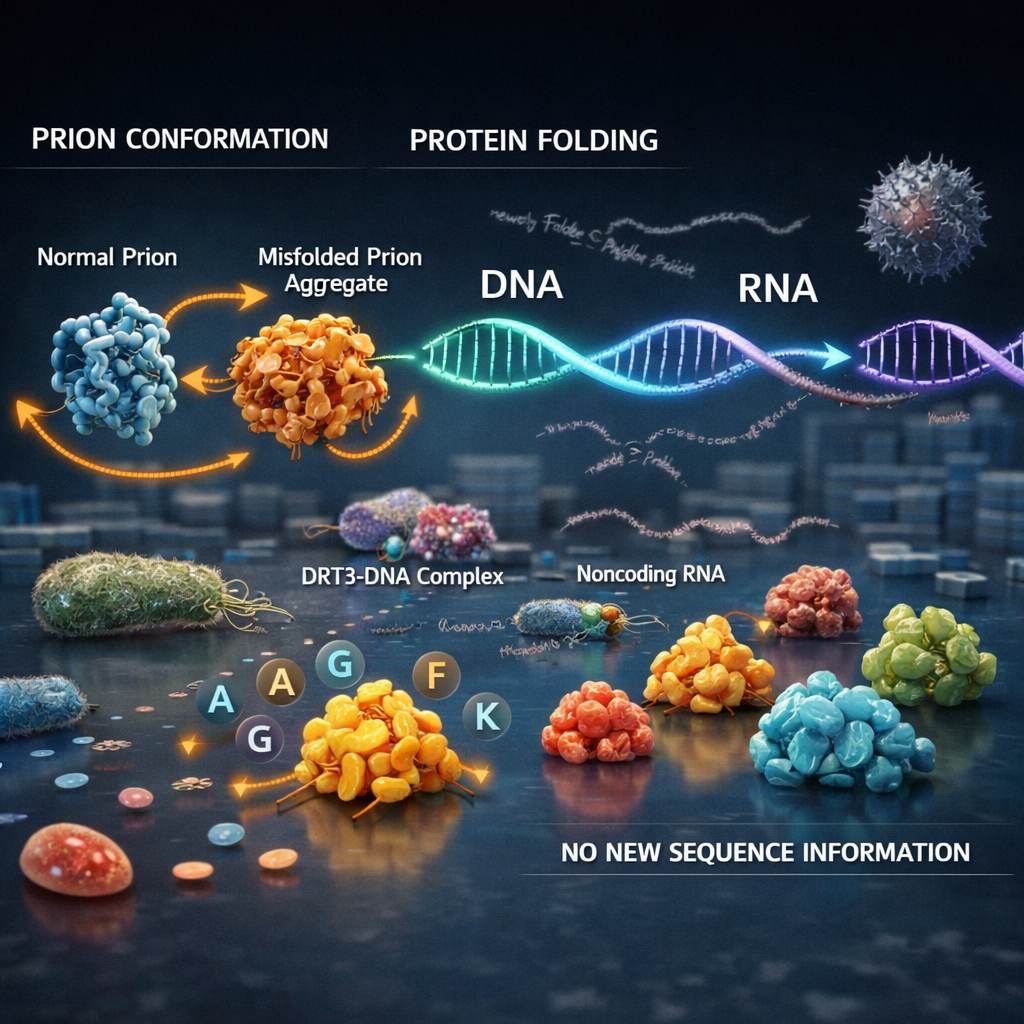
Prions create a more unsettling example. A misfolded protein can contact another version of the same protein and encourage it to adopt a similar shape. In diseases such as Creutzfeldt-Jakob disease, that shape change can spread through tissue.
It sounds like one protein creates another protein’s information. The comparison has a real kernel of truth: proteins can transmit structural information. The mistake comes when structural copying gets confused with sequence copying.
Shape Is Not Amino-Acid Sequence
A prion does not rewrite the amino-acid sequence of the protein it contacts. The target protein already contains that sequence. The prion changes how the chain folds in three-dimensional space.
Think of two identical pieces of paper folded differently. One fold can influence another sheet to take the same shape, but the letters printed on the paper have not changed.
That process is called conformational templating. “Template” here refers to shape, not a nucleotide sequence.
The Boundary Matters
Prion biology can produce stable, heritable-looking states in some organisms because a protein shape persists as cells divide. Yeast prions provide a classic research example. Yet the inherited state does not mean a protein wrote its amino-acid instructions into DNA.
The distinction becomes visible when you compare the molecules involved:
| Feature | DNA sequence copying | Prion conformational templating |
|---|---|---|
| Template type | Nucleic-acid sequence | Protein shape |
| Product | New nucleic-acid sequence | Protein with altered folding |
| Information copied | Ordered nucleotides | Three-dimensional conformation |
| Ribosome required | No | No |
| Protein-to-DNA transfer | No | No |
This is not a minor vocabulary point. If you call prions “protein genes,” you predict the wrong experiments and misunderstand why treatments target protein aggregation rather than a newly written DNA sequence.
Treat prions as a genuine protein-to-protein structural pathway. Keep it separate from protein-to-DNA sequence synthesis.
Myth: Proteins Cannot Influence DNA in Any Direct Way
This belief swings too far in the opposite direction. Proteins interact with DNA constantly. Transcription factors bind regulatory regions, enzymes cut or repair DNA, and histone proteins help package chromosomes.
So a careful reader might ask: if proteins touch DNA and control its activity, why can’t they also encode DNA?
They can influence DNA’s condition and use. That is different from writing a nucleotide sequence from their own amino-acid sequence.
Molecular Influence Is Not Sequence Transfer
A DNA repair enzyme can recognize damage and restore a missing base. A DNA polymerase can synthesize a new strand, but it reads a nucleic-acid template. A transcription factor can bind a promoter and alter gene expression, but it does not convert its amino-acid order into a DNA sequence.
Those proteins act like tools, switches, or machines. Their effects can be direct and powerful without transferring their own sequence information.
That difference also clarifies epigenetics. Chemical marks on DNA or histone proteins can change gene activity without changing the underlying DNA letters. A cell can remember a regulatory state while preserving the same nucleotide sequence.
The central dogma concerns the origin of sequence instructions, not whether proteins affect when those instructions get used.
Why DRT3 Forces a New Question
In April 2026, Deng and colleagues reported the DRT3 bacterial defense system in Science, with the work associated with Stanford University. The system includes an enzyme called Drt3b. Researchers found that Drt3b synthesizes DNA using its own protein structure as a mold, without a nucleic-acid template.
That finding creates the first confirmed protein-templated DNA synthesis mechanism.
The wording matters. Drt3b does not simply bind DNA, protect DNA, or recruit an ordinary DNA polymerase to copy a missing strand. Its own protein structure guides the production of DNA. This is the exact kind of mechanism that makes the old classroom map incomplete in a deeper way.
What DRT3 Does Not Yet Mean
DRT3 does not show that proteins routinely encode the DNA sequences of every gene. It does not mean your proteins constantly rewrite your genome. It does not erase the distinction between a bacterial defense reaction and ordinary heredity.
The discovery instead identifies a narrow, mechanistic exception to a boundary scientists thought had no confirmed example: protein-templated DNA synthesis without a nucleic-acid template.
A useful updated map is:
- DNA → RNA: transcription, the general cellular route
- RNA → protein: translation by ribosomes
- RNA → DNA: reverse transcriptase, recognized in 1970
- RNA → RNA: RNA-dependent RNA polymerase in RNA viruses
- Protein → DNA: Drt3b in the DRT3 system, reported in 2026
- Protein → protein: prion structural templating
DRT3 belongs on the map. It does not turn every protein into a genetic writer.
How to Read the Updated Central Dogma Map
Imagine you are looking at a cell diagram after adding the missing arrows. The map now contains more routes, but the arrows still need labels. Without those labels, you might mistake copying for translation, molecular movement for information transfer, or structural influence for sequence encoding.
The safest approach asks three questions: what molecule supplies the template, what molecule gets produced, and what kind of information moves?
The Five Routes That Cause Most Confusion
DNA → RNA remains the general rule for transcription. RNA polymerase reads one DNA strand and builds a complementary RNA strand. RNA → protein describes translation, where a ribosome reads messenger-RNA codons and assembles amino acids.
RNA → DNA uses reverse transcriptase. RNA → RNA uses RNA-dependent RNA polymerase. Protein → protein, as seen in prions, transmits a shape rather than a new amino-acid sequence.
DRT3 adds protein → DNA, but with an unusual qualification: Drt3b’s protein structure acts as a mold for DNA synthesis. The mechanism does not resemble standard gene expression, and its role in bacterial defense gives it a specific biological context.
Information Flow and Molecule Movement Are Different
A protein can move into a nucleus. It can bind DNA. It can cause a chromosome to become more accessible. None of those events mean the protein’s sequence entered the DNA.
Likewise, an RNA molecule can move between the nucleus and cytoplasm, or a viral protein can recruit host enzymes. Location tells you where a molecule goes. It does not tell you which sequence information transfers.
That distinction matters in genetics, virology, and medicine. If a drug changes a transcription factor, it may change gene activity without changing the genome. If a retrovirus inserts DNA into a chromosome, RNA-derived information has entered DNA, but protein-derived information has not.
A Better Study Habit
When you see a new arrow, label its mechanism before deciding whether it breaks the central dogma. Ask whether the arrow describes template copying, translation, structural templating, or regulation.
Then identify the alphabet. DNA and RNA use nucleotide sequences. Proteins use amino-acid sequences and three-dimensional shapes. DRT3 matters because it links a protein structure to DNA synthesis, while prions remain protein-to-protein shape transmission.
If you practice with quizzes after studying, dnanswer.app’s biology questions can give you a quick way to sort these pathways by mechanism rather than memorize a flat list.
The most accurate diagram is not the one with the fewest arrows. It is the one that tells you what each arrow actually means.
Conclusion
Keep DNA → RNA → protein as your starting point, but stop calling it the entire map. Add RNA → DNA, RNA → RNA, noncoding RNA, prion-based shape transmission, and the DRT3 protein → DNA pathway. When you meet a claimed exception, identify the template, the product, and the information type. That three-part check will tell you whether biology broke the rule or your diagram left something out.
Frequently Asked Questions
Does reverse transcription violate the central dogma?
No. Reverse transcription transfers sequence information from RNA to DNA, and Crick’s central dogma allows nucleic-acid-to-nucleic-acid transfer. Retroviruses such as HIV use reverse transcriptase to create DNA from an RNA genome before integration into a host chromosome.
What makes DRT3 different from reverse transcription?
DRT3 is different because Drt3b synthesizes DNA using its own protein structure as a mold, without a nucleic-acid template. Reverse transcriptase copies an RNA template into DNA, so its template and product both belong to the nucleic-acid family.
Are prions genetic information?
Prions transmit protein shape, not a new DNA or RNA sequence. The target protein already has its amino-acid sequence; contact with the prion changes how that chain folds. Some resulting states can persist across cell divisions without protein writing a gene.
Why doesn’t every RNA become a protein?
Only messenger RNA carries a sequence arranged for ribosomal translation. Ribosomal RNA helps build the ribosome, transfer RNA delivers amino acids, and regulatory RNAs control gene activity. Their functions depend on RNA structure and interactions, not conversion into proteins.