Niche Definition in Biology: Meaning and Examples
Is a niche just the place where an animal lives? No. A bird and a beetle can share one oak tree and hold completely different niches. The niche definition in biology describes a species' job, not its address: what it eats, when it is active, what it survives, and how it changes the world around it.
That job description is written in DNA. Enzymes (proteins that speed up chemical reactions), metabolic pathways, and gene variants decide what a species can use. This article busts five common myths, starting with the costliest.
Key Takeaways
- A niche is a species' role, not its address.
- Genes and enzymes set which resources a species can use.
- Niche covers food, timing, climate tolerance, and effects on others.
- Two species cannot share an identical niche indefinitely.
- Niches shift through competition, evolution, and the species' own actions.
- An empty niche needs the right genes, not just open space.
Myth 1: A Niche Is Just Another Word for Habitat
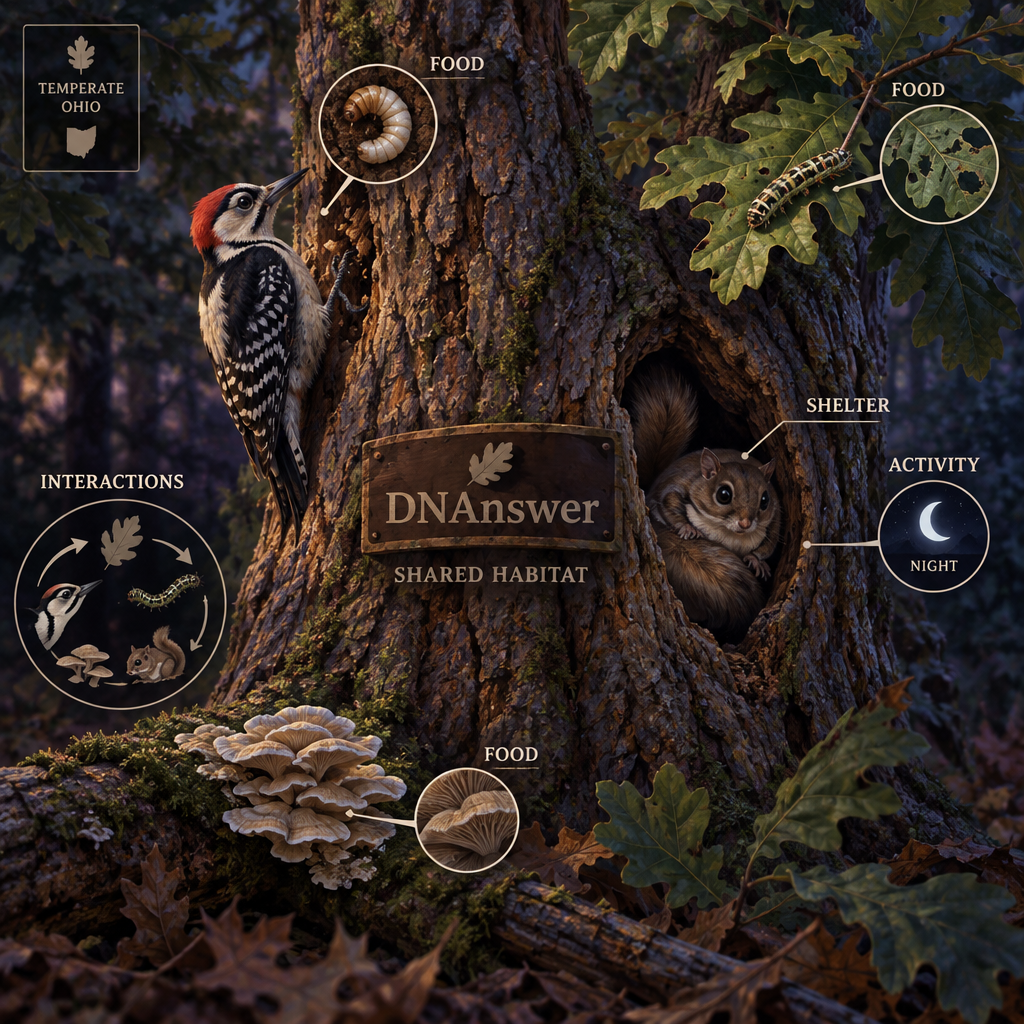
Picture a mature oak forest in Ohio. A woodpecker, a leaf-eating caterpillar, a fungus, and a flying squirrel all live there. Same habitat. Four very different lives.
Most people believe niche means habitat because both words feel like "where something lives." That is a fair guess. Textbooks often introduce them together, and in everyday speech "niche" even means a cozy corner.
Habitat is the address, niche is the occupation
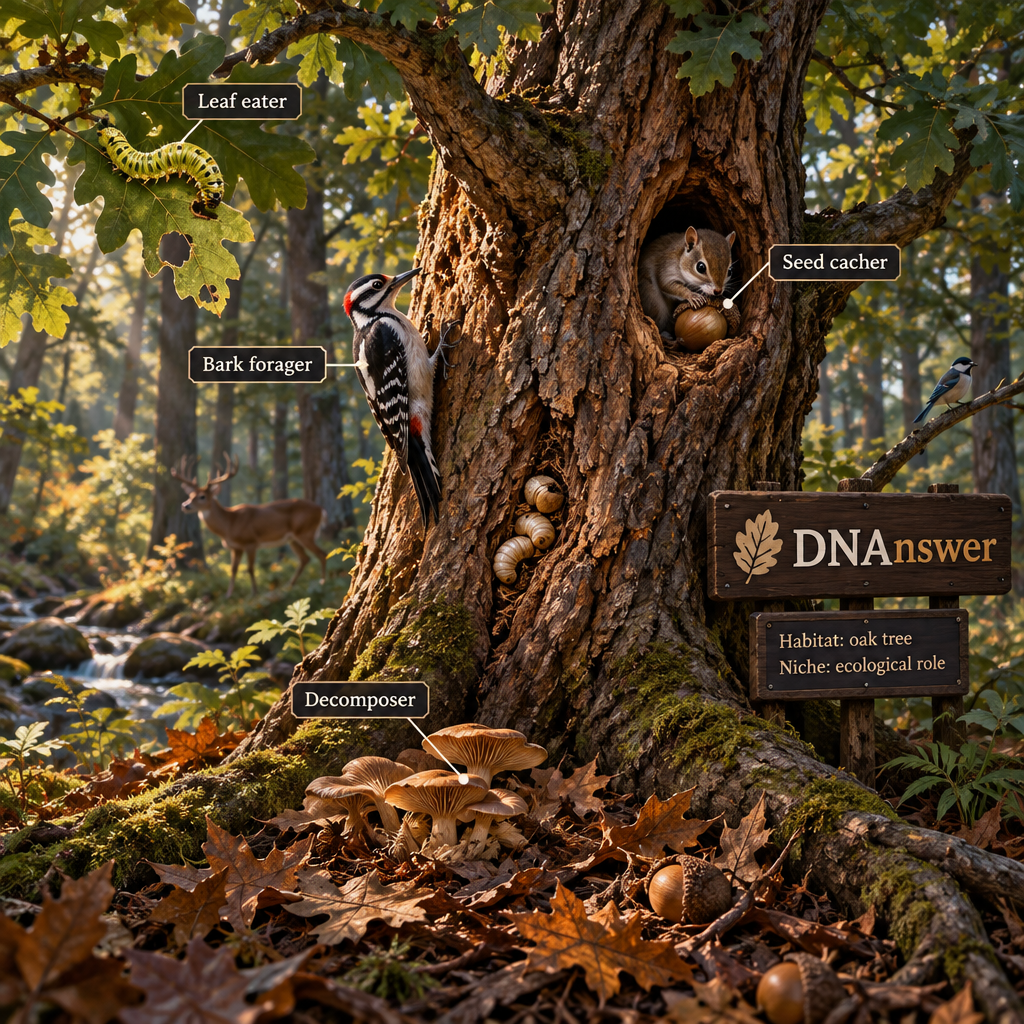
A habitat is the physical place a species lives, such as a pond, a prairie, or a rotting log. A niche is everything the species does and needs there. Think of habitat as your street and niche as your job, your schedule, your diet, and your effect on the neighbors.
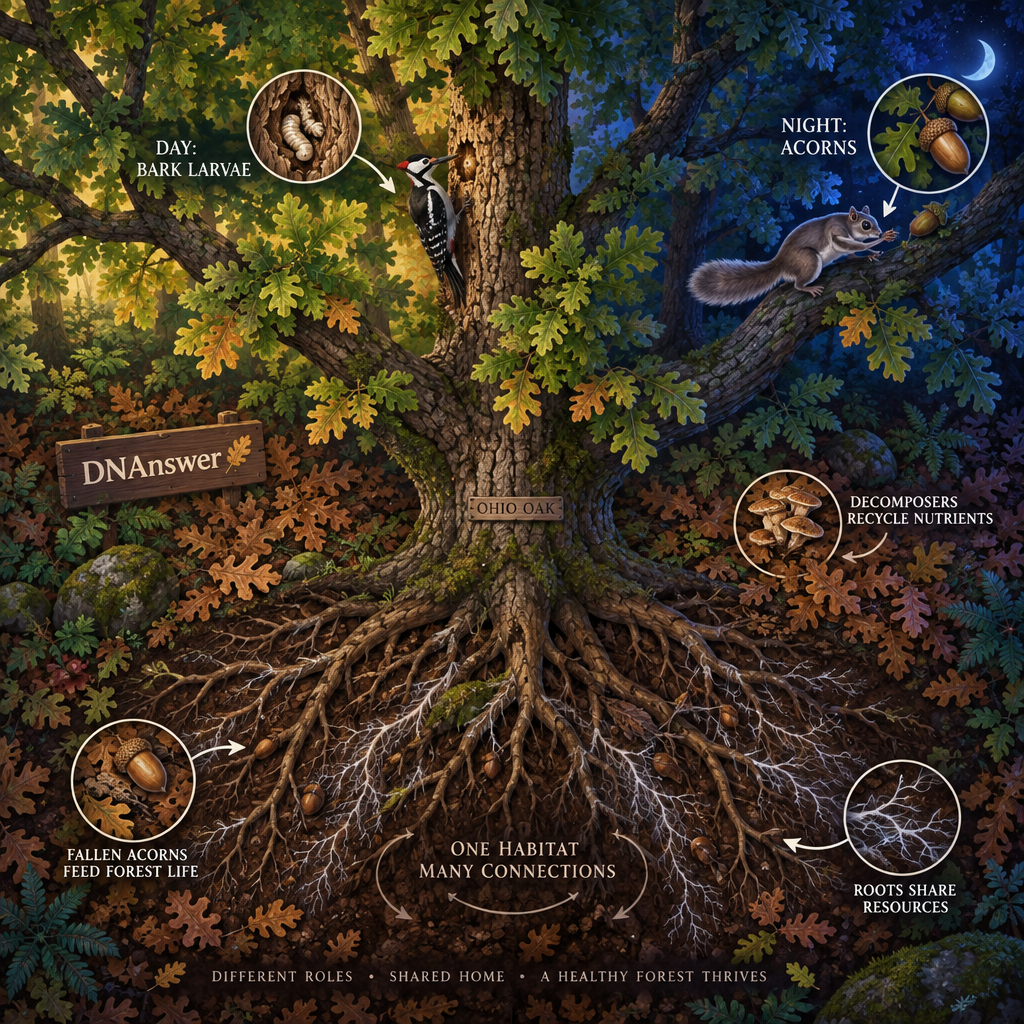
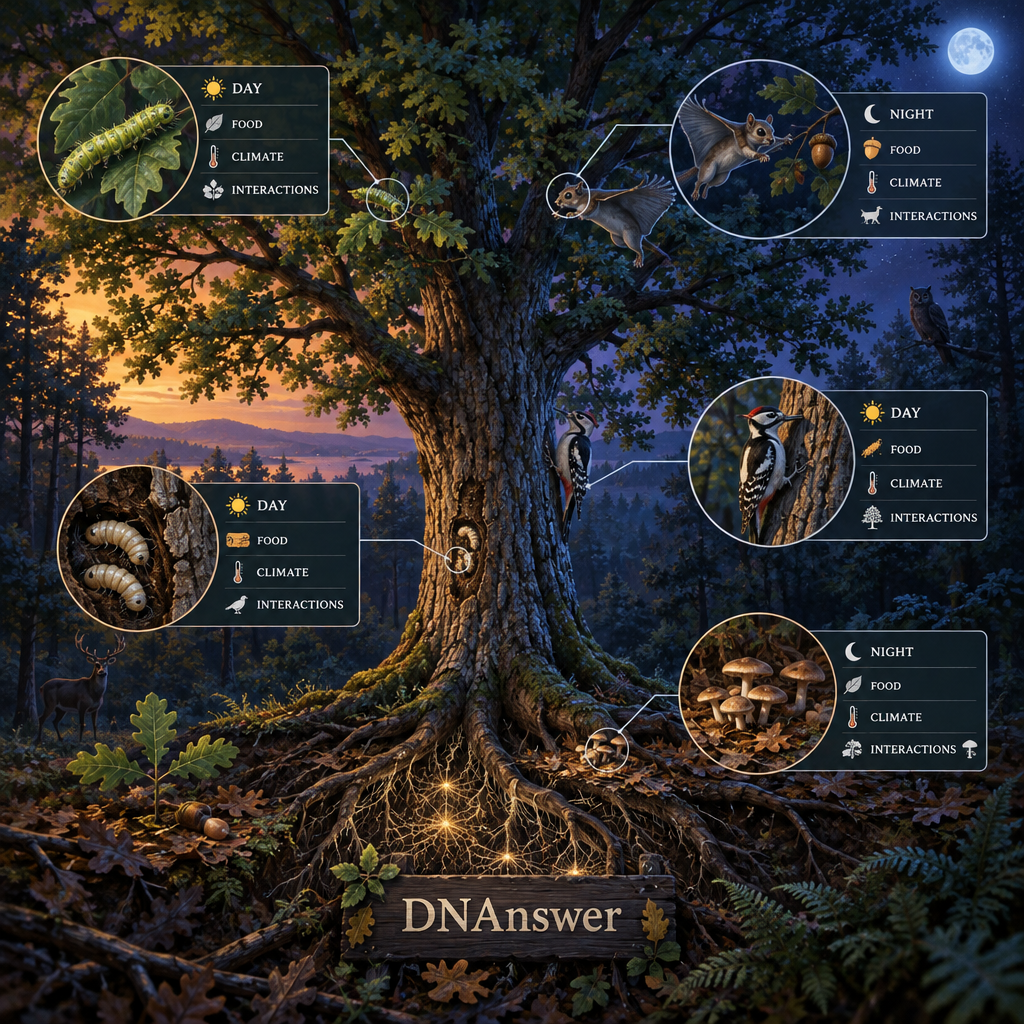
The woodpecker drills bark for beetle larvae. The caterpillar chews oak leaves, which are loaded with bitter chemicals called tannins. The squirrel glides at night and eats acorns and fungi. The fungus breaks down dead wood. Four niches, one tree.
Where the definitions came from
Three scientists shaped the idea. Joseph Grinnell, working in California in the early 1900s, used niche mostly as a place-based idea: the set of surroundings a species fits into. Charles Elton, in 1927, shifted the meaning to a species' role in the food web, what it eats and what eats it. G. Evelyn Hutchinson, in 1957, made it mathematical.
Hutchinson defined the niche as an n-dimensional hypervolume. That sounds heavy, but the idea is simple. Pick any factor, such as temperature. Each species survives only within a range. Add another factor, such as prey size, and you get a box. Add a third and you get a 3D block. Add dozens and you get a shape too big to picture, which is the "n-dimensional" part. The species can live wherever every factor falls inside its range.
A niche is the set of environmental conditions and resources within which a species can survive and reproduce, described by Hutchinson in 1957 as an n-dimensional hypervolume.
What should you do differently? When you read "niche," ask "what job?" before you ask "what place?" Habitat is one dimension of the niche, not the whole thing.
Myth 2: A Niche Is All About What a Species Eats
Ask most people what a niche is and they say "its food." That belief has a real basis. Diet is the easiest part of a niche to see, and Elton's food-web view put eating at the center. Food competition also drives many famous stories in ecology.
But diet is one axis out of many. A niche also includes when a species is active, what temperatures it tolerates, where it nests, what diseases it resists, and what it gives back to the system.
Dimensions beyond dinner
Consider four American warblers that feed in the same spruce trees in Maine: Cape May, bay-breasted, yellow-rumped, and black-throated green. Robert MacArthur's 1950s fieldwork, a classic in ecology, showed they hunt insects in different zones of the tree. Some work the outer twigs, others the inner trunk, others the treetop. They also differ in how they move and when they nest. The food looks similar. The niches differ in space and behavior.
Timing counts too. Mosquito species differ in biting hours. Bats and swallows both eat flying insects, but bats take the night shift and swallows take the day. Same menu, different clock.
The DNA behind the menu
Even diet itself is a genetic matter. Adults of many mammals stop making lactase, the enzyme that digests milk sugar, after weaning. Some human populations carry gene variants that keep lactase running into adulthood, which opens dairy as a food source. That is a niche expansion written in a single stretch of DNA.
Koalas eat eucalyptus leaves that poison most animals. Their liver enzymes break the toxins down. Remove those enzymes and the "food niche" vanishes.
What should you do differently? When you hear a niche described by diet alone, ask what else is missing: timing, temperature, shelter, and effects on others.
Myth 3: Two Species Can Share the Same Niche Forever
Surely two similar species can just get along? Plenty of people assume nature has room for everyone, and in a big forest it can look that way. Two kinds of squirrels in one park seem to coexist fine.
The kernel of truth is that species with overlapping niches can live side by side. The catch is that overlap is not identity. Perfect overlap does not last.
The competitive exclusion principle
The competitive exclusion principle says that two species competing for the exact same limited resource cannot coexist for long. One wins. The other disappears locally or changes. Russian biologist Georgy Gause tested this in the 1930s with two species of Paramecium, tiny single-celled organisms, in lab flasks. Grown alone, each thrived. Grown together on the same food, Paramecium aurelia drove Paramecium caudatum toward extinction.
Small advantages compound. If one species converts food into offspring just a bit faster, it slowly takes over. Biologists call the result a winner even when the margin was tiny.
How species avoid the knockout
Competitors often escape through niche partitioning, splitting the resource so each uses a different slice. The Maine warblers do this by foraging in different parts of the tree. Lizards on Caribbean islands divide branches by thickness. Lions and cheetahs overlap in prey but differ in hunting time and habitat use.
Darwin's finches on the Galápagos Islands show partitioning over evolutionary time. When two ground-finch species share an island, their beak sizes diverge so they eat different seed sizes. On islands where one lives alone, beaks sit in between. Peter and Rosemary Grant documented a drought in 1977 on Daphne Major: large-beaked birds survived because only they could crack the tough seeds that remained.
What should you do differently? When two species seem to share a niche, look for the hidden difference. It is usually there, and it is usually a gene-level one.
Myth 4: Niches Are Fixed Features of a Species
If a niche is a job description, you might think it comes stamped on the species forever. Field guides help that impression. They list one diet, one range, one lifestyle per species.
That snapshot is useful, yet it hides how much niches move. Three forces reshape them: competition, evolution, and the organisms themselves.
Fundamental versus realized niche
Hutchinson split the niche into two. The fundamental niche is everything a species could use and survive in with no competitors or predators. The realized niche is what it actually uses once rivals push back.
Ecologist Joseph Connell showed this with barnacles on Scottish rocks in the 1960s. The barnacle Chthamalus could live across a wide band of the shore. But a larger rival, Balanus, crowded it out of the lower zone. Remove Balanus and Chthamalus spread downward into its fundamental niche. Competition had shrunk its realized niche.
Evolution rewrites the job description
Genes change the niche itself. Bacteria in Richard Lenski's long-running lab experiment at Michigan State, begun in 1988, are a famous example. After roughly 31,000 generations, one population evolved the ability to use citrate, a compound in the growth medium, as food. A new enzyme-handling trait opened a resource the ancestors could not touch. That is a niche widening through DNA change.
Species build their own niches
Niche construction means organisms modify their surroundings in ways that change the pressures on themselves and others. Beavers in Wisconsin or Maine dam streams, creating ponds that host fish, frogs, and waterfowl. Earthworms rework soil chemistry. Wolves in Yellowstone, reintroduced in 1995 and 1996, changed elk behavior, which allowed willows along streams to recover in some areas, though scientists still debate how large that effect was.
Species that reshape the system far beyond their numbers are called keystone species. Remove a sea otter from a kelp forest and urchins boom, grazing the kelp. The otter's niche holds up other niches.
What should you do differently? Treat any niche description as a snapshot of one time and one set of neighbors.
Myth 5: An Empty Niche Is Just an Unused Place
Walk into a vacant house and you could move in. Many people picture an "empty niche" the same way: open space that any newcomer would fill. The picture comes from real events. After the dinosaurs died out about 66 million years ago, mammals diversified into many roles that large reptiles had held.
But an empty niche is not a vacancy sign. It is an unfilled job, and a species needs the equipment to do it.
Why open space is not enough
Take Australia's cane toads. People released them in 1935 to eat beetles in sugarcane fields. The toads thrived in Queensland, but they did not control the beetles. They spread across northern Australia and poisoned predators that had never met their toxin. A free niche was not the issue. The toads had traits that fit a new set of conditions, and local animals lacked defenses.
The reverse also happens. A bare volcanic island may have plenty of insects, yet no bird arrives with the right bill, gut, and behavior to exploit them for generations.
The molecular requirements
Filling a niche means carrying the right chemistry. To eat nectar, you need enzymes for sugars. To eat wood, you need gut microbes or genes that break down cellulose, the tough fiber in plant walls. To live in hot springs, you need proteins that do not unravel at high heat. Thermus bacteria from Yellowstone, source of the heat-stable enzyme used in PCR (the DNA-copying technique in labs), show that last point well.
Cleaner fish illustrate a niche that depends on behavior wired into the brain. Cleaner wrasses remove parasites from larger fish at "cleaning stations" on coral reefs. The job needs tolerance of risk, recognition of clients, and honest service, because clients can eat cheaters. No generic small fish can step in.
Here is how a niche opens up, in the order it usually happens:
- A resource exists, such as a seed type, a toxin-rich plant, or a parasite-laden host.
- A species with a useful gene variant appears, by mutation or arrival.
- The variant gives a survival edge when it uses that resource.
- Individuals carrying it reproduce more, and the variant spreads.
- Competitors adjust, shift, or lose ground.
- The niche settles into a new shape.
What should you do differently? When someone says a niche is "open," ask what traits a newcomer would need to fill it. Often none exists nearby.
How Specialists and Generalists Show the Niche Story
Having busted the myths, you can see why species fall on a spectrum from narrow to wide niches. A specialist uses a small slice of resources. A generalist uses a broad range.
Giant pandas eat almost nothing but bamboo, despite having a carnivore's gut. That narrow niche works while bamboo lasts and fails when it flowers and dies off. Raccoons eat fruit, eggs, trash, and crayfish, and they live in cities from Boston to Los Angeles. Generalists tend to survive change. Specialists tend to win in stable settings, where being the best at one thing beats being decent at many.
The trade-off is real. A specialist's advantage comes with a genetic cost, since the enzymes and body features tuned for one resource often work poorly on others. I'd say that is the single best reason extinction risk rises as niches narrow.
If you want to test your grasp of habitat, niche, and adaptation, the quizzes on dnanswer.app work well for practice, since each question forces you to apply a term to a concrete case.
Conclusion
Next time you see an animal, skip "where does it live?" and ask three questions: what does it use, when does it use it, and what does it change? Then ask which genes make that possible. You will find the niche there. If you can answer those four questions about a crow, a clam, or a cleaner fish, you understand the idea better than most textbooks teach it.
Frequently Asked Questions
What is the simple definition of a niche in biology?
A niche is the role a species plays in its ecosystem: what it eats, when it is active, what conditions it tolerates, and how it affects other species. Habitat is only its location.
Can a species have more than one niche?
A species has one niche, but it can shift across life stages. Tadpoles graze algae in water, while adult frogs hunt insects on land, so the same species fills two quite different roles over its life.
What happens when two species compete for the same niche?
One usually wins, the other moves to a different resource, or both evolve apart over time. Gause's Paramecium experiments showed the first outcome, while Darwin's finches show the third.
Does a niche exist if no species fills it?
Not in a meaningful sense. A resource may exist, but a niche is a species' relationship to it. Without a species carrying the right genes, the resource sits unused until one evolves or arrives.