Krebs Cycle: How Cells Release Energy
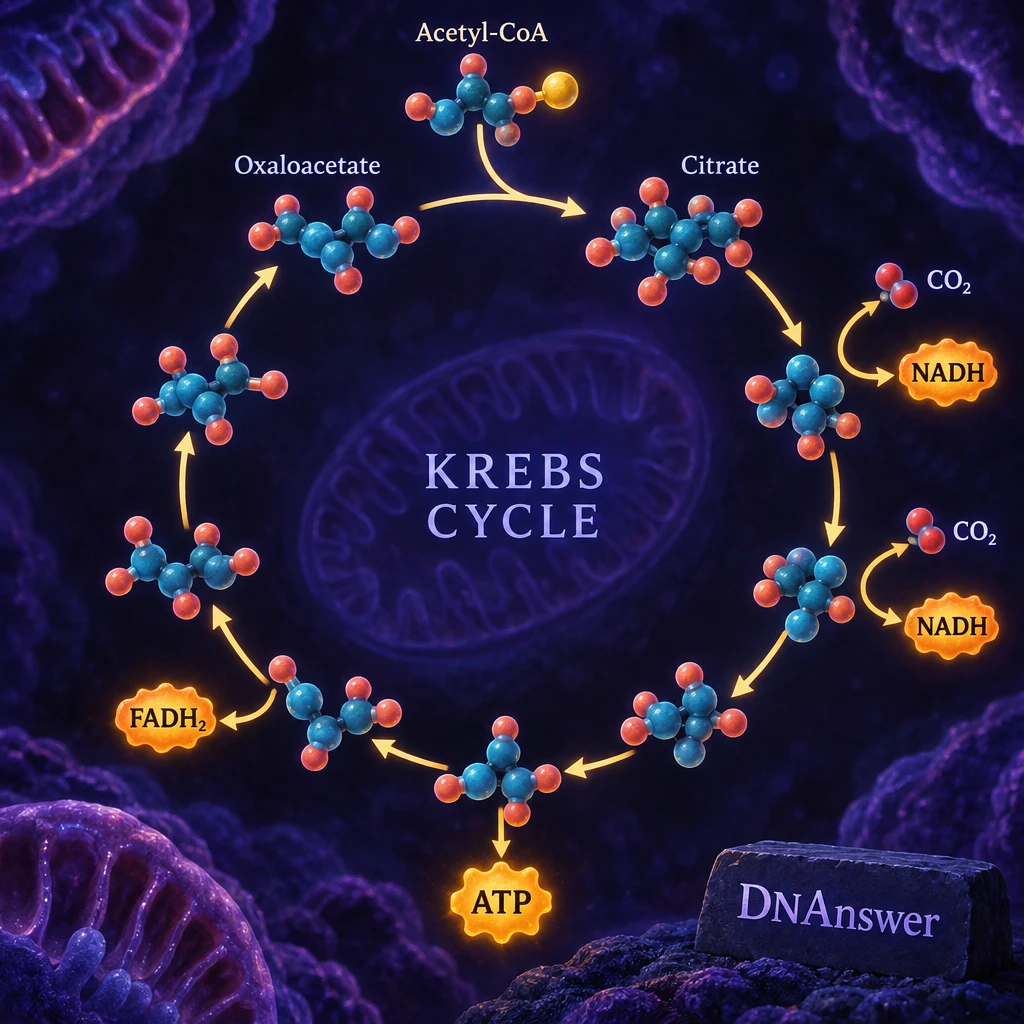
Why does your Krebs cycle, the famous energy engine of every textbook, make almost no energy itself? Each turn produces exactly one ATP, your cell's usable energy currency. That's it. The real payoff is something else.
The Krebs cycle strips energy-rich electrons (tiny charged particles) from food-derived fuel and loads them onto carrier molecules. Those carriers then power most of your ATP production somewhere else. If you came here to understand how your cells turn breakfast into usable energy, follow the electrons, not the molecule names. Five common myths stand in the way.
Key Takeaways
- One turn directly yields just one ATP equivalent.
- Main output: three NADH and one FADH2 electron carrier.
- Each glucose molecule needs two turns, not one.
- The cycle never touches oxygen but stops without it.
- Standard biochemistry counts eight reactions, not five.
- Cycle molecules double as raw materials for building your body.
Meet the Cycle Before You Bust the Myths
Three names, one pathway. The Krebs cycle, the citric acid cycle and the TCA cycle (short for tricarboxylic acid cycle) all describe the same loop of chemical reactions. Hans Krebs worked it out in 1937 at Cambridge University in England, and he later shared the 1953 Nobel Prize in Physiology or Medicine for it.
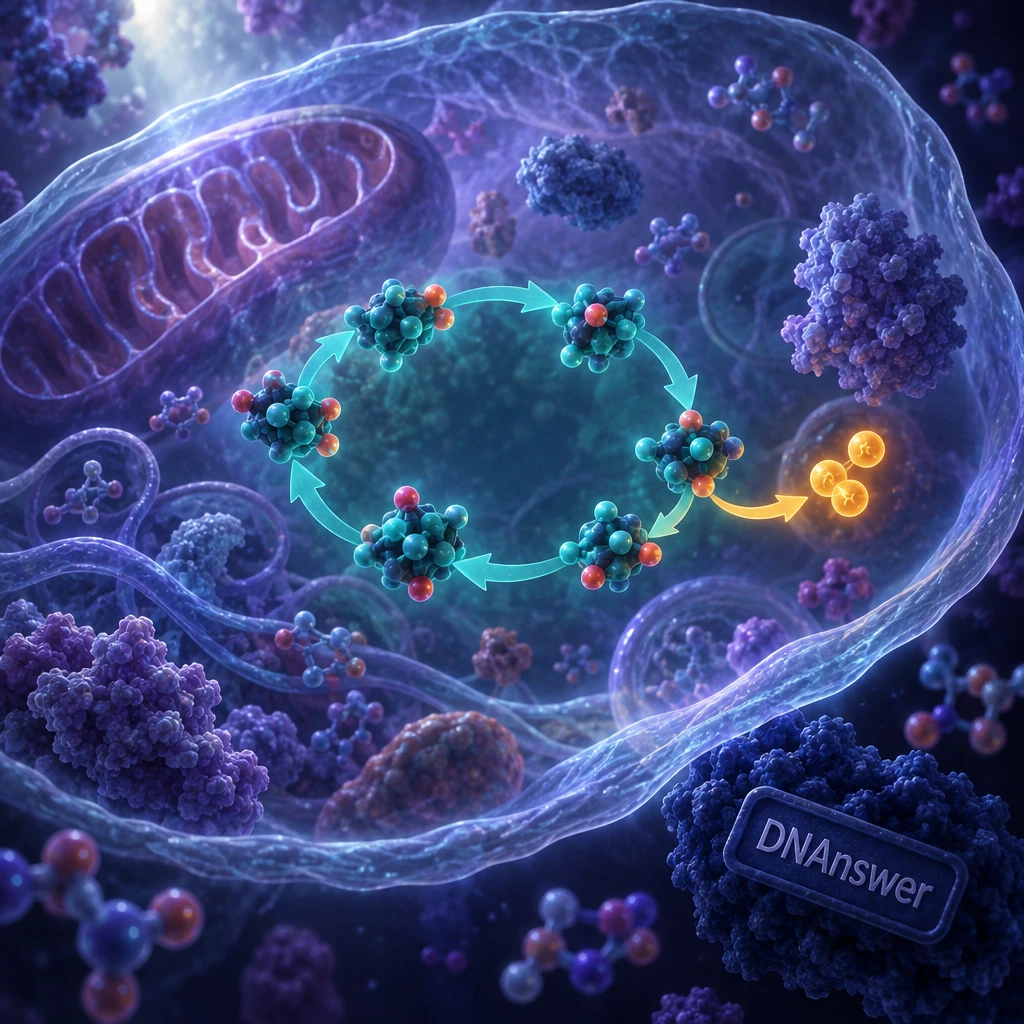
The cycle runs inside your mitochondria, small compartments in your cells that process energy. More precisely, it runs in the mitochondrial matrix, the fluid-filled core of each one. A busy cell like a heart muscle cell holds thousands of mitochondria.
Fuel enters as acetyl-CoA, a molecule that delivers a two-carbon piece of food to the cycle. That two-carbon piece can come from sugar, fat, or some amino acids (the building blocks of protein). The cycle doesn't care which meal it came from.
The acetyl group joins oxaloacetate, a four-carbon molecule that waits at the cycle's starting point. Together they make citrate, a six-carbon molecule (the same citric acid that makes lemons sour). Then a chain of reactions pulls the citrate apart, captures its energy, and rebuilds oxaloacetate at the end. That rebuilt oxaloacetate accepts the next delivery of fuel. This reuse is why it's a cycle rather than a one-way line.
Myth 1: "The Krebs Cycle Makes Most of Your ATP"
Picture the diagram from high school biology. The Krebs cycle sits in the middle, big and circular, with arrows everywhere. It looks like the main event. So you assume it's where your energy gets made.
That belief has a real kernel. Together with the steps that follow, the cycle is the major route your cells use to produce energy. Textbooks often call it the central hub of metabolism, and that's fair. The mistake is crediting the cycle with ATP that other machinery makes.
What the cycle actually hands over
Each turn makes one ATP or GTP directly. GTP is a close cousin of ATP that carries the same amount of usable energy, and your cell swaps one for the other easily. Everything else of value leaves as electron carriers:
- Three NADH molecules, each loaded with a pair of high-energy electrons
- One FADH2 molecule, a second type of electron carrier
- Two carbon dioxide molecules, the waste you breathe out
- One rebuilt oxaloacetate, ready for the next turn
Where the ATP really comes from
The carriers drive their electrons to the electron transport chain, a series of proteins embedded in the inner mitochondrial membrane. That chain uses the electrons' energy to pump charged particles across the membrane, and the resulting pressure spins an enzyme that builds ATP. Each NADH ends up powering roughly 2.5 to 3 ATP. Each FADH2 powers roughly 1.5 to 2.
Run the numbers for one turn. Three NADH give about 7.5 ATP. One FADH2 gives about 1.5. Add the single direct ATP, and one turn is worth about 10 ATP in total. Only one of those ten comes straight from the cycle.
So think of the Krebs cycle as a loading dock, not a power plant. Its job is to fill electron carriers. When you read that the cycle "produces energy," translate it in your head: it captures energy in a form the next machine can spend.
Myth 2: "One Turn Covers One Glucose Molecule"
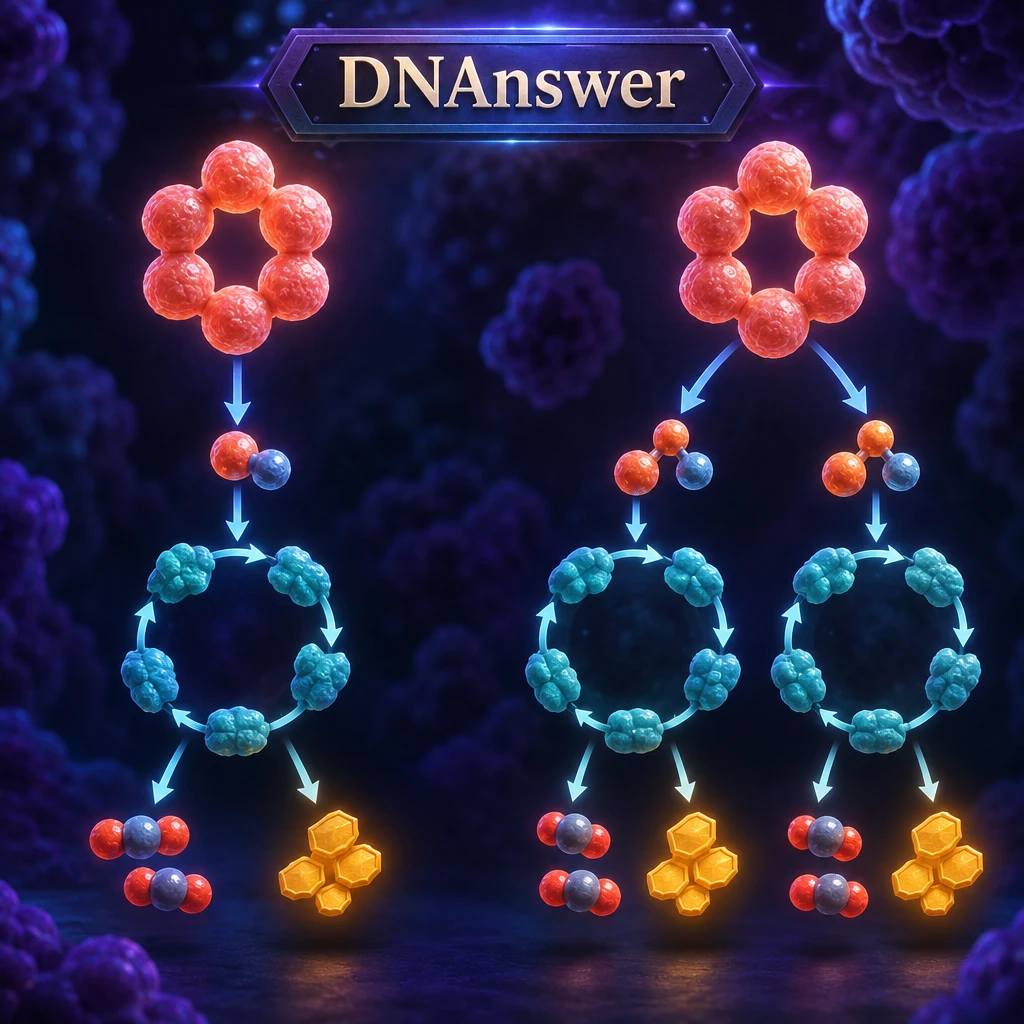
You eat a spoonful of sugar. One glucose molecule enters a cell. You'd expect one trip around the cycle. It takes two.
The confusion makes sense, because diagrams show a single loop per glucose. But before glucose reaches the mitochondria, a pathway called glycolysis splits its six carbons into two three-carbon molecules of pyruvate. Each pyruvate gets trimmed to acetyl-CoA, and each acetyl-CoA drives one turn. Two pieces mean two turns.
Here is the per-glucose accounting from the cycle alone, which simply doubles the per-turn numbers:
- Direct ATP (or GTP): 1 per turn, so 2 per glucose
- NADH: 3 per turn, so 6 per glucose
- FADH2: 1 per turn, so 2 per glucose
- Carbon dioxide: 2 per turn, so 4 per glucose
- Electron carriers in total: 4 per turn, so 8 per glucose
After those two turns, your original glucose is gone. All six of its carbons have left as carbon dioxide: four in the cycle and two in the trimming step just before it. You exhale them.
Next time you count outputs, multiply by two before you say "per glucose." It's the single most common slip in exam answers, and it halves every number that follows.
Myth 3: "Everything Around the Cycle Counts as the Cycle"
Where the confusion starts
A summary figure tells you the total per glucose is 4 ATP, 10 NADH and 2 FADH2. You read it under a Krebs cycle heading. Naturally, you credit the cycle with all of it.
Those numbers are real, but they bundle three separate stages. Glycolysis contributes 2 ATP and 2 NADH. Turning two pyruvates into acetyl-CoA adds 2 more NADH. Only then does the cycle add its 2 ATP, 6 NADH and 2 FADH2. Check the arithmetic: 2 plus 2 gives 4 ATP, and 2 plus 2 plus 6 gives 10 NADH. The totals fit, but the cycle owns only part of them.
Drawing the borders cleanly
The preparation step deserves its own mention. It releases one carbon dioxide and one NADH per pyruvate, and it happens just before the cycle. Many diagrams draw it as an arrow leading into the loop, so it looks like step zero. Biochemists treat it as a separate reaction run by its own enzyme complex, pyruvate dehydrogenase.
At the other end sits the electron transport chain, which makes roughly 26 to 28 ATP per glucose. Fold that in, and you get the commonly quoted total of about 30 to 32 ATP per glucose. Older textbooks say 36 to 38. The difference comes from updated estimates of how much ATP each carrier is worth, not from any change in your cells.
When you see a total, ask which stages it covers. The cycle's direct yield is 2 ATP per glucose. Anything bigger includes neighbors.
Myth 4: "The Krebs Cycle Burns Oxygen"
Hold your breath for a minute. Your Krebs cycle starts slowing within moments, even though no reaction in it uses a single oxygen molecule. That sounds contradictory. It isn't.
People link the two for a good reason. The cycle belongs to aerobic respiration, the oxygen-requiring way of extracting energy from food. And without oxygen, the cycle stops. So "it uses oxygen" feels like a fair shorthand.
Although oxygen itself is not part of the Krebs cycle, its presence at the end of the mitochondrial electron transport chains ensures recycling of NAD+ and FAD required in the Krebs cycle.
That definition, standard in biochemistry references, explains the whole puzzle. The cycle needs empty carriers to load. NAD+ and FAD are the empty versions of NADH and FADH2. Oxygen sits at the very end of the electron transport chain, where it accepts spent electrons and becomes water.
The traffic jam
Take oxygen away and the chain backs up. Loaded carriers can't unload, so no empty carriers return to the cycle. The cycle has nowhere to put its electrons, and it stalls. The dependence is real, but indirect, like a factory that shuts down because its delivery trucks never come back.
Where your breathing fits
The carbon dioxide you exhale doesn't come from the oxygen you inhale either. The cycle builds that carbon dioxide from carbons that were once your food. The oxygen you breathe in ends up as water. During a hard sprint, when oxygen runs short, your muscles shift toward glycolysis alone and make lactate, which buys time but yields far less ATP.
Myth 5: "The Cycle Has Five Steps"
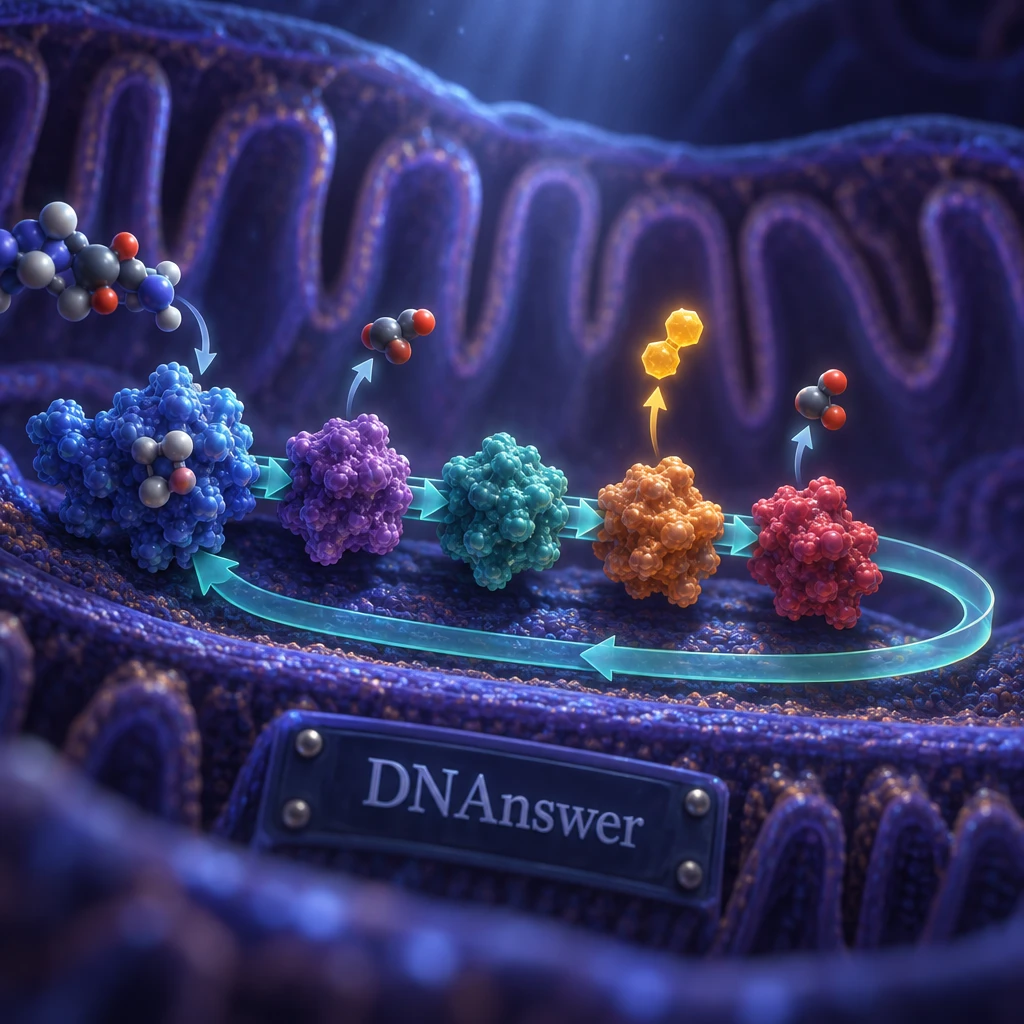
Search for the steps of this cycle, and plenty of results promise five. That number comes from teaching summaries that group reactions into stages, such as "fuel enters, carbons leave, energy is captured, oxaloacetate returns." Those groupings help you remember. They aren't the chemistry.
Standard biochemistry counts eight reactions, each run by its own enzyme. Here's the loop:
- Acetyl-CoA joins oxaloacetate to make citrate (six carbons).
- Citrate rearranges into isocitrate, a reshaped version of itself.
- Isocitrate loses one carbon as CO2 and hands electrons to NAD+, making NADH.
- The five-carbon product loses another CO2, makes a second NADH, and becomes succinyl-CoA.
- Succinyl-CoA becomes succinate and makes one GTP or ATP.
- Succinate hands electrons to FAD, making FADH2 and forming fumarate.
- Fumarate picks up water and becomes malate.
- Malate hands electrons to NAD+, making the third NADH and rebuilding oxaloacetate.
A simple diagram helps: draw a circle and mark eight points around it, like numbers on a clock. Put citrate at the top. Mark CO2 at points 3 and 4, GTP at 5, FADH2 at 6, and NADH at 3, 4 and 8. Now you can see the pattern. The carbons leave early, and electrons get collected all the way around.
If a quiz asks for five, it wants the grouped summary. If it asks for the reactions, the answer is eight. Learn the eight once, and you can rebuild any shortened version from them.
Beyond Energy: The Cycle as a Supply Depot
Your Krebs cycle is also a parts shop. Its molecules can leave the mitochondria and become raw material for building other things.
Citrate can move out into the cell's main fluid and become the starting point for fatty acids and cholesterol. Oxaloacetate can feed the construction of new glucose when you've gone hours without eating. Several cycle molecules supply the carbon frames for amino acids. Succinyl-CoA helps build heme, the iron-holding part of hemoglobin that carries oxygen in your red blood cells.
This two-way traffic explains why the cycle is called a hub. Fuel arrives from carbohydrates, fats and proteins, and building blocks leave for other pathways. When your cells pull molecules out for construction, they refill the cycle through side reactions so the loop keeps turning.
The cycle isn't only a human feature. Almost all oxygen-using life runs some version of it, from oak trees to bacteria. Researchers studying Mycobacterium tuberculosis, the germ behind TB, have found it splits its cycle into separate branches when iron runs low, rerouting carbon to survive. Scientists study those detours as possible weak spots for new drugs.
Conclusion
Next time you see an energy figure, ask two questions: per turn or per glucose, and which stages does it include? Those two checks catch almost every Krebs cycle mistake. Then test yourself. DNAnswer runs free molecular biology quizzes, adds new ones regularly, and you can try one at the quiz page to see whether the eight steps stuck.
Frequently Asked Questions
How much ATP does the Krebs cycle make directly?
One ATP or GTP per turn, so two per glucose molecule. The rest of its value leaves as NADH and FADH2, which help the electron transport chain make roughly 26 to 28 more ATP per glucose.
What goes into and comes out of the Krebs cycle?
Acetyl-CoA, water, and empty carriers go in. Each turn releases three NADH, one FADH2, one ATP equivalent and two carbon dioxide molecules, and rebuilds oxaloacetate for the next round.
Where does the Krebs cycle happen?
It happens in the matrix, the inner fluid of your mitochondria. In bacteria, which have no mitochondria, the same reactions run in the cell's main fluid.
Why is it called the citric acid cycle?
Its first product is citric acid, or citrate, the same compound that gives lemons their sour taste. Hans Krebs described the cycle in 1937, which is why it also carries his name.