How Does PCR Work? DNA Copies, Step by Step
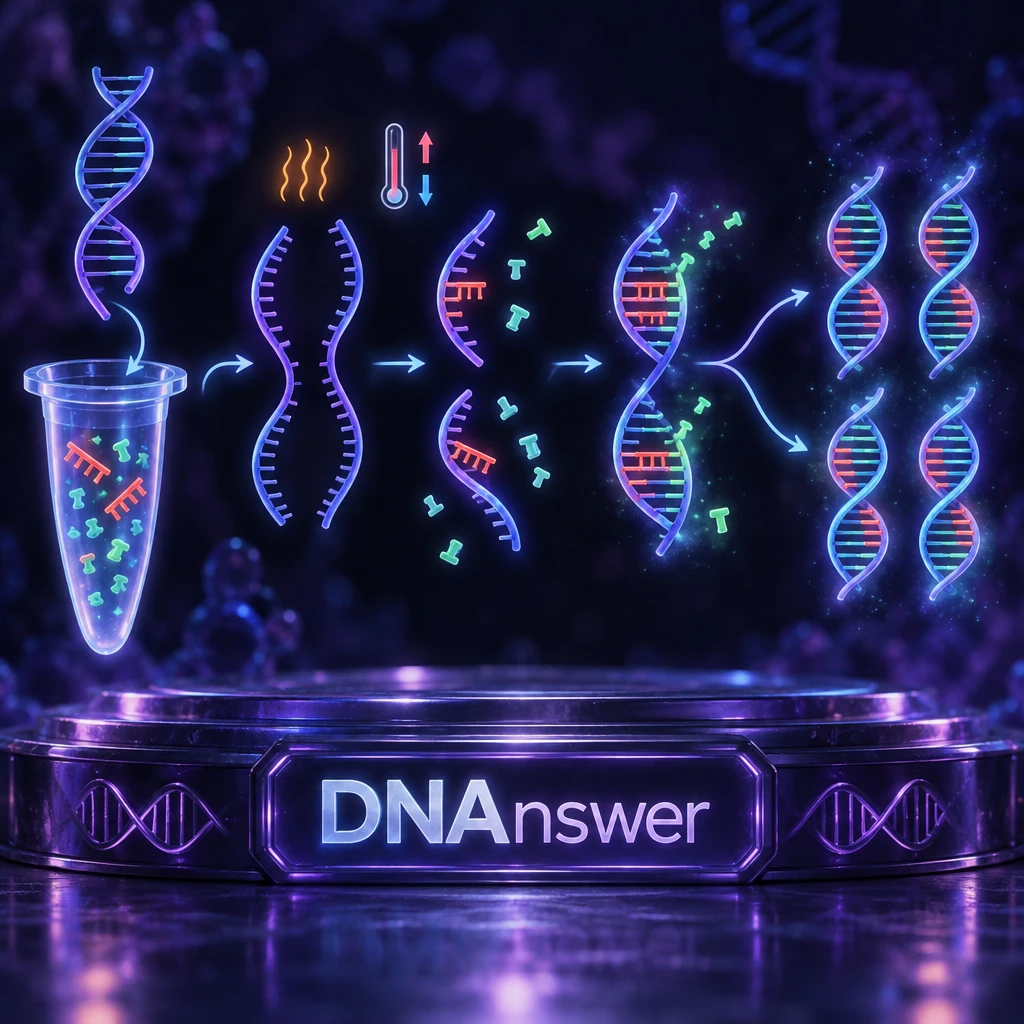
You can copy a stretch of DNA a billion times without a single living cell. So how does PCR work if no cell runs the copying? The answer is a tube, a heater, and a few cheap ingredients. With PCR, the polymerase chain reaction, you copy one chosen DNA segment through repeated temperature changes.
You heat the DNA to separate its two strands. You cool it so primers (short DNA guides) attach. Then a heat-tolerant enzyme, a molecular copying tool, builds new strands. You repeat the loop, and every copy becomes a template for the next round.
Key Takeaways
- PCR copies one target segment, not your whole sample.
- Primers decide exactly which stretch of DNA gets copied.
- Heat separates DNA strands; it doesn't cut them.
- Three-step and five-step descriptions show the same process.
- Copies double only in early cycles, then level off.
- Typical temperatures are starting points, not a fixed recipe.
Copying DNA Without a Cell: What Goes in Your Tube
A PCR tube holds less liquid than a raindrop. Typically you work with about 20 to 50 microliters, a tiny fraction of a teaspoon, yet that drop contains everything a cell would use to copy DNA.
The ingredient list
Here is what you mix together before the machine starts:
- Template DNA: your starting genetic material, from blood, saliva, a plant leaf or a swab.
- Primers: two short pieces of single-stranded DNA, usually about 18 to 25 letters long, that mark where copying starts and stops.
- Taq polymerase: the copying enzyme. It comes from Thermus aquaticus, a bacterium that lives in hot springs at Yellowstone National Park.
- Nucleotides: the four DNA building blocks, A, T, G and C. Labs call them dNTPs.
- Buffer and magnesium: salty water that keeps the pH steady, plus magnesium, which the enzyme needs to work. For standard Taq, most reactions run well with magnesium at about 1.5 to 2.0 millimolar.
- Water: to bring the mix up to its final volume.
The machine that changes the temperature
You place the tube in a thermal cycler, also called a thermocycler. It is a heated metal block that swings between hot and cool settings every minute or so, on a program you set.
Before these machines existed, scientists moved tubes by hand between water baths at different temperatures. Engineers at Cetus Corporation, where Kary Mullis worked when he invented PCR in the 1980s, built an early prototype nicknamed "Mr. Cycle." Mullis went on to win the Nobel Prize in Chemistry in 1993 for the method.
Myth: PCR Copies All the DNA in Your Sample
PCR copies only the stretch between your two primers. Everything else in the tube stays at roughly its starting amount, while your target grows into the billions.
The belief makes sense. You hear "PCR copies DNA," and DNA in a sample means the whole genome. Some articles describe PCR as "molecular photocopying," and a photocopier copies the whole page. But PCR works more like a highlighter plus a copier: it copies only what you highlight.
How primers pick the target
A primer is a short string of DNA letters that matches one exact spot on your template. DNA letters pair by strict rules: A sticks to T, and G sticks to C. So a 20-letter primer only grips a place where the template shows the exact matching 20 letters.
You design two primers, one for each strand, facing each other across the region you want. The enzyme can only start building from a primer. It can't begin on bare single-stranded DNA. That rule means copying starts at your primers and nowhere else.
Why the short product wins
In the first cycles, the enzyme runs past the far end of your target and makes long, ragged copies. From the third cycle on, it starts making copies that begin at one primer and stop exactly at the other. Those precise copies, which scientists call amplicons, then serve as templates themselves, and they multiply far faster than anything else.
After about 30 cycles, your tube holds over a billion copies of a fragment that might be only 500 letters long. The other 3 billion or so letters of a human genome sit there almost untouched.
So when you read that a COVID-19 test "found the virus," the PCR in that test did not copy the virus. It copied one short stretch of the virus's genetic code that the primers recognized. If you want to know what a PCR result means, ask first what the primers targeted.
The Three-Step Cycle, Temperature by Temperature
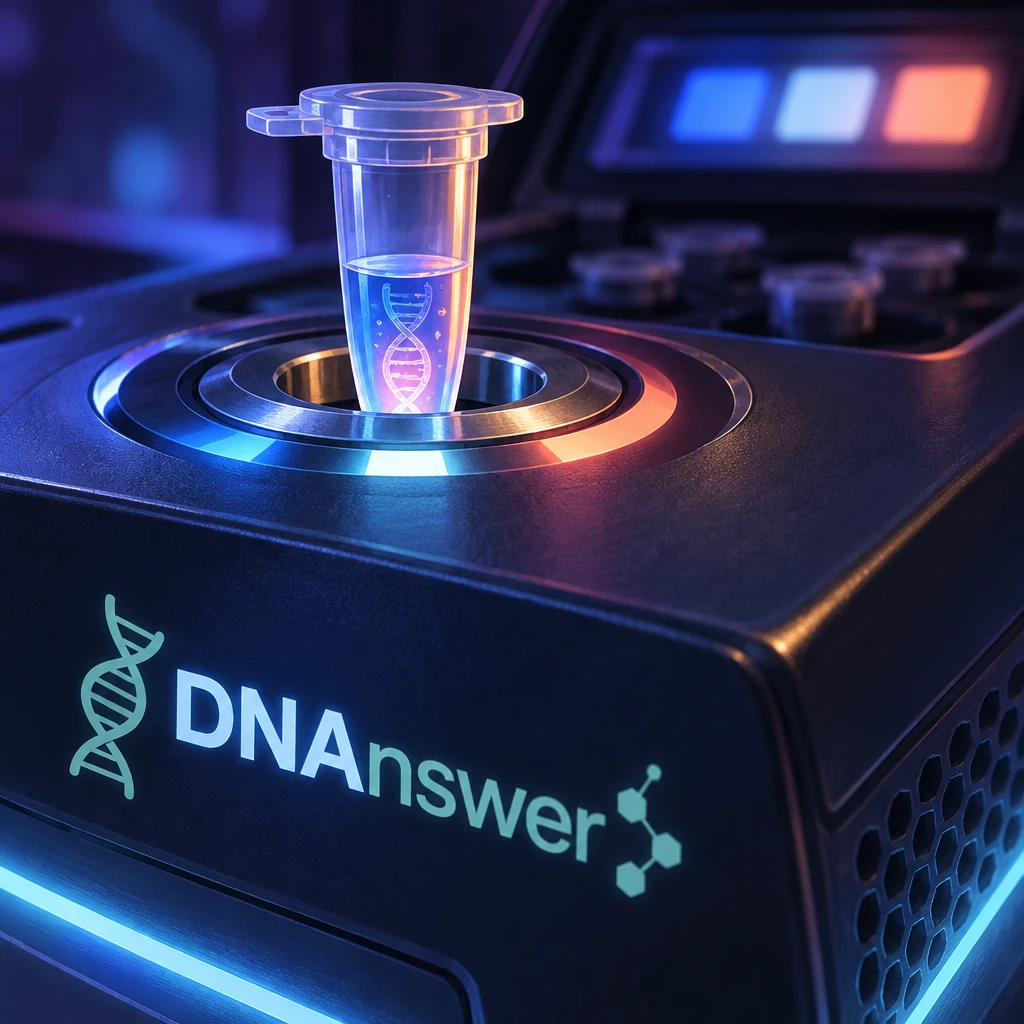
Every cycle repeats the same three moves. Each one needs its own temperature, so the machine heats and cools the tube in a set rhythm. Here is one cycle with the typical settings for standard Taq polymerase:
- Denaturation, about 203 to 208°F (95 to 98°C), for 10 to 60 seconds. The heat breaks the weak bonds that hold the two DNA strands together. You end up with two single strands, each with its letters exposed.
- Annealing, typically 113 to 140°F (45 to 60°C), for 30 to 60 seconds. The machine cools the tube. Primers find their matching spots and stick, because at this temperature the matching bonds hold firm. The right temperature depends on your primers' letters, since G–C pairs bind more tightly than A–T pairs.
- Extension, about 158 to 167°F (70 to 75°C), commonly 162°F (72°C). The machine warms the tube to the temperature where Taq works fastest. The enzyme grabs the end of each primer and adds nucleotides one by one, reading the template and adding the matching letter each time. Taq adds roughly 1,000 letters per minute, so a 1,000-letter target needs about one minute here.
Each step does one job. Heat opens the DNA, cooling lets the guides land, and warm conditions let the enzyme build.
Why does Taq matter so much? An ordinary enzyme from your own cells would fall apart at 203°F, the way an egg white turns solid in a hot pan. Taq comes from a microbe that thrives in near-boiling water, so it survives every heating step. Before Taq, scientists had to add fresh enzyme after every cycle.
One cycle takes roughly two to three minutes. Run 30 of them and the whole job finishes in about two to three hours. When you look at a time like that, remember that most of it goes into heating and cooling the block, not into the chemistry itself.
Myth: Heat Cuts DNA Into Pieces
Picture a zipper. Heat doesn't cut the zipper's teeth off. It just pulls the two sides apart.
Many people imagine the 203°F step as heat chopping DNA strands apart, and the image is understandable. Heat breaks things down in everyday life. Cooking destroys food, and boiling water kills germs. "Denaturation" also sounds like destruction.
What actually happens is gentler. DNA has two kinds of bonds. Strong covalent bonds link the letters along each strand into a backbone. Weak hydrogen bonds hold the letters of one strand to the letters of the other. PCR heat breaks only the weak ones. Each backbone stays whole, so each strand keeps its full sequence and can serve as a template.
This matters because the method depends on it. If heat really cut strands, every cycle would shred your template, and you would end up with less DNA, not more. The same zipper logic explains why cooling works: the strands, and the primers, can zip back up once the heat drops.
That said, heat does cause slow damage over very long runs, and Taq loses some activity with each hot step. That wear is one reason labs avoid running far more cycles than they need.
Three Steps or Five? Same Process, Different Counting
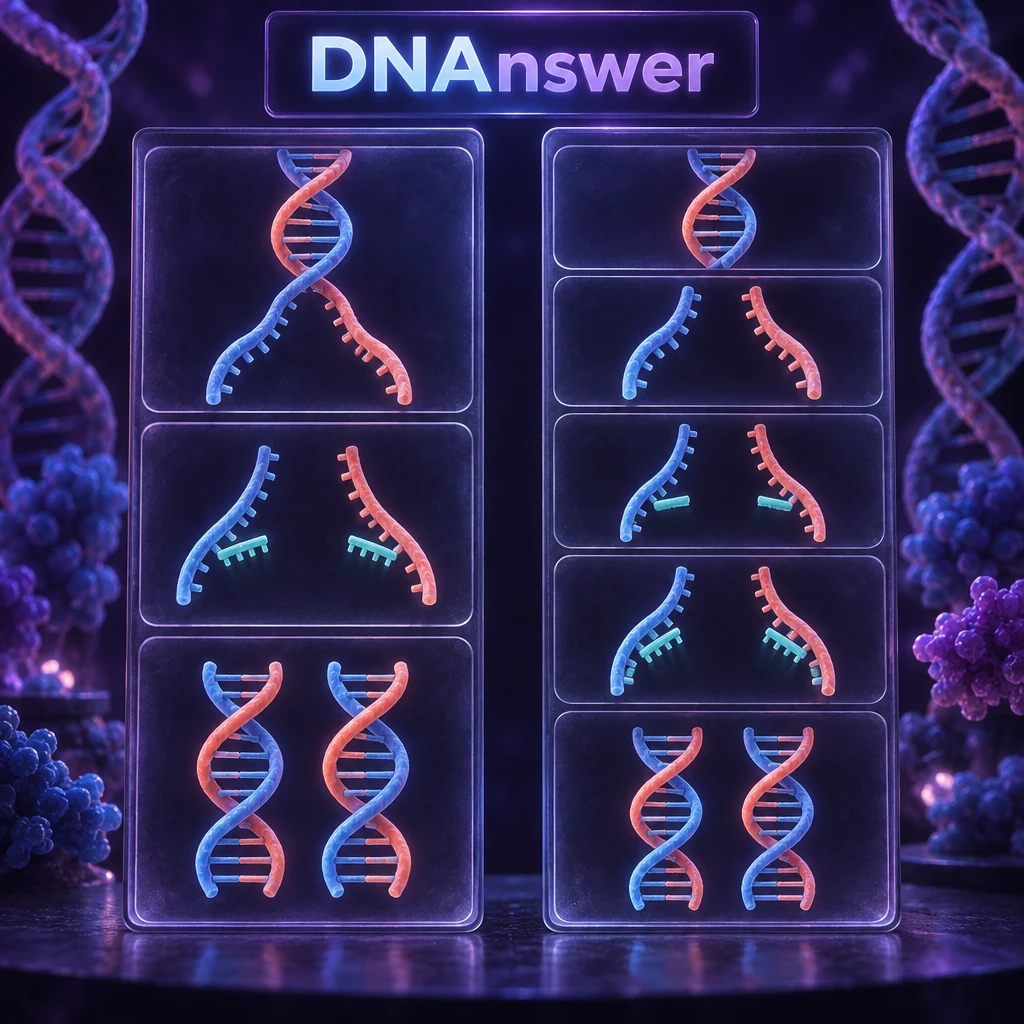
Some textbooks list three PCR steps. Others list four, five, even six. You might assume they describe different methods. They don't. The difference comes from what each author chooses to count.
The repeating cycle versus the bookends
The three steps, denaturation, annealing and extension, form the loop that repeats 25 to 35 times. A real PCR program also has stages that run only once:
- Initial denaturation, at the very start, at 203 to 208°F for about 2 to 5 minutes. This long first heating fully separates tangled starting DNA, such as a whole human genome. Some enzymes also need it to switch on. Labs call these hot-start enzymes because they stay inactive until heated, which stops them from copying the wrong things while you set up the tube.
- Final extension, at the end, usually around 162°F for about 5 to 10 minutes. It gives the enzyme time to finish any half-built strands.
- Hold, often at about 39°F (4°C). The machine keeps the finished samples cold until you collect them.
Count the three cycle steps plus initial denaturation and final extension, and you get five steps. Add the hold, and you get six. Same chemistry, different bookkeeping.
When three steps become two
Some labs run two-step PCR. If the primers stick well at a temperature within about 5°F (3°C) of the extension temperature, the machine merges annealing and extension into one step. This shortens the run because the block doesn't have to switch and settle between two temperatures.
When you meet a list of steps, check which ones repeat and which run only once. That single question clears up almost every version you'll see in a textbook or a lab manual.
Myth: Your DNA Doubles Perfectly in Every Cycle
The math is seductive. One copy becomes 2, then 4, then 8. After 30 cycles, 2 multiplied by itself 30 times gives about 1.07 billion. After 40 cycles, you would have over a trillion. Many explanations stop right there.
The doubling idea isn't wrong. In the early cycles, when ingredients are plentiful, a well-designed reaction comes close to doubling each round. That is why each cycle "theoretically" doubles your target, and why a single starting molecule can still give you a usable amount.
PCR amplification: a chain reaction in which every newly built copy of the target becomes a template in the next cycle, so the number of copies grows exponentially until the reaction runs short of ingredients.
The catch sits in that last phrase. Real reactions slow down. The primers and nucleotides get used up. Taq wears out after many trips to 203°F. By-products build up, and copies start sticking to each other instead of to primers. The growth curve flattens into what scientists call the plateau phase.
Labs plan around this. Most runs use 25 to 35 cycles. If you start with fewer than about 10 copies of your target, up to 40 cycles may make sense. Past about 45 cycles, the reaction tends to produce nonspecific bands: wrong products made where primers stuck loosely to the wrong spots. More cycles add errors faster than they add useful copies.
This is also why real-time PCR, or qPCR, exists. A qPCR machine measures the glow from the copies after each cycle and reads the result during the early, near-doubling phase. Measure at the plateau instead, and a sample that started with 100 copies can look almost the same as one that started with 10,000.
So treat "a billion copies" as a ballpark, not a promise. The number you actually get depends on your starting amount, your primers and how hard you push the cycle count.
Myth: The Textbook Temperatures Are a Universal Recipe
You've now seen numbers like 203°F, 140°F and 162°F. It's tempting to treat them as fixed settings, like 350°F for chocolate chip cookies. In practice they work more like a starting guess.
The textbook figures come from standard Taq and typical primers, and they work for many routine jobs. That's why they appear everywhere. But each reaction has its own ingredients, and the best settings shift with them.
Your primers set the annealing temperature
Every primer has a melting temperature, the point where half of it lets go of its target. That number depends on its length and on how many G and C letters it contains. Labs usually set annealing a few degrees below the melting temperature. Set it too low, and primers stick to near-matches, so you copy the wrong DNA. Set it too high, and they barely stick, so you get almost nothing.
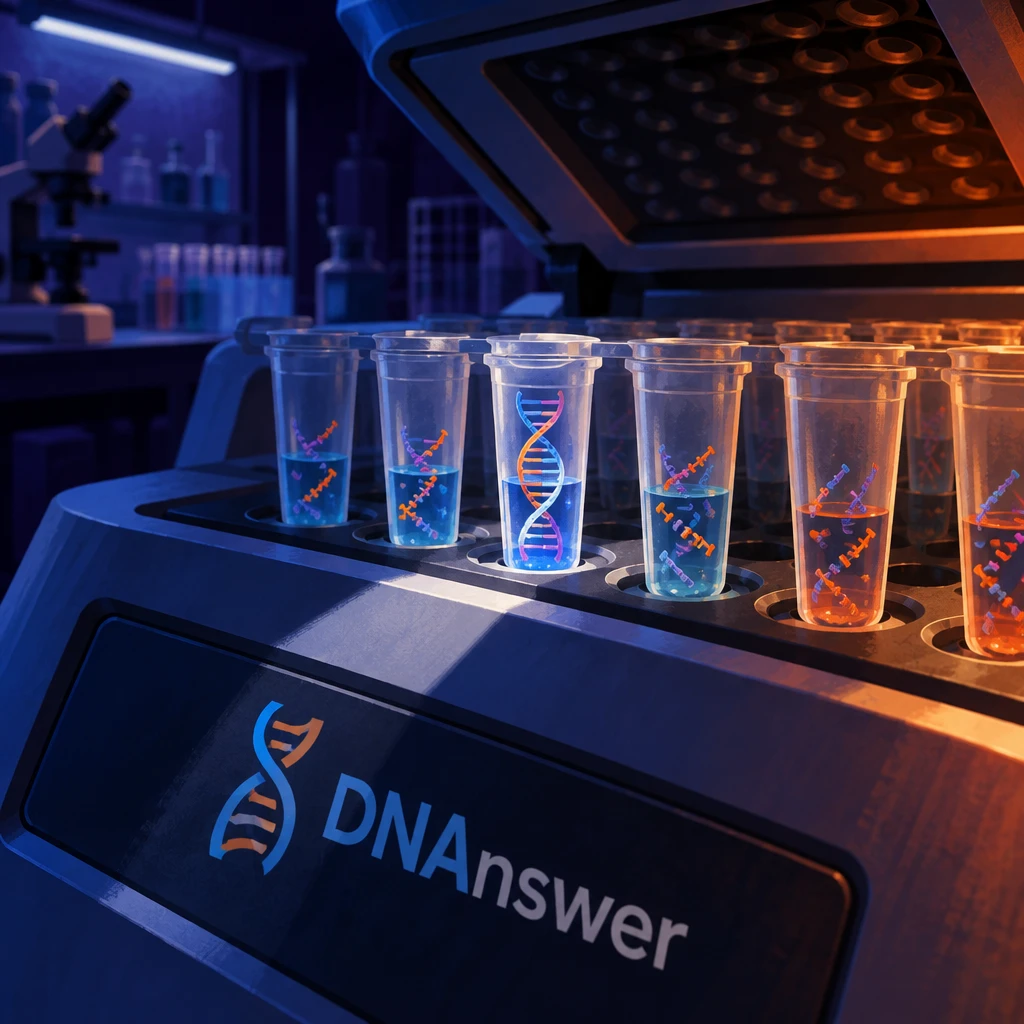
When a lab doesn't know the best value, it runs a gradient PCR. The thermal cycler holds different rows of tubes at slightly different annealing temperatures in one run, and the lab picks the setting that gives the cleanest product.
Your enzyme and target set the rest
Different polymerases prefer different conditions. Some high-accuracy enzymes copy faster than Taq and need shorter extension times. Others need a hotter or longer first heating to activate. Longer targets need longer extension: about 1 minute per 1,000 letters for Taq is a rough guide, so a 3,000-letter target needs about 3 minutes.
Templates differ too. A sample rich in G and C letters holds its strands together more tightly and may need a hotter denaturation step.
Start with the enzyme maker's protocol, which gives buffer, magnesium and cycling settings tested for that specific product. Then adjust one setting at a time. Change three things at once and you won't know which change fixed the problem.
How PCR Differs From Copying Inside Your Cells
Your cells copy all 3 billion or so letters of your genome before each cell division, and they do it at body temperature, about 98.6°F. PCR copies one short stretch and needs swings above 200°F. Both follow the same pairing rules, but the setups differ in four main ways.
Unzipping and starting
Your cells don't use heat to separate strands. An enzyme called helicase unzips the DNA at body temperature. Cells also build their own starting guides, short RNA primers made by an enzyme called primase. In PCR, heat replaces helicase, and you supply ready-made DNA primers instead.
Scope and accuracy
A cell copies the whole genome once per division, from many starting points at once. PCR copies only the region between your primers, again and again. Cells also proofread: their copying enzymes check and fix mistakes, and your body ends up with only about one error per billion letters. Taq has no proofreading, so it makes roughly one error per 10,000 to 100,000 letters. For a quick test, that rate is fine. For cloning a gene, labs switch to proofreading enzymes.
PCR borrows the cell's core trick, using one strand as a pattern for the other, and strips away everything else. That stripped-down design is why it fits in a desktop machine.
Conclusion
Next time you read about a PCR test, ask two questions: what did the primers target, and how many cycles did the test run? Those two answers tell you what the result can and cannot show. A positive test found one specific sequence, and a high cycle count means the sample started with very little. If you want to check how well the cycle has stuck, take a free PCR quiz on DNAnswer and see which steps you remember.
Frequently Asked Questions
How does PCR make copies of DNA?
PCR makes copies by cycling temperature. Heat separates the DNA strands, cooling lets primers attach, and warmth lets Taq polymerase build matching strands. Each new copy joins the next cycle as a template, so the target multiplies with each round.
What are the three steps of PCR and their temperatures?
The steps are denaturation at about 203 to 208°F, annealing at roughly 113 to 140°F, and extension at about 158 to 167°F. Your primers and enzyme shift the exact values, so labs fine-tune annealing for each new primer pair.
Why do some explanations list five PCR steps?
Five-step lists add the one-time opening and closing stages to the three repeating ones. Initial denaturation fully separates the starting DNA before cycling begins, and final extension finishes incomplete strands at the end. The copying chemistry stays the same either way.
How long does a PCR run take?
A standard run of about 30 cycles takes roughly two to three hours. Fast enzymes and newer machines can finish in under an hour, because shorter heating and cooling times shrink each cycle to well under a minute.