Mitochondrial DNA: Why You Inherit This Entirely From Your Mother
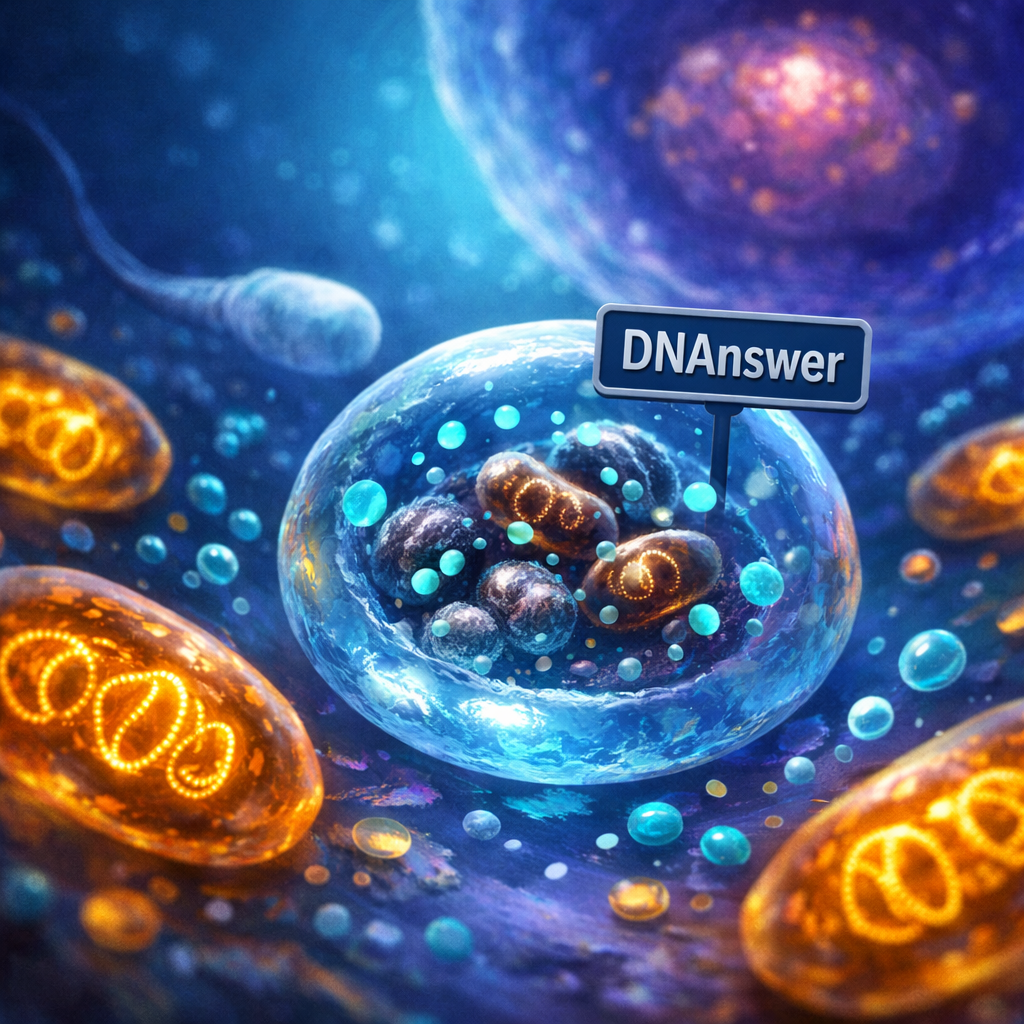
You've probably heard that your mitochondrial DNA comes entirely from your mother, and figured that must mean your father's mitochondria simply never make it into the picture. That's not quite right. His mitochondria do enter the egg at fertilization — they just get marked for destruction almost immediately, in a process closer to cellular cleanup crew work than simple absence.
This matters because the real mechanism explains a lot of things the simplified version can't: why genetic genealogy tests trace maternal lines specifically, why certain diseases skip fathers entirely, and why rare exceptions to "mom only" occasionally show up in the research. Getting the mechanism right changes what you actually understand about your own cells.
Key Takeaways
- Mitochondrial DNA (mtDNA) comes almost entirely from the mother, not because sperm carries none.
- Sperm mitochondria enter the egg but get tagged and destroyed by a process called mitophagy.
- Nuclear DNA and mtDNA follow completely different inheritance rules — don't conflate them.
- "Mitochondrial Eve" is a genetic reference point, not the first human woman.
- Paternal leakage — father's mtDNA surviving — has been documented in rare, specific cases.
- mtDNA tracks ancestry and some diseases; it doesn't shape most inherited traits.
Myth #1: Fathers Contribute Zero Mitochondria to the Embryo
This is the biggest misconception, and it's an understandable one. The truth is that sperm cells do carry mitochondria — usually somewhere around 50 to 75 of them, clustered in the sperm's midpiece, the segment that powers the tail's whip-like swimming motion. Compare that to an egg, which carries somewhere in the range of 100,000 to 200,000 mitochondria. The sperm's contribution isn't zero. It's just tiny, and then it gets erased.
The belief that fathers contribute nothing at all probably comes from oversimplified diagrams in biology textbooks — the ones showing a sperm as basically a DNA-delivery torpedo, stripped of anything else. That image isn't wrong exactly, it's just incomplete. It skips the part where the torpedo actually has cargo beyond its nucleus.
What Actually Happens After Fertilization
Once sperm and egg fuse, the sperm's mitochondria are physically inside the fertilized egg, sitting in the cytoplasm — the gel-like interior of the cell — right alongside the egg's own mitochondria. For a brief window, both sets coexist in the same cell.
Then the embryo's own machinery goes to work. Proteins tag the sperm-derived mitochondria with a molecular marker, essentially a "destroy this" label, and specialized structures called autophagosomes engulf them and break them down. This selective elimination process is called mitophagy — literally "self-eating" of mitochondria. It's not passive decay. It's targeted, active removal, similar to a cleanup crew clearing a scene rather than the scene simply never existing.
Why the Numbers Make This Easy
Even without mitophagy, sperm mitochondria would likely lose out on sheer numbers. When an egg holds up to 200,000 mitochondria and sperm bring maybe 75, the math already favors maternal inheritance overwhelmingly. Mitophagy just makes sure the odds become a certainty.
Researchers studying this — including work published through groups examining human and animal embryos — have traced the tagging process to ubiquitin, a small protein that marks other proteins and organelles for disposal throughout the body, not just in reproduction. It's the same system your cells use to clear out damaged parts during ordinary cellular housekeeping.
Knowing this changes how you think about "maternal inheritance." It's not that fathers are irrelevant to mitochondrial biology. It's that the embryo actively chooses one set over the other, every single time, through a mechanism built into fertilization itself.
Myth #2: Mitochondrial DNA and Nuclear DNA Inherit the Same Way
They don't, and confusing the two leads people to misread everything from ancestry results to disease risk. Nuclear DNA — the DNA packed into 23 chromosome pairs inside the cell's nucleus — comes roughly half from each parent. Mitochondrial DNA comes almost entirely from the mother alone. These are two separate genomes with two separate sets of rules, living in two different parts of the same cell.
It's easy to see why people assume they work the same way. Both are called "DNA," both get passed from parent to child, and most biology classes spend far more time on nuclear DNA — the stuff that determines eye color, height ranges, and disease risk from genes like BRCA1 — than on mitochondria at all. If nuclear DNA is the default mental model for "inheritance," mtDNA looks like an exception rather than a fundamentally different system.
Two Genomes, Two Jobs
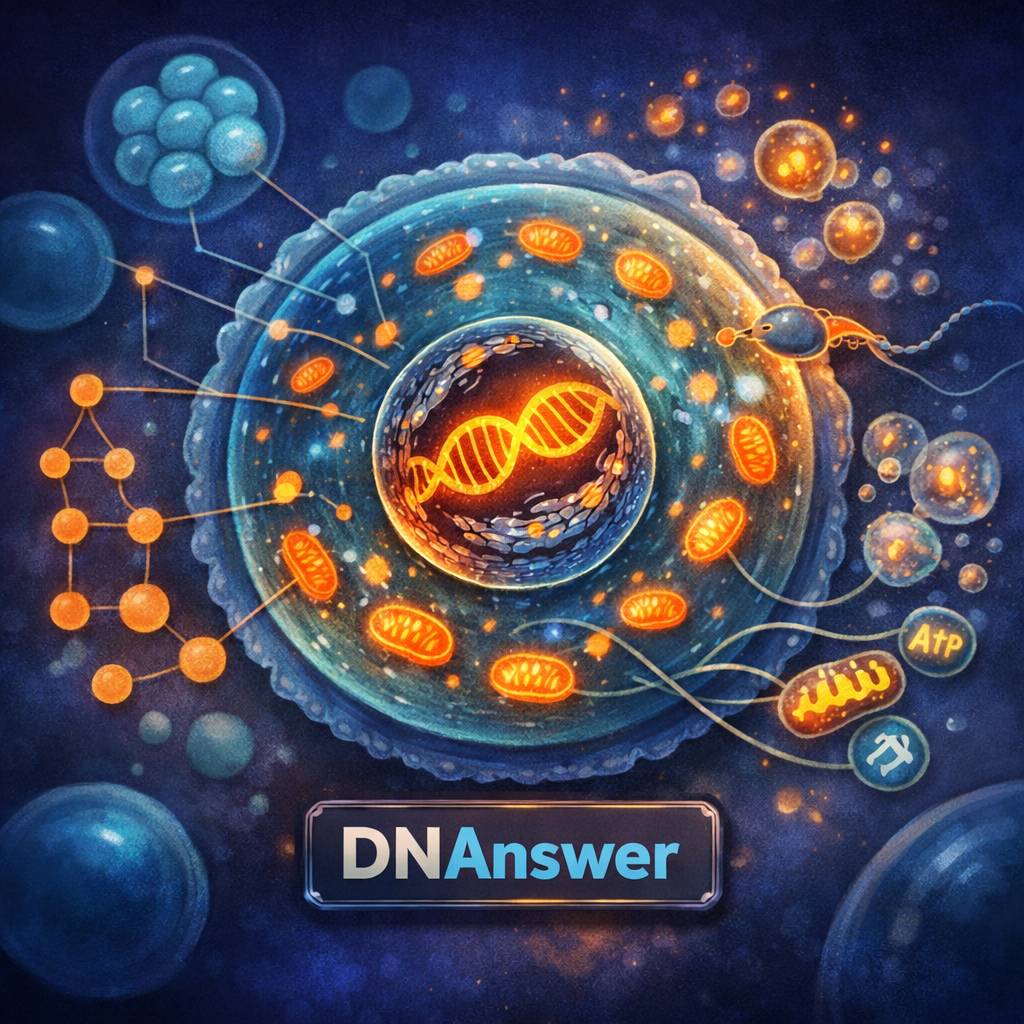
Nuclear DNA is enormous: about 3.1 billion base pairs, coding for roughly 20,000 genes, shuffled and recombined every generation through the mixing of maternal and paternal chromosomes. Mitochondrial DNA, by contrast, is a tiny circular loop of about 16,569 base pairs carrying just 37 genes. It doesn't recombine. It gets passed down essentially as a single unbroken copy, generation after generation, changed only by mutation.
Those 37 mitochondrial genes aren't random — most of them build components of the electron transport chain, the molecular machinery mitochondria use for cellular respiration, the process that converts food and oxygen into usable cellular energy (ATP). This is the whole reason mitochondria matter biologically: they're the power plants of the cell, and they need their own small genome to keep that power plant running efficiently.
Where Heteroplasmy Comes In
Because mtDNA doesn't mix between parents, mutations that appear in it tend to stay within one lineage. But a single cell can actually carry a mix of normal and mutated mitochondrial DNA at once — a condition called heteroplasmy. Some cells might be 10% mutant, others 90%, depending on how mitochondria happened to divide up during development.
Heteroplasmy: the presence of more than one type of mitochondrial DNA within a single cell or individual, in contrast to homoplasmy, where all mitochondrial DNA copies are identical.
This matters clinically. The severity of a mitochondrial disease often depends on what percentage of mitochondria in a given tissue carry the mutation — which is one reason two siblings with the same mitochondrial mutation can have wildly different symptoms.
Myth #3: Mitochondrial Eve Was the First Human Woman
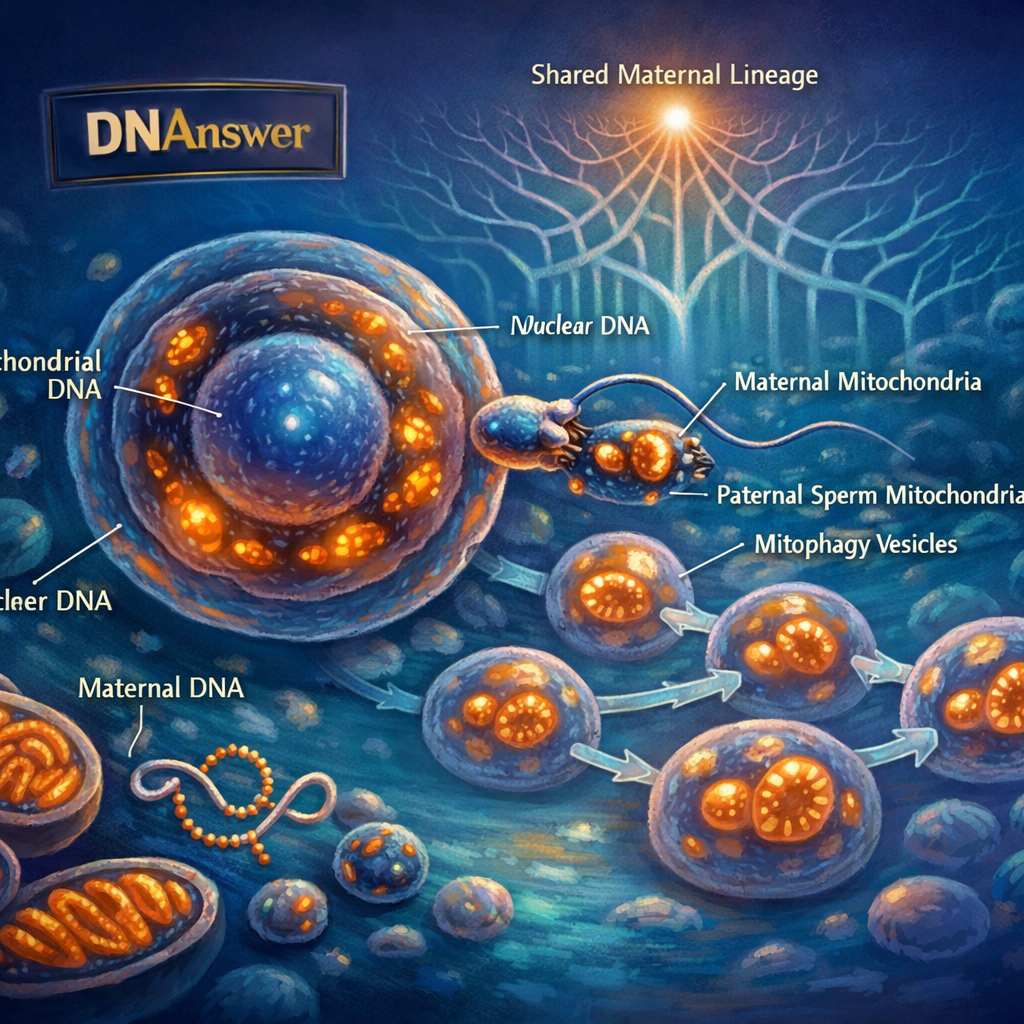
She wasn't a first anything, and treating her that way is probably the most persistent misunderstanding to come out of genetic genealogy. Mitochondrial Eve is the label given to the most recent common ancestor from whom all living humans inherited their mitochondrial DNA — a statistical coalescence point, not a solitary founding woman.
The confusion is baked into the name itself. "Eve" invokes a single original woman, echoing a familiar cultural story, and headlines from the late 1980s research (led by Rebecca Cann, Mark Stoneking, and Allan Wilson at UC Berkeley) leaned into that framing because it was catchy. The actual finding was more nuanced but far less dramatic-sounding.
What the Research Actually Showed
The 1987 study analyzed mitochondrial DNA from 147 people across different populations and traced maternal lineages backward until they converged. That convergence point — estimated to be roughly 150,000 to 200,000 years ago, likely in Africa — is mitochondrial Eve. She lived alongside plenty of other women at the time, many of whom have living descendants today.
Here's the part that trips people up: those other women aren't "missing" from your family tree. Their nuclear DNA very likely flows through you and everyone else alive. What's missing is specifically their unbroken maternal-line mtDNA thread — because somewhere down the centuries, every one of those lines eventually hit a generation with no daughters, or a daughter who had no daughters, breaking the chain. Mitochondrial DNA inheritance is fragile that way: it only survives if there's an unbroken line of mothers having daughters, generation after generation.
Why This Distinction Actually Matters
If you take a mitochondrial DNA test through a genetic genealogy service, you're not finding "the first woman." You're finding your specific maternal haplogroup — a genetic population group defined by shared mtDNA mutations — and tracing how it connects back to that single coalescence point shared by every human alive. It's a powerful tool for mapping ancient migration patterns, since mtDNA mutates slowly and predictably, at a rate scientists estimate around one mutation every 3,500 years per lineage. But it's a tool for tracing lines, not for locating humanity's origin story in one individual.
Myth #4: "No Paternal DNA" Means No Exceptions, Ever
The pattern is nearly universal, but "nearly" is doing real work in that sentence. In the overwhelming majority of human reproduction, mitophagy destroys sperm mitochondria completely, and mtDNA passes only through the mother. But paternal leakage — cases where some paternal mitochondrial DNA survives into offspring — has been documented, including in a well-known 2018 case study published in the Proceedings of the National Academy of Sciences.
Most people never hear about this because it's genuinely rare, and popular science communication tends to round rare exceptions down to zero for the sake of a clean story. That rounding is usually harmless. It becomes a problem when someone assumes "always" means there's literally no mechanism for anything else to happen.
The 2018 Case and What It Showed
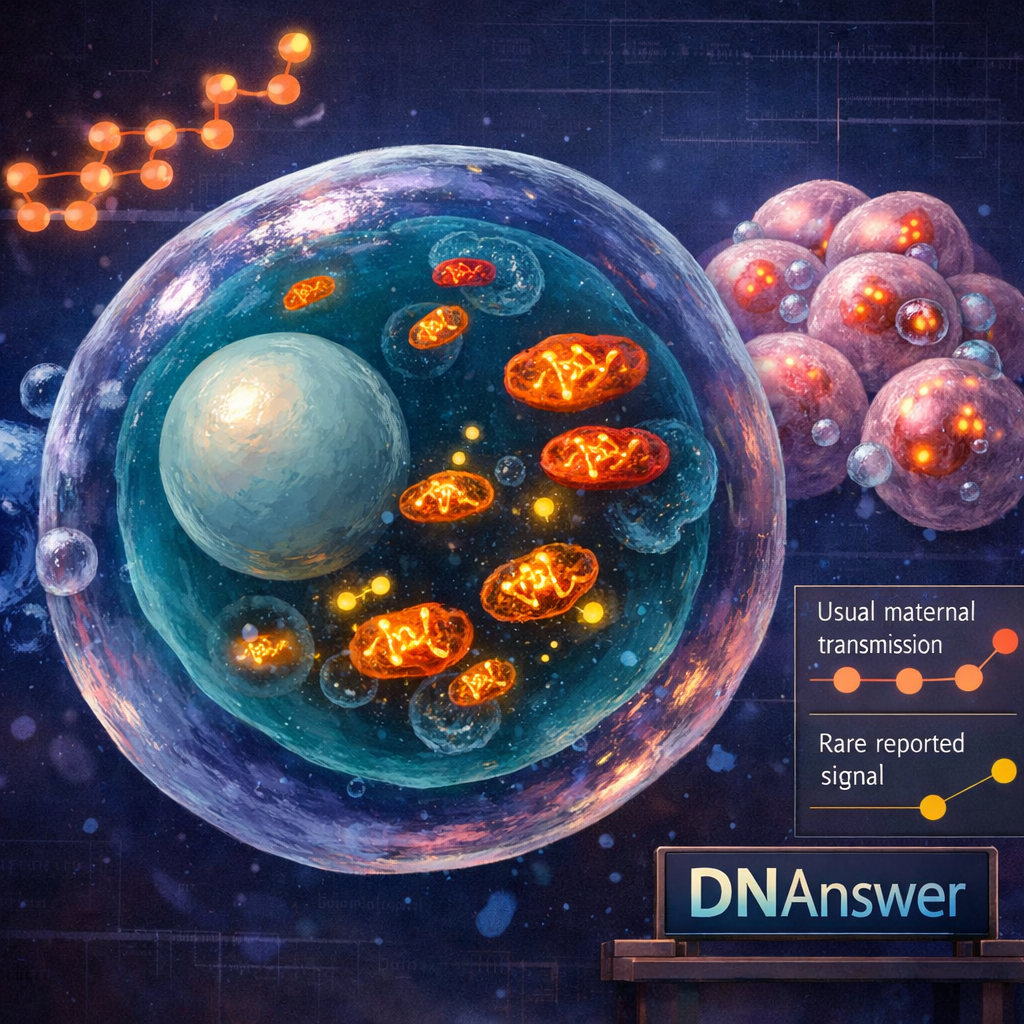
Researchers led by Shiyu Luo identified multiple members across three unrelated families who showed clear heteroplasmy for both maternal and paternal mitochondrial DNA — meaning lab testing detected two distinct mtDNA signatures in the same individuals, one traceable to each parent. This had been reported anecdotally before, but rarely with this level of confirmation across multiple family members and generations.
The leading theory for why it happens in these families points to a possible defect in the mitophagy tagging system itself — some inherited quirk that lets a small fraction of paternal mitochondria slip past the "destroy this" marker. It's not that mitophagy fails to fire at all; it's that it may fail to catch every single target in certain genetic backgrounds.
Why This Doesn't Undermine Genetic Genealogy Testing
Paternal leakage cases number in the dozens across the medical literature, against a global population in the billions. For virtually everyone taking a mitochondrial DNA test for ancestry or genealogy purposes, the maternal-only assumption holds completely. Testing companies don't build in exceptions for this because, statistically, you're vastly more likely to win a state lottery than to be part of a documented paternal leakage lineage.
What this does mean is that "always" claims in biology deserve a little humility. The mechanism is strong enough to be treated as a rule for nearly every practical purpose — disease inheritance patterns, ancestry tracing, forensic identification — while acknowledging that biology rarely produces a rule with zero exceptions anywhere in eight billion people.
Myth #5: Mitochondrial DNA Shapes Most of Your Inherited Traits
It doesn't, and this misconception tends to come from people who've heard "mitochondrial DNA is important" and stretched that into "mitochondrial DNA determines a lot about you." In reality, mtDNA's 37 genes mostly code for pieces of the energy-production machinery. Nuclear DNA's roughly 20,000 genes are what drive the vast majority of your physical traits, including facial structure, height, hair and eye color, and inherited disease risk.
Where mtDNA actually earns its importance is in a narrower, more specific category: energy metabolism disorders. Because muscle and nerve tissue demand enormous amounts of cellular energy, they're hit hardest when mitochondria don't produce ATP efficiently. That's why mitochondrial diseases so often show up as muscle weakness, vision loss, hearing loss, or neurological symptoms rather than as changes to appearance.
- Fatigue and muscle weakness — often the earliest sign, since muscle tissue burns through energy quickly and shows deficits first.
- Vision and hearing changes — conditions like Leber hereditary optic neuropathy trace directly to specific mtDNA mutations.
- Neurological symptoms — seizures, developmental delays, or stroke-like episodes in conditions such as MELAS syndrome.
- Heart and organ involvement — cardiomyopathy can develop when heart muscle cells can't generate enough ATP.
- Variable severity between relatives — due to heteroplasmy, siblings with the same mutation can have very different outcomes.
Mitochondrial diseases affect an estimated 1 in 5,000 people, according to the United Mitochondrial Disease Foundation — a real but far smaller slice of inherited conditions than nuclear DNA disorders account for overall. Because these conditions pass through the maternal line exclusively (barring the rare leakage cases already discussed), family history on the mother's side becomes a genuinely useful diagnostic clue that doctors specifically ask about.
If you're curious about how these two inheritance systems play out generation to generation, there's an inheritance-pattern quiz in the DNAnswer app that walks through maternal versus biparental inheritance with real pedigree examples — useful if you learn better by working through scenarios than by reading definitions.
The takeaway isn't that mitochondrial DNA is unimportant. It's that its importance is concentrated and specific — tied to energy production and a defined set of disorders — rather than spread across the broad range of traits people usually mean when they ask "what did I inherit from my parents."
Conclusion
The next time someone repeats "you only get DNA from your mom's side," you can correct the record with the more interesting version: your father's mitochondria showed up, and your embryo destroyed them on purpose. If you're exploring genetic genealogy testing, look specifically for mtDNA haplogroup results — they trace ancient maternal migration, not your whole ancestry.
Frequently Asked Questions
Does mitochondrial DNA determine physical traits like eye color?
No. Eye color, height, and most physical traits come from nuclear DNA, inherited from both parents. Mitochondrial DNA's 37 genes mostly build energy-production machinery, not the traits people associate with family resemblance.
Can a mitochondrial DNA test tell me who my biological father is?
Not directly. Standard mtDNA tests trace maternal-line ancestry only. Paternity testing requires nuclear DNA analysis (usually via autosomal markers), which is a completely different lab process.
Why do some mitochondrial diseases skip fathers but not mothers?
Because mtDNA passes almost exclusively through the maternal line via egg cytoplasm, fathers with a mitochondrial mutation typically don't pass it to any children, while affected mothers pass it to all of theirs, subject to heteroplasmy variation.
Is paternal leakage something I should worry about if I take a genealogy DNA test?
No. Documented paternal leakage cases are extremely rare — a few dozen in the medical literature worldwide. For virtually every ancestry test result, the maternal-only mtDNA assumption is scientifically sound.