Electron Transport Chain
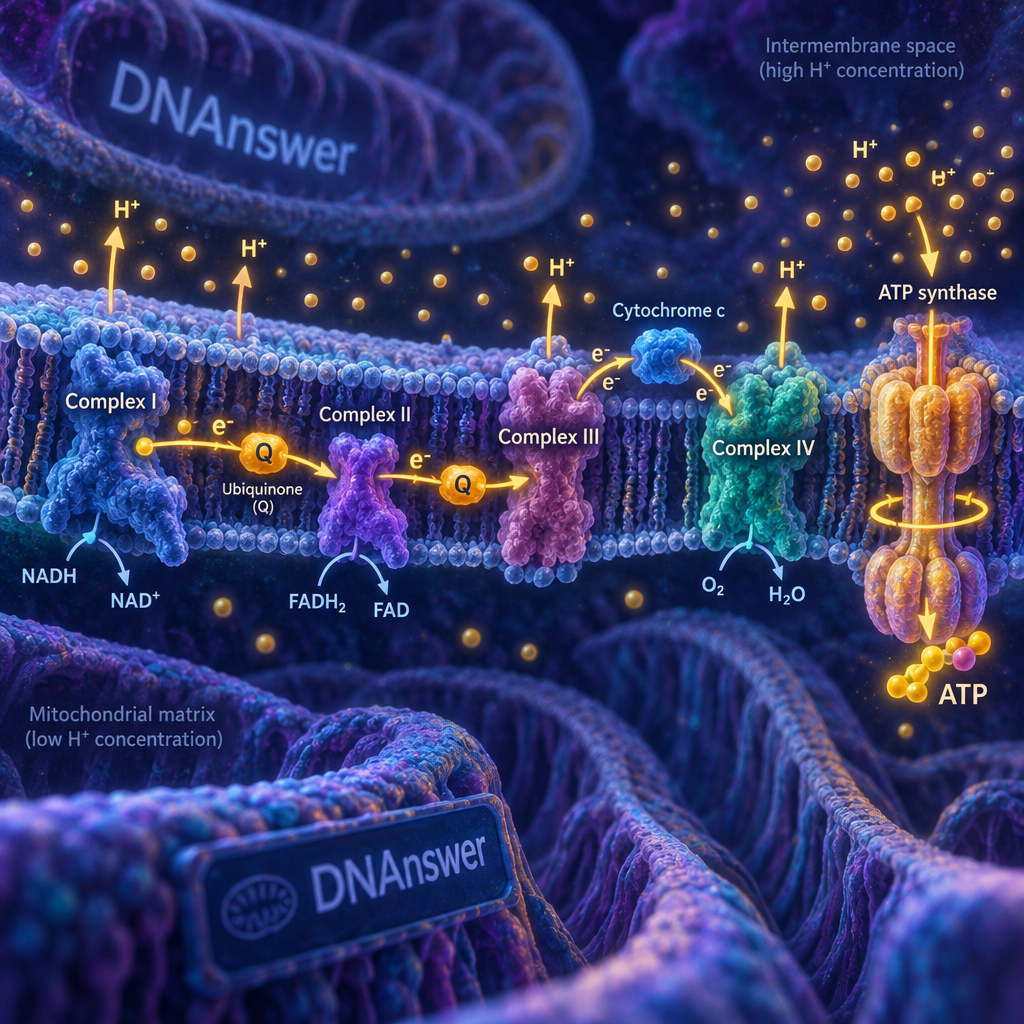
Does the electron transport chain actually make ATP? No. It builds a battery. Protein complexes in the inner mitochondrial membrane pass electrons from NADH and FADH2 down to oxygen, and the energy released pumps protons across the membrane. That electron transfer chain creates a charge difference, and an enzyme called ATP synthase spends it to make most of your cell's ATP (the molecule cells use as energy currency). Oxygen waits at the end and becomes water.
Key Takeaways
- The chain pumps protons; ATP synthase makes the ATP.
- Electrons flow one way, from NADH and FADH2 to oxygen. It's no cycle.
- Oxygen acts only at the final step, forming water.
- Modern estimates: about 2.5 ATP per NADH, 1.5 per FADH2.
- Bacteria and chloroplasts have their own versions.
- The chain can run backward, and that's tied to disease.
Myth 1: "The Chain Makes ATP"
Here is a fact that surprises most students: none of the four big protein complexes in the chain touches ATP. They move electrons and pump protons. Another machine does the ATP work.
Why the myth feels right
Textbooks often draw one diagram labeled "electron transport chain" with ATP arrows at the bottom. The two processes run together, so they get merged in your head. And the chain is the reason ATP gets made. That's a fair shortcut, but it hides the mechanism.
What actually happens
The complexes use energy from passing electrons to push protons (hydrogen ions, H+) out of the mitochondrial matrix, the inner compartment, and into the intermembrane space between the two membranes. Three of the four complexes are proton pumps. Protons pile up on one side, like water behind a dam.
The pile creates an electrochemical gradient: a difference in both charge and concentration across the membrane. The inner membrane blocks protons from leaking back. Their only easy route home runs through ATP synthase.
The dam and the turbine
ATP synthase works like a turbine. Protons rush through it, the rotor spins, and the motion joins ADP and phosphate into ATP. Scientists call this coupling chemiosmosis. The whole package, chain plus ATP synthase, is oxidative phosphorylation.
So the two terms aren't identical. The electron transport chain is the pumping half. Oxidative phosphorylation is the full process, pumping plus ATP production.
Next time you see a diagram, look for the protons. They're the real currency.
Myth 2: "It's a Cycle, Like the Krebs Cycle"
The name sounds circular, and it shares a neighborhood with the Krebs cycle (also called the citric acid cycle), which does loop. So many people assume electrons circle around and get reused. They don't.
One-way traffic
Electrons enter at the top and leave at the bottom. Think of a waterfall with several ledges, not a merry-go-round. At each step, electrons drop to a lower energy level and give up a bit of energy. They end up joined to oxygen, and that's the end of their trip.
What does get recycled are the carriers. NADH hands over its electrons and turns back into NAD+, which returns to the Krebs cycle and glycolysis to pick up more. The molecules cycle. The electrons don't.
The flow, step by step
Here is the path from fuel to water:
- NADH delivers two electrons to Complex I (NADH dehydrogenase), which pumps four protons across the membrane.
- Both complexes hand electrons to coenzyme Q (also called ubiquinone), a small carrier that floats freely inside the membrane.
- Coenzyme Q passes them to Complex III, which pumps more protons.
- Complex III passes them to cytochrome c, a small protein that shuttles along the membrane surface.
- Cytochrome c delivers them to Complex IV, the last pump.
- Complex IV hands the electrons to oxygen, which picks up protons and forms water.
Notice that FADH2 skips Complex I. That detail matters in Myth 4.
Myth 3: "Oxygen Gets Used Up at the Start"
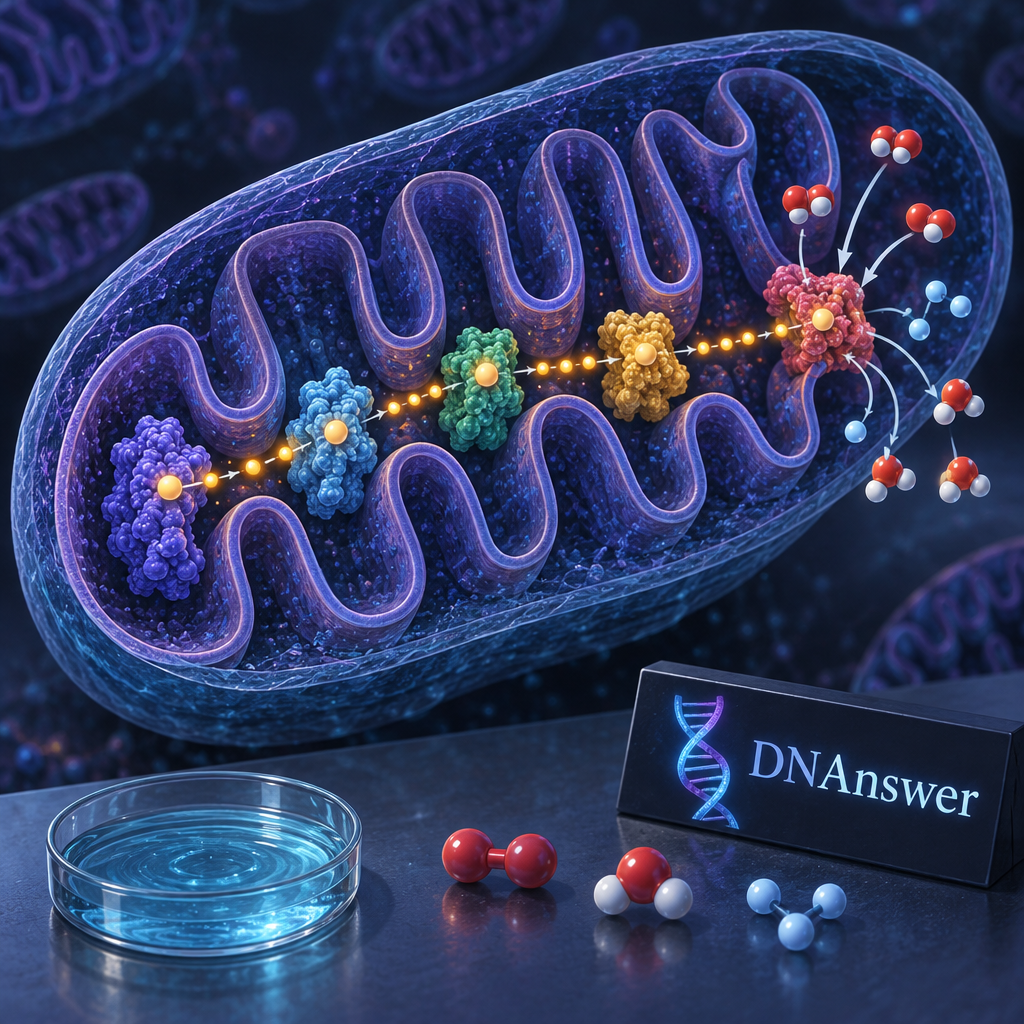
If you breathe in oxygen and burn sugar, it's natural to imagine oxygen reacting with the sugar early on. Biology class often says "cells burn glucose with oxygen," and that wording hides the order of events.
Where oxygen really appears
Glucose is taken apart in stages, and oxygen isn't involved until the very end. Glycolysis and the Krebs cycle strip electrons off the fuel and load them onto NADH and FADH2. Neither process uses oxygen directly. Only at Complex IV does oxygen show up, accepting electrons and protons to make water.
Oxygen is the final electron acceptor. It's the exit door. Its job is to take electrons away so the chain keeps moving.
Why a missing exit door stops everything
Picture a hallway with a locked door at the end. People pile up and nobody can enter. In the chain, if oxygen isn't there, electrons can't leave Complex IV. Every upstream carrier stays loaded, NAD+ runs out, and the Krebs cycle stalls too.
That's why cyanide is so deadly. It binds to Complex IV and blocks the exit. Cells don't die from a lack of fuel but from a traffic jam at the final step.
Some bacteria use other acceptors in place of oxygen, such as sulfate. Their chains still work, just with a different exit.
Myth 4: "A Glucose Makes Exactly 36 or 38 ATP"
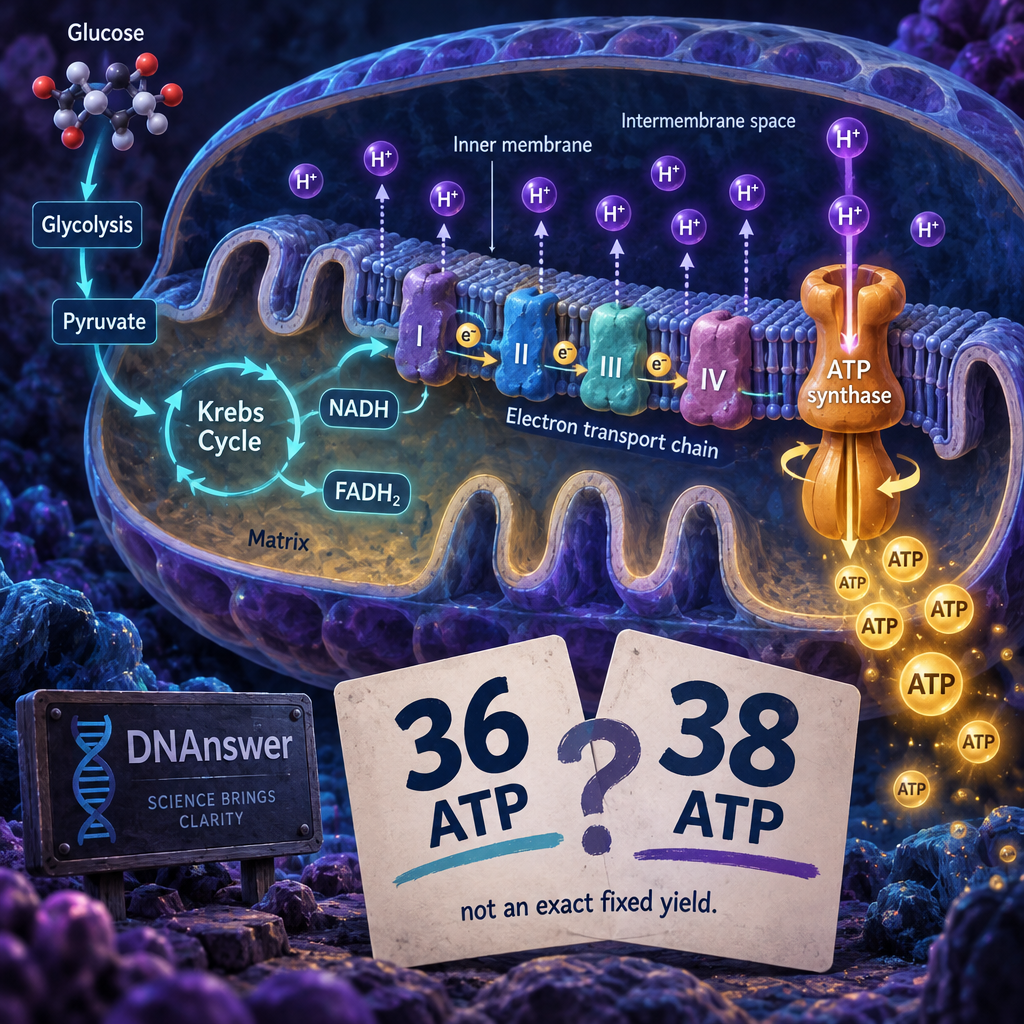
You probably memorized this number. Maybe you still have it on a flashcard. It's neat, and it's out of date.
Where the old numbers came from
Those were whole numbers that made the arithmetic clean. The assumption was that protons and ATP link in tidy ratios, and that isn't true.
Protons pumped don't match ATP made one-to-one. ATP synthase needs a set number of protons to turn its rotor, and extra protons are also used to move ATP and phosphate across membranes. Some protons leak back across the membrane without making anything. So the real yield is a fraction.
The modern estimates
Current teaching gives about 2.5 ATP per NADH and 1.5 per FADH2. FADH2 yields less because it enters at Complex II, which skips Complex I's pumping. Its electrons drive the pumping of only about 6 H+, compared with an unspecified number for NADH.
Even the pump counts have been argued over. One reason is that a crystal structure of Complex I showed only three obvious pumping units, which led some to propose 3 protons per two electrons instead of 4. A study measuring living mouse and human cells in a more physiological setting concluded that 4 protons per two electrons is correct for Complex I.
About 2.5 ATP per NADH and about 1.5 per FADH2 are the standard modern estimates, and both are approximate.
What to do with this
Myth 5: "It Only Happens in Mitochondria"
For most animal cells, that's right, and it's the version taught first. But the chain is much older than mitochondria. It's a general design for turning electron flow into a proton gradient.
Bacteria got there first
Bacteria have no mitochondria, yet they run electron transport chains in their cell membranes. The details vary by species, but the logic is the same: redox reactions pump ions across a membrane and ATP synthase uses the gradient. Mitochondria are widely thought to descend from bacteria that moved inside early cells.
Chloroplasts run it with light
In plants and algae, a chain sits in the thylakoid membrane inside chloroplasts. Photosynthesis flips the energy source. In mitochondria, food-derived electrons release energy as they fall toward oxygen. In chloroplasts, light energy lifts electrons up, and they then fall through a chain that pumps protons.
The result matches: a proton gradient drives ATP synthase. The ATP then helps build sugar. Mitochondria turn sugar into water, and chloroplasts help build sugar from carbon dioxide.
So when someone asks how it differs in photosynthesis, the short answer is: different fuel, different membrane, same trick.
The Complexes at a Glance
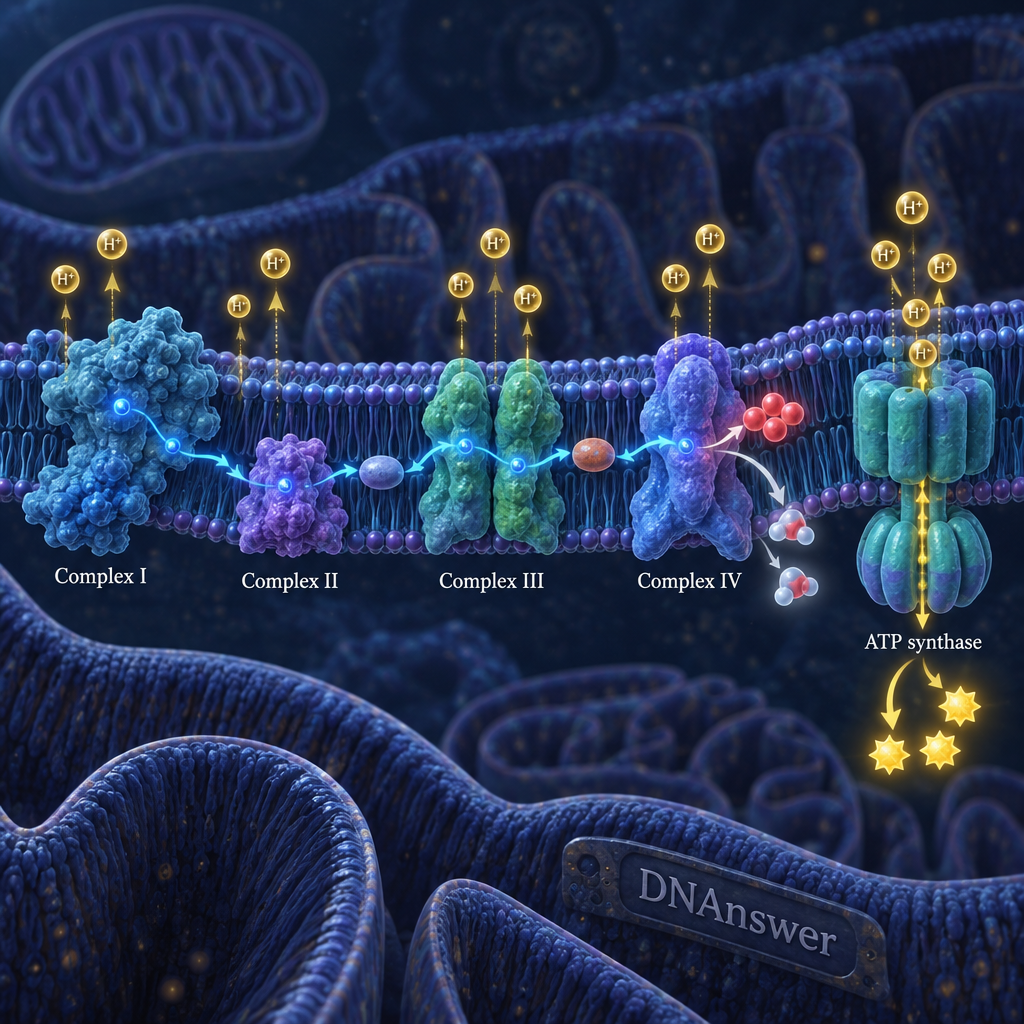
If you want a quick reference, here is what each part does. Complex I takes electrons from NADH and pumps four protons. Complex II takes electrons from FADH2 via succinate and pumps none. Complex III receives electrons from coenzyme Q, pumps protons, and passes electrons to cytochrome c. Complex IV takes them from cytochrome c, pumps protons, and hands them to oxygen to make water.
Want to test yourself? DNAnswer, a free web app, has molecular biology quizzes where you can practice cell energy questions and track your progress.
Myth 6: "The Chain Only Runs Forward, and It's Always Helpful"
Forward flow is the normal story, and for good reason. But the machinery can run backward, and that's one of the more surprising findings in mitochondrial biology.
Reverse electron transport
In reverse electron transport (RET), electrons flow backward from the coenzyme Q pool toward Complex I, turning NAD+ into NADH. A burst of reactive oxygen species (ROS, damaging oxygen-containing molecules) follows. Britton Chance and Gunnar Hollunger at the University of Pennsylvania first described it in 1960 using purified guinea pig kidney mitochondria, where excess succinate drove the reaction.
For roughly 50 years, scientists doubted it happened in living tissue. In 2014, Michael Murphy and colleagues at the University of Cambridge reported it in rodent models of heart attack and stroke. Succinate piles up while tissue is starved of oxygen. When blood returns, mitochondria burn through that stockpile fast and trigger RET, and the ROS burst injures the tissue.
Why it matters now
Later work has linked RET to aging, cancer stem cells, and Parkinson's disease models. A report in August 2026 described phospho-tau, the altered protein found in Alzheimer's disease, entering mitochondria and reversing electron flow. That finding points to RET as a possible drug target, though it's early-stage research, not a treatment.
The practical lesson: a chain isn't a fixed pipe. Its direction depends on conditions, and that's why damaged chains can harm cells instead of just failing to feed them.
Conclusion
Use the corrected picture to answer exam and everyday questions. If someone asks where ATP comes from, say protons build the gradient and ATP synthase spends it. If a number appears, use 2.5 and 1.5 as estimates. Next time you read about a mitochondrial disease or a poison like cyanide, ask which step broke: electron flow, proton pumping, or the final handoff to oxygen.
Frequently Asked Questions
What is the electron transport chain in simple terms?
It's a set of protein complexes in the inner mitochondrial membrane that pass electrons from NADH and FADH2 to oxygen. Along the way they pump protons across the membrane, storing energy that ATP synthase turns into ATP.
Where does the electron transport chain happen?
In eukaryotic cells, it's in the inner mitochondrial membrane. The membrane folds into cristae, which increase surface area. In plants it also runs in chloroplast thylakoid membranes, and in bacteria it sits in the cell membrane.
Why is oxygen needed for the electron transport chain?
Oxygen is the final electron acceptor. Without it, electrons can't leave Complex IV, so the whole chain backs up and ATP production collapses. Oxygen combines with electrons and protons to form water.
What's the difference between the electron transport chain and oxidative phosphorylation?
The chain is the electron-passing and proton-pumping part. Oxidative phosphorylation includes that plus ATP synthase, which uses the gradient to make ATP. Think of the chain as one half of the process.