Benzodiazepines and the Chemistry of Anxiety
Benzodiazepines are among the most widely prescribed psychoactive drugs in the world, yet many aspects of their effects on consciousness, anxiety, memory, and emotional processing remain incompletely understood.
Drugs such as diazepam, alprazolam, lorazepam, and clonazepam primarily act on the GABAergic system, the brain’s major inhibitory signaling network. Their clinical effects include anxiolysis, sedation, muscle relaxation, anticonvulsant activity, and impaired memory formation.
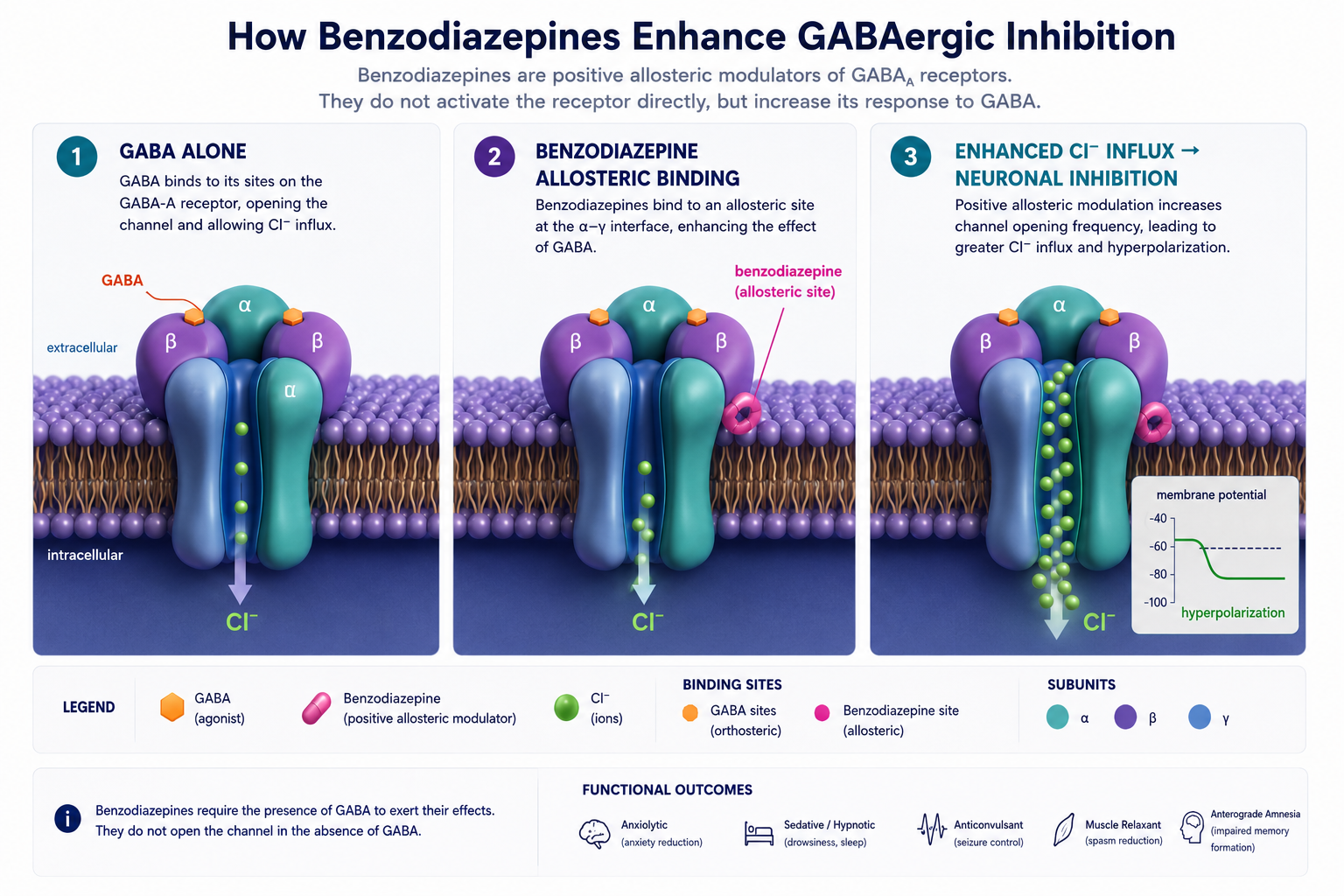
At the molecular level, benzodiazepines do not directly activate neuronal inhibition themselves. Instead, they function as positive allosteric modulators of the GABA_A receptor.
The GABA_A receptor is a ligand-gated chloride ion channel composed of multiple protein subunits embedded in neuronal membranes. Under normal conditions, the neurotransmitter GABA binds to the receptor and promotes chloride influx into neurons, reducing neuronal excitability.
Benzodiazepines bind to a distinct regulatory site located between specific α and γ receptor subunits. Their binding increases the receptor’s responsiveness to endogenous GABA, increasing the frequency of chloride channel opening and enhancing inhibitory neurotransmission throughout the central nervous system.
Although this general mechanism is well established, the relationship between receptor subtype composition and clinical effects is more complex than a simple one-to-one mapping. Experimental evidence suggests that receptors containing the α1 subunit are strongly associated with sedative, anticonvulsant, and amnestic effects, while α2- and α3-containing receptors appear more closely linked to anxiolytic and muscle-relaxant properties. However, these associations are based largely on genetic and pharmacological models and do not fully explain the complexity of human subjective experience.
Long-term benzodiazepine exposure introduces additional neurobiological adaptations. Chronic use may alter receptor expression, subunit composition, synaptic plasticity, and network excitability, contributing to tolerance, dependence, and withdrawal phenomena. Abrupt discontinuation in dependent individuals may lead to rebound anxiety, insomnia, autonomic hyperactivity, perceptual disturbances, and in severe cases seizures.
Another major unresolved question concerns consciousness and emotional perception. Modern neuroscience has identified many of the molecular and circuit-level actions of benzodiazepines, including altered activity within networks involving the amygdala, hippocampus, thalamus, and prefrontal cortex. However, the precise relationship between these measurable neural changes and the subjective experience of anxiety reduction, sedation, or altered awareness remains incompletely understood.
Benzodiazepines are often considered safer than several other sedative-hypnotic drugs when taken alone because they depend on endogenous GABA signaling and show a ceiling effect on respiratory depression under many conditions. However, this does not mean they are harmless. They can still produce severe sedation, impaired coordination, confusion, falls, cognitive impairment, and potentially life-threatening toxicity when combined with alcohol, opioids, or other central nervous system depressants.
More than half a century after their introduction, benzodiazepines remain both clinically valuable and scientifically complex, illustrating how even widely used medications can still contain major unanswered questions at the molecular, cellular, and systems-neuroscience levels.
References:
- Sigel E, Ernst M. The Benzodiazepine Binding Sites of GABA_A Receptors. Trends Pharmacol Sci. 2018;39(7):659–671.
- Engin E, Benham RS, Rudolph U. An Emerging Circuit Pharmacology of GABA_A Receptors. Trends Pharmacol Sci. 2022;43(12):1014–1027.