Dominant and Recessive in Genetics: Key Differences
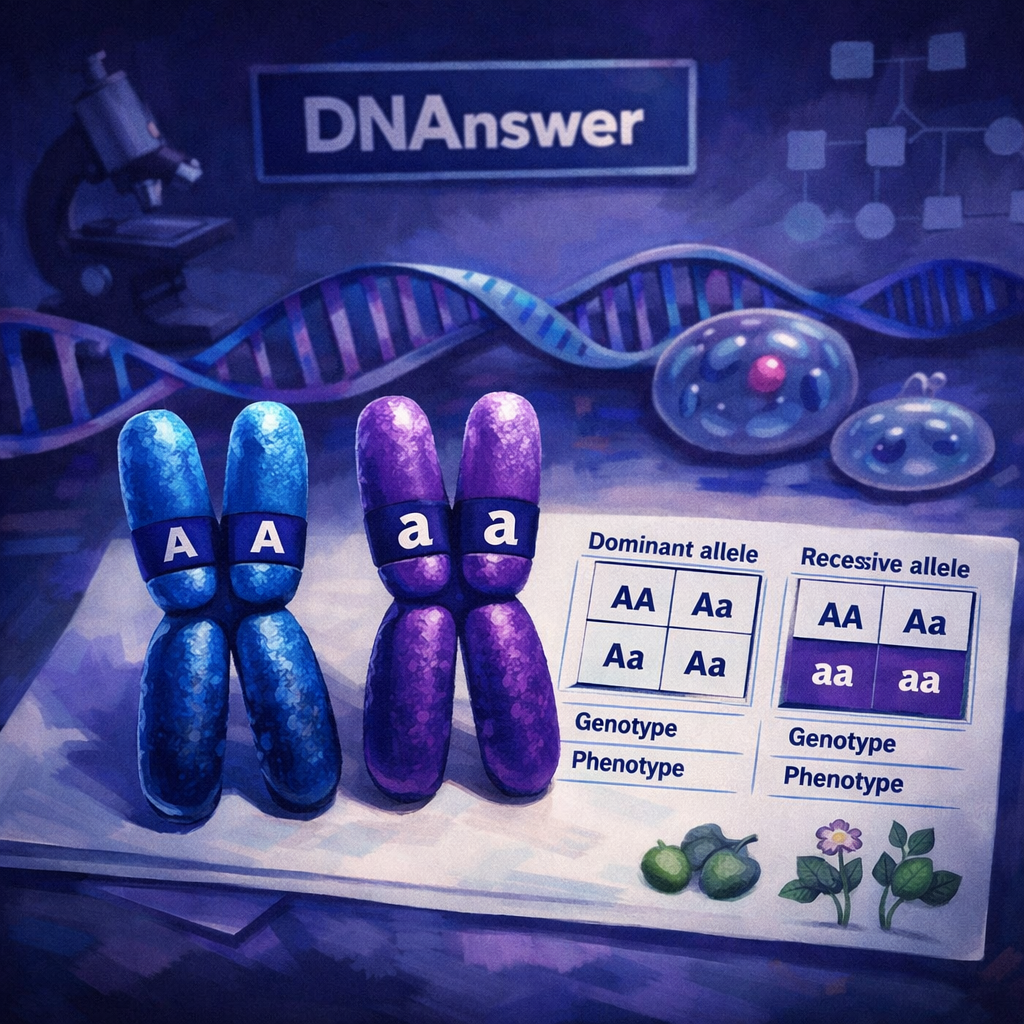
You probably think a dominant allele must be the more common one in a population, or that it somehow "wins" because it's biologically stronger. Neither is true. Dominant and recessive in genetics describe a molecular relationship between two gene copies, not a contest of strength or popularity.
Most of what people remember from high school biology about this topic is a simplified sketch, not the full picture. Real traits like height, skin tone, and disease risk usually break the tidy rules Gregor Mendel worked out with pea plants in the 1860s. Getting this straight changes how you read a family health history or a genetic test result.
Key Takeaways
- Dominant doesn't mean common, strong, or "better" — it's about molecular interaction, not popularity.
- Genotype (gene combo) and phenotype (visible trait) are different things — confusing them causes most mix-ups.
- Recessive disorders can hide for generations in carriers who show no symptoms at all.
- Incomplete dominance and codominance break the neat "one wins" story taught with pea plants.
- Height, skin color, and most disease risk come from dozens of genes, not one dominant-recessive pair.
- A Punnett square only works cleanly for single-gene traits — most human traits aren't that simple.
Myth: A Dominant Allele Is More Common in the Population
A lot of people assume dominant means widespread — that if brown eyes are dominant, most people must carry the dominant version because it "took over." That's not how allele frequency works. Dominance describes what happens inside one individual's cells, not how often a version of a gene shows up across a population.
The honest reason this myth sticks around is that in a few textbook examples, the dominant trait actually is common. Brown eye color is a reasonable example of a mostly dominant trait that's frequent in many populations. So the pattern seems to hold — until you hit the counterexample that breaks it completely.
Huntington's disease is caused by a dominant allele, and it's rare, affecting somewhere around 3 to 7 per 100,000 people of European descent. Meanwhile, the recessive allele for cystic fibrosis is carried by roughly 1 in 25 people of European ancestry, even though the disease itself only shows up when someone inherits two copies. The dominant allele for Huntington's is far less common in the gene pool than the recessive allele for cystic fibrosis. Frequency and dominance are simply unrelated variables.
What actually determines how common an allele is comes down to population genetics: mutation rate, whether the trait affects survival or reproduction, genetic drift, and how populations mix over generations. A dominant allele that kills people before they reproduce, like some severe dominant disorders, gets weeded out fast. A harmless recessive allele can ride along in carriers for thousands of years without ever causing a problem, because it only shows up when two copies meet.
"Dominant" and "recessive" describe the relationship between two alleles at the same gene, not how widespread either version is in a population.
Next time you hear that a trait "must be common because it's dominant," treat that as a red flag, not a fact. Check actual allele frequency data instead of assuming the label tells you anything about numbers. The word "dominant" is doing a very narrow job — describing what happens inside one cell — and population size was never part of its definition.
Myth: Dominant Traits Are Stronger or Evolutionarily Superior
People hear "dominant" and picture something like a dominant sports team — powerful, winning, superior. Genetics borrowed the word, but the biology behind it has nothing to do with fitness or evolutionary advantage. A dominant allele isn't "better" than a recessive one — it's just the version whose protein product gets expressed when only one copy is present.
Here's the honest origin of the confusion: English is doing double duty. "Dominant" in everyday language means powerful or controlling. When 19th-century scientists needed a word for "the allele that shows up in the phenotype" — the observable trait, as opposed to the genotype, the actual gene combination a person carries — they reached for the word already sitting there. It stuck, and it dragged its everyday connotations along with it.
What's actually happening at the molecular level is more like a majority-rules situation, and often not even that. Many dominant alleles work because they still produce a functional protein, and one working copy is enough to get the job done. Many recessive alleles are recessive precisely because they're broken — they don't produce a working protein at all, so you need two broken copies before the trait or disorder shows up. There's no strength contest. There's a working molecule and a non-working one, and the working one usually gets to set the phenotype.
Evolution doesn't care about dominance labels either. A dominant allele that causes a lethal disorder before reproductive age gets removed from the gene pool just as fast as a harmful recessive one, sometimes faster, because a single copy is enough to cause harm. Sickle cell trait shows the flip side: carrying one recessive sickle cell allele can actually protect against severe malaria in some regions, making that "weaker" recessive allele a survival advantage in specific environments.
Consider three real cases side by side:
- Huntington's disease — dominant, severe, and it still persists in the population because symptoms often start after people have already had children.
- Cystic fibrosis — recessive, severe, and carriers show no symptoms at all, letting the allele hide for generations.
- Sickle cell allele — recessive for the disease, but one copy can offer malaria resistance, making it a net advantage in some environments.
None of those outcomes line up with "dominant equals stronger." Evolutionary success depends on survival and reproduction, full stop, and dominance is just a description of gene expression mechanics.
Myth: One Gene Always Equals One Simple Trait
Mendel's pea plants make it look like every trait traces back to a single gene with two possible versions. That's true for pea flower color and pod shape. It's not true for almost anything you'd care about in a person. Most human traits are polygenic — controlled by many genes acting together, each contributing a small effect.
The kernel of truth here is real: some human traits genuinely are single-gene, or close to it. Attached versus unattached earlobes, certain blood type patterns, and a handful of rare single-gene disorders follow something close to Mendel's original ratios. That's exactly why the pea-plant model got taught as the default. It works, just not for most things.
Height Isn't a Dominant-Recessive Pair
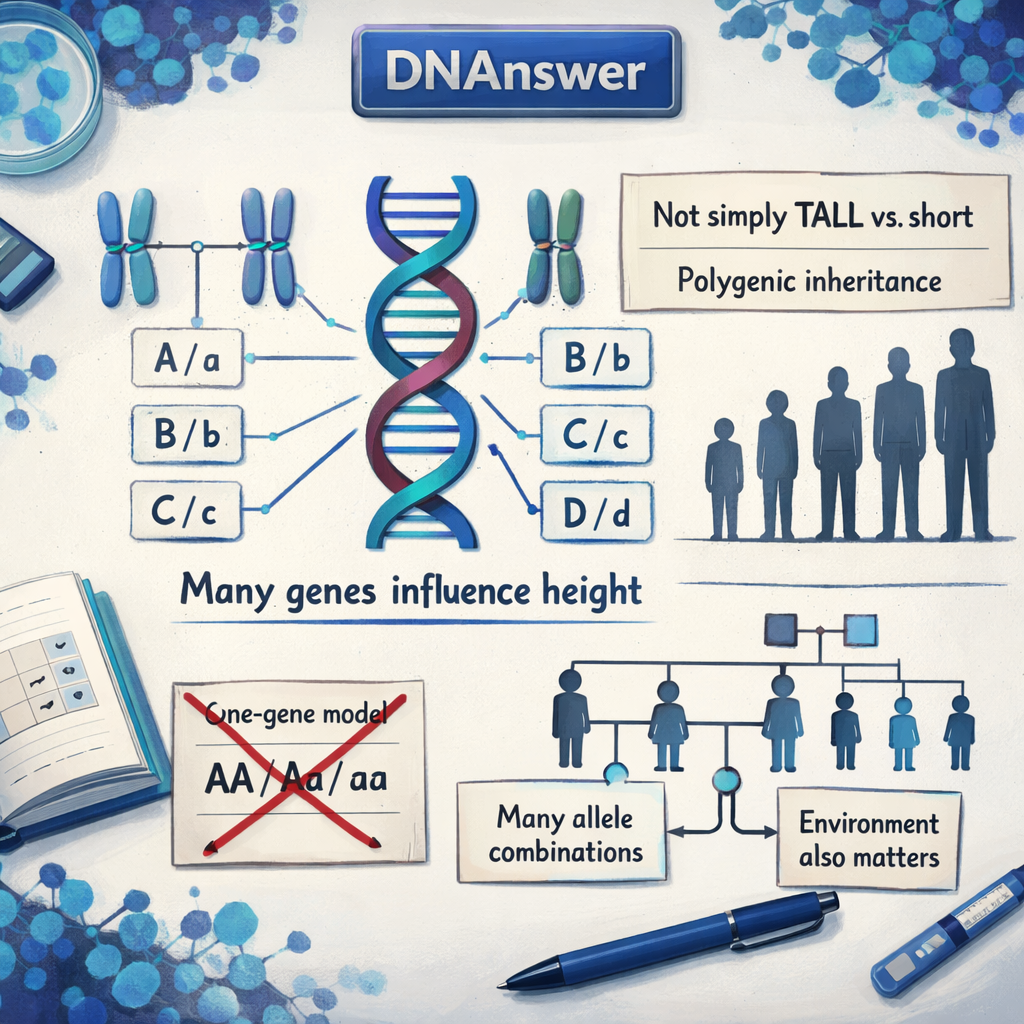
Height is one of the most obvious counterexamples. Researchers have identified hundreds of genetic variants that each nudge height up or down by a tiny amount, and combined they still only explain part of the variation — the rest comes from nutrition, childhood health, and other environmental factors. There's no "tall allele" and "short allele" locked in a Mendelian showdown. Height is a polygenic trait, built from dozens of small genetic inputs plus environment.
Skin Color Works the Same Way
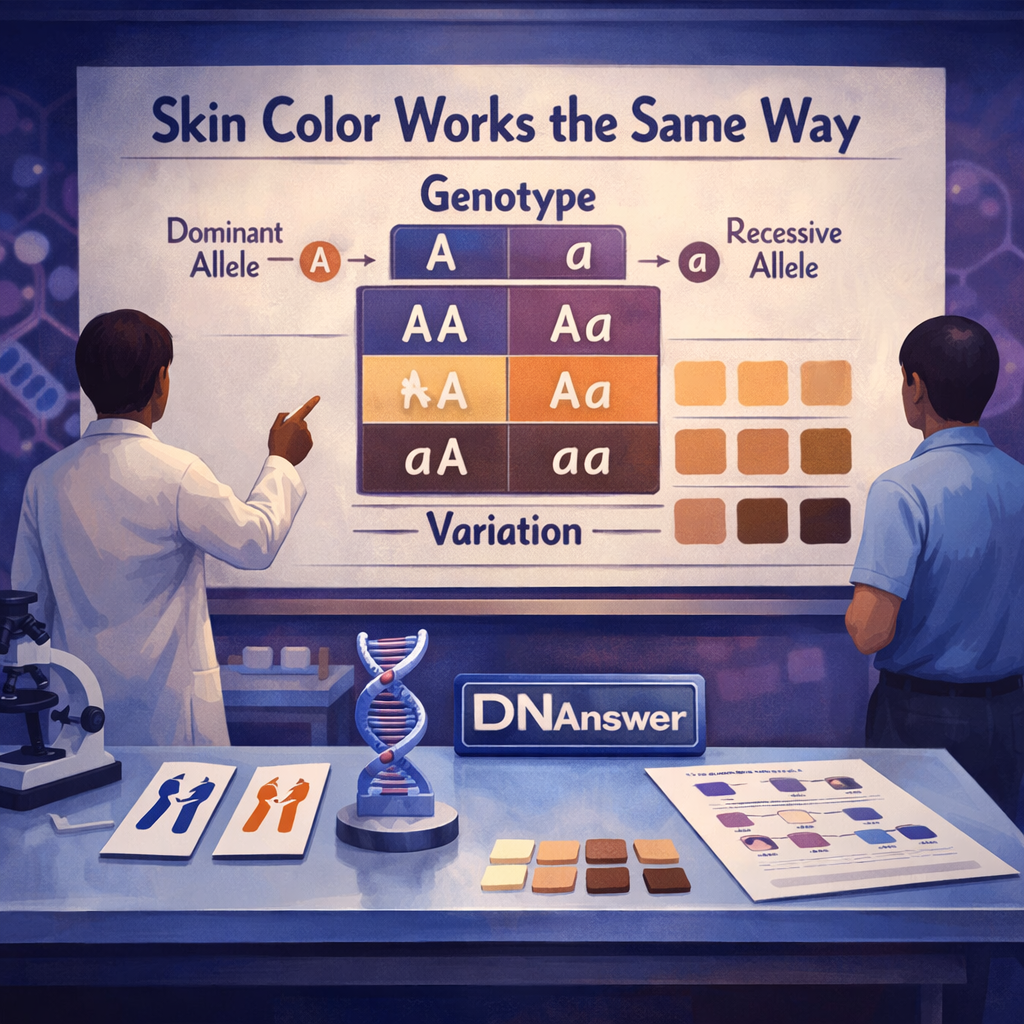
Skin color follows a similar pattern. Genes like SLC24A5 and MC1R each influence pigment production, but no single gene switches skin tone on or off. The result is a gradient across human populations, not a small set of discrete categories — which is itself strong evidence against a simple dominant-recessive model.
Disease Risk Rarely Comes from One Gene
Common conditions like type 2 diabetes, heart disease, and most cancers involve dozens to hundreds of genetic variants, each adding a small amount of risk, layered on top of diet, activity level, and age. A handful of disorders — cystic fibrosis, sickle cell disease, Huntington's — really do trace back to one gene, which is exactly why they get used as the classroom examples. They're the exception, not the rule, and treating them as typical badly misrepresents how most disease risk actually works.
Myth: Genotype and Phenotype Are the Same Thing
Someone says "I don't have the gene for X" when they mean "I don't show the trait." Those are two different claims, and mixing them up causes real confusion, especially around carrier status. Genotype is the actual combination of gene copies you carry; phenotype is what you can observe or measure. You can carry a gene without it ever showing up.
This mix-up is understandable, because most of the time genotype and phenotype line up close enough that the distinction doesn't matter in daily conversation. If you have brown eyes, you probably carry at least one dominant allele for brown pigment, and your genotype and phenotype tell the same story. The gap only becomes obvious once you look at recessive traits and carrier status, where the two can tell completely different stories.
Take a person who is heterozygous for cystic fibrosis — meaning they carry one normal copy of the CFTR gene and one mutated copy. Their genotype includes the disease allele. Their phenotype shows no symptoms at all, because the one working copy makes enough functional protein. Compare that to someone who's homozygous recessive, carrying two mutated copies. Same gene, different genotype, and now the phenotype includes the disease itself.
This is exactly why genetic carrier screening exists before pregnancy. Two parents can each be healthy, symptom-free carriers of the same recessive condition and still have a child who inherits both mutated copies and develops the disorder. A basic Punnett square — a simple grid geneticists use to predict the odds of offspring genotypes from two parents' allele combinations — shows that two heterozygous carriers have roughly a 25% chance of having a child with two recessive alleles, a 50% chance of another carrier, and a 25% chance of a child with two normal copies. None of that risk would be visible by looking at the parents' phenotypes alone.
If you've ever gotten a genetic test back and seen a gene flagged, that flag is describing genotype. Whether it ever becomes phenotype — an actual observable trait or condition — depends on dominance, the specific mutation, and sometimes other genes or environmental factors entirely. Reading a genotype report without understanding the difference is how people end up more scared, or less concerned, than the result actually warrants.
Myth: Every Trait Follows Simple Dominant-Recessive Rules

The classroom version of genetics treats dominance as an all-or-nothing switch: one allele wins, one loses, done. In reality, that's just one of several patterns alleles can follow. Two big exceptions — incomplete dominance and codominance — show up constantly once you start looking for them.
Incomplete dominance happens when neither allele fully covers the other, so the heterozygous offspring end up with a blended trait somewhere in between. The textbook example is snapdragon flower color: cross a red-flowered plant with a white-flowered one, and you don't get red or white offspring — you get pink. Neither allele dominates. They blend.
Codominance is different from blending. Both alleles get expressed fully and separately, side by side, rather than mixing into something intermediate. Human ABO blood type is the standard example: someone with one A allele and one B allele doesn't produce some intermediate blood type. They produce both A and B antigens on their red blood cells at once, giving them type AB blood. Both versions show up in full, simultaneously.
Why Textbooks Lead with Pea Plants Anyway
Mendel picked pea plants partly because he got lucky. Traits like pod color and seed shape happen to follow clean, complete dominance, which is exactly why they produce such tidy, easy-to-teach ratios. If he'd studied snapdragon flower color first, the story of genetics might have opened with blending instead of dominance, and the whole framing taught in schools might look different today.
How to Spot an Exception in Real Life
Watch for phenotypes that don't fit either parent cleanly. A child's trait that looks like a blend, or a case where a person seems to display two versions of something at once, is a strong signal you're looking at incomplete dominance or codominance rather than a simple dominant-recessive pair. Blood type is the most everyday example: it's worth knowing your ABO type precisely because it doesn't follow the "one allele hides the other" story people expect from high school biology.
What Simple Dominance Still Gets Right
None of this means the classic Mendelian model is wrong or useless. It's genuinely correct for a real subset of traits, and it's still the right starting point for understanding inheritance mechanics before layering in the exceptions.
Simple complete dominance explains plenty of real single-gene conditions well. Achondroplasia, a common cause of dwarfism, follows dominant inheritance in close to textbook fashion — one copy of the altered FGFR3 gene is enough to produce the trait. Recessive conditions like phenylketonuria (PKU), where a baby can't properly break down an amino acid called phenylalanine, follow the two-copies rule closely enough that newborn screening programs across the United States rely on exactly that logic to catch it early.
A Punnett square remains a genuinely useful tool for single-gene traits and for the actual math behind carrier-based genetic counseling. It's not wrong. It's just narrower than most people realize, and the mistake isn't using it — it's assuming it applies to everything.
If you want to get a real feel for how these crosses play out with actual numbers instead of guesswork, running through interactive Punnett square exercises, like the ones built into the DNAnswer app, makes the probabilities click faster than reading about them ever does. Watching the 25/50/25 split show up across dozens of simulated crosses tends to cement the logic in a way a static diagram in a textbook can't.
The honest takeaway isn't "throw out what you learned in school." It's knowing which traits actually behave the simple way, and catching yourself before you apply that model to height, skin color, or disease risk, where it quietly stops working.
Conclusion
Stop asking whether a trait is dominant or recessive, and start asking how many genes are actually involved. That single question filters out most of the confusion. If it's one gene, a Punnett square and Mendel's rules probably apply. If it's height, skin tone, or disease risk, you're looking at dozens of genes plus environment, and no dominance label will explain it alone.
Frequently Asked Questions
Does a dominant trait always show up in every generation?
Not always. Dominant traits can skip a generation if a carrier doesn't pass the allele on, or if the trait has reduced penetrance — meaning some people with the allele never develop the visible trait at all, for reasons researchers don't fully understand.
Can two brown-eyed parents have a blue-eyed child?
Yes, if both parents are heterozygous carriers of a recessive blue-eye allele. Eye color actually involves several genes, not just one, so the classic single-gene brown-blue explanation is a simplification, but the carrier logic behind it still holds.
Is it possible for a trait to be neither dominant nor recessive?
Yes. Incomplete dominance blends both alleles into an intermediate trait, and codominance expresses both alleles fully at once, like AB blood type. Many traits also involve multiple genes, which don't fit the dominant-recessive framework at all.
Why do genetic disorders sometimes appear with no family history?
New mutations can appear spontaneously in an egg or sperm cell, causing a dominant disorder with no prior family history. Recessive disorders can also surface unexpectedly when two unrelated carriers, both symptom-free, happen to have a child together.