The Six Kingdoms of Life Are Already Outdated. Here's Why
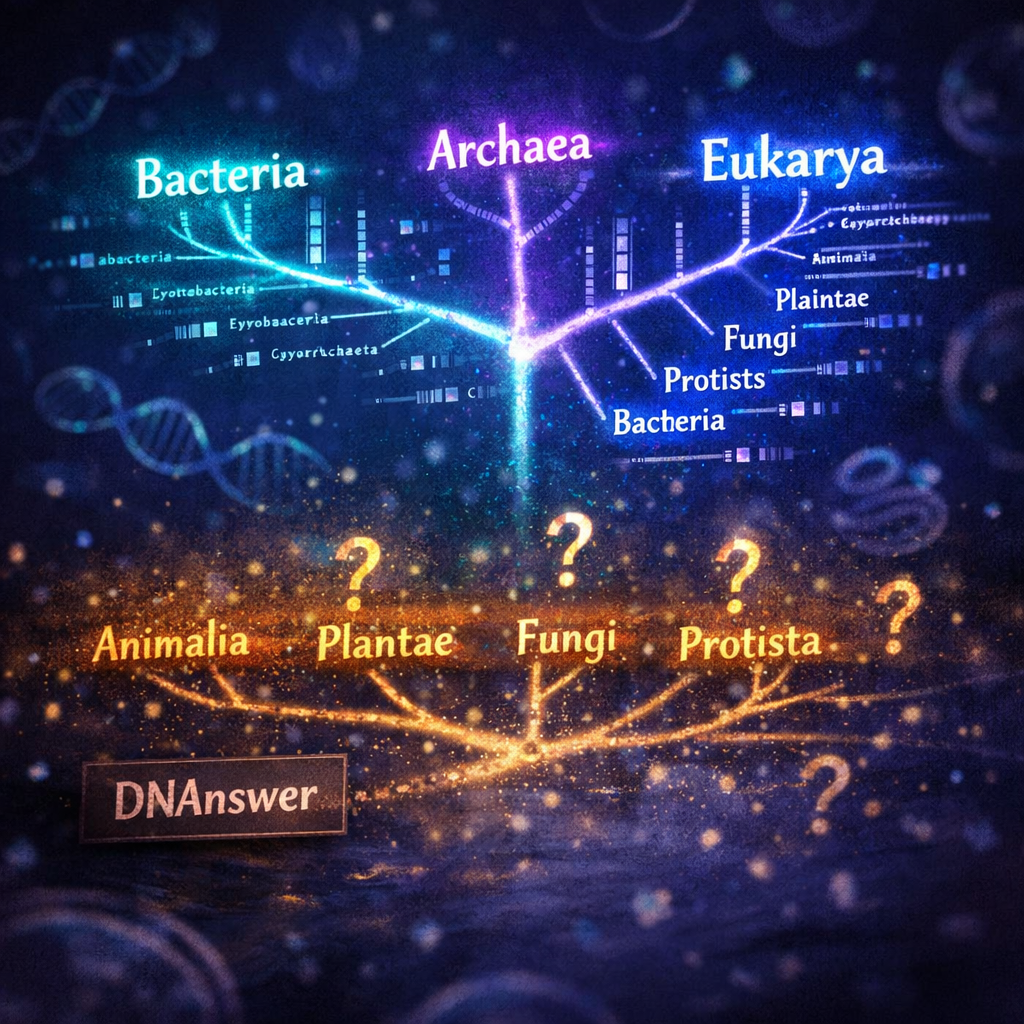
You probably learned six kingdoms in ninth-grade biology: animals, plants, fungi, protists, and two kinds of bacteria. That chart is wrong — not slightly outdated, structurally wrong. Since the 1990s, biologists have organized life using a completely different top level: three domains, built not from how organisms look, but from their genes.
If you're trying to understand domains of life taxonomy classification and how the three domains system kingdoms vs domains debate actually shook out, here's the short version. Domains sit above kingdoms in the hierarchy, they're based on molecular evidence rather than appearance, and even this newer system is currently being challenged again.
Key Takeaways
- Domains rank above kingdoms; they aren't interchangeable classification levels.
- Carl Woese's 1977 rRNA sequencing revealed Archaea as genetically distinct from Bacteria.
- Archaea aren't "weird bacteria" — their cell membranes and genetics differ fundamentally.
- The three-domain system, proposed in 1990, still isn't universally accepted today.
- Newer genomic data has produced serious two-domain proposals challenging Woese's model.
- Classification runs on DNA and molecular evidence now, not shape or habitat.
Myth: Kingdoms and Domains Are Just Different Names for the Same Thing
A lot of people assume "domain" is just a fancier word for "kingdom" — like calling a couch a sofa. It isn't. A domain is a taxonomic rank sitting above kingdom, and mixing the two up means misunderstanding how the whole tree of life is built.
This confusion makes sense. Most people's last formal exposure to biology classification was a poster with six equal-looking boxes: Animalia, Plantae, Fungi, Protista, Eubacteria, Archaebacteria. Nothing on that poster tells you these categories exist at different structural depths. They look like six flavors of the same thing.
The taxonomic hierarchy, in order from broadest to narrowest, actually runs: domain, kingdom, phylum, class, order, family, genus, species. That's eight nested levels, and domain sits at the very top. When Carl Woese and his colleagues proposed three domains in 1990, they weren't renaming the six kingdoms. They were adding an entirely new level above them, then reshuffling which kingdoms belonged where underneath it.
What This Means for the Six-Kingdom Chart
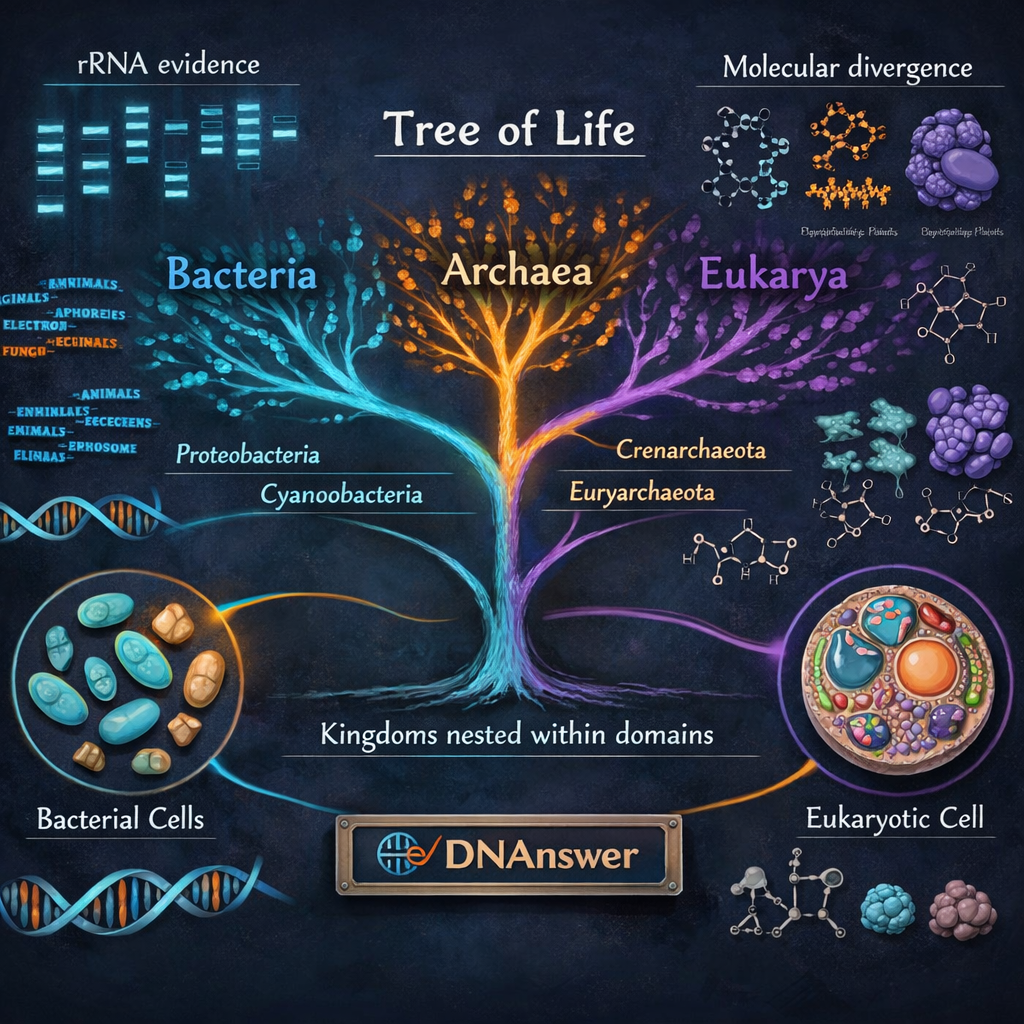
Under the three-domain model, the domain Bacteria contains its own kingdoms of bacterial life. The domain Archaea contains a separate set of kingdoms for organisms that look like bacteria under a microscope but are genetically closer to us than to them. The domain Eukarya contains everything with a nucleus — animals, plants, fungi, and protists all nested inside one domain, not existing as separate top-level categories.
So the old six-kingdom system isn't deleted. It's demoted. Four of those six kingdoms now live inside a single domain (Eukarya), while the two bacterial-looking kingdoms turned out to represent two entirely separate domains. That's the real shift: not new names, but a new floor built underneath the names you already knew.
The practical fix: whenever you see "kingdom" and "domain" used interchangeably in an article or quiz, treat that as a red flag. It usually means the source hasn't updated past the version of biology taught before 1990.
Myth: Archaea Are Just a Weird Type of Bacteria
This is the costliest misconception on this list, because it undoes the entire reason the three-domain system exists. Archaea are not bacteria with unusual habits. They're a separate domain of life, as different from Bacteria at the molecular level as bacteria are from you.
The honest origin of this myth is visual. Under a standard light microscope, Archaea and Bacteria look nearly identical: both are single-celled, both lack a nucleus, both are roughly the same size. Early microbiologists grouped them together because that's all they had to go on — shape, size, and where they lived. Organisms found in salt flats or hot springs got filed under "extremophile bacteria" and left there for decades.
The Molecular Evidence That Split Them Apart
The correction came from genetics, not a better microscope. In 1977, Carl Woese and George Fox at the University of Illinois compared ribosomal RNA sequences — the genetic code inside the cellular machinery that builds proteins — across hundreds of organisms. Ribosomal RNA works well for this because it changes slowly over evolutionary time, so its differences act like a molecular clock.
What they found: the RNA sequences of certain "bacteria" living in extreme environments were about as different from ordinary bacteria as bacteria are from eukaryotes (organisms with a nucleus, including you). That's not a minor variation. That's evidence of a split that happened near the root of the entire tree of life.
The biochemistry backs this up in ways you can check without sequencing anything yourself:
- Bacterial cell walls contain peptidoglycan, a mesh-like sugar-protein material; Archaea never have peptidoglycan in their walls.
- Archaeal cell membranes use ether-linked lipids, a chemically distinct fat structure that resists heat and acid far better than the ester-linked lipids in bacterial and eukaryotic membranes.
- Archaeal RNA-copying machinery resembles the eukaryotic version more closely than the bacterial one, despite Archaea looking like bacteria on the outside.
- Many Archaea thrive in conditions that kill nearly all bacteria — over 176°F in some hydrothermal vents, or salt concentrations near saturation in places like Utah's Great Salt Lake.
None of that is skin-deep. It's built into the chemistry of how these cells survive and replicate.
The takeaway: if you're studying biology or just trying to sound accurate at a dinner conversation, drop the phrase "archaebacteria" entirely. It's outdated even as a translation. Archaea and Bacteria are cousins that split near the beginning of life on Earth, not a bacterium with a strange address.
Myth: The Three-Domain System Is Settled Science
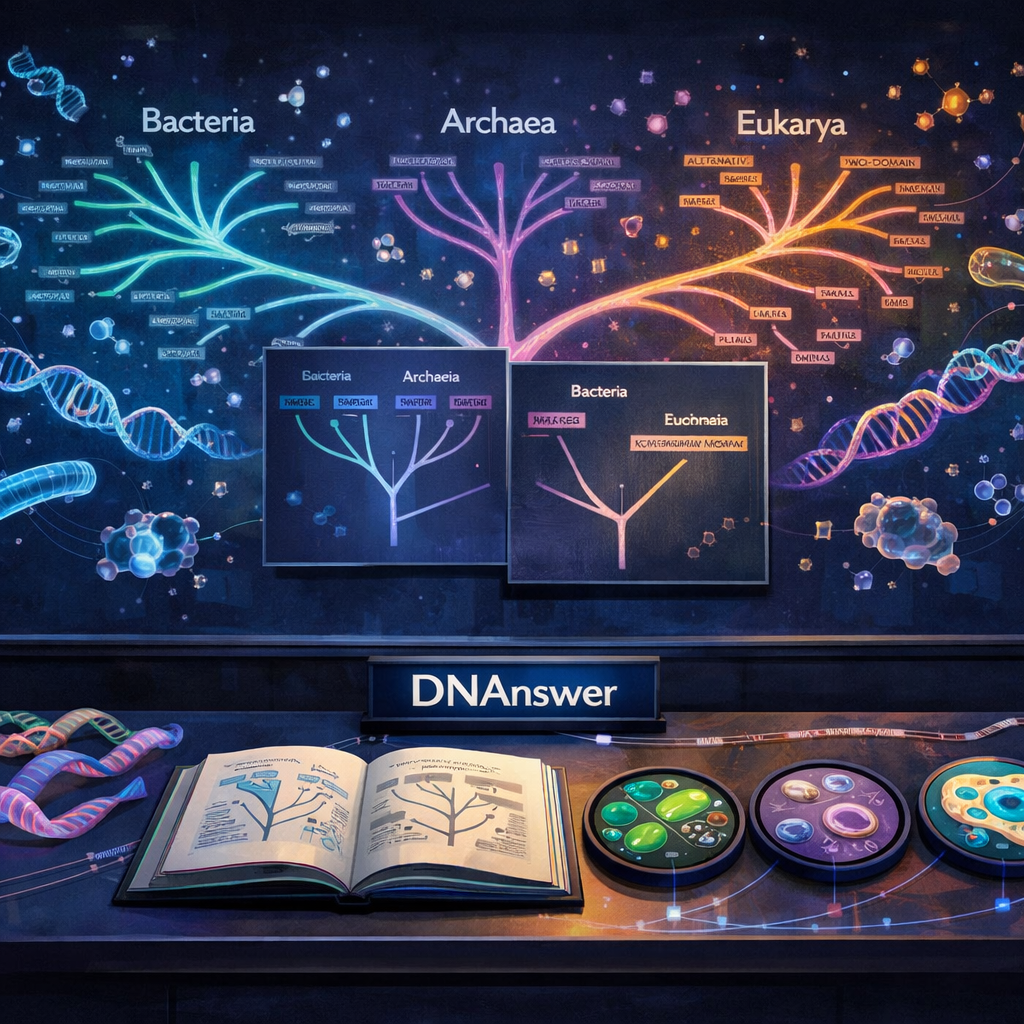
Plenty of textbooks present three domains — Bacteria, Archaea, Eukarya — as the final word. It isn't. Genomic data collected over the last fifteen years has reopened the question, and some researchers now argue for a two-domain tree instead.
The origin of this myth is understandable: three domains has been the dominant teaching model since the 1990s, and it replaced something that felt just as permanent (six kingdoms) for decades before that. When a model survives one generation of textbooks, people assume it's done evolving. Science doesn't work that way, and taxonomy especially doesn't.
Where the Challenge Comes From
The pushback centers on Eukarya's origin story. In 2015, a team led by Thijs Ettema's group at Uppsala University, working with metagenomic samples pulled from deep-sea sediment near a hydrothermal vent field called Loki's Castle in the Arctic Ocean, identified a group of Archaea now called Lokiarchaeota. Genomic analysis showed these organisms carry genes resembling eukaryotic proteins — the kind involved in shaping a cell's internal skeleton.
This matters because it supports a two-domain proposal: instead of three separate branches, some scientists argue Eukarya actually branched out of Archaea, rather than standing apart as an equal third domain. Under that model, life splits into just Bacteria and Archaea, with eukaryotes as a lineage nested inside the archaeal branch rather than sitting beside it.
"The three domains of life" is the phrase Carl Woese, Otto Kandler, and Mark Wheelis used in their 1990 paper proposing Bacteria, Archaea, and Eukarya as the primary divisions of life — a framework that redefined biology's top rank and is still being tested against new genomic evidence today.
This isn't settled either way. Plenty of microbiologists still defend three domains as the more useful and better-supported model, and the debate depends heavily on which genes you weight most in the analysis and how you build the phylogenetic tree (a branching diagram showing evolutionary relationships based on shared traits). What's certain is that "three domains, case closed" is the wrong takeaway for 2024's biology.
What to do with this: hold the three-domain system loosely. It's the best-supported, most widely taught framework right now, and it's a genuinely useful mental model. Just don't treat it as a law of nature. Treat it as biology's current best answer, subject to revision the moment better genomic tools arrive.
Myth: You Can Classify Organisms Just by Looking at Them
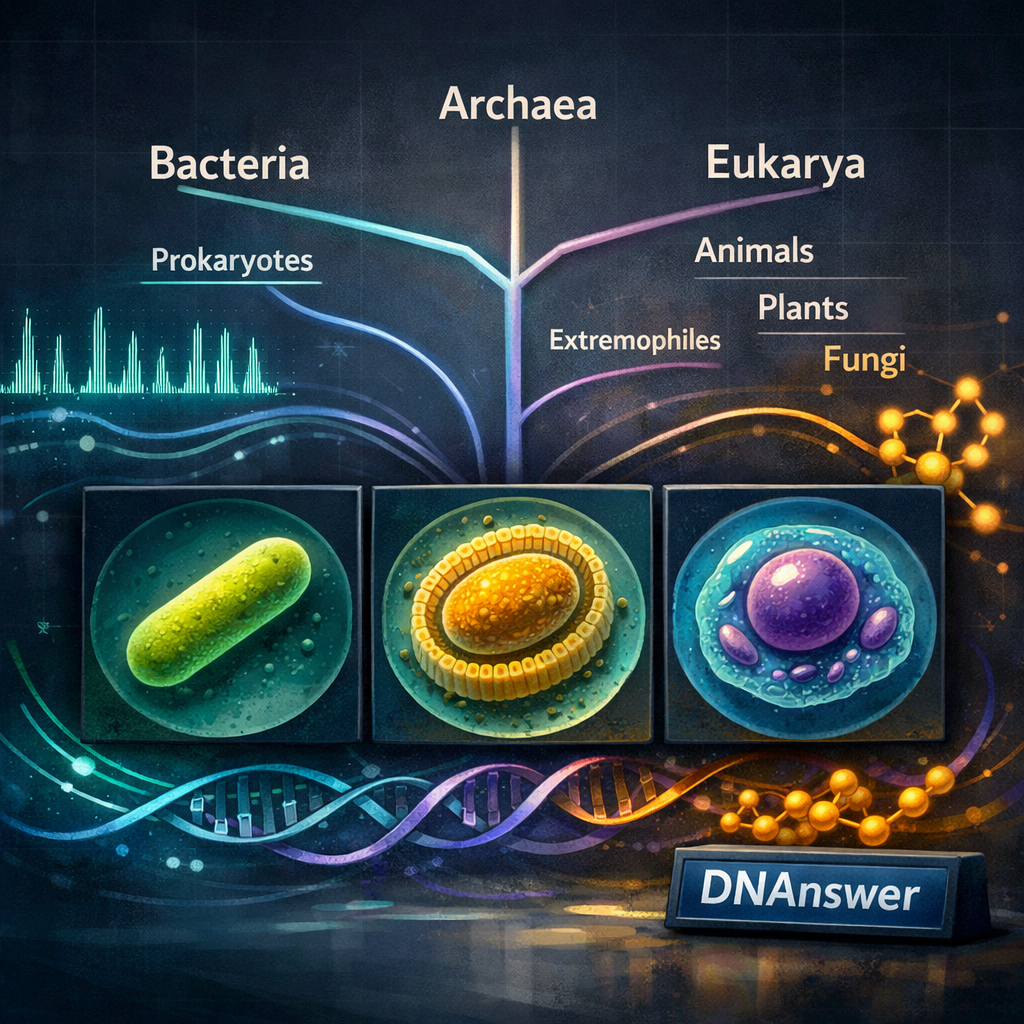
Older biology assumed you could sort life by appearance and habitat: does it have a cell wall, does it live in soil or seawater, does it move. That approach built the six-kingdom system, and it felt reasonable for a century. It's also why that system eventually broke.
The kernel of truth here is real: appearance isn't useless. Animals really do share visible traits that separate them from plants, and that visual sorting got biology remarkably far before DNA sequencing existed. Carl Linnaeus built an entire, mostly durable classification system in the 1700s using nothing but observable structure.
Why Molecular Evidence Overturned Appearance-Based Sorting
The problem is convergence and disguise. Two organisms can look almost identical under a microscope while being genetically worlds apart — that's exactly the Archaea-vs-Bacteria situation. Conversely, organisms that look wildly different can share close genetic kinship once you actually sequence their genomes.
Molecular taxonomy — classifying organisms by comparing DNA and RNA sequences rather than physical traits — solved this by measuring the thing that actually tracks evolutionary history: inherited genetic code. Ribosomal RNA sequencing gave Woese a way to compare organisms that share almost no visible features but do share ancient genetic machinery, since ribosomes exist in essentially every living cell and mutate at a fairly predictable rate.
This is also where horizontal gene transfer complicates the picture further. Normally, genes pass down through reproduction, parent to offspring, in a clean branching pattern. But bacteria and archaea also swap genes directly between unrelated organisms, sometimes across domains, through mechanisms like viral transfer or direct DNA uptake from the environment. That means the tree of life isn't purely a tree in places — it has crosslinks, like vines connecting separate branches. Phylogenetics (the study of evolutionary relationships through shared traits and genes) has had to build statistical methods just to account for this genetic sharing without breaking the whole model.
The practical shift for anyone learning biology today: stop asking "what does it look like" and start asking "what does its genome say." A microbe that resembles a common gut bacterium under a microscope might turn out, on sequencing, to belong to a domain that split off from Bacteria almost 3.5 billion years ago near the root of the tree of life. Looks lie. Genomes are harder to fake.
Myth: Extremophiles Are Rare Exceptions, Not Central to the Classification Story
Textbooks sometimes treat extremophiles — organisms that live in punishing conditions like boiling hot springs, acidic mine drainage, or Antarctic ice — as biological trivia. Cool footnote, not core science. That framing undersells them badly: extremophile Archaea are the organisms that revealed the three-domain system in the first place.
People treat extremophiles as sideshows because they don't affect daily biology class content. You don't need to know about Sulfolobus thriving in 176°F sulfuric hot springs to pass most intro courses, so it gets mentioned once, briefly, then dropped.
Why Extremophiles Sit at the Center of the Story
Here's the actual sequence of events. Microbiologists in the 1970s were curious about organisms living in geothermally heated environments, including hot springs at Yellowstone National Park. When Woese sequenced their ribosomal RNA alongside ordinary bacteria and eukaryotes, the extremophiles didn't fit either existing category. That mismatch is what forced the creation of a third domain.
Extremophiles also demonstrate, in the most dramatic way possible, why cell membrane chemistry matters for classification. Archaea surviving near-boiling temperatures or extreme salinity depend on those ether-linked lipids mentioned earlier — membrane fats that don't fall apart under conditions that would liquefy an ordinary bacterial or human cell membrane. That's not incidental detail. It's the physical reason a third domain had to exist as a separate category rather than as a subgroup of Bacteria.
There's a broader lesson buried here about how classification actually gets revised: it's usually the edge cases, not the common examples, that break old models. E. coli behaves exactly the way a 1960s biology textbook predicted. A methane-producing archaeon living in a cow's gut, or a salt-loving archaeon surviving in brine ponds along San Francisco Bay, does not. Those edge cases are where new domains get discovered, and it's worth remembering that pattern the next time a "settled" biological category gets challenged by an organism that simply refuses to fit it.
If you want to see how much of this can actually stick without a genetics degree, quizzes on DNAnswer's app run through exactly this kind of molecular evidence — rRNA comparisons, membrane chemistry, domain-versus-kingdom questions — in a format built for people learning it for the first time, not reviewing it.
Conclusion
The next time a chart, quiz, or textbook presents six kingdoms as complete, you'll know what's missing: the molecular layer underneath it. Treat classification the way biologists do now — as a working model built on the best current DNA evidence, not a finished answer. When new genomic data challenges it again, that's the system doing its job.
Frequently Asked Questions
Are humans in a kingdom or a domain?
Both. Humans belong to the domain Eukarya and, within it, the kingdom Animalia. Domain and kingdom aren't competing labels — domain is the broader rank containing the kingdom underneath it.
Why did scientists replace six kingdoms with three domains?
Ribosomal RNA sequencing in 1977 showed that Archaea, then classified as bacteria, were genetically as different from true Bacteria as both are from eukaryotes, forcing a new top-level split.
Is Archaea more closely related to Bacteria or to humans?
Genetically, Archaea share more similarities with eukaryotes (including humans) in their DNA-copying and protein-building machinery, even though Archaea physically resemble bacteria under a microscope.
Could the three-domain system be replaced again?
Yes. Genomic discoveries like Lokiarchaeota, found near hydrothermal vents in 2015, support two-domain proposals where Eukarya branches out of Archaea rather than standing as a separate third domain.