How the Glymphatic System Works
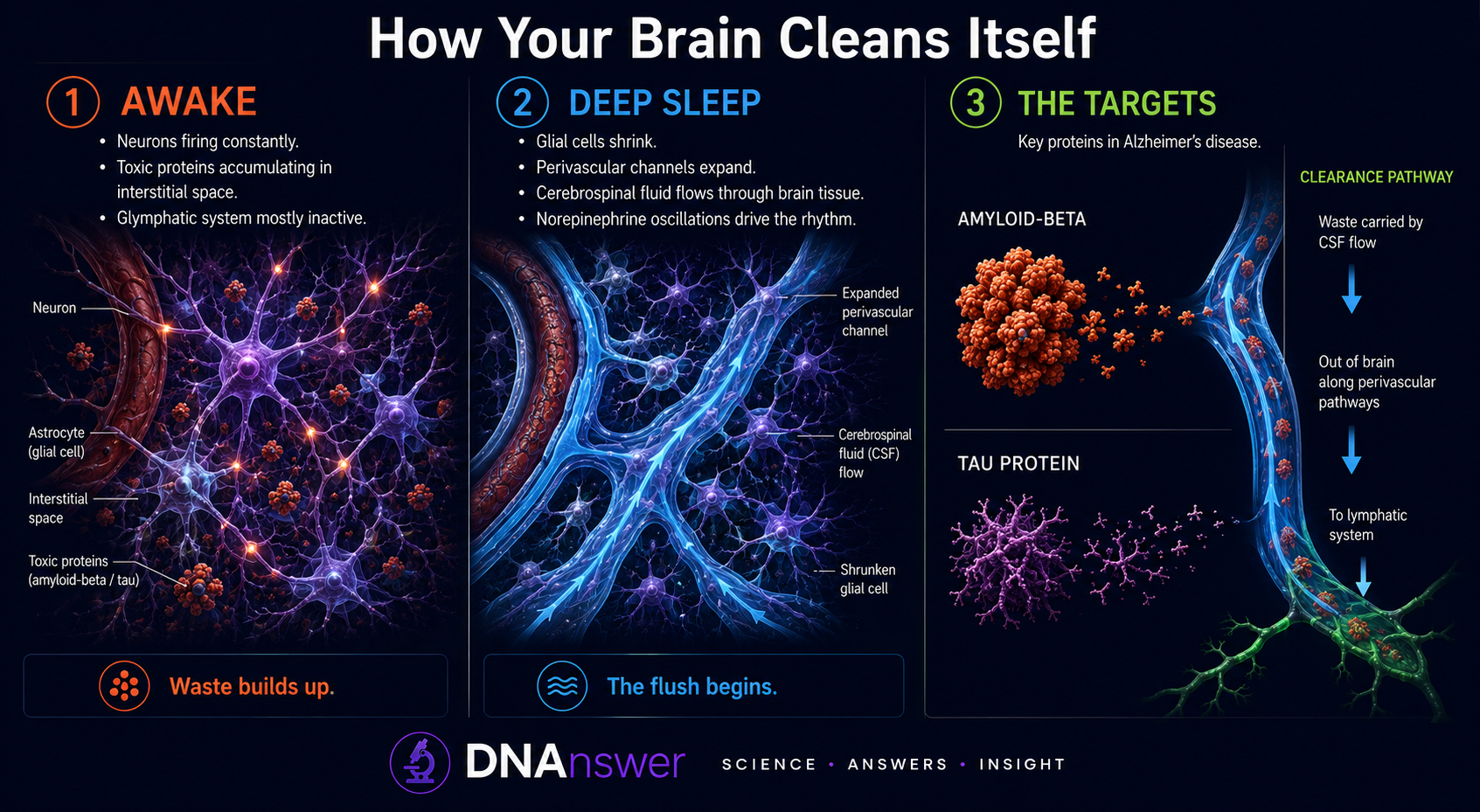
The brain is the most metabolically active organ in the body. Around the clock, billions of neurons fire electrical signals, process information, and coordinate every function that keeps you alive and thinking. But this relentless activity comes at a cost. Like any engine running at full capacity, the brain produces waste — toxic byproducts that accumulate in the spaces between cells with every hour you spend awake.
For decades, neuroscientists puzzled over how the brain clears this waste. Unlike every other tissue in the body, the brain lacks a conventional lymphatic system — the network that elsewhere drains cellular debris and carries it away for disposal. The answer, when it finally emerged, was elegant and unexpected. In 2013, neuroscientist Maiken Nedergaard and her team at the University of Rochester identified a previously unknown waste clearance pathway in the brain. They called it the glymphatic system — a name combining glial cells, the brain's support cells that make the system possible, and lymphatic, reflecting its functional similarity to the body's lymphatic network. The glymphatic system works by enabling cerebrospinal fluid to flow through the brain's tissue along perivascular spaces — channels that run alongside blood vessels, flushing out soluble proteins and metabolic waste including amyloid-beta and tau, the same proteins that accumulate in the brains of Alzheimer's patients.
The mechanism depends critically on sleep. During wakefulness the glymphatic system operates at minimal capacity. But during deep sleep something remarkable happens. The glial cells that line the brain's perivascular spaces shrink significantly, expanding the channels through which cerebrospinal fluid flows. The fluid surges through the brain tissue, collecting toxic waste and carrying it out toward the body's peripheral lymphatic system for disposal. A landmark study published in Cell in January 2025 added a crucial new layer to this picture. Researchers identified that the glymphatic system is driven during sleep by slow, synchronized oscillations in norepinephrine, a neurotransmitter released by a region of the brain called the locus coeruleus, which cause rhythmic changes in cerebral blood volume that effectively pump cerebrospinal fluid through the brain tissue. In other words, the brain has its own internal pump, and it runs on a chemical rhythm that only activates when you sleep.
A 2025 clinical trial directly tested whether this sleep-active glymphatic clearance increases plasma levels of Alzheimer's-related biomarkers in humans, finding measurable increases in amyloid-beta and tau in morning blood samples following normal sleep, but not following sleep deprivation, providing the most direct human evidence yet that the glymphatic system clears these proteins from the living human brain during sleep.
The implications for neurodegeneration are significant. When sleep is chronically disrupted, the glymphatic system cannot complete its nightly clearing cycle. Amyloid-beta and tau accumulate. Over years and decades, that accumulation may contribute directly to the development of Alzheimer's disease, not as a consequence of the illness, but as one of its earliest molecular causes. This reframes sleep entirely. It is not passive downtime. It is the only window during which your brain can perform the maintenance that keeps it functional. Every hour lost to poor or insufficient sleep is an hour the glymphatic system cannot do its work. The chemistry of a clear mind, it turns out, depends on the chemistry of the night.
References:
-
Corbali, O., & Levey, A. I. (2025). Glymphatic system in neurological disorders and implications for brain health. Frontiers in Neurology, 16, 1543725.
-
Hablitz, L. M., et al. (2025). Norepinephrine-mediated slow vasomotion drives glymphatic clearance during sleep. Cell, 188.
-
Dagum, P., et al. (2025). The glymphatic system clears amyloid beta and tau from brain to plasma in humans. medRxiv.