Why Do You Have Your Grandmother's Memories?
There is a question biology has been quietly wrestling with for decades: when something terrible happens to your grandmother, does a trace of that experience end up inside you? Not as a story she told, not as a habit she passed down, but written into the very molecules of your cells.
The answer might be yes.
This is the territory of epigenetics. Your genetic sequence, the actual letters of your DNA code, stays essentially the same throughout your life. But layered on top sits a second system of instructions, chemical tags that tell your cells which genes to switch on and which to silence. These tags respond to your environment, your stress levels, what you eat, what you experience. And some of those changes appear to be heritable.
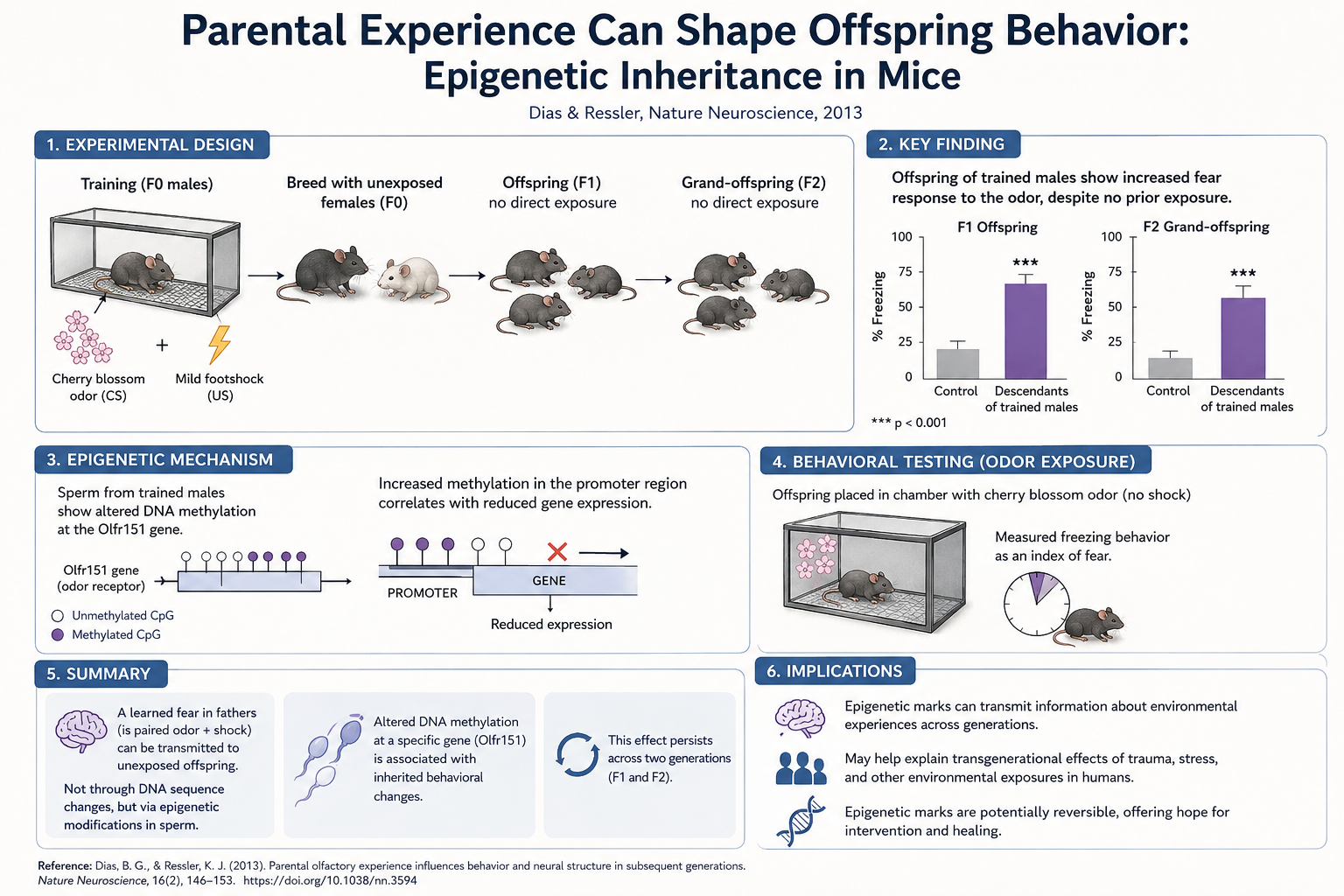
The most striking demonstration came from Emory University in 2013. Researchers Brian Dias and Kerry Ressler trained male mice to fear the scent of cherry blossom by pairing it with mild electric shocks. Then they looked at the children and grandchildren of those mice. Neither generation had ever encountered the scent before. Yet their brains were already wired to treat it as a threat. When Dias examined the sperm of the conditioned fathers, the gene responsible for detecting that odor showed an altered pattern of methylation, a chemical modification that tunes gene activity without changing the underlying DNA sequence. The father's experience had left a physical mark on his reproductive cells, and that mark was passed on.
DNA methylation is one of the primary languages of epigenetics. Think of your genome as a vast library. Methylation is a librarian locking certain books away. When a gene is heavily methylated, it goes quiet. Remove the tags, and it speaks again. What Dias and Ressler showed was that a learned experience could rearrange which books were locked, and that rearrangement could be inherited.
The human implications are significant. Children and grandchildren of Holocaust survivors, famine survivors, and war refugees often show altered stress responses and different baseline anxiety, even when they grew up in complete safety. For years this was attributed to learned behavior. Now biology appears to play a role too. A 2025 study in Scientific Reports measured DNA methylation across three generations of Syrian refugees and found measurable biological differences directly linked to a grandmother's wartime exposure.
It is worth being honest about what we do not yet know. Some researchers argue that evolution actually tries to erase epigenetic marks between generations, striving to give each new life a clean start. The field is young, and translating findings from mice to humans is never simple.
But here is the hopeful part. Unlike mutations in the DNA sequence itself, epigenetic marks can potentially be reversed. Exercise, diet, therapy, and targeted treatments may be able to reset inherited patterns.
Your biology is not a clean slate. It carries echoes of lives you never lived. But the choices you make today may be writing something into the generations that come after you.
Biology has a longer memory than we ever gave it credit for.
References
-
Dias, B. G., & Ressler, K. J. (2013). Parental olfactory experience influences behavior and neural structure in subsequent generations. Nature Neuroscience, 16, 146–153. https://doi.org/10.1038/nn.3594
-
Švorcová, J. (2023). Transgenerational epigenetic inheritance of traumatic experience in mammals. Genes, 14(1), 120. https://doi.org/10.3390/genes14010120
-
Pishva, E., et al. (2025). Epigenetic signatures of intergenerational exposure to violence in three generations of Syrian refugees. Scientific Reports. https://doi.org/10.1038/s41598-025-89818-z