You Are Not 100% Human
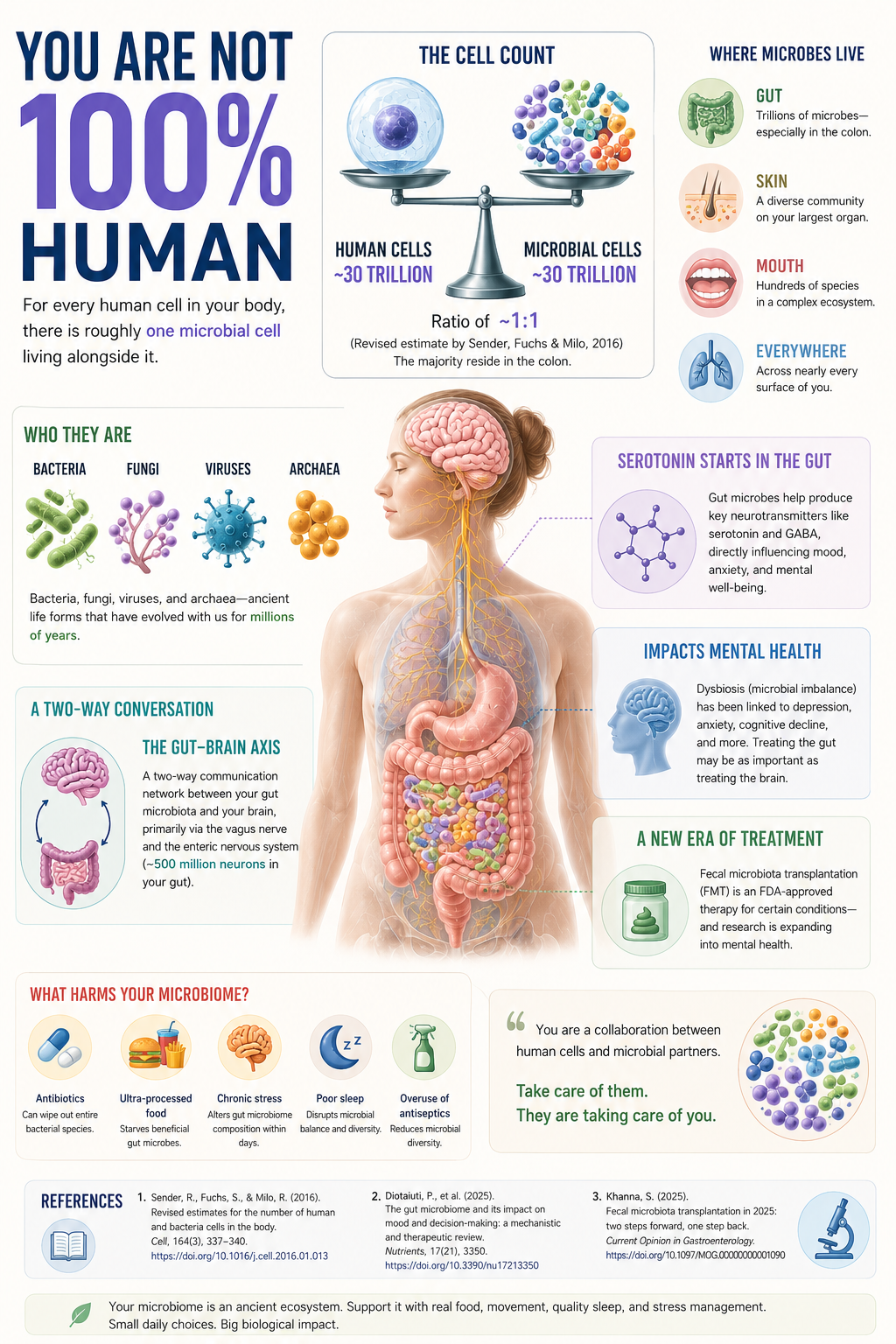
There is a fact about your body that most biology classes never quite get around to telling you. For every human cell you carry, there is roughly one microbial cell alongside it. Bacteria, fungi, viruses, and ancient single-celled organisms called archaea, living in your gut, on your skin, in your mouth, and across nearly every surface of you. The revised estimate, established by researchers Sender, Fuchs, and Milo in 2016, put the ratio of bacterial to human cells at approximately one to one, with the vast majority residing in the colon.
We spent most of the twentieth century thinking of microbes as enemies. We built an entire medical culture around killing them. Antibiotics, antiseptics, sterile environments. And while that instinct has saved countless lives, it came with a blind spot: we were not just eliminating pathogens. We were disrupting an ecosystem that evolution had spent millions of years building inside us.
The clearest illustration of how deep that partnership goes is the gut-brain axis. The gut-brain axis is a communication pathway that allows a two-way exchange of information between the microbiota of the gastrointestinal tract and the nervous system, with the vagus nerve serving as its primary channel. Your gut has its own nervous system, roughly 500 million neurons lining your digestive tract, and it talks directly to your brain, constantly, in both directions. This is not a metaphor. It is a physical, electrochemical conversation happening right now, beneath your awareness.
The implications of this conversation are only beginning to surface. Consider serotonin, the molecule most associated with mood, emotional stability, and a general sense that things are going to be alright. The assumption for decades was that serotonin was a brain chemical, produced in the brain, managed by the brain. Research has since shown that gut microbiota play a direct role in the synthesis of neurotransmitters including serotonin and GABA, with specific probiotic strains demonstrating measurable anxiolytic and antidepressant effects in both animal and clinical studies. The brain is not the sole author of your emotional state. Your gut has a significant editorial role.
This reframes something important about depression. For years, major depressive disorder was understood primarily as a neurological condition, a problem of neurotransmitter imbalances in the brain. A comprehensive 2025 review found that gut microbiota modulate neurochemical pathways involving serotonin, dopamine, GABA, and glutamate, and that dysbiosis — disruption of the microbial community — has been associated with neuropsychiatric disorders including depression, anxiety, cognitive decline, and impulsivity. The possibility emerging from this research is that treating the gut may be as important as treating the brain.
This has led to one of the more remarkable frontiers in modern medicine: fecal microbiota transplantation, the transfer of gut bacteria from a healthy donor to a patient. The FDA approved the first microbiome-based therapies of this kind in 2022 and 2023, and the 2024 American Gastroenterological Association guidelines formalized specific recommendations for their use across multiple conditions. The idea that you might one day treat depression, anxiety, or cognitive decline by reshaping someone's gut bacteria is no longer science fiction. It is an active area of clinical research.
What destroys the microbiome in the meantime is, unfortunately, a list that reads like a summary of modern life. A single course of antibiotics can wipe out entire bacterial species, some of which may never fully recover. Ultra-processed food starves the microbes responsible for keeping inflammation in check. Chronic stress alters the composition of the gut microbiome within days. Poor sleep does the same. The conditions we consider ordinary inconveniences turn out to have a direct molecular impact on the ecosystem inside us.
The bigger philosophical question this raises is one that science is not quite ready to answer. If your gut bacteria influence your mood, your anxiety, your ability to think clearly, how much of what you feel on any given day is genuinely you, and how much is the trillions of organisms shaping your neurochemistry from below? The boundary between self and microbe is far less clean than we ever imagined.
You are not a single organism living alone. You are a collaboration, one that evolution refined over millions of years, and that modern life is disrupting faster than we fully understand. Take care of them. They are, in a very real sense, taking care of you.
References
-
Sender, R., Fuchs, S., & Milo, R. (2016). Revised estimates for the number of human and bacteria cells in the body. Cell, 164(3), 337–340.
-
Diotaiuti, P., et al. (2025). The gut microbiome and its impact on mood and decision-making: a mechanistic and therapeutic review. Nutrients, 17(21), 3350.