What Is a Primer in DNA Replication — And Why Can't It Start Without One?
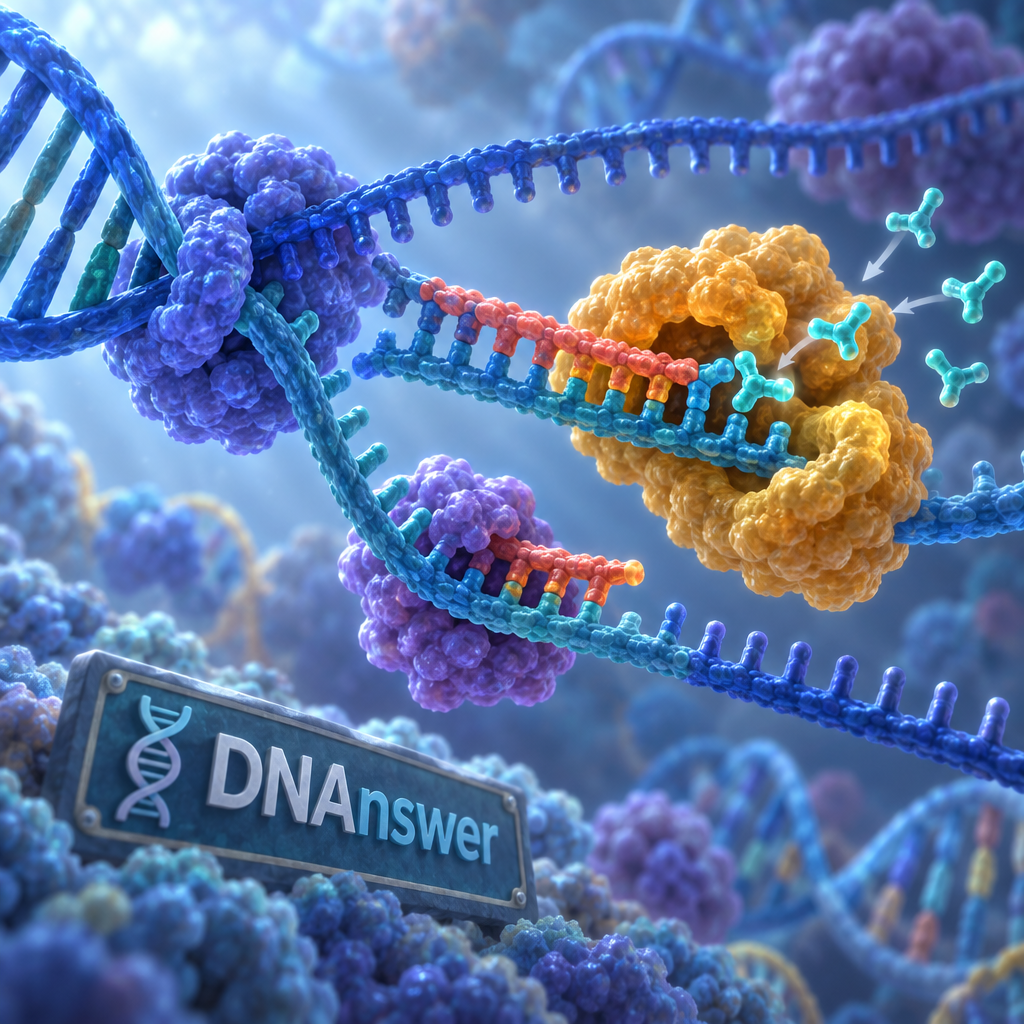
Here's something that surprises most biology students: DNA polymerase, the enzyme responsible for copying your entire genome, cannot start a new DNA strand on its own. It's an incredible machine, but it has one fatal flaw — it can only add to an existing chain, never begin one from scratch. That's why every single strand of DNA in your body started its life attached to a short stretch of RNA.
This is the real answer behind the search phrase primer DNA replication RNA primer function primase enzyme DNA polymerase primer — and it's not a trivia detail. It's the reason your cells need a whole extra enzyme, primase, just to get copying started at all.
Key Takeaways
- DNA polymerase can only extend existing strands, never start new ones from scratch
- Primase builds a short RNA primer, not a DNA one, at each replication start point
- The primer supplies a free 3'-OH group DNA polymerase needs to attach new bases
- Leading and lagging strands both need primers — lagging strands need far more
- RNA primers get removed and replaced with DNA, then sealed by DNA ligase
- DNAnswer's replication quiz module tests whether you've actually got this straight
Myth: DNA Polymerase Can Just Start Copying a Strand on Its Own
Most people picture DNA replication like a photocopier: feed in the original, and the machine spits out a copy, start to finish, no extra steps. It's an easy mental image to hold onto, since DNA polymerase gets all the attention in textbooks as "the enzyme that copies DNA." So it seems reasonable to assume it handles the whole job solo.
The kernel of truth here is that DNA polymerase really does do almost everything — it reads the template strand, matches up the correct bases, and builds the new strand with remarkable accuracy, making fewer than one mistake per billion bases copied. That track record makes it easy to overestimate what it can do unassisted.
Here's the catch: DNA polymerase's chemistry depends on having something to grab onto. It can only add a new nucleotide (one unit of DNA, made of a sugar, phosphate, and a base) onto a free 3'-OH group — a hydroxyl chemical group sitting on the third carbon of the sugar in the last nucleotide of an existing chain. No existing chain, no 3'-OH group, no new bases added. Period.
This isn't a workaround or a backup plan. It's baked into the enzyme's active site — the pocket where the chemical reaction actually happens. DNA polymerase is built to check a base pair for accuracy and then extend it. It has no mechanism at all for linking two free-floating nucleotides together to begin a brand-new strand.
A primer is a short strand of nucleic acid that provides the free 3'-OH end DNA polymerase requires before it can add a single new base.
Think of DNA polymerase as a skilled editor rather than a writer. Hand an editor a finished paragraph and they'll improve every sentence in it. Hand them a blank page and ask them to write the opening line, and they're stuck — that's simply not the skill they have. Evolution solved this gap by building a separate enzyme whose entire job is writing that opening line.
That enzyme is primase, and it's the reason this whole system works. Primase doesn't share DNA polymerase's limitation, because it builds its short starter strand out of RNA, not DNA, using a completely different mechanism that doesn't require an existing 3'-OH to begin with.
If you remember one thing from this section, remember this: DNA polymerase is an extender, not an originator. Every time replication starts anywhere in your genome, something else has to lay down the first few nucleotides first.
Myth: Primers Are Made of DNA
If DNA polymerase is building DNA, it seems logical that whatever kicks off the process should also be DNA. Same material, same molecule, just a shorter piece — that's the natural guess, and a lot of students carry it straight into exams.
The confusion partly comes from how replication gets drawn in diagrams. Many simplified textbook illustrations show primers as a vague darker segment on the new strand without clearly labeling the chemistry, so readers fill in the gap with "it's DNA, just different."
The actual answer is that the primer is RNA (ribonucleic acid), a close chemical cousin of DNA but with one key structural difference: RNA uses the sugar ribose instead of deoxyribose, and that single change is enough to let primase build it without needing a pre-existing end to extend. Primase is a specialized type of enzyme called an RNA polymerase, built specifically to start chains from nothing.
Why RNA, Specifically
The ribose sugar in RNA has an extra oxygen atom compared to deoxyribose, which happens to be exactly what lets RNA polymerases, including primase, initiate a strand de novo (from the Latin for "starting fresh," meaning with no template extension required). DNA polymerases never evolved that same starting ability, because once an RNA primer exists, there's no evolutionary pressure for DNA polymerase to duplicate the trick.
What This Means for Accuracy
RNA primers are also deliberately short and temporary — usually around 10 to 12 nucleotides in humans. Because they get removed later, cells don't need them to be perfectly accurate the way the rest of the genome does. That's a built-in quality-control shortcut: a less critical, replaceable starter piece buys time for the real, high-fidelity DNA to take over.
Next time you see a replication diagram, look for the small RNA segment at the start of each new DNA stretch. If a textbook or quiz question calls it "a short piece of DNA," that's the error worth catching — and worth correcting if you're the one studying for the test.
Myth: Only the Lagging Strand Needs a Primer
This is one of the more common mix-ups, usually picked up by combining two separate true facts: the leading strand copies continuously, and Okazaki fragments (the short, choppy pieces that make up the lagging strand) obviously each need their own primer. From there, it's a short leap to assuming the leading strand, since it's continuous, only needs one primer and the lagging strand needs the special treatment.
Half of that is right. The lagging strand genuinely does need a fresh RNA primer for every single Okazaki fragment, because DNA replication only runs in one chemical direction (5' to 3'), and the lagging strand's template runs the opposite way from the leading strand's. That forces the lagging strand to be copied in short, backward-stitched segments rather than one smooth pass.
But the leading strand isn't exempt from the rule — it only needs fewer primers. Every strand of DNA, no matter which one, requires at least one RNA primer to begin, because the 3'-OH limitation applies universally to every DNA polymerase molecule on earth. The leading strand gets exactly one primer at the origin of replication (the specific spot on the DNA where the double helix first unwinds and copying begins) and then runs continuously from there.
The Leading Strand's Single Starting Point
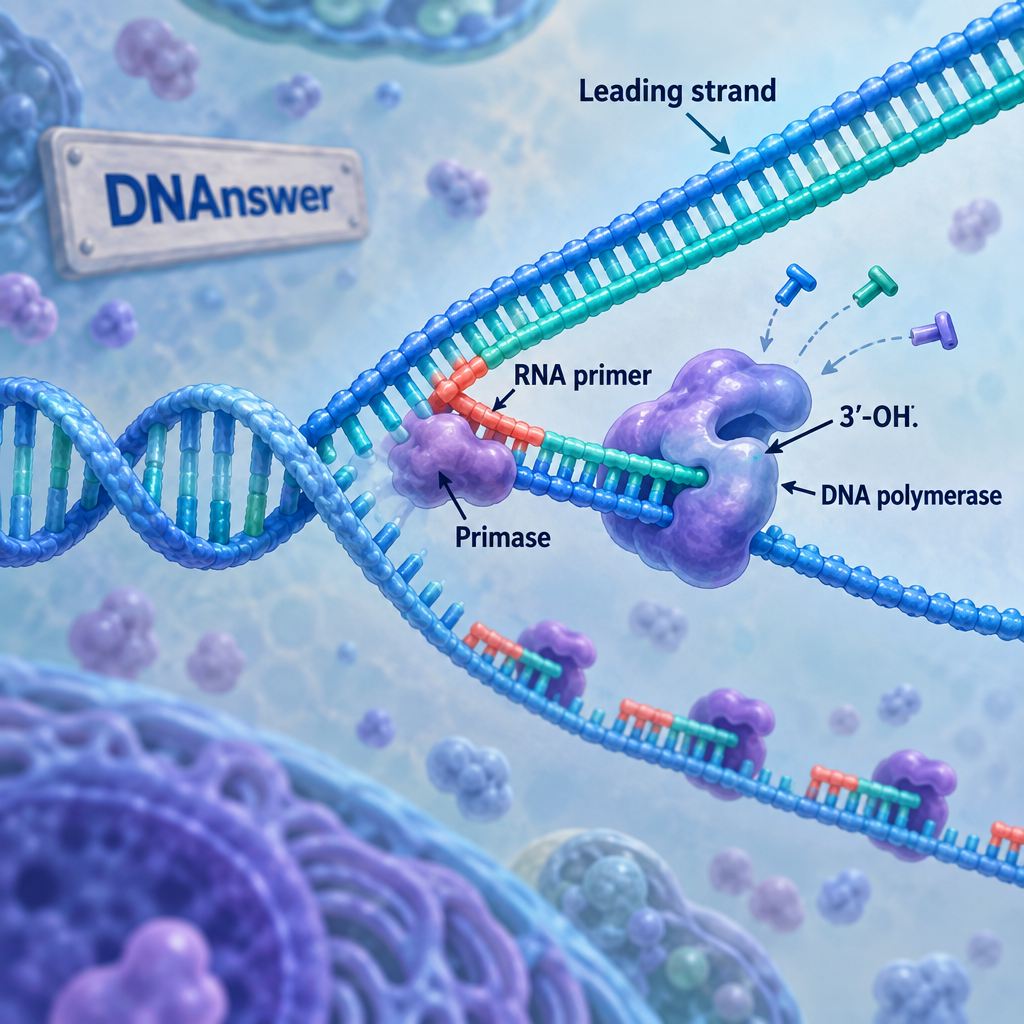
Once primase lays down that one RNA primer on the leading strand, DNA polymerase takes over and keeps extending in the same direction the replication fork (the Y-shaped point where the double helix splits apart) is moving. No new primer is needed again on that strand, because the 3'-OH end never runs out mid-stream.
Why the Lagging Strand Needs So Many
The lagging strand's replication fork keeps opening up new template in the "wrong" direction relative to how DNA polymerase reads it. So the cell copies it in short bursts, each one needing its own fresh RNA primer and its own short run of new DNA, stitched together afterward. In a human cell, a single chromosome's lagging strand might need thousands of separate primers across its length, compared to the leading strand's one.
The useful way to remember it: primer count isn't about which strand is "special," it's about how many separate starting points DNA polymerase needs on that particular strand. One starting point, one primer. Thousands of fragmented starting points, thousands of primers.
Myth: Primase and DNA Polymerase Do the Same Job
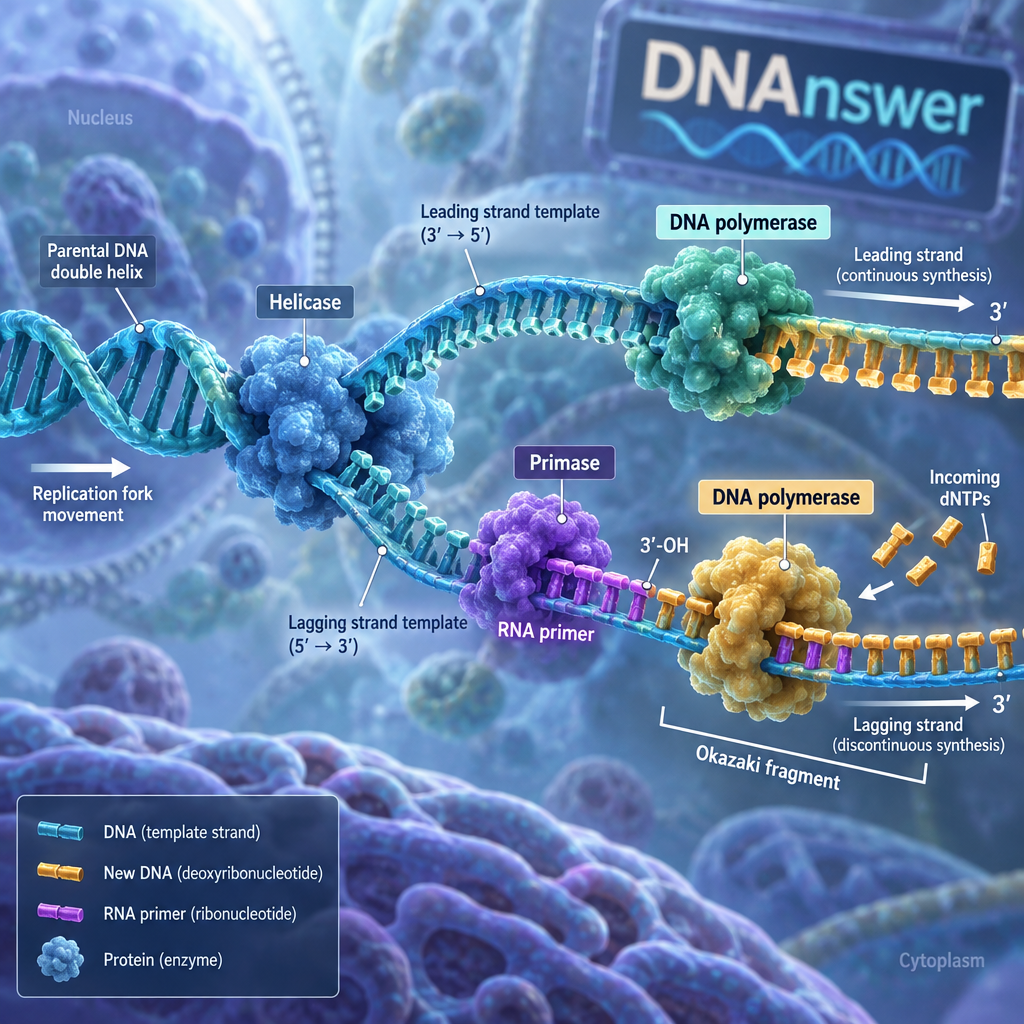
Because primase and DNA polymerase show up together, at the same moment, at the same spot on the DNA, a lot of people assume they're just two names for the same enzyme — or that primase is some kind of built-in subunit of DNA polymerase rather than its own separate protein.
The confusion also comes from how often the two get mentioned in the same sentence in biology class, which can make them feel interchangeable rather than complementary.
Here's the real division of labor. Primase is an RNA polymerase that builds short RNA starter sequences with no proofreading ability at all. DNA polymerase, by contrast, has a built-in proofreading function — as it adds each new base, it checks whether that base correctly pairs with the template strand, and if it doesn't, the enzyme backs up and removes the mistake before continuing.
That proofreading step is a completely separate skill from "being able to start a strand." Confusing the two leads to a specific wrong idea: that DNA polymerase proofreads its way into being able to start a strand, when actually those two capabilities have nothing to do with each other. A protein can be excellent at error-checking and still be structurally incapable of initiating a chain, and that's precisely DNA polymerase's situation.
Here's a short rundown of what separates the two enzymes in practice:
- Primase builds RNA primers roughly 10-12 nucleotides long; DNA polymerase extends strands that can run millions of bases.
- Primase has no proofreading ability; DNA polymerase actively checks and corrects mismatched bases as it goes.
- Primase works without needing an existing 3'-OH end; DNA polymerase requires one at every single step.
- Primase's product (RNA) gets deleted later; DNA polymerase's product (DNA) becomes the permanent genome.
- Primase acts briefly and locally; DNA polymerase stays active across the whole replication process.
Mixing these two up on a quiz usually costs more points than it should, precisely because the question is testing whether you understand why two separate enzymes exist at all, not just that they both touch the DNA strand.
Myth: The RNA Primer Stays in the Finished DNA Strand
This is the myth that trips people up even after they've correctly learned that primers are RNA. If primase builds RNA, and the final chromosome is pure DNA, something has to happen to that RNA in between — but plenty of learners never connect the dots and walk away assuming the RNA primer just somehow gets converted into DNA in place, or worse, that it stays put permanently as a weird RNA patch inside a DNA molecule.
Neither is correct, and figuring out what actually happens explains one more clever piece of cellular machinery.
Removal: A Second Enzyme Clears the RNA
A different enzyme — in humans, primarily one called RNase H alongside a flap endonuclease — recognizes the RNA-DNA junction and chews away the RNA primer, nucleotide by nucleotide. This happens on both strands, but it happens constantly and repeatedly on the lagging strand, since every one of its many Okazaki fragments carries its own primer that needs removing.
Fill-In: DNA Polymerase Returns to Patch the Gap
Once the RNA is gone, there's a small gap where DNA is missing. A DNA polymerase molecule extends the neighboring DNA fragment's 3'-OH end into that gap, replacing the removed RNA with actual DNA bases. This is the same enzyme category doing a cleanup pass, using the exact same 3'-OH rule as before — it's extending, not originating, true to form.
Sealing: DNA Ligase Closes the Final Gap
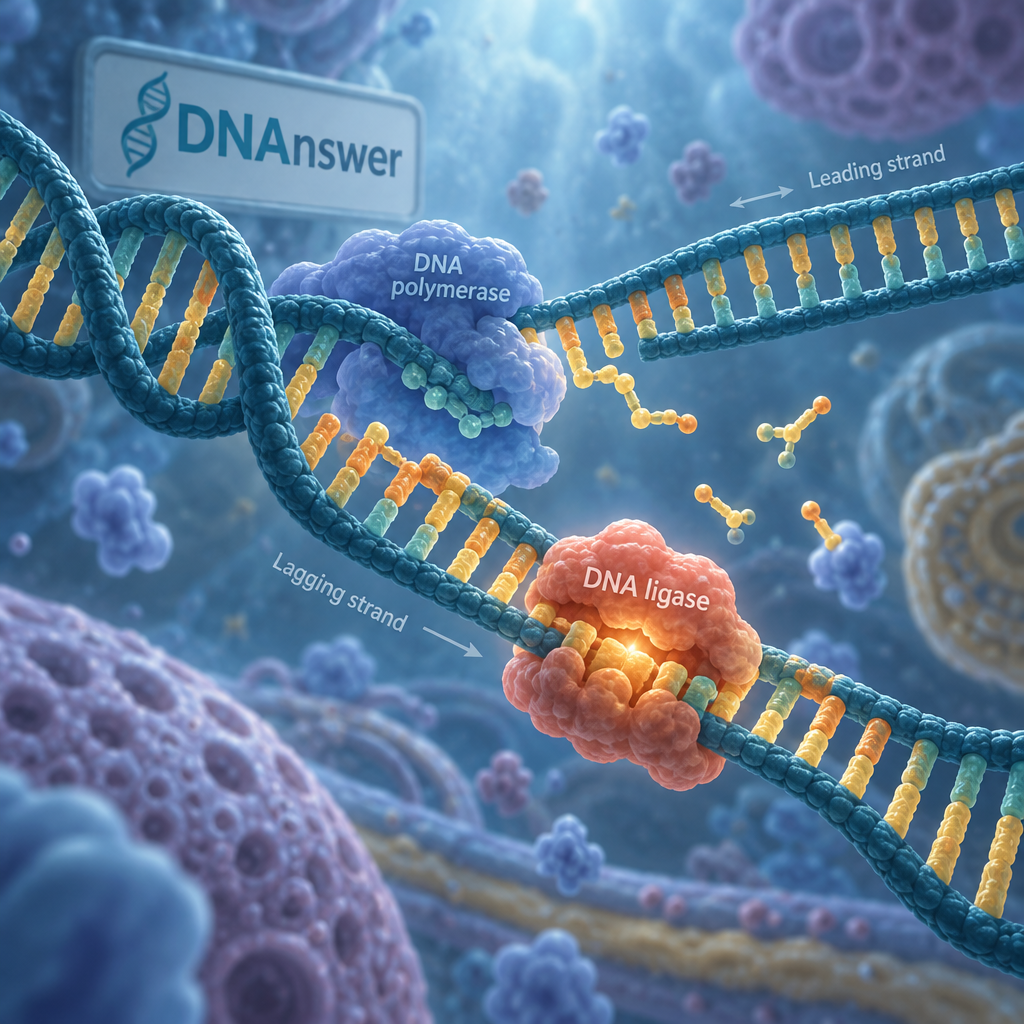
Even after the gap gets filled with DNA, there's a structural break between that patch and the next fragment over — no actual chemical bond links them yet. DNA ligase is the enzyme that forms that final bond, sealing the backbone into one continuous, unbroken strand. Without ligase, a chromosome would be a string of disconnected DNA pieces rather than one continuous molecule.
By the time replication finishes, there is no RNA left anywhere in either new DNA strand — all of it got swapped out for DNA and sealed shut. This entire removal-fill-seal sequence also explains why the two copies produced by semiconservative replication (where each new DNA molecule keeps one original strand and gains one brand-new strand) end up as pure DNA, matching the original exactly, with no RNA leftovers anywhere in sight.
Why This Limitation Exists at All
It's worth stepping back and asking the question a good biology teacher eventually gets: why would a cell evolve such an apparently clumsy system, instead of just building a DNA polymerase that can start strands on its own?
The honest answer involves accuracy trade-offs. DNA polymerase's proofreading mechanism depends on comparing a newly added base against the base already sitting across from it on the template strand. To check a match, the enzyme needs two bases already paired up — which means it needs an existing primer-template pair to check against in the first place. An enzyme that starts fresh, with nothing yet paired, has no reference point to proofread against.
Primase, by not needing to proofread, can afford to be a little less accurate, since its short, disposable RNA segment gets deleted before it ever becomes part of the permanent genome anyway. That division of labor means the permanent DNA sequence only ever gets built by the one enzyme family capable of checking its own work.
This whole system is a good example of why biology so often favors specialized division of labor over one enzyme that attempts to do everything. A single enzyme that could both initiate and proofread would need to switch between two very different chemical modes, and every switch point is a chance for error. Splitting the job between primase and DNA polymerase keeps each enzyme doing one thing well.
It's also worth noting that this isn't unique to your cells. Bacteria, archaea, and viruses all show some version of the same priming requirement, which is a strong sign the limitation traces back to the basic chemistry of how new chains form, not to some fixable design flaw specific to humans.
Conclusion
Once you see DNA polymerase as an extender rather than a starter, the rest of replication stops feeling like a list of enzyme names to memorize and starts making mechanical sense. Next time a quiz question mentions primers, check whether it's testing the "why," not just the "what" — that's usually where the real points are hiding. If you want to test that understanding against real quiz questions, DNAnswer's replication module is built exactly for that.
Frequently Asked Questions
What exactly is a primer in DNA replication?
A primer is a short RNA strand, usually 10-12 nucleotides long in humans, built by primase. It gives DNA polymerase the free 3'-OH end it needs to start adding new DNA bases.
Why can't DNA polymerase start replication without a primer?
DNA polymerase's active site can only attach new bases onto an existing 3'-OH end; it has no chemical mechanism for linking two free nucleotides together from scratch.
Does the leading strand need a primer too?
Yes. The leading strand needs exactly one RNA primer at the origin of replication, then copies continuously. The lagging strand needs a new primer for every Okazaki fragment, often thousands per chromosome.
What happens to the RNA primer after replication?
Enzymes including RNase H remove it, DNA polymerase fills the resulting gap with DNA, and DNA ligase seals the remaining break, leaving a strand of pure DNA with no RNA remaining.