Prokaryotic Cell vs Eukaryotic Cells: Key Differences
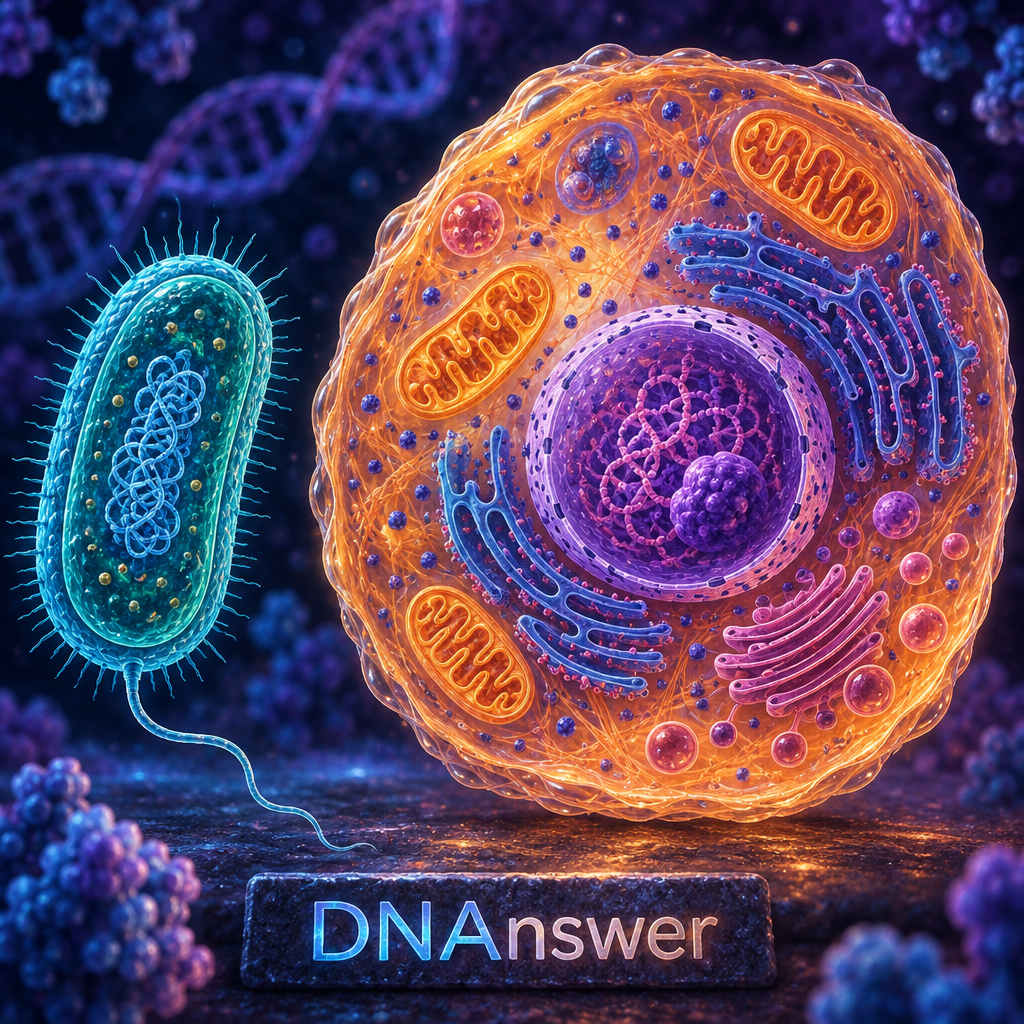
Does a bacterium really count as a "simple" cell? Not if you ask the chemistry. In the prokaryotic cell vs eukaryotic cells debate, bacteria run reactions that no animal, plant, or fungus can run, and they have done it for roughly 3.5 billion years.
You probably remember "no nucleus versus nucleus." That is true, but it hides more than it shows. This guide corrects the myths that cost students points and cost curious readers a clear picture of life.
Key Takeaways
- Prokaryotes lack a nucleus but still organize their DNA in a nucleoid.
- "Simple" is a myth: bacteria and archaea out-diversify eukaryotes chemically.
- Some prokaryotes build protein-walled compartments, such as magnetosomes and carboxysomes.
- Archaea are not bacteria; their machinery resembles ours.
- Many eukaryotes, like yeast and amoebas, are single cells.
- Mitochondria began as bacteria living inside another cell.
The Side-by-Side: What Actually Differs
Picture a bacterium next to a human cheek cell under a microscope. The bacterium is a dot. The cheek cell could hold hundreds or thousands of them by volume. Size is the first visible difference, and it drives most of the rest.
Here is the comparison on the criteria that matter. A prokaryote is a cell with no membrane-wrapped nucleus. A eukaryote is a cell whose DNA sits inside one.
Size: Typical bacteria measure about 1 to 5 micrometers (a micrometer is one-millionth of a meter). Typical eukaryotic cells run about 10 to 100 micrometers.
DNA: Prokaryotes usually carry one circular chromosome in a region called the nucleoid, plus optional small rings called plasmids. Eukaryotes carry several linear chromosomes inside a nucleus, wrapped around proteins called histones.
Organelles: Eukaryotes have membrane-bound compartments such as mitochondria and the endoplasmic reticulum. Prokaryotes lack those, though they have other internal structures (more on that below).
Ribosomes: These are the protein-building machines. Prokaryotic ribosomes are the 70S type; eukaryotic cytoplasmic ribosomes are the 80S type. The "S" stands for Svedberg units, a measure of how fast a particle settles in a spinning centrifuge.
Division: Prokaryotes split by binary fission, a simple copy-and-pinch. Eukaryotes use mitosis, a staged process with a spindle that pulls chromosomes apart.
Body plan: Nearly all prokaryotes are single cells. Eukaryotes include both single cells and multicellular bodies.
That list is the textbook version. The myths start where the list stops.
Myth 1: Prokaryotes Are Simple, Primitive Cells
Here is the case for the myth. Prokaryotes are smaller, have fewer visible parts, and appeared first in the fossil record. "Early and small" sounds like "basic and unfinished," and many older textbook diagrams drew a bacterium as a plain bag with a squiggle.
Old does not mean unevolved
Bacteria and archaea have evolved for just as long as you have. Every living species today sits at the tip of a branch that is equally old. A bacterium's lineage did not pause in 3.5 billion years; it kept adapting.
The chemistry is the proof
Prokaryotes carry out photosynthesis, fix nitrogen from air into usable forms, and live on hydrogen, sulfur, iron, or methane. Cyanobacteria (blue-green bacteria) began producing oxygen billions of years ago and reshaped the atmosphere. Plants, animals, and fungi cannot fix nitrogen themselves. Soybean farmers in Iowa rely on root-dwelling bacteria to do it for them.
Prokaryotes also win on survival. Some live in boiling springs, such as those at Yellowstone, and others in brine or deep rock. No eukaryote matches that range.
What to do with this: drop the word "primitive" from your vocabulary. Say "smaller and structurally different," which is accurate. When a quiz asks which group is more metabolically diverse, the answer is prokaryotes.
Myth 2: Prokaryotes Have No Organized DNA
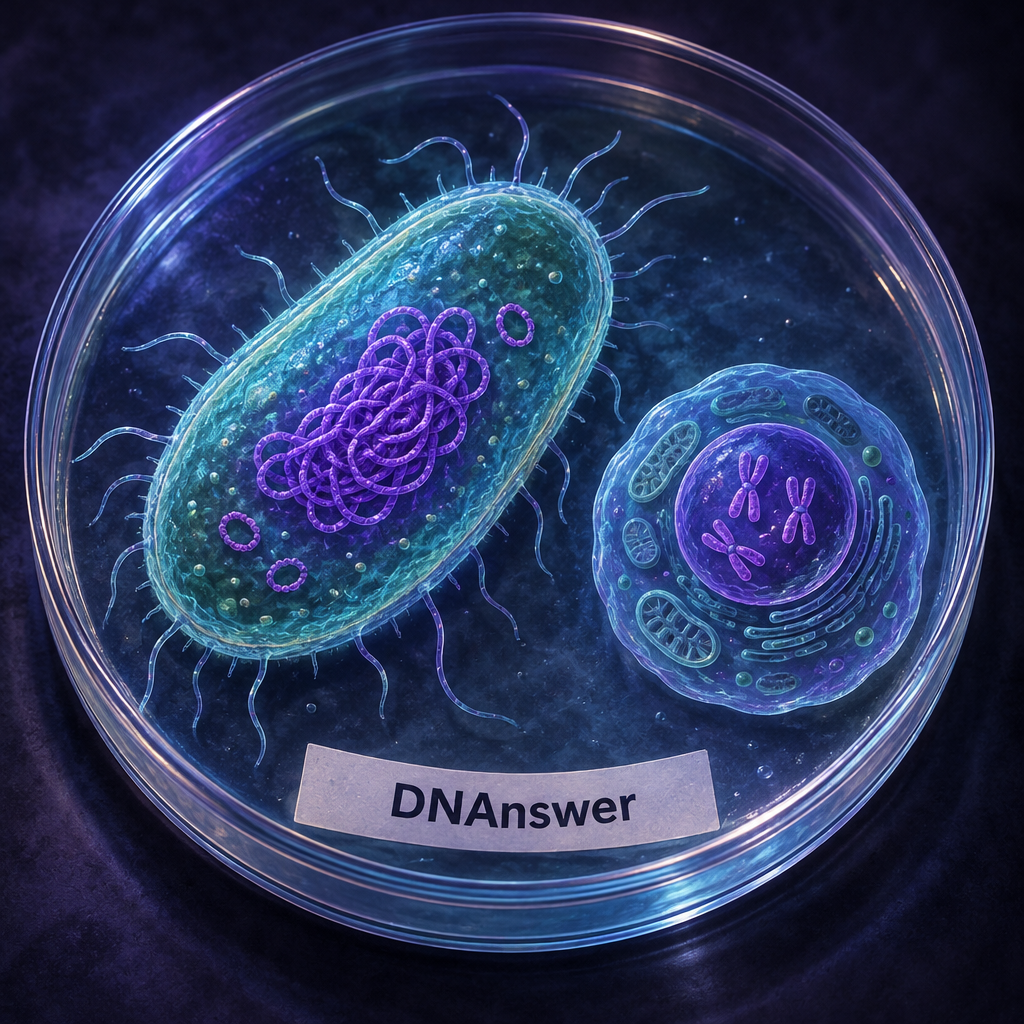
The belief makes sense. If a cell has no nucleus, its DNA must float around loose. Many diagrams show a vague tangle in the middle of the cell, which reinforces the idea.
The truth is that bacterial DNA is tightly organized. The chromosome sits in the nucleoid, a dense region with no membrane around it. Proteins fold and loop the DNA so a molecule roughly 1,000 times longer than the cell fits inside. In Escherichia coli (E. coli, the gut bacterium), the chromosome is about 4.6 million base pairs long, a figure well documented in genome studies.
Plasmids add another layer. A plasmid is a small, circular loop of extra DNA that copies itself independently. Plasmids often carry genes for antibiotic resistance, and bacteria can pass them to neighbors. That is one reason resistance spreads so fast in hospitals.
Eukaryotes organize DNA differently, not more. Histones spool the DNA into units called nucleosomes, and the nucleus separates DNA from the rest of the cell. Many archaea also use histone-like proteins, which hints at a family link we will return to.
One genuine drawback of the circular-chromosome rule: it has exceptions. Some bacteria, such as Borrelia (the genus that causes Lyme disease), carry linear chromosomes. So write "usually circular," not "always."
The practical takeaway: on an exam, "nucleoid" is the right word for the DNA region, and "no nucleus" never means "no organization."
Myth 3: Only Eukaryotes Have Organelles
The steelman is strong. Textbooks define organelles as membrane-bound compartments, and prokaryotes lack mitochondria, a Golgi, and a nucleus. So "no organelles" is accurate under that narrow definition.
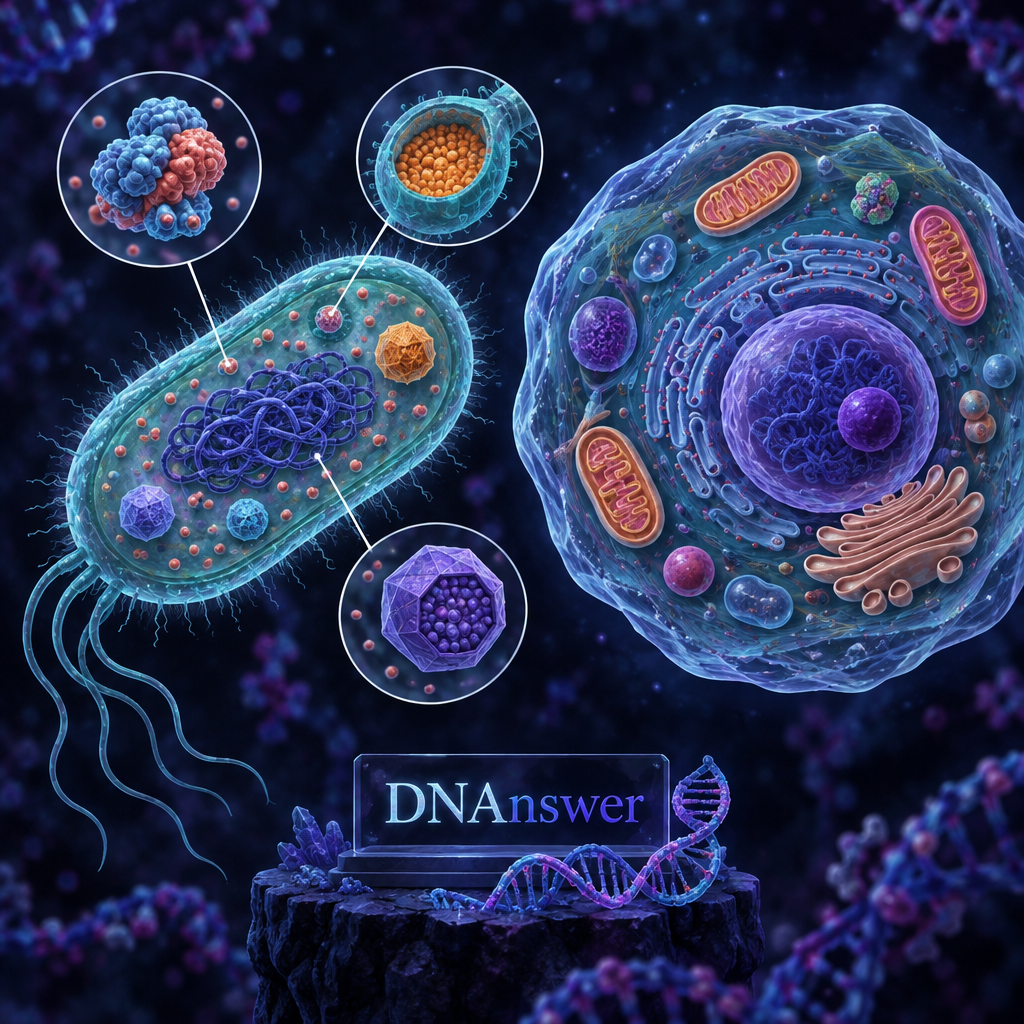
The trouble is that the definition leaves out real internal structure. Prokaryotes build compartments with protein walls instead of fat membranes.
Three examples worth knowing
- Carboxysomes: Protein-shelled boxes in cyanobacteria that pack the enzyme Rubisco (the one that captures carbon dioxide) alongside its fuel.
- Magnetosomes: Chains of tiny magnetic crystals, wrapped in membrane, inside some bacteria. They work like a compass needle and help the cells orient along Earth's magnetic field.
- Gas vesicles: Protein-walled bubbles that let aquatic microbes float up toward light.
- Ribosomes: Present in every cell, and arguably the oldest "organelle" of all, though they have no membrane in either domain.
Bacteria of the phylum Planctomycetota go further, with internal membrane-bound sections, which blurs the line even more.
So say it carefully: prokaryotes lack membrane-bound organelles in most cases, but they are not unstructured. Their interiors are organized, just with different building materials.
Myth 4: Bacteria and Archaea Are the Same Thing
The mix-up has a fair origin. Archaea look like bacteria under a microscope: tiny, no nucleus, circular DNA. Until the late 1970s, scientists filed them together. Then Carl Woese and George Fox compared ribosomal RNA sequences in 1977 and found archaea were a separate lineage.
Life now sits in three domains: Bacteria, Archaea, and Eukarya. A domain is the highest rank of classification, above kingdom.
Carl Woese and George Fox proposed in 1977 that life divides into three primary lineages, not two, based on ribosomal RNA sequences.
The surprise is where archaea sit. Their DNA-copying and gene-reading machinery looks more like ours than like bacteria's. Their histone-like proteins and their way of starting transcription resemble eukaryotic versions. Their membranes, though, use different chemistry from both other groups.
Many archaea thrive in extreme settings: hot springs, salt lakes, and acidic pools. Others live quietly in your gut and in ocean water.
Be careful, though. Archaea are not "ancestors" of humans. We share a common ancestor with them, and recent genome work points to a group called Asgard archaea as our closest known relatives. That is still an active research area, so treat the details as evolving.
The takeaway: when someone says "bacteria and archaea," they are naming two groups, not repeating themselves. If you remember one fact, remember that archaea are closer to you than to E. coli.
Myth 5: Every Eukaryote Is Multicellular
Think of the word "eukaryote" and you picture animals, plants, mushrooms. They all have many cells. That example set makes the myth natural.
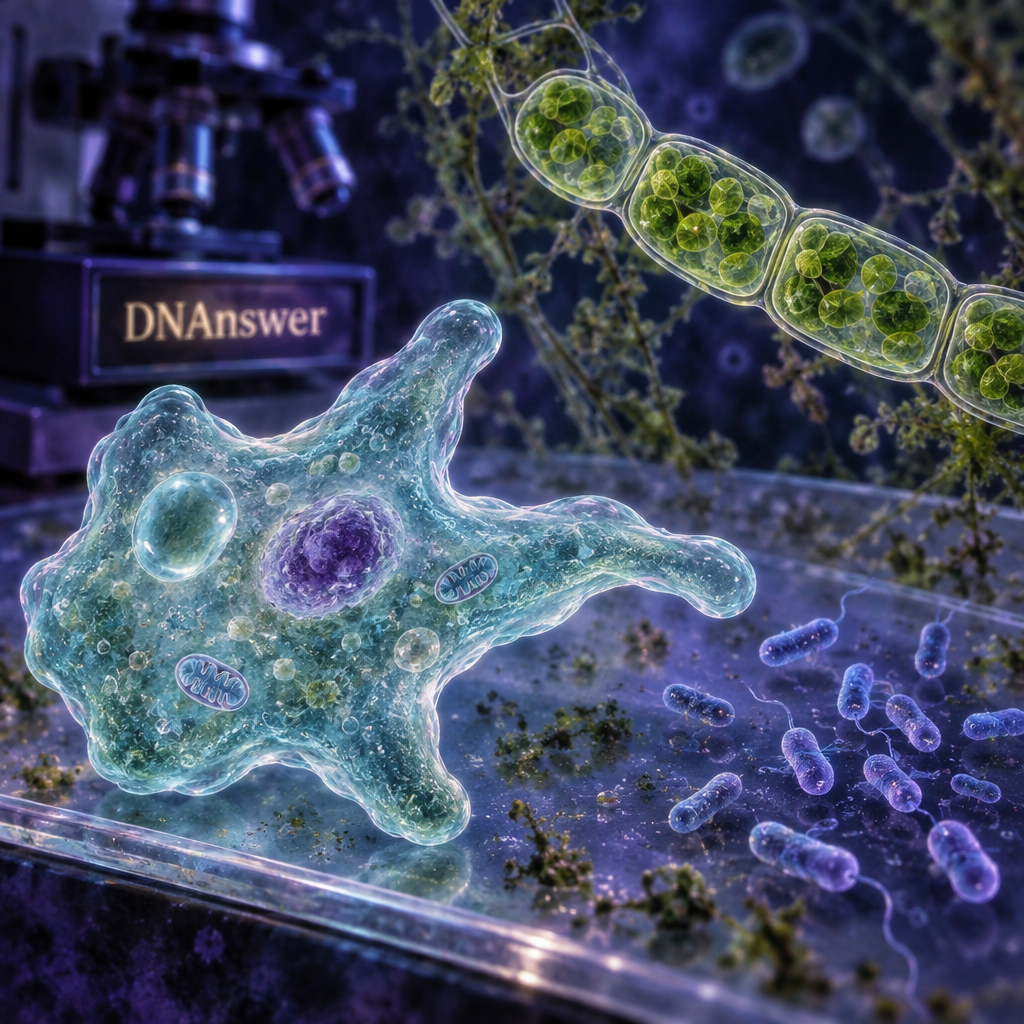
The category is far bigger. Baker's yeast (Saccharomyces cerevisiae, the organism behind bread and beer) is a single cell with a nucleus. So is Amoeba, and so is Paramecium, a swimming pond cell covered in tiny hairs. Plankton, many algae, and the parasite behind malaria (Plasmodium) are single-celled eukaryotes too.
Protists, the informal group of mostly single-celled eukaryotes, are among the most varied life forms on Earth. A Paramecium handles feeding, waste, movement, and reproduction in one cell, so it contains complexity that multicellular bodies split among organs.
The reverse myth also needs a nudge. A few prokaryotes cooperate in groups. Cyanobacteria form filaments, and some bacteria build biofilms, the slimy layers on your teeth. These are communities, though, not true tissues with specialized cell types in the way an animal has them.
The clean rule: nucleus presence defines a eukaryote, not body size or cell count. If a question asks whether yeast is a prokaryote, the answer is no, even though it is a single cell.
Why the Divide Is Blurrier Than the Textbook Says
Where did the first eukaryote come from? Evidence points to a merger. Billions of years ago, a host cell took in a bacterium and kept it alive. That bacterium became the mitochondrion, the organelle that makes most of a cell's usable energy.
Lynn Margulis argued this case in 1967, and it is now widely accepted. This is endosymbiotic theory: one cell living inside another until the two become one. Mitochondria still carry their own circular DNA and 70S-type ribosomes, which looks bacterial. Chloroplasts in plants, the sites of photosynthesis, tell the same story with a cyanobacterial ancestor.
So your cells contain bacterial leftovers. That explains an old oddity: some antibiotics that target bacterial ribosomes can also disturb mitochondria, which is one reason doctors weigh side effects.
The coupling of gene steps is another bridge. In prokaryotes, ribosomes start reading messenger RNA while it is still being copied from DNA, because nothing separates the two jobs. In eukaryotes, the nucleus splits them. Copying (transcription) happens inside; building proteins (translation) happens outside, after the message is edited.
Eukaryotes thus share parts with both groups, and they did not simply "evolve from" bacteria in a straight line. The picture is more like a fusion.
If you want to test yourself, a quiz on cell biology, such as those on dnanswer.app, is a quick way to see which of these details stick.
Verdict: Which Cell Type Fits Which Question
Choose "prokaryote" thinking when you care about metabolic range, speed, or survival in harsh places. These cells reproduce fast, trade genes easily, and fill nearly every habitat. A bacterium can divide about every 20 minutes in ideal lab conditions, which is why infections and fermentations scale so quickly.
Choose "eukaryote" thinking when you care about internal compartments, large genomes, or multicellular bodies. Membranes let a cell run chemistry in separate rooms, and that division of labor made tissues possible. The cost is energy and time: eukaryotic cells divide more slowly and need far more resources to build.
Choose "archaea" thinking when a question mentions extreme heat or salt, or when the machinery sounds eukaryote-like. The drawback of this shortcut is that many archaea live in ordinary places, so extreme habitat is a hint, not proof.
The best rule of all: stop asking which cell is "better." Each solved the problem of living with different tools.
Conclusion
Next time you read "prokaryote," ask what it does, not what it lacks. You will make better calls on exams, in news about antibiotic resistance, and when you wonder why your gut bacteria matter. Check three facts before you answer any cell question: where the DNA sits, what the ribosomes are, and which domain the organism belongs to.
Frequently Asked Questions
Do prokaryotes have mitochondria?
No. Prokaryotes make energy using their cell membrane instead. Mitochondria are eukaryote-only, though they descended from bacteria, which is why they keep their own DNA.
Are viruses prokaryotes or eukaryotes?
Neither. Viruses are not cells, so they sit outside both groups. They lack their own ribosomes and must hijack a host cell to make proteins.
Which is bigger, a prokaryotic or eukaryotic cell?
Eukaryotic cells are usually bigger, often 10 to 100 micrometers across versus 1 to 5 for typical bacteria. Exceptions exist: Thiomargarita magnifica, a bacterium reported in 2022, grows long enough to see without a microscope.
Do prokaryotes have a cell wall and eukaryotes do not?
Not exactly. Most bacteria have a wall made of peptidoglycan, while plants use cellulose and fungi use chitin. Animal cells have no wall, and some archaea use different wall materials.