Ribosome Function: Why Your Protein Factory Is Made of RNA
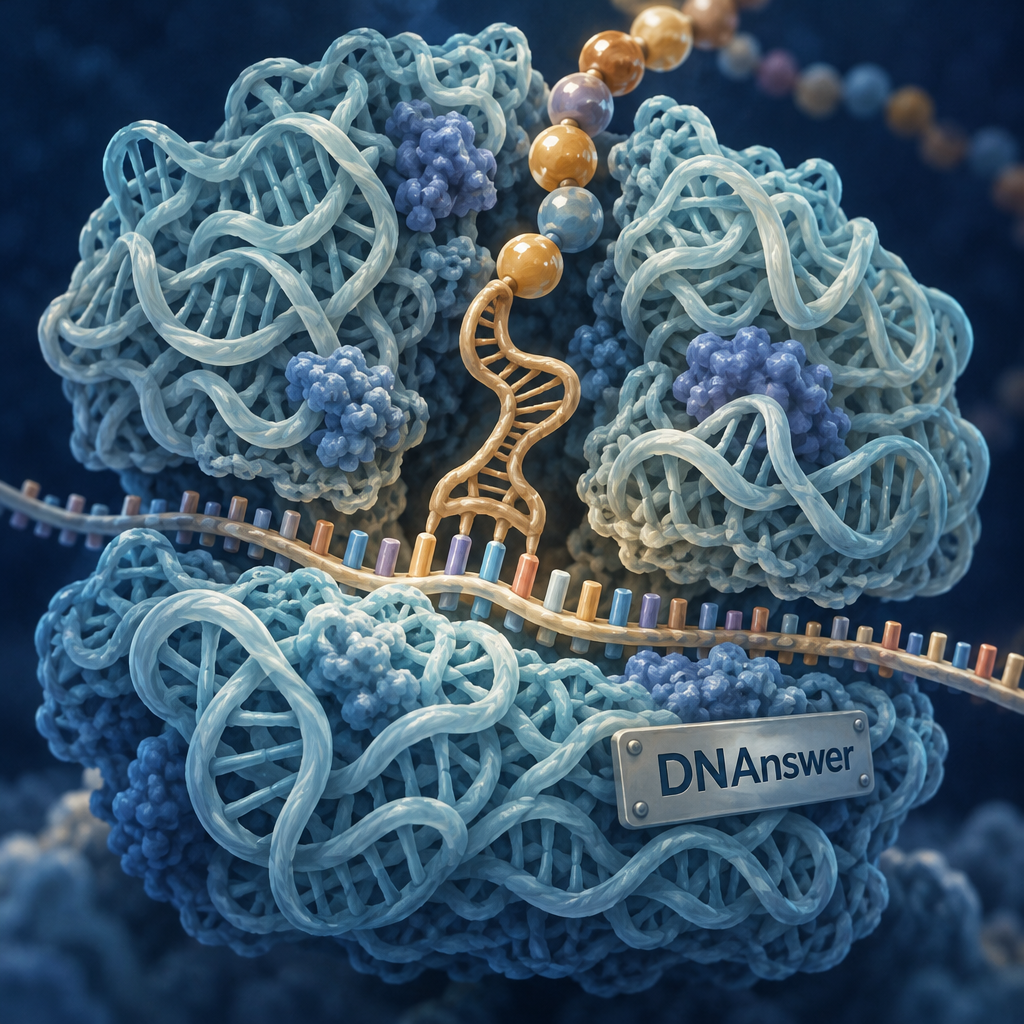
Is the ribosome made of protein, since proteins do the cell's work? No. About two-thirds of its mass is RNA, and that RNA, not a protein, links amino acids together. Ribosome function is to read messenger RNA (mRNA, the copy of a gene) and chain amino acids (protein's building blocks) in the right order. The machine doing it is a ribozyme, an enzyme made of RNA, held steady by proteins.
Key Takeaways
- Ribosomes are about two-thirds RNA by mass, not mostly protein.
- Ribosomal RNA (rRNA) forms peptide bonds; ribosomal proteins stabilize it.
- mRNA is the script, tRNA the delivery driver, rRNA the machine.
- Bacterial 70S and human 80S ribosomes differ enough for antibiotics to exploit.
- Ribosomes have no membrane, so "organelle" is a loose label.
Myth 1: "Enzymes Are Proteins, So the Ribosome Must Be Protein"
The belief makes sense. Almost every enzyme you met in school, from amylase in saliva to the lactase that digests milk sugar, is a protein. An enzyme is a molecule that speeds up a chemical reaction. If the ribosome builds proteins, it seems natural that proteins build the ribosome's core.
The kernel of truth is real: ribosomes do contain proteins. A eukaryotic ribosome (the kind in your cells) holds about 80 different ones. But the mass tells the story. Roughly two-thirds of a eukaryotic ribosome is ribosomal RNA (rRNA), and one-third is protein.
Where the catalysis actually happens
The reaction that matters is the peptide bond, the chemical link between two amino acids. It happens in a pocket called the peptidyl transferase center (PTC). Structural studies of the large subunit showed that no protein sits at the reaction site. The pocket is built from rRNA.
That makes the ribosome a ribozyme. The proteins sit mostly around the edges, stabilizing the folded RNA and helping the machine assemble.
What to do with this
Drop the rule "enzymes are proteins." Replace it with "most enzymes are proteins, and the most important one in your body isn't." When someone calls the ribosome a protein-made machine, you now have the counterexample.
One honest caveat: scientists still debate exactly how much the proteins tune the reaction. The RNA does the chemistry, but the proteins aren't decoration.
Myth 2: "The Ribosome Is Just a Passive Reading Platform"
Picture a ribosome as a cassette player: mRNA goes in, protein comes out, and the player just holds the tape. Most textbook diagrams push this picture. They draw the ribosome as a gray blob and put the action on the tRNAs.
The picture has a grain of truth. The ribosome does hold the mRNA and the tRNAs in the right positions, and positioning matters. Without it, amino acids would float around and rarely meet.
Two subunits, two jobs
Every ribosome has a small subunit and a large subunit. The small one is the decoding machine: it checks that each mRNA codon (a three-letter chunk of code) pairs with the matching anticodon on a tRNA. The large one is the catalyst. It forms the peptide bonds and feeds the growing chain into a channel called the nascent peptide exit tunnel.
So the ribosome actively proofreads the match, builds the bond, and shoves the whole assembly forward one codon at a time.
Speed shows it isn't passive
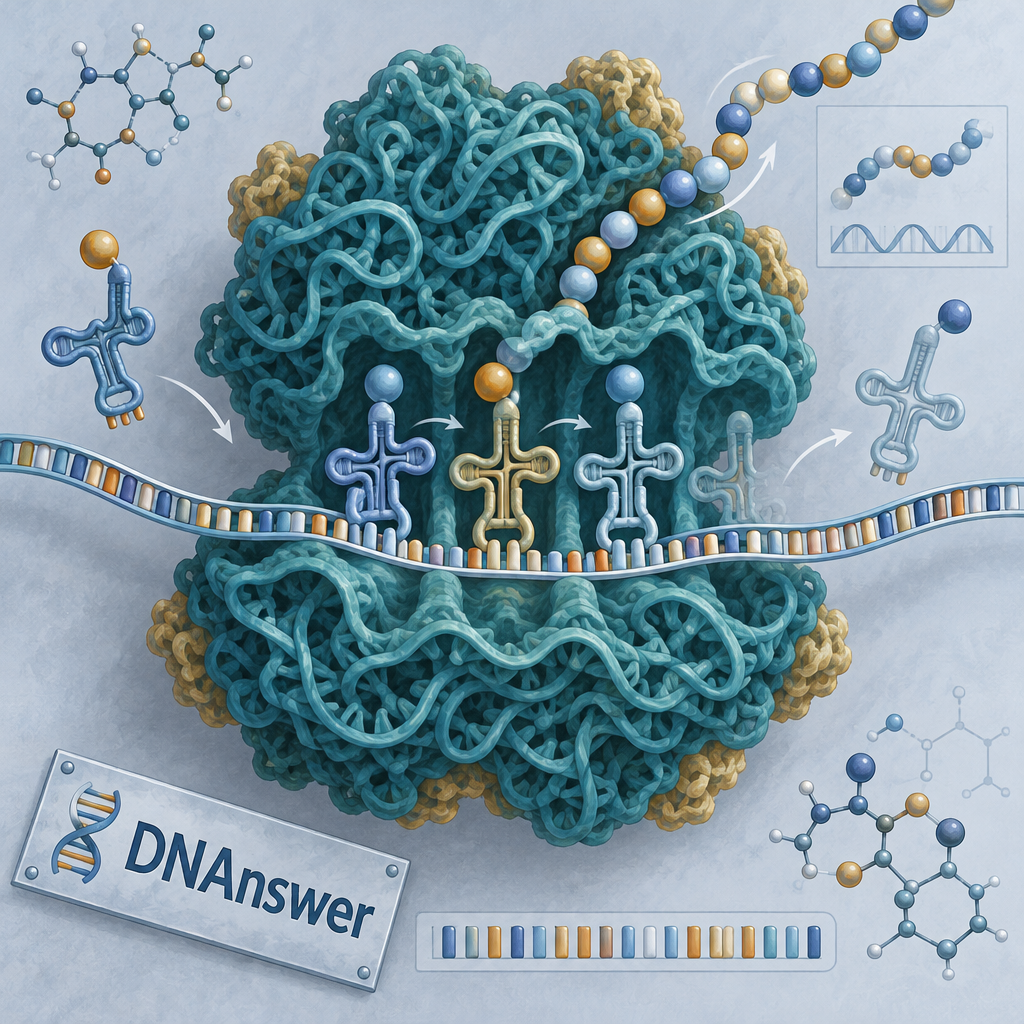
A bacterial ribosome can build an average-sized protein in a few seconds to a minute. A passive platform wouldn't manage that pace. And the work is costly: the cell spends more than 60% of its total energy on protein production.
Next time you see the cassette-player diagram, remember that the "player" is doing the chemistry.
Myth 3: "rRNA, mRNA and tRNA Are Basically the Same Thing"
Same letters, same chemical family, so it's fair to lump them together. All three are RNA. All three show up in the same textbook chapter. Even the names differ by one letter.
But they do three different jobs, and mixing them up makes translation unintelligible. Think of a print shop.
- mRNA (messenger RNA) is the order form. It carries the instructions copied from a gene in DNA. Your cells make a new copy for each job, and it doesn't build anything.
- tRNA (transfer RNA) is the delivery driver. Each one carries a single amino acid and has an anticodon, a three-letter tag that matches one codon on the order form.
- rRNA (ribosomal RNA) is the press itself. It forms the ribosome's structure and catalyzes the bond.
Why the confusion costs you
If you think mRNA does the building, you can't explain why a faulty ribosome kills a cell even when the genes are fine. If you think rRNA carries the code, you can't see why vaccines use mRNA as a message that the ribosome then reads.
One rule keeps them straight: only mRNA gets read, only tRNA gets delivered, and only rRNA does the building. Nothing else in the cell copies that division of labor so cleanly.
Myth 4: "Ribosomes Are Membrane-Bound Organelles"
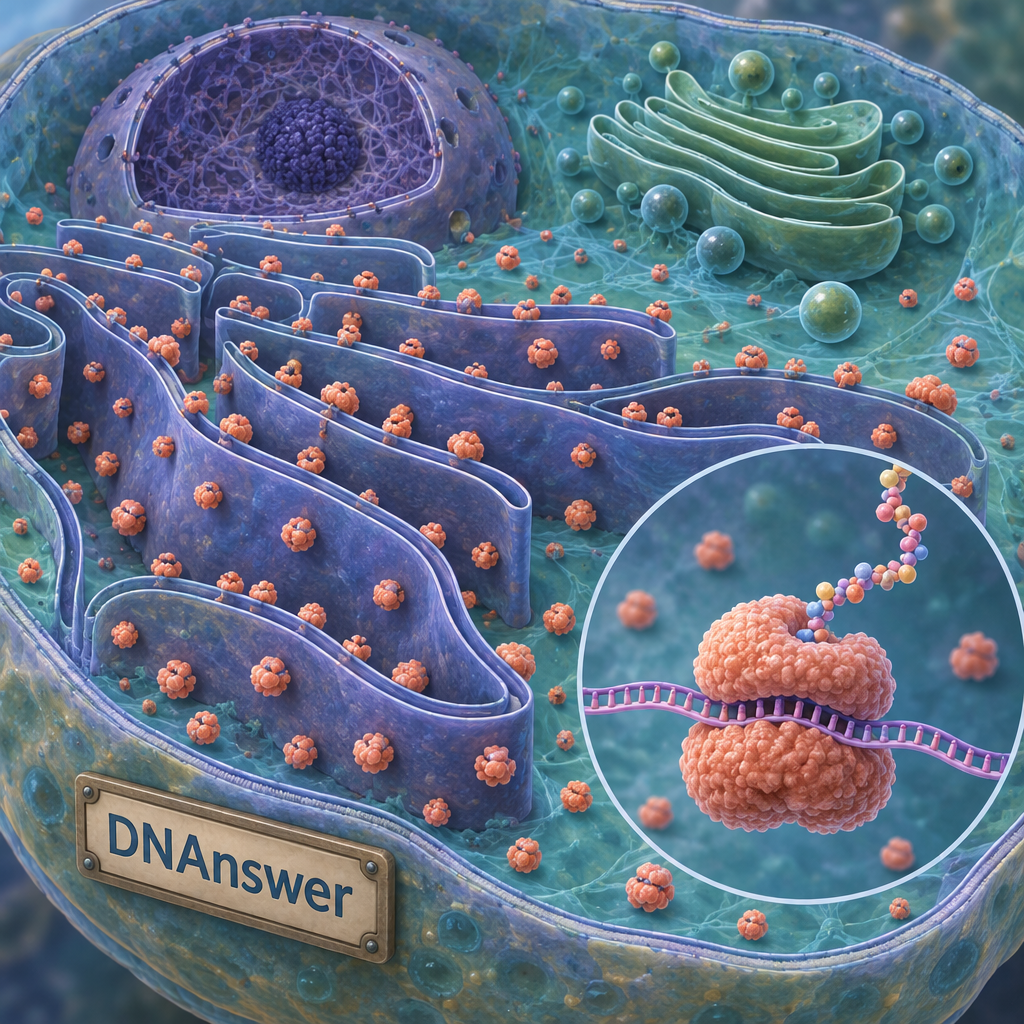
Your biology class probably listed the ribosome next to the nucleus and the mitochondria under "organelles," the cell's tiny working parts. So calling it one is not careless. Many reputable sources still do.
The strict definition is the trouble. Many biologists reserve "organelle" for structures wrapped in a membrane, a thin fatty skin. The ribosome has none. It's a bundle of RNA and protein floating in the cytoplasm (the cell's jelly-like interior), or parked on the endoplasmic reticulum, a folded membrane network where proteins destined for export get made.
Free versus attached
In eukaryotes, ribosomes may drift free or sit on the endoplasmic reticulum. Bacteria have no such network, so their ribosomes float freely. Cells hold anywhere from tens of thousands of ribosomes in a bacterium to millions in a human cell.
The label matters less than the habit it builds. Call it a "macromolecular machine" and you remember that it's a molecular complex, not a compartment. Use "non-membrane-bound organelle" if you want the broad term and the accurate one.
George Palade first spotted these particles in 1955 with an electron microscope. The name comes from "ribo" (from ribonucleic acid) plus the Latin soma, meaning body.
Translation in Six Steps: What the RNA Machine Actually Does
You now know the cast. Here is the show, called translation: the process of reading mRNA and building a protein.
- The small subunit grabs the mRNA. It finds the start point on the mRNA strand and locks on.
- The large subunit joins. The two halves snap together around the mRNA, ending initiation, the setup phase.
- A new tRNA delivers the next amino acid. The small subunit checks that its anticodon matches the codon.
- The rRNA forms the peptide bond. The PTC links the new amino acid to the chain. The ribosome then slides one codon along the mRNA. Steps 4 and 5 repeat in a loop called elongation.
- A stop codon ends the job. No tRNA matches a stop codon. Proteins called release factors step in, the chain detaches, and the subunits separate. That is termination.
How the rRNA does the chemistry
The PTC doesn't force the reaction with brute strength. It positions the two amino acids in close contact and in the right orientation. That alone speeds the bond-making enormously. Research also points to a proton shuttle, a handoff of a hydrogen ion that helps the reaction along.
The finished chain exits through the tunnel in the large subunit, then folds into a working protein. Then the subunits drift apart, ready for the next mRNA.
If you want to test yourself on this sequence, the free quizzes on dnanswer.app include translation and RNA questions that track your progress.
Why Is the Ribosome Made of RNA? A Living Fossil
The surprising part isn't that RNA can do the job. It's that evolution never replaced it with something better. Proteins are far more versatile catalysts, yet life kept an RNA core at its busiest workstation.
The leading explanation is the RNA world hypothesis: early life ran on RNA before DNA and proteins took over. RNA can both store information, like DNA, and catalyze reactions, like enzymes. So one molecule could, in principle, do both jobs.
The ribosome, the cell's protein-making machine, is a ribozyme: its catalytic heart is RNA, not protein.
That sentence summarizes what structural studies of the ribosome concluded, and it fits the RNA-first picture. Proteins arrived later and were added as scaffolding.
Why it never got swapped out
A machine this central is hard to redesign. Every living thing relies on the same basic ribosome design, so changing the core would break everything built on top of it. Evolution tinkers around the edges instead. That explains why the catalytic site stayed RNA while proteins crowded in around it.
The drawback of this story: the RNA world is a hypothesis, not a proven history. Nobody can rewind four billion years. But the ribosome is the best surviving clue.
70S vs. 80S: Why Antibiotics Can Hit Bacteria and Spare You
The numbers 70S and 80S look like sizes. They aren't. The S stands for Svedberg units, which measure how fast a particle settles in a spinning centrifuge. That depends on shape as well as mass, which is why the parts don't add up: a bacterial 70S ribosome has a 50S large subunit and a 30S small one.
Bacteria have 70S ribosomes. Your cells have 80S ribosomes, built from 60S and 40S subunits.
The structural differences
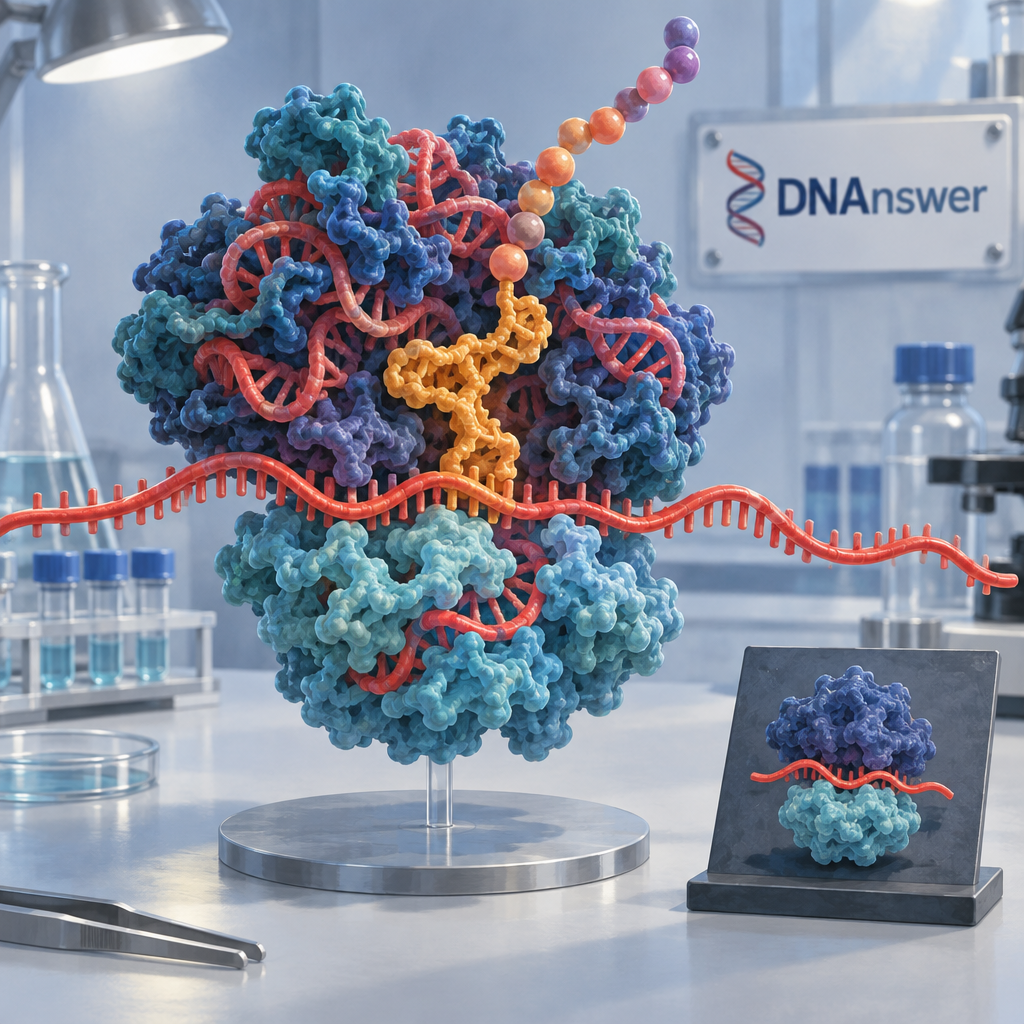
The 80S version is bigger. A bacterial ribosome has three rRNA molecules and about 55 proteins, with roughly 60% rRNA and 40% protein by mass. Your ribosome has four rRNA molecules and about 80 proteins, and its mass is about 4.2 million daltons, a unit of molecular weight.
Those differences give drugs something to grab. Many antibiotics bind the bacterial ribosome and jam translation, so the bacterium can't build proteins and dies or stops growing. The human 80S ribosome is shaped differently, so those drugs mostly leave it alone.
A limit worth knowing
Mitochondria, the energy-making parts inside your cells, carry their own ribosomes, and those resemble bacterial ones. That resemblance fits the idea that mitochondria descended from ancient bacteria. It also helps explain why some antibiotics cause side effects. Don't treat the ribosome gap as a perfect wall.
Conclusion
Use this idea as a filter. When you read that a drug, a vaccine or a gene disorder "affects protein production," picture the ribosome: an RNA machine reading an mRNA order. Antibiotics make sense because bacterial and human ribosomes differ. mRNA vaccines make sense because your ribosomes read any message they receive. Start there, and the rest of molecular biology gets easier.
Frequently Asked Questions
Do ribosomes use RNA to make proteins?
Yes, in three ways. mRNA supplies the instructions, tRNA delivers the amino acids, and rRNA forms the machine and catalyzes the peptide bonds. Proteins in the ribosome support that RNA rather than replace it.
Which rRNA catalyzes peptide bond formation?
The rRNA in the large subunit does it: 23S rRNA in bacteria, and the equivalent 28S rRNA in human cells. It forms the peptidyl transferase center, where the amino acids join.
Why are ribosomes called protein factories?
They assemble every protein your cell needs from amino acids, following mRNA instructions. Cells hold anywhere from tens of thousands of ribosomes (bacteria) to millions (human cells), and protein production takes more than 60% of a cell's energy.
Why does the S in 70S and 80S not add up?
Svedberg units measure how fast a particle settles in a centrifuge, not its size, so they aren't additive. A 70S ribosome is a 50S plus a 30S subunit, and an 80S is a 60S plus a 40S.