Genes Explained: How DNA Shapes Your Traits
Can a single gene make you shy, tall, or bold? No. The strongest personality-linked DNA variant researchers have found nudges a person from the 50th percentile to the 50.35th. That is a rounding error, not a destiny.
Genes are stretches of DNA that carry instructions for building proteins and RNA molecules, the tiny machines and messengers your cells run on. Those molecules shape traits like eye color, height, and disease risk. Most traits come from many genes, plus environment and chance, so your DNA sets probabilities, not a fixed fate.
Key Takeaways
- A gene is a recipe for a protein or RNA, not a trait.
- Most traits involve hundreds of tiny-effect variants, not one gene.
- Heritability describes groups of people, never your personal "percent genetic."
- Dominant alleles aren't stronger and aren't always common.
- Consumer DNA tests estimate risk; they rarely predict outcomes.
From DNA to Trait: The Short Version
Your cells read DNA like a cook reads a cookbook. The book stays in the kitchen's safe; the cook copies one recipe and makes the dish. Everything in this article builds on that picture, so it's worth ten minutes of setup.
DNA, genes, chromosomes, genome
DNA (deoxyribonucleic acid) is a long molecule written in four chemical letters: A, C, G, and T. Those letters are called bases. A gene is a stretch of that text, often thousands of letters long, that holds the instructions for one protein or RNA molecule. Humans have about 20,000 protein-coding genes.
A chromosome is a tightly wound package of DNA. You have 23 pairs, one set from each parent. Your genome is the full set of DNA in a cell, about 3 billion letters per copy. Think of the genome as the whole library, chromosomes as the volumes, and genes as individual recipes.
How a recipe becomes a protein
The cell first copies a gene into a temporary RNA message. This step is called transcription. Then cell machines called ribosomes read that message three letters at a time and link amino acids (the building blocks of proteins) into a chain. This step is translation. The chain folds into a protein, such as an enzyme that breaks down sugar or a pigment-making tool in your skin.
Your genotype is the DNA you carry. Your phenotype is the trait you can observe. The gap between those two words is where most of the myths below live.
Myth 1: One Gene Controls One Trait
You probably learned this in school. Gregor Mendel's pea plants were either tall or short, round or wrinkled, because each trait he tracked hung on one gene. Textbooks then showed a Punnett square (a grid that predicts offspring combinations) for eye color, and the one-gene-one-trait idea stuck.
Mendel picked traits that behave simply, and a few human traits do too. Cystic fibrosis and sickle cell disease each trace to one gene. But those are the exceptions that make the textbook.
Why most traits are polygenic
Height is the classic case. A polygenic trait is one shaped by many genes at once, each adding a small push. Large studies have tied thousands of DNA variants to height, and no one of them moves you more than a fraction of an inch. Skin color, blood pressure, and cholesterol work the same way.
Personality is even more spread out. In September 2026, a study in Nature mapped the genetic variants behind personality traits. Author Ted Schwaba of Michigan State University said there is no single personality gene, and even the biggest single-variant effects are very small. An earlier Yale-led analysis, published in Nature Human Behavior in August 2024, pooled almost 700,000 people and found over 200 genetic sites across the Big Five traits: extraversion, openness, agreeableness, neuroticism, and conscientiousness.
Even "single-gene" traits have wrinkles
Eye color looks like a one-gene trait, but several genes feed into it. Two brown-eyed parents can have a blue-eyed child, and the reverse is possible too. Do this instead: whenever you see a headline about "the gene for" anything, read it as "one of many small contributors to." If the trait is common and everyday, assume hundreds of variants are involved.
Myth 2: "Personality Is 50% Genetic" Means Half of You Is DNA
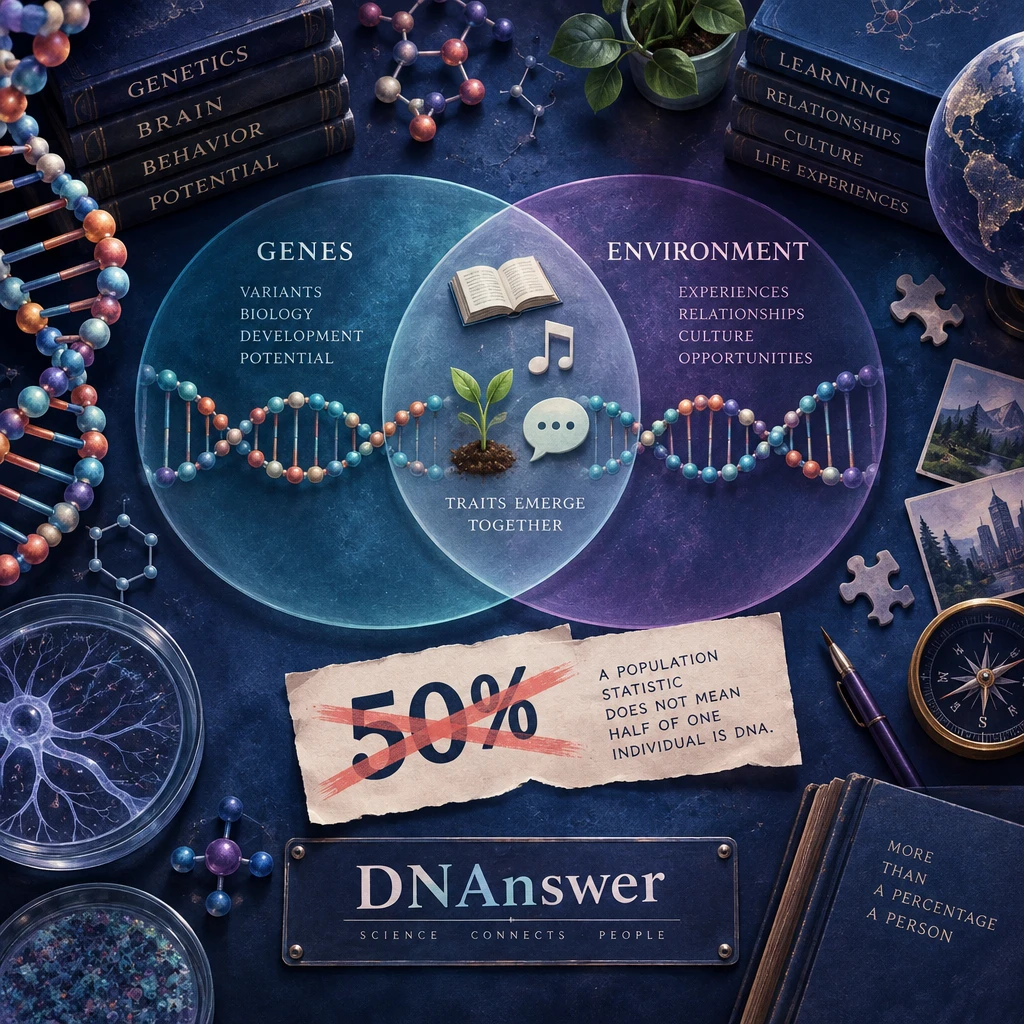
This is the most misread number in genetics. Studies often put the heritability of personality traits at roughly 40 to 60 percent, and people hear: half of my personality came from my genes, half from my upbringing. The logic seems sound, since a percentage sounds like a slice of a pie.
The number has a real basis. Twin studies compare identical twins (who share nearly all their DNA) with fraternal twins (who share about half). Identical twins end up more alike in personality, and that gap is where the figures come from.
What heritability actually measures
Heritability is a statistic about a population. It asks: in this group of people, how much of the differences between them lines up with differences in their DNA? It says nothing about how much of one person's personality comes from genes. Your personality isn't 50 percent genes any more than a cake is 50 percent flour because flour explained half the differences between two bakeries' cakes.
Heritability describes how much of the variation in a trait across a group is associated with genetic variation. It does not describe how much of one individual's trait is "caused" by genes.
That definition matters, because the figure changes with the group and the setting. Height is highly heritable in well-fed populations. In a place where many children go hungry, nutrition explains more of the differences, and heritability drops.
The number shrinks when you look at DNA directly
The twin-study figures and the DNA-based figures don't match. In the 2026 Nature analysis, the variants researchers could actually measure explained just 4.8 to 9.3 percent of the differences in a given personality trait. Scientists call this the "missing heritability" puzzle: twin studies suggest a lot, while the individual variants we can find add up to less. Rare variants, tiny effects, and interactions between genes all likely hide in the gap.
What to do with this: treat any "your personality is X percent genetic" claim as a statement about crowds. It can't tell you which of your habits came from DNA, and it can't tell you what you can change.
Myth 3: Genes Are Destiny
If a gene variant raises your risk, surely you're stuck with it. This belief has a respectable root. Some genetic conditions are strict. Huntington's disease, for example, follows from one inherited change, and no lifestyle choice cancels it.
But those cases are rare. For most traits and common diseases, DNA tilts the odds and the world does the rest.
Genes are recipes, not blueprints
A blueprint fixes every beam and window. A recipe depends on the kitchen: the oven, the ingredients, the cook's timing. Two people can follow the same recipe and get different cakes. The same genes can produce different outcomes depending on diet, stress, infections, and sheer luck during development.
Yale's Daniel Levey, who led the 2024 personality analysis, made the point plainly: finding these variants doesn't mean they are fated or unchangeable.
Epigenetics: the dimmer switch
Your cells carry the same DNA but use it differently. A liver cell and a neuron hold identical genomes. Epigenetics means chemical tags on DNA, or on the proteins it wraps around, that turn genes up or down without changing the letters. Diet, smoking, exercise, and stress can all shift these tags.
Researchers still debate how far epigenetic marks pass from parent to child in humans, so be wary of claims that your grandparents' hardships rewrote your genes. The solid takeaway is smaller and more useful: gene activity responds to life.
A concrete case
Take type 2 diabetes. Hundreds of variants nudge the risk, and a parent with the disease raises yours. Yet weight, activity, and diet change the outcome a great deal. Your family history tells you where to pay attention, such as asking your doctor about blood sugar screening earlier. It doesn't hand down a verdict.
Myth 4: Dominant Genes Are Stronger and More Common
Ask someone what "dominant" means and you'll hear: the winning gene, the one that shows up most. The word choice invites that reading, and early genetics lessons reinforce it with tidy 3-to-1 ratios.
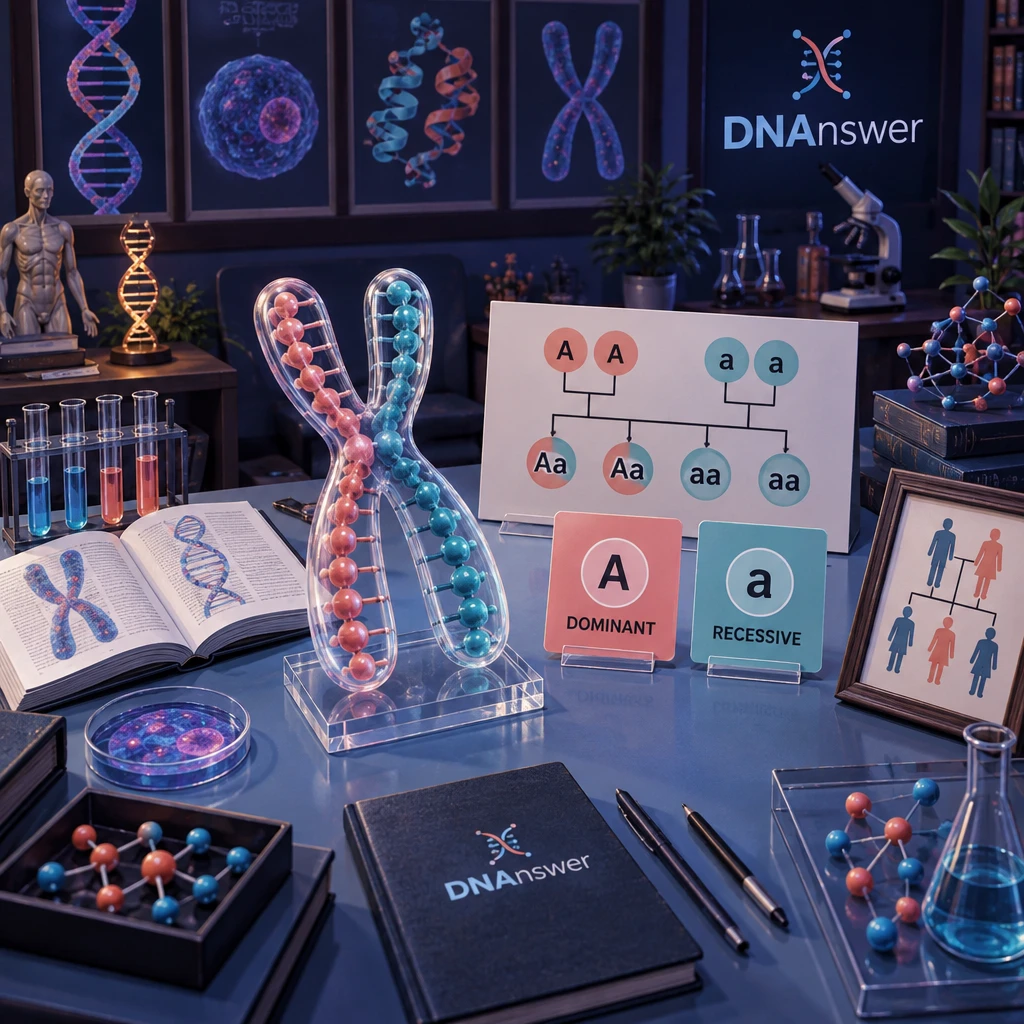
Here's what's true. Most genes come in two copies, one from each parent. Different versions of a gene are called alleles. An allele is dominant when one copy is enough to show the trait, and recessive when you need two copies. That's all the word means. It describes how the trait shows up, not how strong the gene is or how common it is.
Polydactyly, having an extra finger or toe, is usually caused by a dominant allele. Yet it's rare. Meanwhile, blood type O is caused by a recessive allele and is the most common ABO type in the United States. Dominance and frequency are unrelated.
The classic math still works for single-gene traits. If two parents each carry one dominant and one recessive copy (Aa × Aa), each child has a 3 in 4 chance of showing the dominant trait. Combine four unlinked genes and the odds multiply: in one worked example, the chance of a child showing the dominant version of all four traits is 3/16, or about 19 percent.
Do this: when you hear about a "dominant" condition in your family, ask how often it appears in the population and how likely a child is to inherit it. Don't assume dominant means common or severe.
Myth 5: A Consumer DNA Test Can Predict Your Future
Mail-in kits promise to reveal your disease risks, traits, and even personality. The appeal is real: a swab and a few weeks' wait for answers about yourself. And the technology is sound at what it measures.
The trouble is what it measures. Most kits read a limited set of variants, not your whole genome. As the National Library of Medicine's MedlinePlus puts it, these companies may test only a few of the many variants that contribute to a disease or trait, and incomplete results can give false reassurance.
What the tests do well and badly
- Ancestry estimates: reasonable for broad regions, less precise for specifics.
- Single-gene risks: a few well-known variants can matter, such as ones linked to inherited breast cancer risk, but a kit may check only some of them.
- Polygenic scores: these add up many small effects into one risk number. They shift odds, not outcomes, and they work best for the European-ancestry groups most studies include.
- Personality predictions: with single variants moving a trait by a fraction of a percentile, no kit can describe who you are.
Privacy and next steps
Results typically need confirming through a clinician-ordered test before anyone acts on them. Privacy is another cost: companies can share data, be breached, or be sold, and your results also expose your relatives. Results can also affect your ability to get life, disability, or long-term care insurance.
If a kit flags something worrying, don't panic and don't ignore it. Take the result to your doctor or a genetic counselor, who can order a clinical test. If a kit says you're clear, remember it checked a sliver of your DNA.
Myth 6: You Inherit Personality From Mom or Dad (One of Them)
People love to say "you got your temper from your father." Families do resemble each other, and that resemblance has a partly genetic root, so the idea has a kernel of truth.
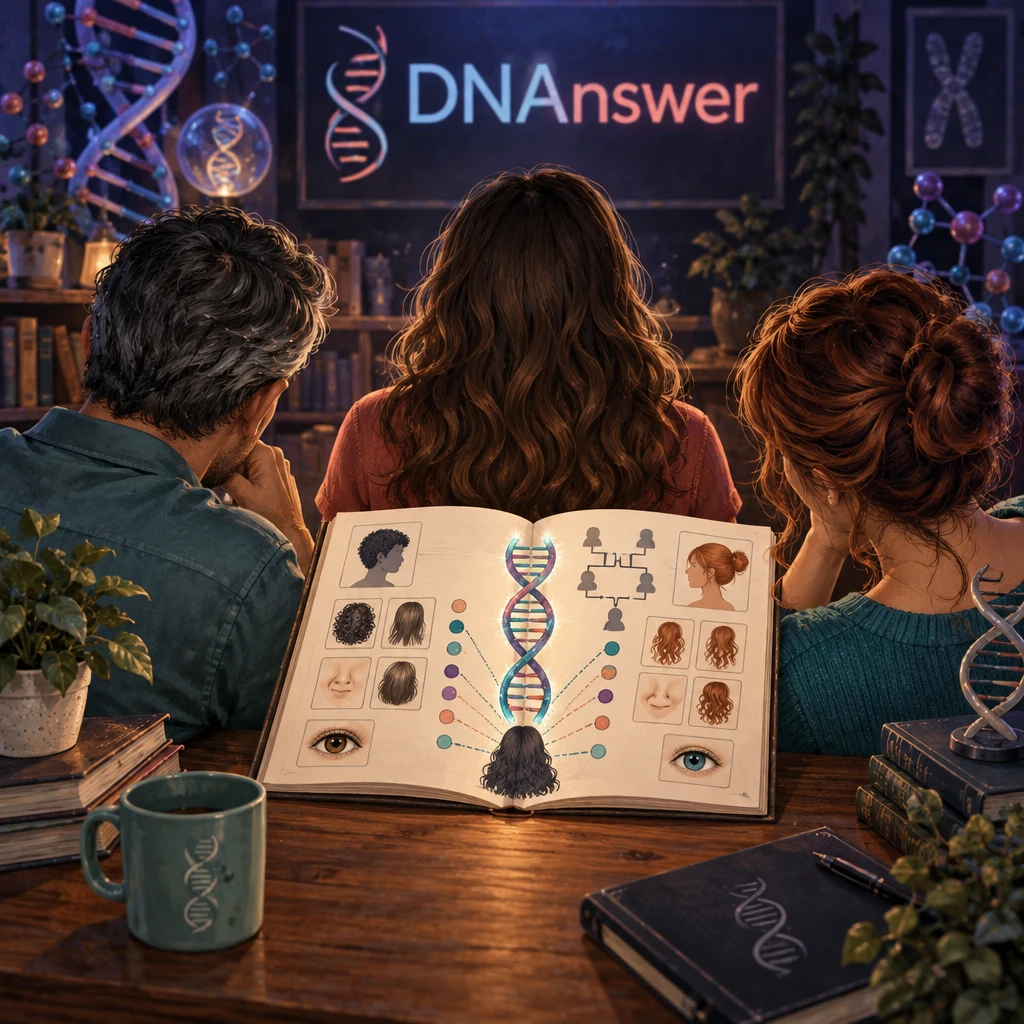
But you don't inherit a trait wholesale from either parent. Your DNA is a shuffled mix: half your autosomal DNA (the 22 non-sex chromosome pairs) comes from each parent, and which pieces you got varies at random. Siblings share about half their variants on average, which is why brothers and sisters can differ sharply.
Personality also reflects the environment each child experiences, and even siblings in one house live it differently: birth order, friends, teachers, illness, luck. Research on twins raised together suggests that the shared family home accounts for surprisingly little of the differences in adult personality, while experiences unique to each person count for more.
So you don't get "Dad's personality." You get a random half of each parent's DNA, thousands of small nudges, then life does the rest. A smarter question than "who do I take after?" is "which habits do I want to keep or change?" Habits respond to practice far more than a variant's 0.35-percentile nudge suggests.
How Scientists Now Link Variants to Traits
The field is moving from "where in the genome" to "which exact letter changes matter." For almost two decades, studies pointed to regions of DNA tied to a trait or disease without naming the culprit. Each region often holds many variants, so finding the real one was slow.
In February 2026, researchers from The Jackson Laboratory, the Broad Institute, and Yale published a Nature study that tested more than 220,000 previously identified DNA changes across five cell types. They resolved about 20 percent of the regions studied, showing which variants alter gene activity for traits like blood pressure, cholesterol, and blood sugar. Their work also showed that a variant found in people of European ancestry predicted similar effects in variants common in people of African ancestry.
Two limits remain. Many millions of variants are untested, and switching a gene on or off in one cell type is only one piece of a bigger puzzle. Research also leans heavily on people of European ancestry, so predictions are weaker for everyone else.
If you want to test your own grasp of these ideas, DNAnswer has free genetics quizzes where you can earn XP and see how you rank.
Conclusion
Treat DNA as a set of nudges. When you read about a "gene for" something, ask how many variants are involved and how big each effect is. Use family history and clinical testing for health decisions, and skip kits that promise personality answers. For your habits and character, practice and surroundings still carry most of the weight.
Frequently Asked Questions
What is a gene and how does it work?
A gene is a section of DNA that holds instructions for making a protein or RNA molecule. Your cells copy the gene into an RNA message, then read it to build the protein. Those proteins carry out jobs that shape your traits.
What is the difference between DNA, genes, and chromosomes?
DNA is the molecule, genes are the instruction-carrying sections of it, and chromosomes are tightly packed bundles of DNA. You have 23 pairs of chromosomes holding about 20,000 protein-coding genes.
Is personality genetic or environmental?
Both. Twin studies suggest roughly 40 to 60 percent of the differences between people in personality line up with genetic differences. That figure describes groups, not you. Environment, experiences, and chance shape the rest.
Can genetic tests predict what traits or diseases you will have?
Not with certainty. Consumer tests check only some variants and mostly estimate risk. A few single-gene results carry real weight, but you should confirm them through a clinician-ordered test.