Using Models to Predict Molecular Structure Lab: VSEPR Shapes, Bond Angles and Polarity
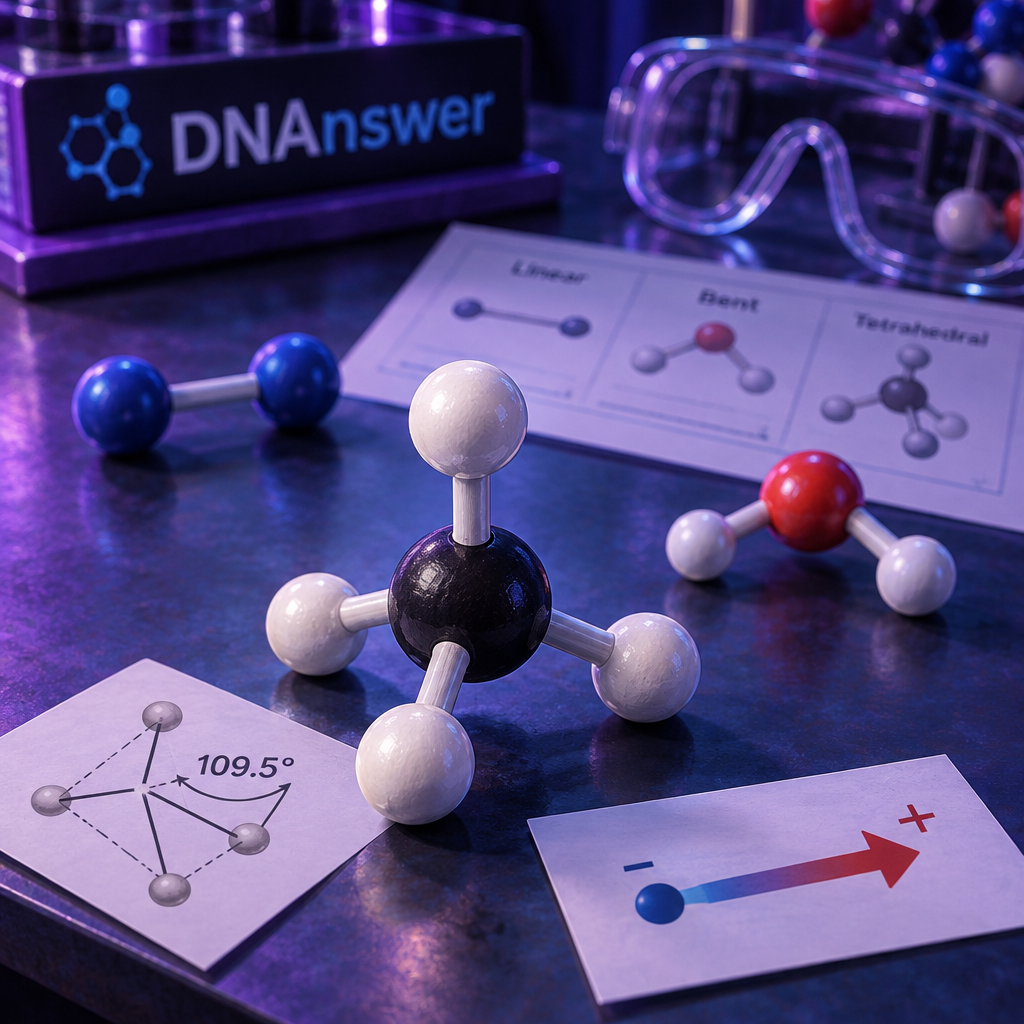
Does a molecule really look like your ball-and-stick model? No. Real molecules have no sticks, and their bond angles rarely match the textbook numbers exactly. Yet the model still predicts shape well enough to explain why water is polar and carbon dioxide is not.
That is the point of a using models to predict molecular structure lab. You draw the Lewis structure, count electron domains around the central atom, and match the count to a VSEPR shape. Lone pairs squeeze bond angles. Then you check whether the bond dipoles cancel. Treat the answers as good approximations, not measurements.
Key Takeaways
- Count electron domains: each bond (single, double, triple) is one domain.
- Lone pairs repel harder than bonding pairs, so bond angles shrink.
- Electron geometry counts lone pairs; molecular geometry names only the atoms.
- Polar bonds do not guarantee a polar molecule. Symmetry can cancel them.
- VSEPR is a predictive model. Real angles often differ by a few degrees.
A Five-Step Method for Predicting Any Shape
Here is the sequence that works in a physical model kit lab and on paper. Skip a step and the later ones go wrong.
- Draw the Lewis structure. A Lewis structure is a diagram that shows every atom, bond and lone pair (a pair of electrons that no other atom shares). Add up valence electrons, the outer-shell electrons an atom uses for bonding, and place them until each atom is satisfied.
- Pick the central atom. It is usually the least electronegative atom that can make several bonds. Hydrogen is never central.
- Count electron domains. A domain is a region where electrons sit around the central atom: one bond, one lone pair, or one lone electron. Count each bond once, whatever its order.
- Match the count to the electron geometry. Two domains give linear, three give trigonal planar, four give tetrahedral, five give trigonal bipyramidal, and six give octahedral.
- Remove the lone pairs from the picture. The atoms that remain give the molecular geometry. Then adjust the angles downward for lone-pair squeeze.
Why does this work? Electrons repel each other. Valence shell electron pair repulsion, or VSEPR (say "VES-per"), says domains spread as far apart as they can on a sphere around the central atom. Four domains end up at the corners of a tetrahedron, about 109.5° apart.
A worked example: ammonia
Take NH₃. Nitrogen has 5 valence electrons and each hydrogen has 1, so the total is 8. Three bonds use 6 electrons. The last 2 form a lone pair on nitrogen.
That gives four domains: three bonds and one lone pair. The electron geometry is tetrahedral. Hide the lone pair and the atoms form a pyramid, so the molecular geometry is trigonal pyramidal. The H–N–H angle is about 107°, a little under 109.5°.
Where the chart earns its keep
Once you know the domain count and the number of lone pairs, every shape follows. The next section lays out the pattern in plain sentences so you can check your own results.
The Geometry Chart in Words
You can memorize a chart, but you will use it better if you see the pattern. Every extra lone pair swaps one atom for an invisible domain.
Two domains, no lone pairs: linear, 180°. CO₂ is the standard example. Three domains with no lone pairs give trigonal planar, 120°, as in BF₃. Three domains with one lone pair give bent, a little under 120°, as in SO₂ (about 119°).
Four domains is where lone pairs start to matter. Zero lone pairs gives tetrahedral at 109.5° (CH₄). One gives trigonal pyramidal at about 107° (NH₃). Two gives bent at about 104.5° (H₂O).
Five domains give trigonal bipyramidal. With no lone pairs the angles are 90° and 120°, as in PCl₅. One lone pair gives a seesaw shape (SF₄). Two give T-shaped (ClF₃). Three give linear at 180° (XeF₂).
Six domains give octahedral, with 90° angles (SF₆). One lone pair gives square pyramidal (BrF₅). Two give square planar (XeF₄).
Notice a trick in the five-domain family. Lone pairs go in the flat middle ring (the equatorial positions), not the top and bottom (axial). The equatorial spots leave more room, so the repulsion costs less.
Myth 1: "The Model Shows What a Molecule Looks Like"

The belief is natural. You hold a plastic tetrahedron, and it feels like a photograph you can touch. Textbooks reinforce the feeling with clean, colorful drawings.
But VSEPR is a predictive model, a simplified rule set that guesses structure without computing it. Atoms have no sticks and no colors. Electrons form fuzzy clouds, and the molecule constantly vibrates. A bond angle is an average over that motion.
The model also ignores several forces that shift real angles. Neighboring atoms crowd each other. Big atoms take more room than small ones. Electronegative atoms pull bonding electrons away from the center, which changes how much space those electrons need.
Methane shows the model working. Its four equal bonds sit at 109.5°, exactly as predicted, because the symmetry leaves nothing to distort it. Water shows the approximation: the model's lone-pair squeeze gets the direction right, and the measured angle of about 104.5° lands very close to the usual textbook value.
So what should you do differently? Write "predicted" next to every angle in your lab report. Then compare it with a reference value. A model that lands within a few degrees is doing its job, and a gap is data, not a failure.
Myth 2: "Electron Geometry and Molecular Geometry Are the Same Thing"
Many students merge them, and the confusion makes sense. Both names use the same shape words, and many molecules have no lone pairs, so the two answers match. In methane, they do.
They split once the central atom has lone pairs. Electron geometry describes how all domains arrange themselves, lone pairs included. Molecular geometry describes only where the atoms sit. You cannot see a lone pair in a structure, so it does not appear in the name.
Water makes the difference clear. It has four domains, so its electron geometry is tetrahedral. Two of those domains are lone pairs, so its molecular geometry is bent. Same molecule, two correct answers, depending on the question.
How to keep them straight in your lab report
Ask two questions in order. First: how many domains, including lone pairs? That gives the electron geometry. Second: which of those domains hold atoms? That gives the molecular geometry.
If a lab sheet asks for "the shape of the molecule," it almost always means molecular geometry. If you are unsure, write both. A good report labels each one.
Myth 3: "A Double Bond Counts as Two Domains"

This one costs real points. It seems logical: a double bond holds two pairs of electrons, so it should count twice. Your Lewis structure draws two lines, which looks like two things.
Here is why it fails. VSEPR counts regions of electron density, not electrons. The two pairs in a double bond sit between the same two atoms, so they occupy the same region of space and act together. A triple bond works the same way.
Check it with carbon dioxide. Carbon has two double bonds and no lone pairs. Two regions means linear, 180°, and the measured molecule is linear. If you counted four domains, you would predict tetrahedral, and the prediction would be wrong.
Formaldehyde, H₂C=O, gives another test. Carbon has two single bonds and one double bond, so three domains. The shape is trigonal planar with angles near 120°. The real H–C–H angle is a bit smaller, near 116°, because the double bond takes slightly more room than a single bond. That is a good example of the model being right about the shape and only approximate about the angle.
The fix is simple. Count attachments, not lines. Each neighboring atom is one domain, whatever the bond order, and each lone pair is one domain.
Myth 4: "Lone Pairs Take Up Less Space"
The belief has a fair origin. A lone pair has no atom on the end of it. In a drawing it is two dots, while a bond is a solid line with a big atom attached. It looks smaller.
The physics runs the other way. A bonding pair is pulled between two nuclei, so its electron cloud stays narrow and close to the bond axis. A lone pair belongs to only one nucleus. Its cloud spreads out wider and pushes harder on its neighbors.
That gives the repulsion order: lone pair against lone pair is strongest, lone pair against bonding pair is next, and bonding pair against bonding pair is weakest. The strongest push wins, so bonding pairs get squeezed together.
You can read the effect straight off real angles. Starting from a tetrahedral 109.5°, methane keeps it. Ammonia, with one lone pair, drops to about 107°. Water, with two, drops to about 104.5°. Each lone pair costs roughly 2 to 3 degrees.
Valence shell electron pair repulsion theory predicts molecular shape from the number of electron pairs around the central atom, and it can handle nearly any molecule or ion with a nonmetal at the center.
That is the scope the standard general-chemistry textbook treatment gives the model, and it matches how labs use it. In your lab, build ammonia and water with kit pieces that include lone-pair slices if you have them. The lone pair then occupies real room in your hands, and the squeeze stops being abstract.
Myth 5: "Polar Bonds Mean a Polar Molecule"
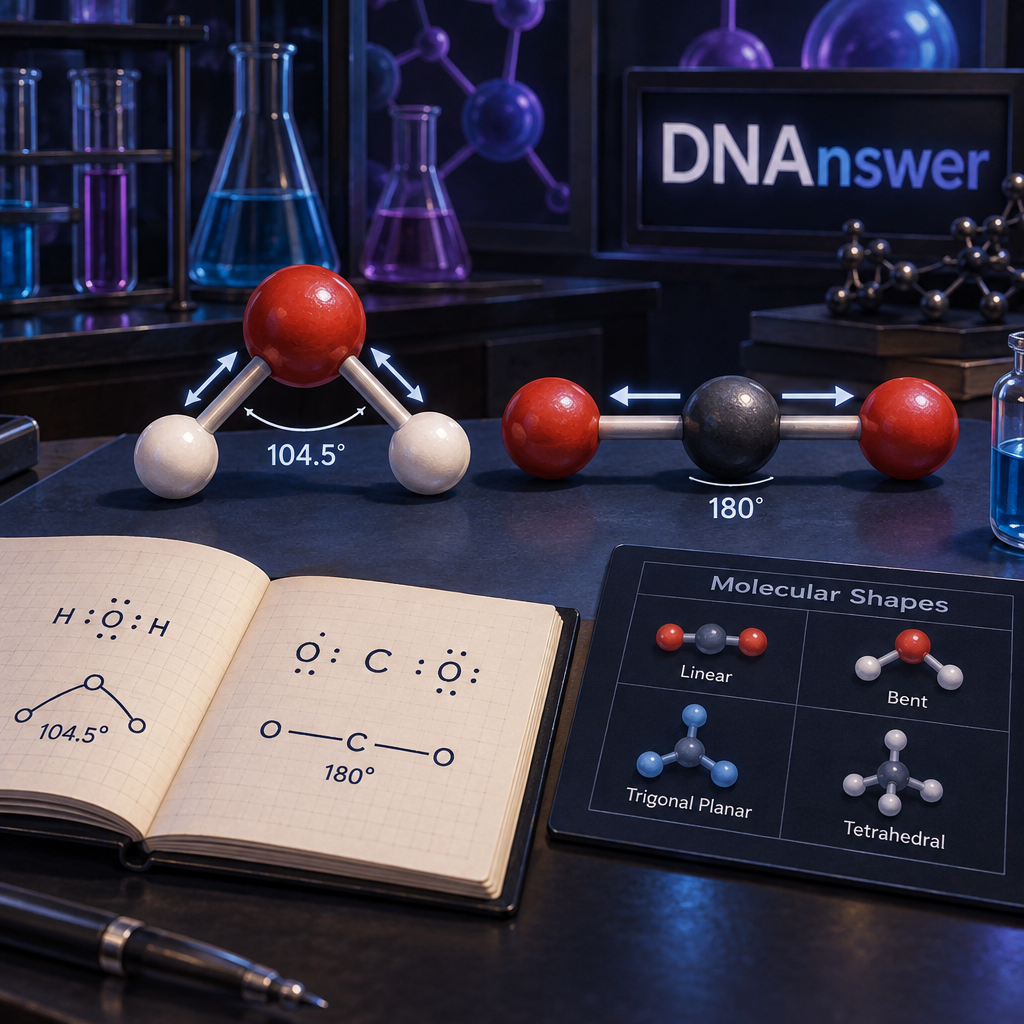
The idea starts from something true. A polar bond forms when two atoms share electrons unequally, because one atom has higher electronegativity (its pull on shared electrons). The more electronegative atom gets a slight negative charge, and the other gets a slight positive charge. Oxygen pulls harder than carbon, so every C=O bond is polar.
So why is CO₂ nonpolar? Each bond has a dipole, an arrow pointing toward the negative end. In CO₂ the two arrows point in opposite directions with equal strength. Add them as vectors, which are arrows with both size and direction, and they sum to zero.
Shape decides the result. Water has polar O–H bonds too, but the molecule is bent, so the two arrows do not oppose each other. They add up to a net dipole. Measured in the gas phase, water's dipole moment is about 1.85 debye (D, the unit chemists use for dipole size). CO₂ measures zero.
A fast polarity test for your lab
Follow three checks in order:
- Are any bonds polar? If every bond joins identical atoms (O₂) or atoms of near-equal pull (C–H), the molecule is nonpolar.
- Draw the dipole arrows on your 3D model.
- Ask whether the arrows cancel. Symmetric shapes with identical outer atoms, such as linear CO₂, trigonal planar BF₃, tetrahedral CCl₄ and octahedral SF₆, all cancel.
Lone pairs break symmetry, which is why ammonia (1.42 D) is polar while methane is not. Swap one outer atom for a different one and symmetry breaks too: CH₃Cl is polar even though CH₄ is not.
Why the Shape of Water Matters for Life
Water is the best case for why this lab is more than busywork. Its bent shape and polar bonds give it a net dipole, with a slightly negative oxygen side and a slightly positive hydrogen side. Neighboring water molecules line up positive to negative and form hydrogen bonds, which are weak attractions between molecules.
Those attractions explain facts you can check. Water stays liquid at room temperature, while the similar-sized molecule methane is a gas far below freezing. Water dissolves salts and sugars, because its charged ends surround ions and polar molecules. Sucrose dissolves easily for the same reason: its many –OH groups are polar.
Now apply it to biology. Cell membranes form because fatty tails are nonpolar and avoid water, while the heads are polar and face it. DNA's two strands pair up through hydrogen bonds between bases, and a double helix sits in water because its phosphate backbone is charged and water-friendly.
If water were linear like CO₂, it would be nonpolar. Life as we know it would not work. One shape, predicted by counting four domains and two lone pairs, explains a huge share of cell chemistry.
Testing Your Predictions: Model Kits, PhET and Their Limits
A strong lab does not stop at building. It checks the model against real data, and that is where the useful lessons sit.
Physical kits and the PhET simulation
With a ball-and-stick kit, build exactly what your Lewis structure says, then rotate it. Use the same habit in every build: set the center atom, attach bonding pieces, then add lone-pair pieces before you name anything. The name should come last.
The PhET Molecule Shapes simulation, free from the University of Colorado Boulder, runs in a browser. In the model view you add bonds and lone pairs to a central atom and watch them spread out. You can switch lone-pair display on and off to compare electron and molecular geometry, and use the angle tool to measure. The "Real Molecules" screen lets you compare the predicted angle with the actual one.
A good lab routine is to predict first, build second, then compare. Write the prediction before you open the simulation, or you will talk yourself into agreeing.
Where VSEPR struggles
The model works best for small molecules with a nonmetal in the center. It weakens in a few cases:
- Heavy-atom hydrides. H₂S has a bond angle near 92°, and PH₃ near 93.5°. VSEPR predicts roughly 104° and 107°. The model gets "bent" and "pyramidal" right but the angles badly wrong.
- Transition metals. Many metal complexes do not follow simple domain counting, because d-orbitals shape the geometry.
- Large or crowded molecules. Atoms bump into each other, and the ideal angles bend.
- Resonance and delocalized electrons. The simple count handles these only when you average the structures.
These failures are the useful part. When a prediction misses, you learn that something beyond repulsion, such as orbital size or crowding, is shaping the molecule. A model earns its place by being simple enough to use and wrong in ways you can learn from.
If you want practice applying these ideas on new molecules, DNAnswer has free molecular biology quizzes where you can test your shape and polarity calls and track your progress.
Conclusion
Use the model as a first guess, then test it. Before your next lab, pick three molecules you have not built, such as SO₂, PCl₃ and CCl₄. Predict the shape, angle and polarity of each. Then compare with reference values. If the angle is off by a few degrees, note why. If the shape is wrong, recount your domains.
Frequently Asked Questions
How do you determine the shape of a molecule using VSEPR theory?
Draw the Lewis structure, count electron domains on the central atom (each bond or lone pair is one), and match that number to a base geometry. Then remove lone pairs from the picture to name the molecular shape.
Why do lone pairs make bond angles smaller?
A lone pair belongs to one nucleus, so its electron cloud spreads wider and repels harder than a bonding pair. It pushes the bonded atoms closer together. In water, two lone pairs shrink the angle from 109.5° to about 104.5°.
Can a molecule have polar bonds but be nonpolar overall?
Yes. If the bond dipoles are equal and point in opposite directions, they cancel. CO₂ has two polar C=O bonds but is linear, so its dipole moment is zero. CCl₄ cancels the same way in three dimensions.
How accurate are VSEPR bond angle predictions?
They are usually close for small molecules, often within a few degrees, as with methane, ammonia and water. They drift for heavier central atoms, such as sulfur in H₂S, where the real angle is near 92° instead of the predicted 104°.