Translation vs Transcription: The Two Steps Nobody Keeps Straight
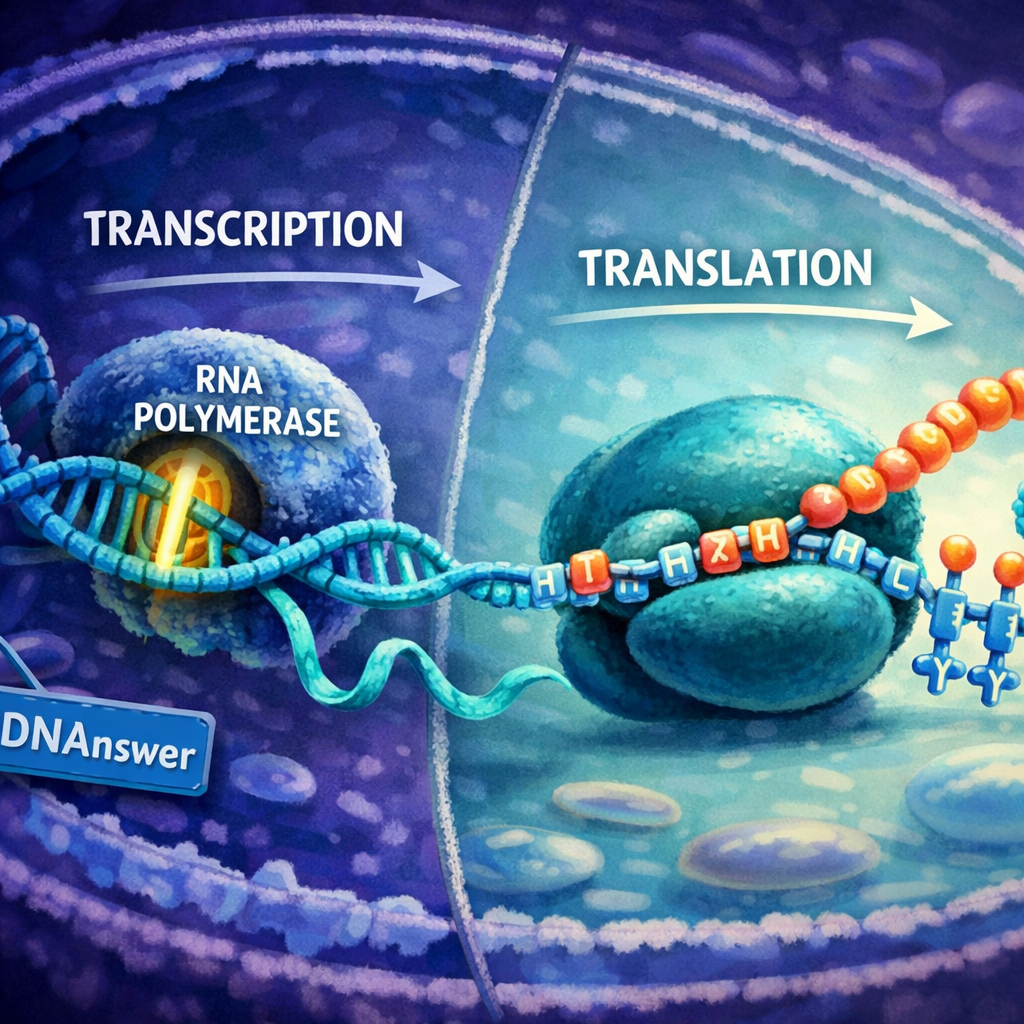
You'd think a word as basic as "transcription" would be easy to keep separate from "translation." It isn't. Ask ten biology students to explain the difference and at least half will start describing DNA making proteins directly, skipping the entire mRNA step. The mix-up isn't stupidity. It's a language problem, literally, because both words are borrowed from how humans handle information, and once you see that borrowed meaning clearly, the biology falls into place and stays there.
This article checks the five most common misunderstandings around transcription, translation, and the central dogma — the rule that genetic information flows from DNA to RNA to protein — against what actually happens inside a cell.
Key Takeaways
- Transcription copies DNA into mRNA inside the nucleus, same molecular "language."
- Translation reads mRNA and builds protein in the cytoplasm, a different language entirely.
- DNA never builds protein directly — mRNA is always the required middleman.
- Codons live on mRNA; anticodons live on tRNA — they're partners, not synonyms.
- The central dogma has real, documented exceptions, including retroviruses like HIV.
- Ribosomes translate; RNA polymerase transcribes — different machines, different jobs.
Myth 1: Transcription and Translation Are Just Two Names for the Same Process
This is the myth that costs students the most points on exams, because it seems harmless right up until a test question asks you to name which enzyme does which job. The honest truth: transcription and translation are two separate, sequential steps, and treating them as interchangeable erases the whole point of the central dogma.
People believe they're the same thing for a reasonable reason. Both words end up meaning "convert information from one form to another" in everyday English, and both happen in a biology unit that gets crammed into a single lecture. If you're skimming a textbook the night before an exam, "DNA gets turned into protein" sounds like one continuous event instead of two distinct machines doing two distinct jobs.
The Linguistic Anchor That Actually Fixes This
Here's the fix, and it's built into the words themselves. Transcription literally means "writing across" — think of a court transcript, where spoken English gets written down as English. Same language, different format. That's exactly what happens when DNA gets copied into mRNA: both are nucleic acids, both use a four-letter alphabet, and the cell is just rewriting one string of genetic letters into another.
Translation, on the other hand, means converting between two different languages — French into English, say. That's what happens when mRNA (still written in nucleic acid letters) gets converted into a protein (written in an entirely different alphabet: amino acids, the building blocks of proteins). Different vocabulary, different rules, different molecular machine required.
What the Molecules Actually Do
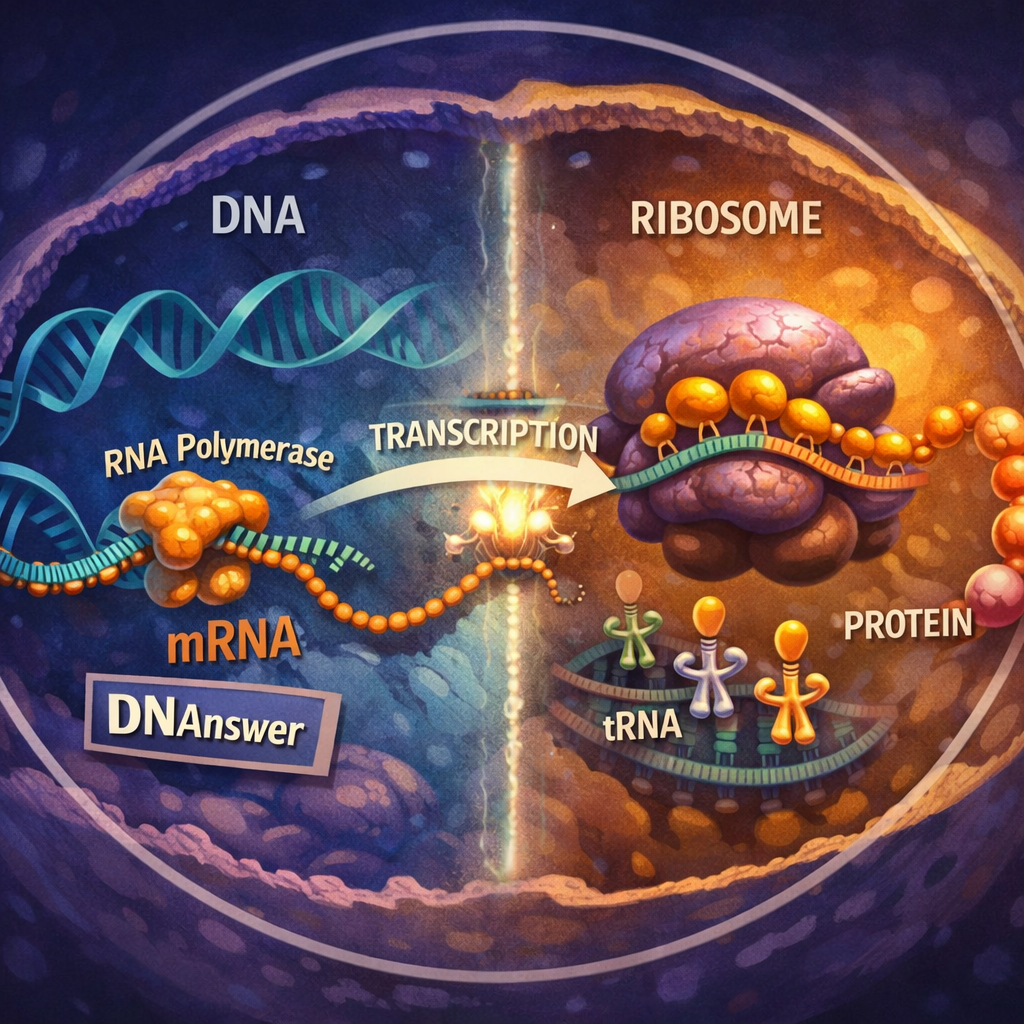
Transcription is carried out by an enzyme called RNA polymerase, which reads the DNA template strand and builds a matching strand of messenger RNA, or mRNA. Translation is carried out by the ribosome, a cellular structure that reads mRNA three letters at a time and assembles a chain of amino acids into a protein.
Transcription: DNA → mRNA (same language, nucleic acid to nucleic acid). Translation: mRNA → protein (different language, nucleic acid to amino acid).
If you remember nothing else from this article, remember that one line. It's the cleanest definition split in the entire subject, and it holds up under exam pressure because it's anchored to something you already know from everyday English, not something you have to memorize cold.
Myth 2: Translation Happens in the Nucleus, Just Like Transcription
This is the second most common mix-up, and it's an easy one to fall into because both processes get taught back-to-back as if they happen in the same room. They don't. Transcription happens inside the nucleus, the membrane-bound compartment that holds a cell's DNA. Translation happens outside it, in the cytoplasm, the jelly-like interior of the cell where ribosomes float free or dock onto a structure called the endoplasmic reticulum.
The origin of this myth is almost architectural. Diagrams in textbooks often show a simplified circle labeled "cell" with DNA, RNA, and protein all crammed inside it, and if the diagram doesn't clearly draw the nuclear membrane as a wall, the brain reads everything as happening in one location. Add to that the fact that some intro courses skip the topic of nuclear pores entirely, and you get students who never learn that mRNA has to physically travel somewhere else before anything else can happen to it.
Why the Separation Exists at All
The separation isn't decorative. It exists because it lets the cell edit mRNA before it becomes protein. Once RNA polymerase finishes transcribing a strand of pre-mRNA, that molecule gets processed — extra sequences called introns get cut out, a protective cap gets added to one end, and a tail of repeated letters gets added to the other. Only after this editing is the finished mRNA allowed to exit through a nuclear pore into the cytoplasm.
This matters biologically because it gives eukaryotic cells (organisms whose cells have a nucleus, including humans, plants, and fungi) a quality-control checkpoint. Bacteria, which lack a nucleus, don't get this checkpoint — their DNA sits directly in the cytoplasm, so transcription and translation can happen almost simultaneously, sometimes on the same stretch of mRNA while it's still being made. That's one real structural difference between how bacterial cells and human cells run the same basic two-step process.
A Quick Mental Checkpoint
Next time you picture this, imagine a two-room office. Room one, the nucleus, is where the DNA blueprint gets copied and cleaned up into an approved memo (the mature mRNA). Room two, the cytoplasm, is the factory floor where ribosomes read that memo and build the actual product. The memo has to leave the office before the factory can use it. Nothing gets built in the room where the blueprint lives.
Myth 3: DNA Builds Proteins Directly, With mRNA as an Optional Middleman
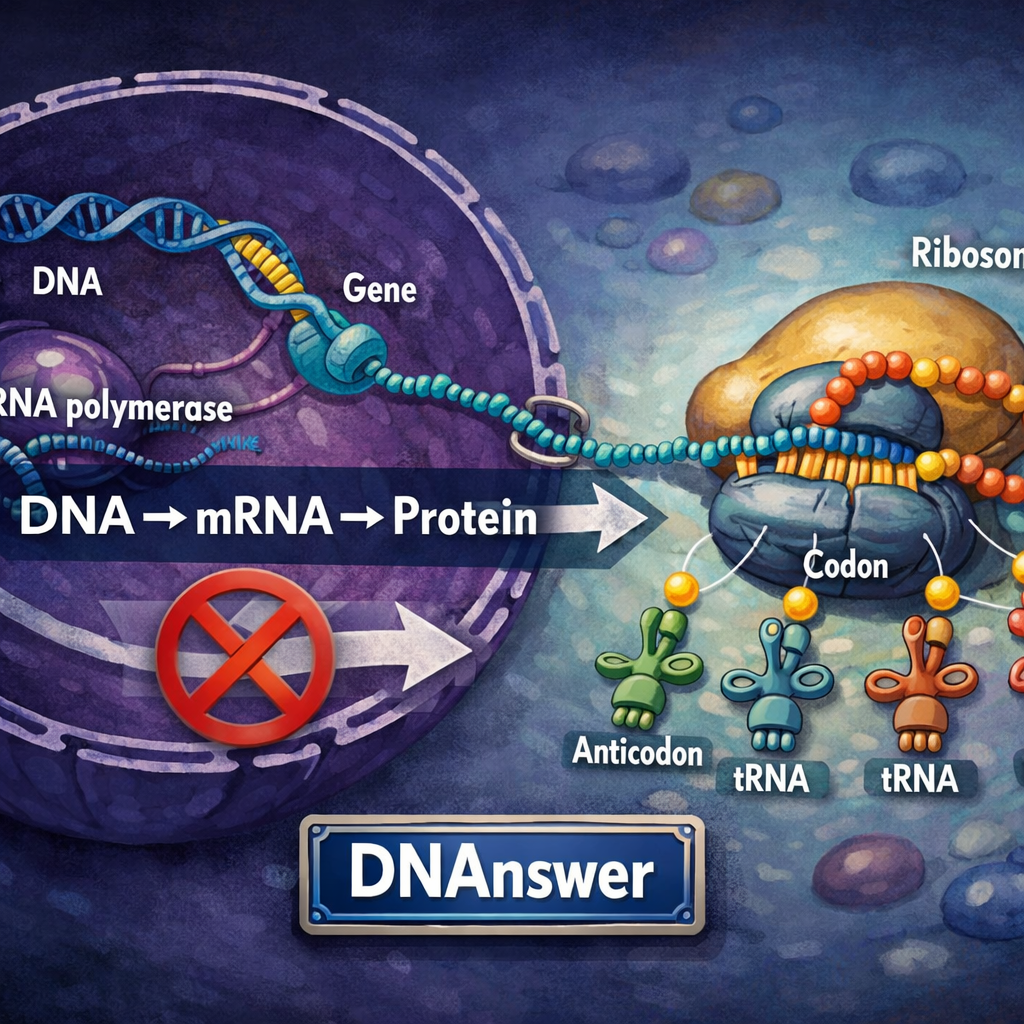
This misconception is subtle because it isn't usually stated outright — it shows up as a gap, where someone describes protein synthesis and simply forgets to mention mRNA exists at all. The correction is direct: DNA never builds protein by itself. mRNA is not optional. It is the required intermediate step in every single instance of protein synthesis across every living cell on Earth.
The kernel of truth that keeps this myth alive is that DNA really is the ultimate source of the instructions. In casual science writing, headlines say things like "this gene makes you tall" or "scientists find the gene for X," and that shorthand — while useful for a headline — quietly implies a gene does something on its own. It doesn't. A gene is just a sequence sitting in the nucleus, inert until RNA polymerase transcribes it.
Why the Cell Bothers With a Middle Step at All
There's a real reason evolution kept this extra step instead of just letting DNA do everything. DNA is precious. A human cell holds one full copy of DNA that has to last a lifetime and get copied accurately every time a cell divides — damage it, and the consequences cascade to every future protein made from that gene. mRNA is disposable. It gets made, used a handful of times, and broken down within minutes to days depending on the transcript.
Using a disposable copy protects the master blueprint from wear and lets the cell control protein output with real precision. Need more of a protein quickly? Make more mRNA copies from the same gene, without touching the DNA at all. Need to shut a protein down fast? Just stop making new mRNA and let the existing copies degrade — much faster than trying to somehow "turn off" DNA itself.
The Sequence, Laid Out Plainly
Here's the full order of operations, spelled out as one continuous sequence:
- RNA polymerase binds to a specific region of DNA and begins transcription.
- A strand of pre-mRNA is built, matching the DNA template letter for letter (with uracil replacing thymine).
- The pre-mRNA is edited in the nucleus — introns removed, a cap and tail added — to become mature mRNA.
- Mature mRNA exits the nucleus through a nuclear pore into the cytoplasm.
- A ribosome attaches to the mRNA and begins reading it three letters (one codon) at a time.
- Transfer RNA, or tRNA, delivers matching amino acids to the ribosome in the order the codons specify.
- The ribosome links the amino acids into a chain, which folds into a finished protein.
Skip step one and nothing downstream happens. There's no version of this pathway where DNA hands amino acids directly to a ribosome. The intermediate isn't a shortcut nature forgot to remove — it's the entire point.
Myth 4: Codons and Anticodons Are Just Two Words for the Same Thing
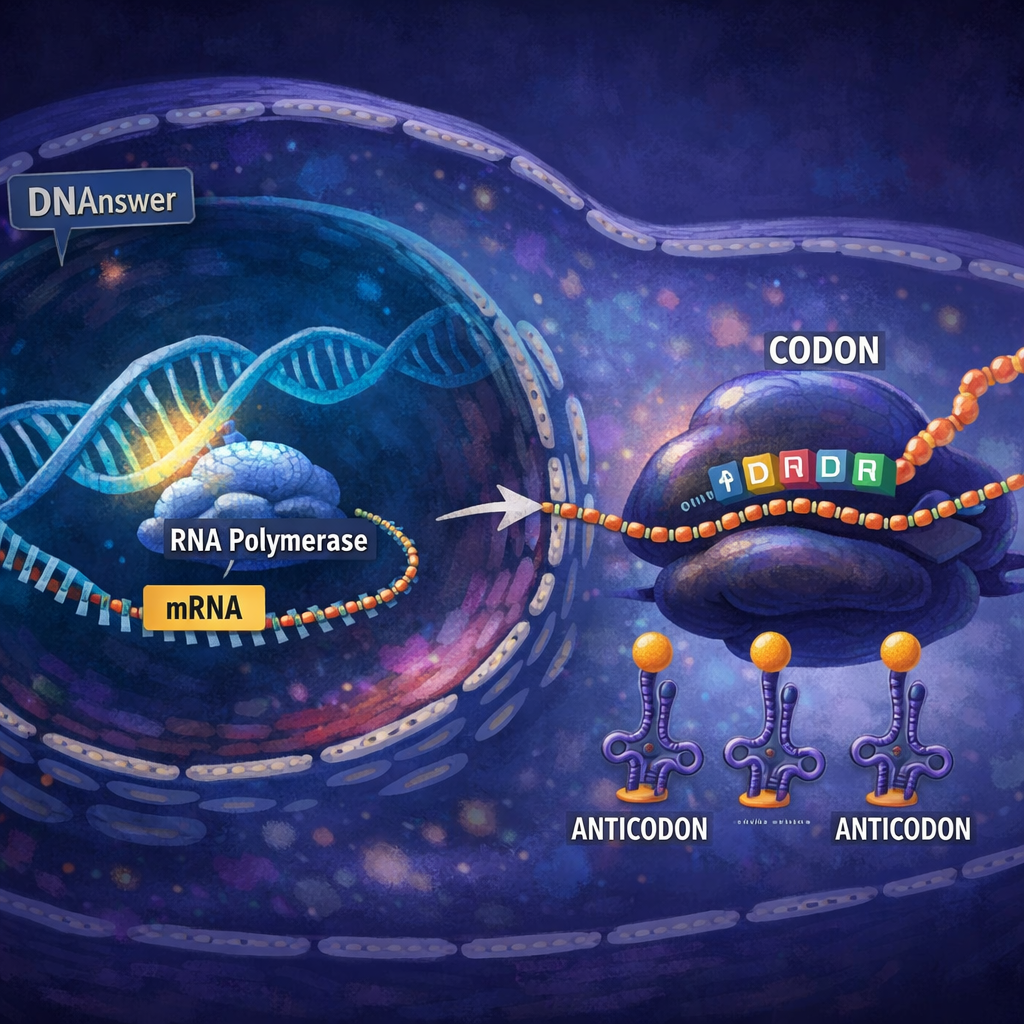
This one trips up almost everyone the first time they hear both terms in the same lecture, because they sound like synonyms and they do refer to related three-letter sequences. They're not synonyms. A codon is a three-nucleotide sequence on mRNA. An anticodon is the complementary three-nucleotide sequence on tRNA that pairs with it. They're partners across a chemical handshake, not two labels for one object.
The confusion has an honest source: both words share the root "codon," both are exactly three letters long, and both are part of the same reading step during translation. If a course introduces them within the same five minutes without a diagram showing them physically pairing up, it's easy to walk away thinking they're interchangeable jargon for "the three-letter thing in translation."
How the Genetic Code Actually Gets Read
Here's the mechanism that separates them cleanly. As the ribosome moves along the mRNA strand, it exposes one codon at a time — a sequence like AUG, GGC, or UAA. Each of these codons is a unit from the genetic code, the set of rules mapping every possible three-letter combination to either a specific amino acid or a "stop" signal. There are 64 possible codons and only 20 standard amino acids, which means the code is redundant — several different codons can call for the same amino acid, a feature biologists call degeneracy.
A tRNA molecule floating in the cytoplasm carries its own three-letter anticodon on one end and a specific amino acid attached to the other end. When a tRNA's anticodon base-pairs correctly with the exposed codon on the mRNA — following the same A-U, G-C pairing rules as DNA, just swapped for RNA chemistry — the ribosome accepts the amino acid it's carrying and adds it to the growing protein chain.
Where This Actually Matters
Getting this backward has real consequences on an exam. If a question asks you to identify the sequence AUG and calls it an anticodon, you've mislabeled the molecule and the location — AUG is a codon, it sits on mRNA, and it happens to be the near-universal start codon that tells the ribosome exactly where to begin reading. The anticodon that pairs with it, carried on the appropriate tRNA, would read UAC. Same three-letter logic, opposite molecule, opposite role.
Think of it like a lock and key: the codon is the lock built into the mRNA sequence, and the anticodon is the one key, carried on tRNA, shaped to fit it and deliver the correct amino acid.
Myth 5: The Central Dogma Only Runs DNA → RNA → Protein, No Exceptions Ever
Most biology courses teach the central dogma as an iron rule — information flows one direction, DNA to RNA to protein, full stop. That's the useful default, and it holds for the overwhelming majority of life on Earth. But treating it as absolutely exceptionless is the myth, because documented biology breaks that arrow in specific, well-studied cases.
The reason this gets taught as ironclad is pedagogical, not dishonest. For a first pass at molecular biology, a firm one-way rule is genuinely the right teaching tool — it's memorable, it's true almost all the time, and adding exceptions too early just muddies a concept students need to lock in first. The framework itself comes from molecular biologist Francis Crick, who proposed it in 1958 and later formalized it in a 1970 paper in the journal Nature.
Francis Crick, 1970, Nature: "The central dogma states that once 'information' has passed into protein it cannot get out again."
The Real Exceptions, Named Specifically
Retroviruses are the clearest exception, and HIV is the textbook example. These viruses carry RNA as their genetic material, and they carry an enzyme called reverse transcriptase that converts their RNA back into DNA once inside a host cell — running the arrow backward, RNA to DNA, before that DNA ever gets inserted into the host genome and transcribed normally from there.
Prions are a second, stranger exception, though they don't break the DNA-RNA-protein flow so much as skip it entirely. A prion is a misfolded protein that can force other normal proteins to misfold the same way, propagating disease (like the human illness Creutzfeldt-Jakob disease) without any DNA or RNA step involved at all — protein directly influencing protein.
What This Means for How You Should Think About the Rule
None of this means the central dogma is wrong or that you should distrust the DNA-to-protein sequence you learned. It means biology, like most systems built by evolution rather than design, keeps a strong default rule and tolerates rare, specific exceptions where a different mechanism turned out to be useful (in a retrovirus's case, useful for hijacking a host cell). Learn the default first. Learn the named exceptions second, and only after the default is solid — reversing that order is how people end up distrusting a rule that's still correct 99% of the time.
If you want to see how fast these five distinctions get genuinely tested rather than just read, the central dogma quiz on dnanswer.app runs you through codon-anticodon pairing and transcription-versus-translation scenarios with an XP score at the end, which is a faster gut check than rereading a textbook chapter.
Conclusion
Once the transcription-versus-translation split clicks, most of molecular biology's early confusion clears up with it. Use the language metaphor as your anchor: transcription rewrites within one language, translation converts between two. Next time a diagram or quiz question mixes them up, ask where the process happens and what molecule comes out the other end — nucleus or cytoplasm, nucleic acid or protein. That single check resolves almost every mix-up on this list.
Frequently Asked Questions
What is the simplest way to remember transcription vs. translation?
Transcription copies DNA into mRNA, same nucleic-acid "language," inside the nucleus. Translation converts mRNA into protein, a different molecular language, in the cytoplasm using ribosomes.
Does translation ever happen in the nucleus?
No — translation requires ribosomes, and mature ribosomes function in the cytoplasm, not the nucleus. Some ribosome assembly starts in a nuclear substructure called the nucleolus, but the actual reading of mRNA into protein happens outside the nucleus.
Can DNA make protein without mRNA?
No. Every known instance of natural protein synthesis in living cells requires an mRNA intermediate; there's no direct DNA-to-protein pathway in normal cell biology.
Are codons and anticodons the same sequence?
No, they're complementary, not identical. A codon on mRNA (like AUG) pairs with a matching anticodon on tRNA (UAC for that example), following standard base-pairing rules.